A security brake needs a release procedure.
Sui says Hashi's Guardian Layer can slow or stop suspicious BTC movements. For a treasury, the next question is how a legitimate transfer gets cleared: who decides, on what evidence, and how quickly?
Keeping your Bitcoin is not the same as keeping it free of obligations.
Hashi plans its mainnet rollout this month. Here's what borrowers and treasury teams need to check before BTC becomes collateral. https://t.co/xE6liZ5kHO
Keeping your Bitcoin is not the same as keeping it free of obligations.
Hashi plans its mainnet rollout this month. Here's what borrowers and treasury teams need to check before BTC becomes collateral. https://t.co/xE6liZ5kHO
FTX gets a Netflix trailer. Your exchange balance still needs more than a good story.
The Altruists arrives Nov. 19. It's drama, not documentary evidence.
The practical question: who can move customer deposits, and can an affiliated trading firm access them?
All in. Every time. Julia Garner and Anthony Boyle star as Caroline Ellison and Sam Bankman-Fried in this limited series about the love scorned prodigies behind the FTX scandal.
The Altruists premieres November 19.
Buying a stock token doesn't automatically put your name on the shareholder register.
Securitize's new Solana stocks are 1:1-backed security entitlements. Direct registration requires conversion where available; 24/7 trading is still a plan.
The wrapper matters.
You can move the model and still lose the evidence.
If an agent sends the wrong refund, can you reconstruct its tool calls after switching providers? Keep redacted traces you can export.
An exit plan needs an audit trail, not just downloadable weights.
An AI you can download is only an exit route if your workflow can move with it.
Mistral's Large 4 preview is live; the company promises weights by month-end. Here's what teams still need to test before switching. https://t.co/aycqYuxd7C
Your AI agent doesn't need every file you own.
Walrus says Console combines encrypted storage with connections to MCP-compatible AI tools.
For builders, the real test is permissions: give an agent one folder, revoke access, then check what it can still retrieve.
What if working with your data didn't feel like managing infrastructure?
No storage renewals to manage. Just a familiar way to work with your data.
That's Walrus Console.
https://t.co/k5cMRTgbDD
An AI you can download is only an exit route if your workflow can move with it.
Mistral's Large 4 preview is live; the company promises weights by month-end. Here's what teams still need to test before switching. https://t.co/aycqYuxd7C
Cardano Foundation says CIP-0113 is live on mainnet: issuers can build identity checks and freeze rules into tokens. Easier controls for regulated assets; for holders, a public blockchain does not mean unrestricted transfers.
https://t.co/nVjKFaZdVc
ECB's Cipollone says a digital euro would let banks extend payment apps across Europe. Issuance still needs legislation and an ECB decision; 2029 is a conditional target. For payment firms, common acceptance could matter more than a new wallet.
https://t.co/7cmbkFr90m
24/7 settlement needs a brake as well as an accelerator. FedNow's receiver-account data can inform a decision to hold a risky payment before sending. For crypto treasury teams, the question is whether fraud checks can keep pace with funding.
24/7 settlement changes where cash can move. It does not answer who supplies liquidity, who can access the network, or who handles a failed transfer on Sunday. What today's Payward–SGB announcement means for institutional crypto. https://t.co/6QiN7snGQD
ECB's Rehn says higher long-term rates are slowing growth and limiting the spread of energy inflation. For firms, that means pressure from both energy bills and financing costs. He offered no fixed rate path: the ECB will decide meeting by meeting.
Two payment routes can fail together if they rely on the same provider.
The next test for 24/7 settlement: can a trading firm still fund its account when that shared dependency goes down?
A backup route needs its own failure test.
24/7 settlement changes where cash can move. It does not answer who supplies liquidity, who can access the network, or who handles a failed transfer on Sunday. What today's Payward–SGB announcement means for institutional crypto. https://t.co/6QiN7snGQD
24/7 settlement changes where cash can move. It does not answer who supplies liquidity, who can access the network, or who handles a failed transfer on Sunday. What today's Payward–SGB announcement means for institutional crypto. https://t.co/6QiN7snGQD
Kraken parent Payward and Singapore Gulf Bank say select institutions in Asia and the Gulf can now settle dollars 24/7. Less waiting for bank cutoffs; access is limited to eligible jurisdictions, with more clients and currencies planned.
https://t.co/tvkF6ZjWCQ
AI can lift stocks and borrowing costs at the same time. The BOJ's Uchida says AI firms' bond issuance is pushing up long-term rates, even as rising shares ease financial conditions. A boom for shareholders can still squeeze borrowers.
https://t.co/ru6wXIBza1
In a new essay, former OpenAI safety specialist David Robinson calls for nuclear-plant rigor at AI labs.
OpenAI says it pauses training or holds models when needed.
For AI buyers: what safety evidence should a launch require?
https://t.co/Vt4DG6GoSe
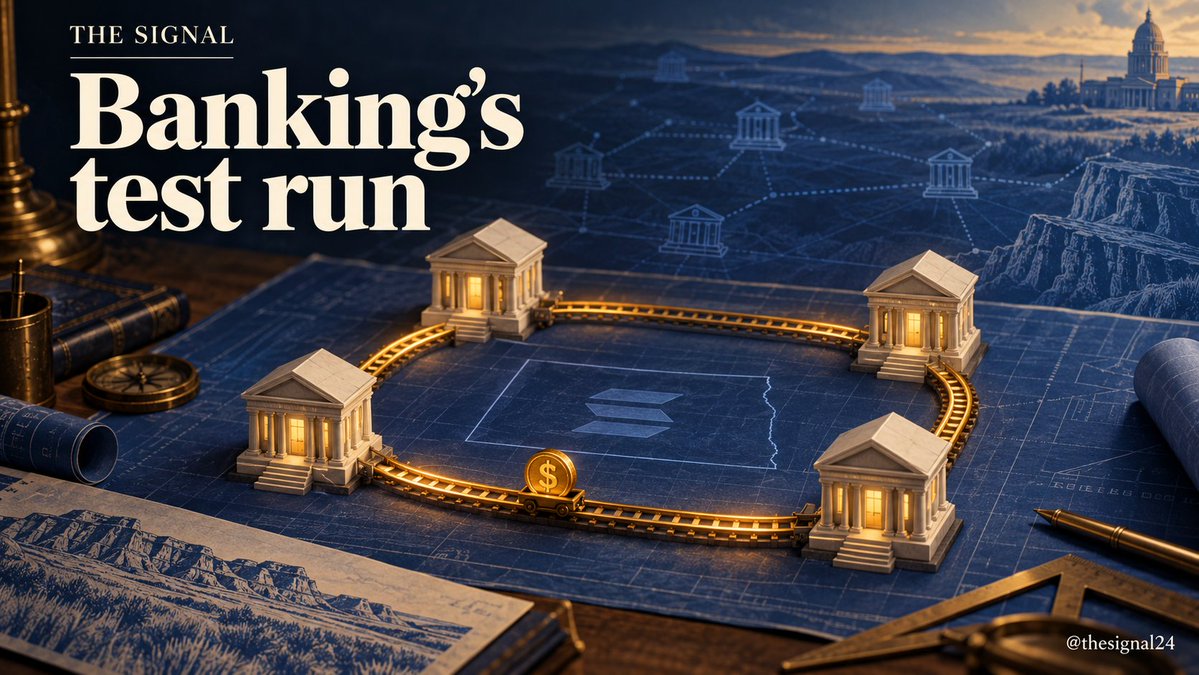
North Dakota's Roughrider Coin is in production on Solana.
But the state bank told The Dakotan access remains in trials with four institutions.
Faster interbank payments are the promise. Broader bank adoption is still ahead.
https://t.co/sfepsFEaa1
The SEC's custody proposal could widen access without widening competition.
Security, recovery and oversight cost money. Larger advisers may spread those costs across more clients.
Watch who can afford to use the permission, not just who gets it.
“Self-custody” can still mean someone else holds your crypto.
The SEC’s new proposal raises a bigger question than where the coins sit: who can move them, who checks the records, and what happens when access fails? https://t.co/M3h13VaEmi
US sanctions target a network Treasury says moved over $2m to Hamas through sham charities and crypto.
That is a network-wide total, not crypto alone. U.S. persons are generally barred from transactions with those designated.
https://t.co/s8qI8t0Wrg
Blast is winding down, citing costs above revenue.
Withdrawals pause for ~a week as Lido assets unwind. Its normal exit interface closes Oct 26; funds remain withdrawable via bridge contracts.
A chain needs an exit plan as much as a growth plan.
https://t.co/m5dlFplxZV
Blast will be shutting down.
We launched Blast with the goal of building a self-sustaining chain for users and developers. Unfortunately, the economics of operating the chain no longer make sense: the ongoing costs of maintaining Blast exceed the revenue generated by the L2, and we do not see a credible path to making the chain economically sustainable.
As a result, we've made the difficult decision to wind Blast down.
We're sorry to the users and developers who believed in Blast, built on it, and supported the ecosystem. Our priority now is making the shutdown as smooth and safe as possible.
We're asking all users to withdraw their assets from Blast to Ethereum mainnet, including any balances held in the Blast PWA.
To make this easier, we will be reducing the withdrawal delay to 24 hours.
As part of the shutdown process, we'll first begin withdrawing Blast's Lido assets. This process is expected to take approximately one week. During this period, withdrawals will temporarily be unavailable, even after the withdrawal delay is reduced to 24 hours.
Once that process is complete, withdrawals will resume with the new 24-hour delay.
Users will have until October 26, 2026 to withdraw through the normal Blast interface.
After October 26, assets will remain withdrawable, but users will need to interact directly with the Blast bridge contracts on Ethereum L1. We'll publish detailed instructions before then.
We strongly encourage everyone to withdraw their assets to Ethereum mainnet before October 26.