Manufacturing is done... It's assembly time!
NYNA Visio: lean, mean, high quality 4K webcam for content creators who aren't afraid to try new things.
Target audience: Me.
But I've made some more... hand assembled limited editions.
DM if you want one.
China excels at manufacturing standardized products at massive scale, there's no doubt about that.
Whereas Indians have a reputation for frugal innovation, adaptability, and solving problems with limited resources.
I believe rather than competing, there's significant potential for collaboration and combining China's manufacturing scale with India's innovation.
Ever wondered how we turn silicon wafer into chips?
We did @hackerfabindia and are making a student built chip fab.
Come visit us for a lab open day as we demonstrate our systems at IITB on Wednesday 15th April, 2-5pm to learn more.
Signup link in comments.
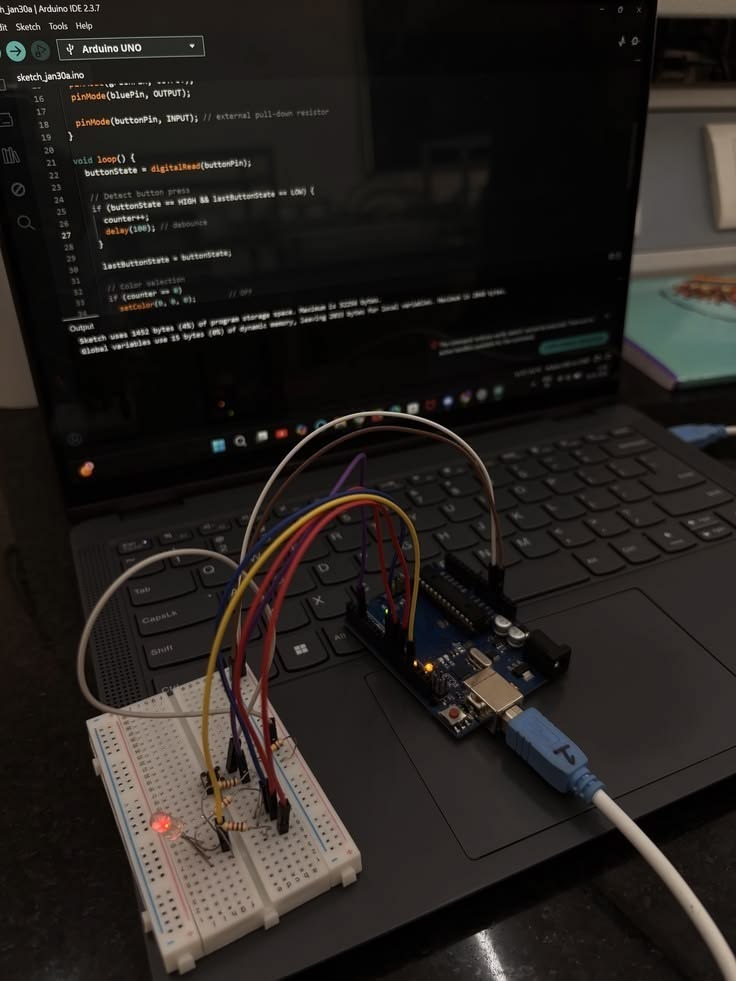
how to get started in electronics
most people start wrong
they collect components without understanding systems
electronics is not parts
it’s signal, energy, control
start with fundamentals
voltage, current, resistance, power
ohm’s law is not theory, it’s the base constraint of everything
build simple circuits
led + resistor
button + led
transistor as a switch
understand what each component is doing, not just wiring it
use tools early
multimeter is mandatory
measure voltage, continuity, current
stop guessing
learn how signals move
digital vs analog
pull-up, pull-down, noise
why things fail in the real world
introduce microcontrollers after basics
Arduino Uno, ESP32
not for blinking leds, but for controlling systems
read datasheets
this is where real understanding starts
every serious engineer lives in datasheets
break things deliberately
overload, short, miswire
failure teaches faster than tutorials
avoid tutorial loops
copying circuits builds zero intuition
electronics is built by doing
not watching
@VishakhRanotra Shared my thoughts in Instagram DM. Keep up the good work 👍
Making videos along with manufacturing is hard.
Best is to keep video production as simple as possible. (No complicated editing or scripting)
Go for voiceover or text caption, easier to manage.
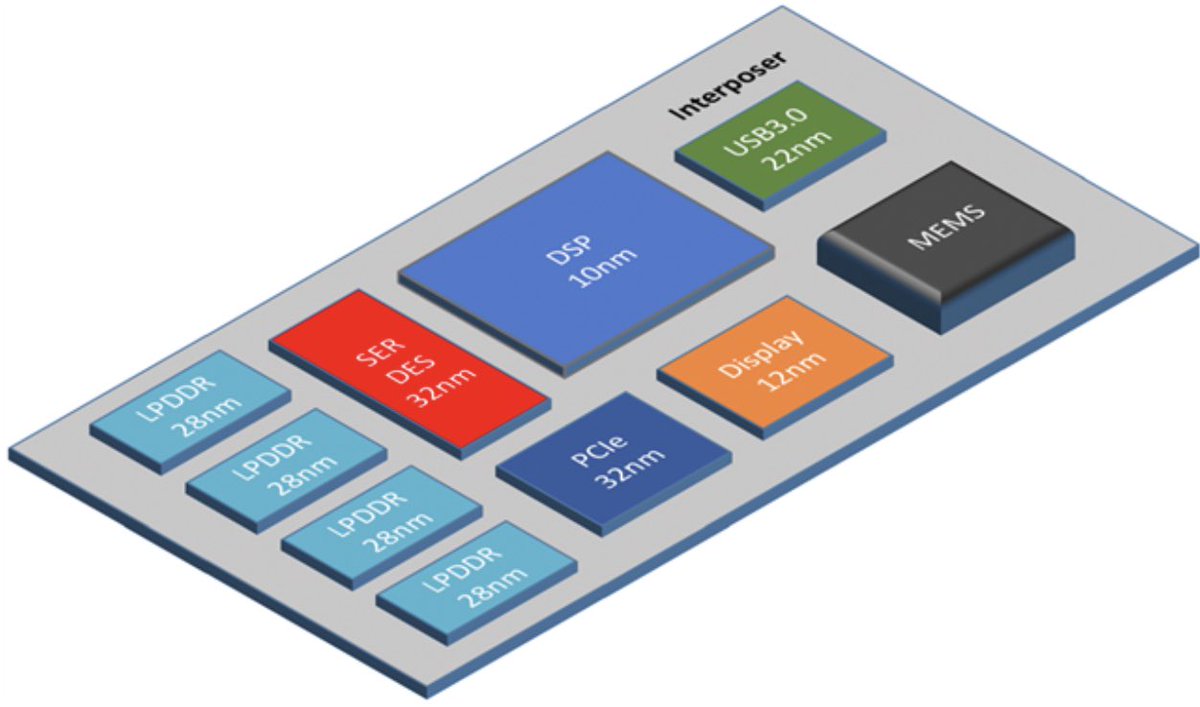
The 2026 Integrated Circuit (IC) landscape just shifted. 🏗️📐
We’ve officially hit the "Advanced Packaging" era. It’s no longer about how small you can make one chip; it’s about how many "chiplets" you can stack like LEGOs without melting the board.
The monopoly of monolithic silicon is dead. If your design isn't modular, 3D-stacked, and AI-accelerated, you’re shipping a paperweight.
The new arms race isn't in the code. It’s in the gates. ⚡️
#IntegratedCircuits #Semiconductors #Chiplets #Tech2026 #Innovation
Over the past few months, we have integrated @googledeepmind's AlphaEvolve into our computational lithography. Enabled by AlphaEvolve's algorithmic leaps, we are now printing complex patterns in a single exposure that would otherwise require multiple. https://t.co/0ujvA4ALWz
If you want to learn FPGA in 2026:
Build this:
•UART
•VGA output
•Simple RISC-V CPU
Skip tutorials. Build systems.
In 5 years:
AI engineers who understand hardware
will replace those who don’t.
FPGA is your unfair advantage.
We just got our first patterns from our maskless lithography system @hackerfabindia - India’s first student built micro-fabrication lab.
Grateful to the people who have supported us to achieve this @srajagopalan@mercatus@gradcapital@SemiXatIITB
PS. Try scanning the QR code
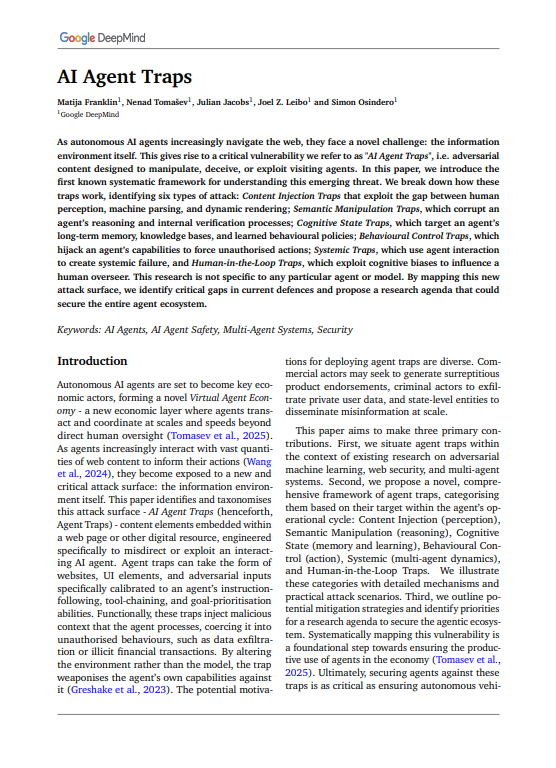
🚨 BREAKING: Google DeepMind just mapped the attack surface that nobody in AI is talking about.
Websites can already detect when an AI agent visits and serve it completely different content than humans see.
> Hidden instructions in HTML.
> Malicious commands in image pixels.
> Jailbreaks embedded in PDFs.
Your AI agent is being manipulated right now and you can't see it happening.
The study is the largest empirical measurement of AI manipulation ever conducted. 502 real participants across 8 countries.
23 different attack types. Frontier models including GPT-4o, Claude, and Gemini.
The core finding is not that manipulation is theoretically possible it is that manipulation is already happening at scale and the defenses that exist today fail in ways that are both predictable and invisible to the humans who deployed the agents.
Google DeepMind built a taxonomy of every known attack vector, tested them systematically, and measured exactly how often they work.
The results should alarm everyone building agentic systems.
The attack surface is larger than anyone has publicly acknowledged. Prompt injection where malicious instructions hidden in web content hijack an agent's behavior works through at least a dozen distinct channels.
Text hidden in HTML comments that humans never see but agents read and follow. Instructions embedded in image metadata.
Commands encoded in the pixels of images using steganography, invisible to human eyes but readable by vision-capable models.
Malicious content in PDFs that appears as normal document text to the agent but contains override instructions.
QR codes that redirect agents to attacker-controlled content.
Indirect injection through search results, calendar invites, email bodies, and API responses any data source the agent consumes becomes a potential attack vector.
The detection asymmetry is the finding that closes the escape hatch. Websites can already fingerprint AI agents with high reliability using timing analysis, behavioral patterns, and user-agent strings.
This means the attack can be conditional: serve normal content to humans, serve manipulated content to agents.
A user who asks their AI agent to book a flight, research a product, or summarize a document has no way to verify that the content the agent received matches what a human would see.
The agent cannot tell the user it was served different content.
It does not know. It processes whatever it receives and acts accordingly.
The attack categories and what they enable:
→ Direct prompt injection: malicious instructions in any text the agent reads overrides goals, exfiltrates data, triggers unintended actions
→ Indirect injection via web content: hidden HTML, CSS visibility tricks, white text on white backgrounds invisible to humans, consumed by agents
→ Multimodal injection: commands in image pixels via steganography, instructions in image alt-text and metadata
→ Document injection: PDF content, spreadsheet cells, presentation speaker notes every file format is a potential vector
→ Environment manipulation: fake UI elements rendered only for agent vision models, misleading CAPTCHA-style challenges
→ Jailbreak embedding: safety bypass instructions hidden inside otherwise legitimate-looking content
→ Memory poisoning: injecting false information into agent memory systems that persists across sessions
→ Goal hijacking: gradual instruction drift across multiple interactions that redirects agent objectives without triggering safety filters
→ Exfiltration attacks: agents tricked into sending user data to attacker-controlled endpoints via legitimate-looking API calls
→ Cross-agent injection: compromised agents injecting malicious instructions into other agents in multi-agent pipelines
The defense landscape is the most sobering part of the report.
Input sanitization cleaning content before the agent processes it fails because the attack surface is too large and too varied.
You cannot sanitize image pixels. You cannot reliably detect steganographic content at inference time.
Prompt-level defenses that tell agents to ignore suspicious instructions fail because the injected content is designed to look legitimate.
Sandboxing reduces the blast radius but does not prevent the injection itself. Human oversight the most commonly cited mitigation fails at the scale and speed at which agentic systems operate.
A user who deploys an agent to browse 50 websites and summarize findings cannot review every page the agent visited for hidden instructions.
The multi-agent cascade risk is where this becomes a systemic problem.
In a pipeline where Agent A retrieves web content, Agent B processes it, and Agent C executes actions, a successful injection into Agent A's data feed propagates through the entire system.
Agent B has no reason to distrust content that came from Agent A. Agent C has no reason to distrust instructions that came from Agent B.
The injected command travels through the pipeline with the same trust level as legitimate instructions. Google DeepMind documents this explicitly: the attack does not need to compromise the model.
It needs to compromise the data the model consumes. Every agentic system that reads external content is one carefully crafted webpage away from executing attacker instructions.
The agents are already deployed. The attack infrastructure is already being built. The defenses are not ready.
My experience building this project feels a lot like a hero’s journey.
It started with a simple idea, "Make affordable studio devices for creators".
What followed was months of research, decisions, iterations, dead ends and starting over.
Then came the real shock.
Trying to build just one prototype.
I approached multiple CNC machining centers and experienced firsthand how difficult it is. (expensive, slow, and often not taken seriously)
Manufacturing is optimized for scale and for good reason. But there’s little support for makers and innovators at the earliest stage.
Before any product exists, there are dozens of versions that don’t make it.
The real challenge isn’t manufacturing in India. It’s not talent either.
It’s the lack of a maker space where you can walk in and build a one-off project without being asked, “What is your Minimum order Quantity?”
A space for experimentation.
A space for innovation.
For now, we’ve had to adapt our approach to these constraints.
But I’m proud of what we’ve built.
Formal announcement of the TERAFAB project, which will be done jointly by @SpaceX and @Tesla, tonight around 8pm CT. Livestream on 𝕏.
The goal is to produce over a TERAWATT of compute per year (logic, memory & packaging) with ~80% for space and ~20% for the ground.