Dear Concerned Indian Doctors,
I see your rage against Temple on X. I have a few points
to make:
1. First and foremost, a business lesson: if Temple were a scam, and any of what we said weren't true, people would know it in just a few days of using Temple. We have 14-day, no-questions-asked returns (which even Apple doesn't offer in India). If the product doesn't work, it fails out of the gate and the company dies before recovering a tenth of its R&D.
2. We have already spent $30m building Temple, $20m out of which is my own money. Selling a few thousand devices recovers a small fraction of this investment. A scam that pays nothing is not a scam anyone would run.
3. I left the Eternal CEO role to chase purpose with Temple. This is not about money. I have enough of it to last for generations. My incentives are fully aligned with getting the science right. I am not staking a reputation earned over 20 years on making a quick buck.
4. Our employees bought into our round a few months ago. The round we're raising now is mostly our customers. Scams don't build that cap table.
5. Most wearable companies start with internal studies. Whoop shipped its band in 2015, and the first published validation followed a few years later. We hold ourselves to a higher standard; pre-prints are a step prior to peer reviewed publications, and they are coming up.
6. At some point you have to stick your neck out and say: we believe in our science, and the product is now valuable enough for people to pay for and use. We believe we are there. More validation continues in public.
7. We are confident that we are building something that the world is going to be positively astonished with. We stand by our science and our methods. Each of our claims is easily verifiable by individuals and institutions alike, and you will see a lot of independent studies come up on their own when the device becomes available to use.
Last but not the least, the most ground breaking features in Temple are not even public yet. And some of them, thankfully, have nothing to do with doctors 🤭
Hope this addresses some or all of your concerns. If not, keep raging 😘🤗
Incredible honour to meet HH Sheikh Mohamed bin Zayed Al Nahyan, President of the UAE, on the sidelines of the Abu Dhabi Future Health Summit.
His vision for Abu Dhabi as a global hub for science, biotechnology, AI and next-generation sensing is incredibly ambitious.
Almost 5 years ago, we chose Abu Dhabi as a home for Ultrahuman. Since then, despite regional uncertainty, Abu Dhabi has only grown stronger and continued to invest in technologies that could define the next few decades.
I believe some of the biggest breakthroughs in human health will come from our ability to continuously sense and understand human biology, long before disease manifests.
We were bullish on Abu Dhabi 5 years ago. Even more so today.
Proud to build Ultrahuman from here. 🇦🇪
A two-year partnership with Ultrahuman aims to connect clinical biomarkers and wearable data, bringing aging assessment into public health.
https://t.co/Q75yHyclwW
#longevity#geroscience#ultrahuman#biomarkers#aging
خطوة جديدة نحو تعزيز الصحة الوقائية ودعم حياة أطول بصحة أفضل في إمارة أبوظبي.
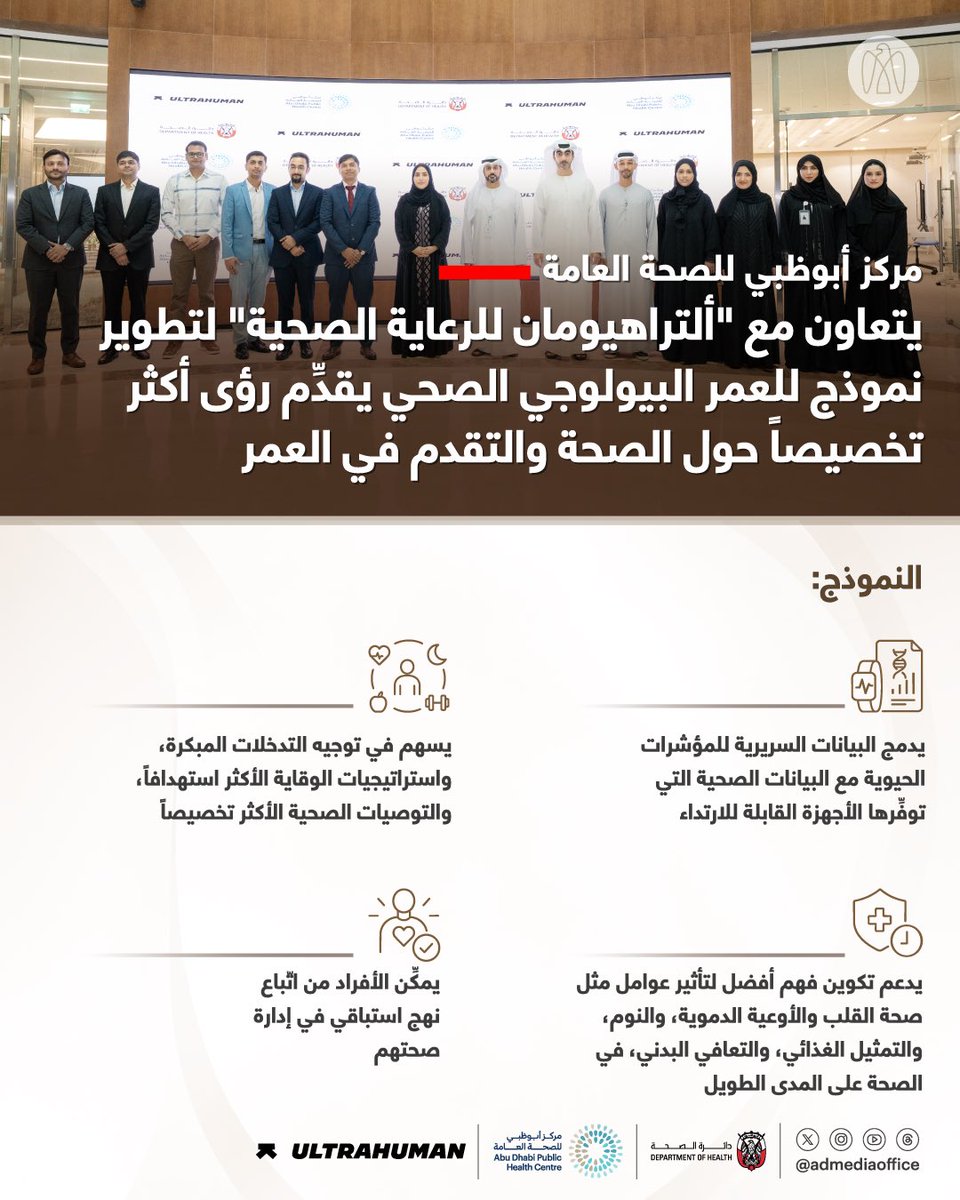
وقّع مركز أبوظبي للصحة العامة وشركة ألتراهومان مذكرة تفاهم للتعاون في تطوير نموذج العمر الصحي البيولوجي، بما يدعم تبنّي نهج أكثر تخصيصاً واستناداً إلى البيانات لفهم الحالة الصحية وتعزيز أنماط الحياة.
مركز أبوظبي للصحة العامة يتعاون مع "ألتراهيومان للرعاية الصحية" لتطوير نموذج للعمر البيولوجي الصحي. النموذج يدمج البيانات السريرية للمؤشرات الحيوية مع البيانات التي توفرها الأجهزة القابلة للارتداء، لتقديم رؤى أكثر تخصيصاً حول الصحة والتقدم في العمر، ما يدعم قدرات الصحة الوقائية.
My fever exposed a surprising difference between my 3 wearables. 👀
Apple Watch Ultra 4 Vs WHOOP 5.0 (MG) Vs Ultra Human Ring AIR.
Throat infection → fever by night.
Apple Watch & WHOOP: no noticeable temperature rise.
Ultrahuman Ring AIR: detected the rise, and the reading matched what I was experiencing. 🤯
One personal experience, but seriously impressive.
Which wearable do you trust most? 👇
My bet that medicines will be some of the biggest consumer products of the next 20 years hinges on two questions:
1. Is the demand there?
Emphatically yes.
Tirzepatide, the molecule behind Mounjaro and Zepbound, already generates more in revenue than Netflix.
Equally striking: more than half of these prescriptions are self-pay. People are spending their own money on medicines that meaningfully improve their lives.
Even a product as good as tirzepatide leaves plenty of room for improvement. And weight loss and diabetes are just one part of the opportunity. Better sleep. Less pain. Fuller hair. Clearer skin. Better treatments for cancer and cardiovascular disease. The unmet needs are enormous.
The demand question is relatively easy—the harder question is below.
2. Will we be able to build these medicines?
My bet is yes. But this is where most of the uncertainty lies.
Three reasons I’m optimistic:
- Drug development is becoming like software. Increasingly, a lot of the research & analysis that is required at all steps of drug development can be done via LLMs. As a result, these steps can be composed within systems and automated. This allows small AI-native teams to do in days & weeks what required dozens of PhDs months to do. With billions going into AI × biology, I expect this trend to only accelerate.
- Our biological toolkit is expanding. CRISPR and base editing. siRNA and mRNA. Bi/tri-specific antibodies, antibody-drug conjugates and targeted protein degradation. CAR-T and emerging in vivo CAR-T approaches. We have more ways to intervene in biology. Better delivery technologies and half-life extension can help medicines reach the right tissues and work longer between doses. Together, these advances expand the range of medicines we can build.
- I have a positive regulatory bias. While regulation is always tough to predict, some of the recent steps from the FDA have been positive. FDA is developing clearer pathways for historical patient data and Bayesian methods in trials, while advancing validated alternatives to animal testing. These changes could reduce development time and cost. As unmet needs continue to grow, I expect more pressure on FDA to keep modernizing.
Twenty years is a long time for these improvements to compound.
Why I could be wrong:
- Biology takes time. Some steps in drug development are inherently incompressible. For example, establishing long-term safety and clinical benefit still requires observing people over time.
- Biology is hard to predict. Compelling mechanisms can still fail in large trials. Last month, Novartis’s long-awaited Lp(a)HORIZON trial showed that pelacarsen lowered Lp(a) but failed to demonstrate a statistically significant reduction in cardiovascular events. This contributed to a selloff that wiped roughly $30B off Novartis’s market value.
These constraints are real. But teams that combine scientific rigor with commercial discipline can bring great medicines to market.
Many of the biggest improvements we can still make to people’s lives are biological. Medicines can deliver them.
What’s a better consumer product than that?
Long pending post …as I unraveled and marveled at the Ultrahuman™ Ring Pro when I first wore it around a month ago.(proud disclaimer: investor in Ultrahuman - in every round to date)
The battery life on this one is like amaze, amaze, amaze 🥳🤯😍
And yet, …..
Introducing Pulsomics, a foundational model of the human pulse.
We built Pulsomics to understand what more the pulse can reveal. By studying the shape of the pulse waveform alongside context from sleep, activity, fitness, blood markers and how you feel, we’re learning what patterns in one signal could tell us about the rest of the body.
One pulse signal. A lot more to uncover.
Join Pulsomics: https://t.co/mis8vCTg76