Some people around you are already living in the future.
You might have sat next to one at a café. Seen one looking a little too calm during a meeting. Or noticed someone who never seems to reach for their phone (anymore!).
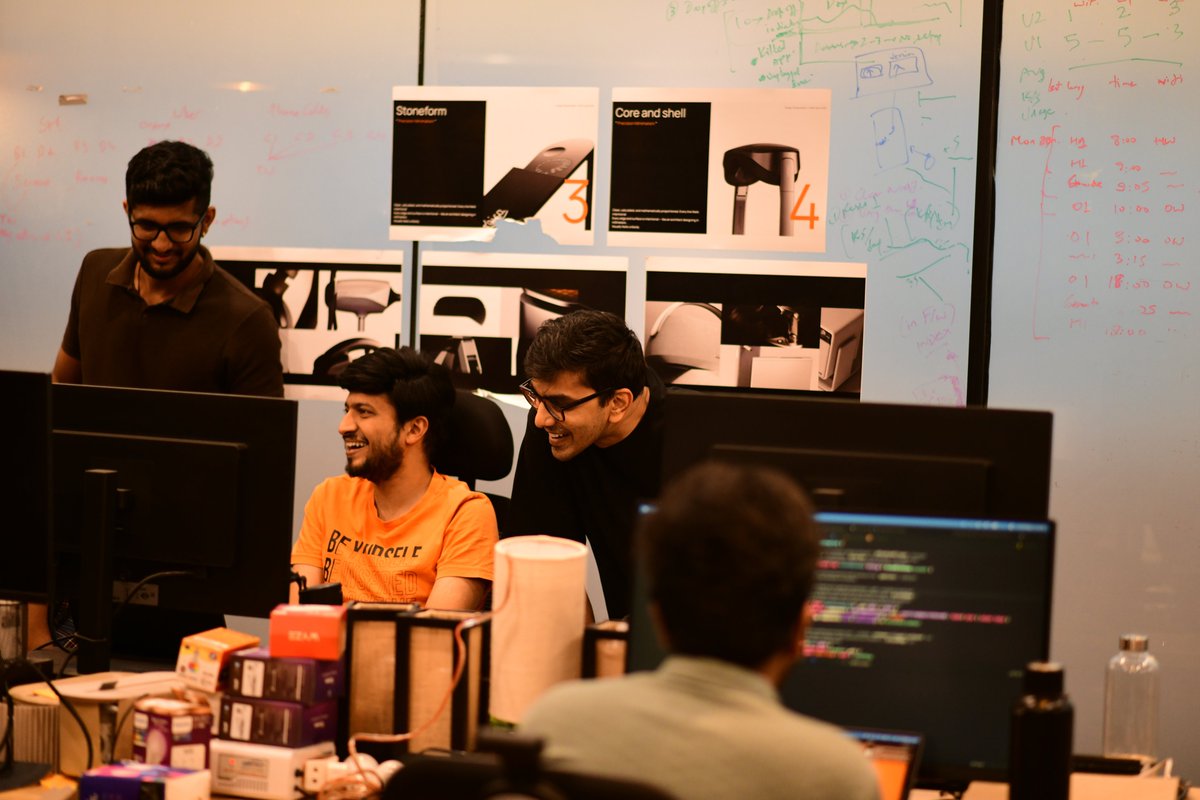
Our team is in San Francisco right now, along with some of our early pilot users. So keep an eye out.
Think you’ve spotted one of us? DM us what you saw. If you’re right, we’ve got a spot saved for you for early access.
Aina Private Pilot is live.
We can’t wait to show you what the future of interfaces looks like. Very soon.
Technical moats are mostly over at this point. If you’re building something that is meant to be durable, the only moats now are:
• Proprietary data
• Network effects
• A physical component
After 9 years. 16K+ family homes. 500M sqft inside real homes covered, we know home robots are being built in wrong order.
So we built Matic the way nature grows a child.
Finally, sharing our vision:
1. Why robots get stuck at the demo
2. Why labs can't ship robots
3. Why we started with eyes, not hands
4. The 99.999% rule in robotics
5. Where Matic is going next
1. Why most robots get stuck at demos
Robot demos look brilliant in a room arranged around its limitations: familiar lighting, predictable furniture, nothing troublesome on the floor.
A family’s home makes no such accommodations. There are cables, toys, shifting rugs and, occasionally, dog poop. Yes, humanoids will need to avoid that too.
Repeating a task under familiar conditions of uncluttered floors is not the same as handling an unfamiliar home with all its chaos.
2. Why labs can't ship robots
SLAM (Simultaneous Localization and Mapping) is how a robot maps its surroundings and locates itself within them. Ask most academics and they'll tell you it's a solved problem.
But real homes are the most chaotic spaces that exist.
There are glass doors that look like open doorways, mirrors, stairs, rugs, charging cables, and Legos placed all around.
So ask yourself: if indoor mapping and navigation is "solved," where are the robots? Why aren't airports, hotels and grocery stores full of them?
Calling it “solved” misses the question families actually care about: can I leave this thing alone and trust it?
3. Why we started with eyes, not hands
Nature doesn't give birth to a fully working human. We took our cue from how nature develops humans: capabilities built on one another.
Children learn to see before they learn to grab, and to grab before they learn to plan and handle the unexpected.
Perception comes first. Manipulation follows. More complex responsibilities come after that. At every stage, the robot must earn the next job by doing its current one well enough.
Before asking a robot to pick up a sock, we wanted it to understand where it was, where the sock was, and how to reach it.
Most of the industry started at the top, with humanoids. We started at the bottom, with a robot whose job is to see and move through a home precisely with 1cm accuracy in any lighting condition.
Floor cleaning gave that foundation an immediately useful job. It forced us to confront navigation, clutter, privacy and everyday reliability before reaching for more complex chores.
The floor cleaner isn’t a detour from our larger ambition. It is how we’re building toward it.
4. The 99.999% rule in robotics
At 90%, one in ten decisions is wrong, and a robot makes thousands in a single clean. That's the robot that bumps, gets lost, and falls down the stairs.
Every extra nine is a new mountain. The failures get rarer, harder to find, and exponentially harder to fix. They barely even happen until they happen in your home.
Matic's visual SLAM runs at 99.999% in 16K+ homes. We’re the ONLY unsupervised home robot at scale with pure vision-only full autonomy. If you ask us, the gap between 80% and 99.999% is where our 9 years of engineering went.
We close that gap inside real homes. When Matic handles something imperfectly, it saves a short clip and keeps it on the device. It only leaves if the family chooses to share it. If they do, it gets labeled, fed back into the model, and every Matic gets smarter, including theirs.
Families control what leaves their homes. We do the work of making the product better.
Better robots earn trust > trust brings more homes > and more homes teach the robot more.
5. Where Matic is going next
Phase one was perception and it's nearly done. Matic has covered 500 million square feet, 400K miles in thousands of real lived-in homes.
Now phase two is going to be about manipulation. And our idea is to build a robot that doesn't just move through your home, but acts in it to eliminate even more chores.
Each step must be useful today, not justified by something we promise tomorrow. The evolution of Matic is the revolution.
The goal isn’t to put the most impressive humanoid in your living room.
It’s giving your family time and energy back through robots that earn your trust, protect your privacy, and help without becoming another responsibility.
More time for each other. Less work getting in the way.
That’s Matic.
Get yours today at https://t.co/tEo81BKSmA
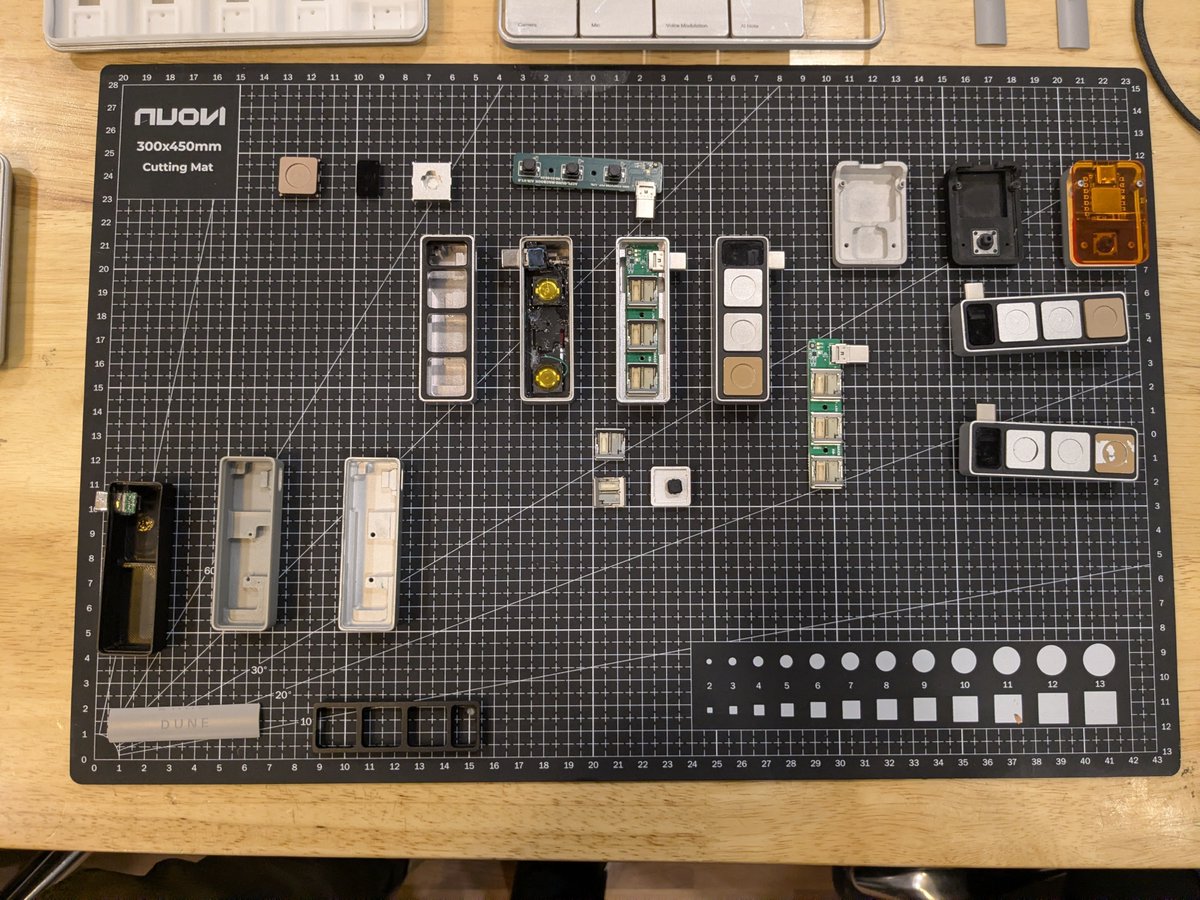
Yes, we designed and shipped about 500 units of a context aware keypad called Dune a few months back to early adopters. It was also an easy to build form as compared to a new wearable device. We had setup calls with a large part of this group to validate parts of the thesis and get a more realistic sense of adoption of AI.
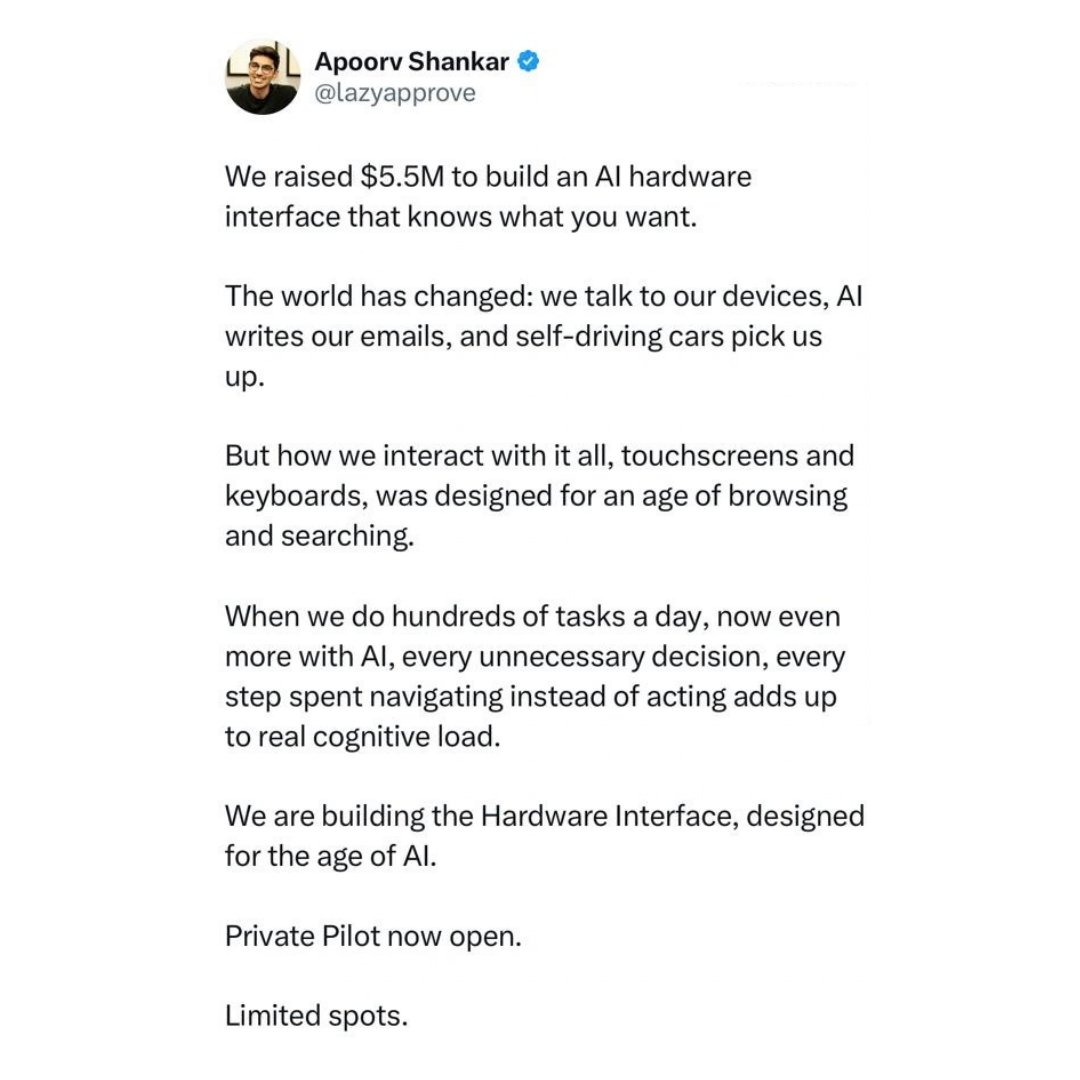
On July 16, we announced our $5.5M seed for Aina after nearly a year of building in stealth. It was built around a thesis we've been working toward since July last year.
“Keyboards and phone touchscreens were designed for the era of Browsing. We'd think of what we need, unlock a device, navigate, find an app, type or tap, and execute the task.
With AI and agents, we just say or write what we want, and it gets done. The browsing step disappears entirely.
Soon, AI assistants will deepen their understanding of our context, calendars, and activities. They'll become proactive and suggest what we need, and all we'll do is say yes. Much of our day-to-day will be handled this way.
We call this the era of Approvals."
The world of software has changed. The hardware interface hasn't. We are still using an interface designed for Browsing when Browsing isn’t needed.
Today, with Agents like Muse, Instinct, and Dot changing how we manage daily tasks, it’s becoming evident that our interaction with computers has significantly changed, and we are heading towards the age of approvals. We need a better way to interact with assistants/computers than pulling out our phones and texting.
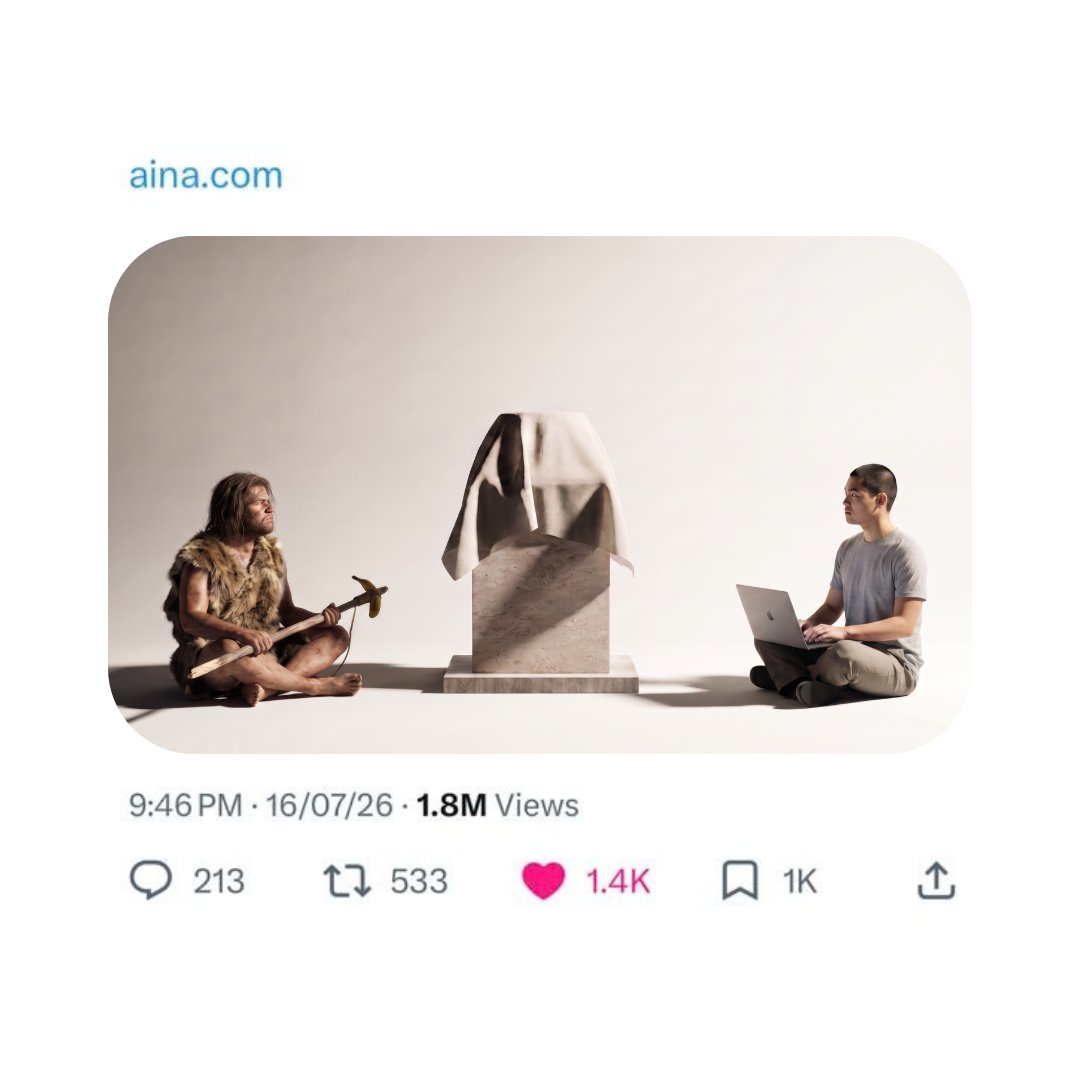
That was the idea behind the video we made for our funding announcement, which reached 1.8M views, leading to thousands of signups for Aina’s Pilot.
Aina’s Pilot is live, the first few units have been shipped, and we will keep sharing more on our Thesis and the product decisions that led us here as we get closer to announcing what we have been building.
Almost there!
The original video post got deleted, so re-sharing here. The thesis we started with 14 months ago is about to become a reality. And we couldn't be more excited to share what comes next!
https://t.co/cswZ1F6edH
If you've ever wanted to build hardware but didn't know where to start, come to this one.
I'll share what we've learned building Aina, from prototype to production. Then you get your hands on a board and build.
Oct 3, 12 PM, Bangalore. Thanks @GrowthX_Club for having me.
Couldn't agree more. We've been building toward this thesis for over a year. When we move from Instructing to Approving for everyday agentic actions, where we just say yes, we'll need a better interface than phone screens.
P.S. Glad to have you in the Pilot :)
Shipping soon.
Muse will be the top installed app for a while thanks to Meta’s distribution might..
But they are starting to have a retention issue: most people still don’t know what to do with a personal agent, so they lose interest after a while.
I bet Muse will get much more proactive rather than reactive like it is today:
“I can take care of this for you. Want me to?”
I think there are a LOT of money saving opportunities in finance
“Your credit card is charging 27% interest. You qualify for a much cheaper way to pay it off. Want me to move it?”
“You have $8,000 sitting in checking earning almost nothing. Want me to move the excess to a higher-yield account?”
“You’re paying off three debts. Putting your extra $300 toward this one first will save the most interest. Want me to change the payments?”
“Your car insurance just went up 22%. Want me to shop for a cheaper policy?”
“You’re paying for two subscriptions you haven’t used in months. Want me to cancel them?”
“Your employer will match another 2% of your 401(k) contributions. Want me to increase it?”
“Your credit card annual fee is coming up, but you barely used the benefits. Want me to downgrade it?”
Other non finance examples:
“Your kid’s soccer practice moved to 6:30. Want me to tell your spouse and update the calendar?”
“This group chat has been trying to pick a restaurant for three days. Friday at 7 works for everyone. Want me to book it?”
“Your package is delayed and will now arrive while you’re at work. Want me to change the delivery?”
“Your sister’s birthday is Saturday. Here are three gift ideas under $50.”
“You usually order groceries on Sunday. Want me to rebuild last week’s cart?”
“You told your friend you’d send them those photos. Want me to do it?”
“You’re running late for dinner. Want me to text the group your ETA?”
“One of the Marketplace couches you saved just dropped $100. Want me to message the seller?”
“Your flight is delayed. Want me to tell the person picking you up?”
“You’ve been trying to make plans with three friends. Saturday afternoon is the only time everyone is free. Want me to organize it?”
“Your dentist asked you to reschedule. I found three open appointments that work with your calendar. Pick one?”
“Your child’s school sent a permission slip due Friday. Want me to remind you tonight?”
“You said you need to return something to Target. The return window closes in four days. Want me to remind you when you’re near one?”
Basically moving from: You think of a task → you ask → AI helps.
To:
AI notices something → suggests an action → you approve.
Then you trust it and Muse handles routine things automatically and tells you afterward.
IMO people aren’t going to keep opening an agent because it can answer questions, unless they are subbing muse for ChatGPT; I don’t think it’s there yet…
They’ll keep opening it because it keeps saving them time, remembering things they forgot, and taking annoying little tasks off their plate.
@vinayakh True, for non recurring tasks, where discovery has been the norm -like online shopping, a large part of the Aha moment is when we see a great option after browsing through 20 bad options.
While booking a flight using an agent is cool, it's something we do once or twice a month. Lasting devices and agents won't be built for complex tasks we do once a month. They'll be built to make everyday tasks effortless. Long-term adoption comes from behavior change, and behavior change needs everyday usage.
.@benthompson says consumer AI has a marketing problem because the average consumer doesn't actually want to be more productive.
"Tech companies are like, 'Let us book your flight for you!' I’ve had a personal assistant for 10 years. He does not come within an inch of booking my flights for me. That is crazy talk."
"I understand which ones are gonna be delayed. I know which seat I want to be on. So the fact that this is continually a demo is hilarious to me."
“Number two: people love shopping. They don’t want to be productive. They want to be entertained. One of the biggest forms of entertainment is shopping.”
"Also, there’s so much information on a product page. Companies have spent so much energy focusing on that. You look at apparel as a category. They’re going to tell you what size the model is wearing, and you want to know that, and you want to look at the different styles."
"The idea of having a personal agent that’s going and getting some of the information and bringing it back to you, and then you’re like, 'Well, what about this other thing? Tell me about this thing.'"
"And you have your eager tech company executive say, “Oh, I have an assistant that can do it for you!"
"And it’s like, no. Not only do I want to do it, I want to complain about it. I’m enjoying myself complaining right now, okay? Would you just let me be and live my life?"