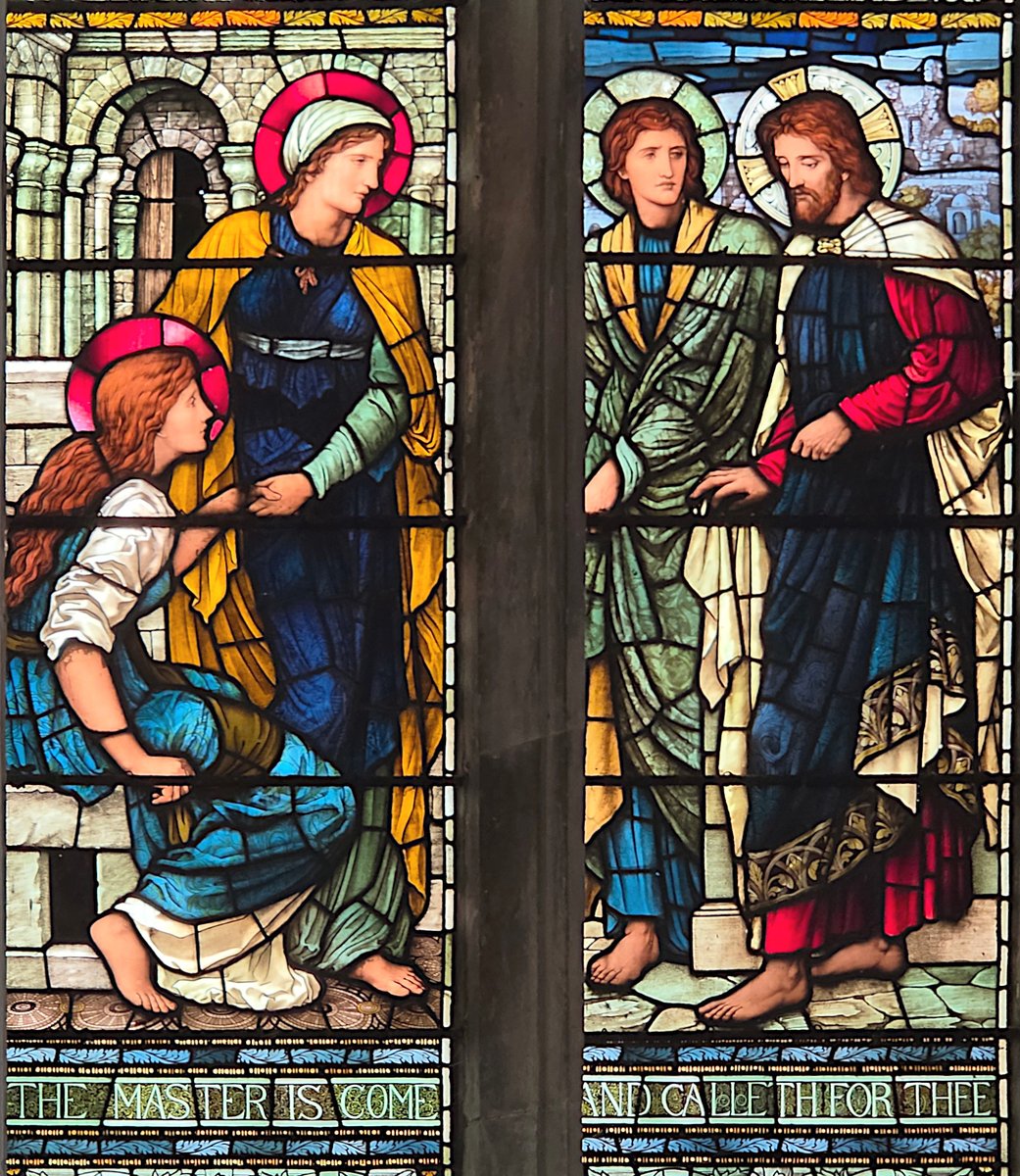
3/3 Dorcas by Percy Bacon, 1928 at Burley-on-the-Hill, Rutland.
'And it came to pass in those days
That she was sick, and died:
Whom when they had washed,
They laid her in an upper chamber.
But Peter put them all forth,
And kneeled down, and prayed;
And turning him to the body said:
Tabitha, arise.
And she opened her eyes:
And when she saw Peter, she sat up.'
St Peter raises Dorcas from the dead, much to the astonishment of her friends, in glass by Margaret Chilton, 1947 in St Machar's Cathedral, Aberdeen.
#StainedGlassSunday#SundayStainedGlass
2/3 Dorcas, also known by her Aramaic name Tabitha, in glass by WIlliam Hudson, 1872 at Uggeshall, Suffolk. She was a well-to-do widow and charitable benefactor in the city of Jaffa. Acts recounts that when she died, she was mourned 'by all the widows... crying and showing the robes and other clothing that Dorcas had made while she was still with them.'
Mautby, another Norfolk thatched round-towered church. The surviving carstone banding suggests the tower was an early one, perhaps 11th Century, though west window and bell stage are later. The south aisle, presumed burial site of Margaret Paston, has long gone. #SteepleSaturday
Hales, probably the best known of the thatched round-towered churches of Norfolk. Largely 12th Century, though apses are unusual in East Anglia, the east window added perhaps a century later. Now in the care of @TheCCT, as is neighbouring Heckingham. #SteepleSaturday
@smileyplankton Carr stone, also known as carrstone or carstone, is a dark red friable sandstone rich in iron oxide found widely in west Norfolk. It was often used elsewhere as decoration in flint buildings, although in the west of the county you get whole buildings constructed from it.
I had to have my photograph taken for the programme for a series of lectures taking place next year (only one by me, thankfully) so I thought I'd use it as my profile picture here as well, as the old one was taken nearly four years ago...
2/2 Hales, the sanctuary. Redundant since the early 70s, it was in a parlous state until rescued by the then-Redundant Churches Fund.
More: https://t.co/QZjopyfqll
2/2 Looking east at Mautby, the early 20th Century rood group atop the medieval screen is a reminder of the church's Anglo-Catholic heyday, though the tabernacle on the altar that I saw when I first visited in 2007 has now gone.
More: https://t.co/DvuQx4qNLG
Horsey, one of Norfolk's many thatched round-towered churches. The church and lower two-thirds of the tower are all of a piece, probably early 13th Century, with a later bell stage. A crisp restoration has left it looking a bit like a polite country cottage with a tower attached.
#SteepleSaturday
The Blessed Virgin, Joseph, Simeon and Anna with the Christchild at the Presentation in the Temple, by Henry Holiday, c1900 in the chancel at Lound, Suffolk. 1/2
@SarahBlick3 Not on the font itself, though I have on the pedestal of the font, as at Kedington, Suffolk, pictured. More often on the floor or wall I think.
Incision marks on the 13th Century font at Blundeston, Suffolk, most likely made by parishioners collecting 'sacred dust' for use in private rituals and devotions. This activity was frowned upon by the Church, but appears to have been common, especially in rural areas.
#FontsOnFriday