Spot-on comparison with 2018 Micron—the key test is whether spot pricing is rolling over or tightening.
On tonight's Q3 call, Kress revealed older Hopper multi-year leases are renewing at up to 2x original rates, B300 rentals are up >60%, and cloud backlog jumped from $2.0T to $2.5T in 90 days while raising FY28 revenue growth to 75% (~$741B).
Hard to get a 2018-style EPS collapse while 3-year-old GPUs renew at 2x, no?
Most 4:20 PM headlines missed why $NVDA reversed from $155.57 ("Board will not reinstate Jensen") to $162.94 (+$181B) once Colette Kress took the mic.
I audited every footnote of the Q3 Form 8-K + all 8 analyst Q&A rounds:
1. 14-Week Calendar Catch: Q4's $130B guide spans 14 weeks ($120.7B normalized = +6.4% QoQ ex-China, with licensed China Hopper permanently halted).
2. Why 71.5% GM Is "Our Bottom": NVDA is absorbing HBM4 inflation on old fixed-price POs in Q4; new pricing kicks in Jan 2027, lifting FY28 GM to 72–73%.
3. The $741.5B Bombshell: Kress raised FY28 growth from 70% to ~75% (+$318B YoY)—implying ~$17.40 EPS (9.4x P/E at $162.94).
4. Live Jevons Paradox: Hopper multi-year renewals hit 2x original rental rates; supply commitments jumped +$111B QoQ to $390B alongside $45.5B/qtr buybacks.
Full 6-chart forensic audit below 👇
The survivorship-free numbers back this up completely. Locking all 100 starting Nasdaq-100 stocks in Jan 2014 through Oct 2026, passive QQQ gained +770%—yet 83% of its own constituents trailed the index (and 92.6% across the US Top 500). Growing active income + consistent index DCA beats stock-picking almost every time.
@DevotedDividend@FASTGraphs Buying mechanically every year from 35 to 45.
Rotating 8%/yr from QQQ into $SCHD grew annual cash dividends right through the 2022 bear ($36.9k to $38.1k) and hit $122k/yr by age 45—covering family bills 2x over with zero share sales. Do you glide by age or valuation?
@MikeZaccardi Wildest stat underneath a 15% $QQQ pullback: single-stock pain is far worse.
Auditing all 100 starting 2014 Nasdaq-100 stocks with zero survivorship bias, 83% trailed passive QQQ (+770%) and 22% lost money outright. Hard to beat self-cleansing index rules, isn't it?
@stockmom Even better than nailing the exact $QQQ bottom: structuring cash flow so crashes work for you.
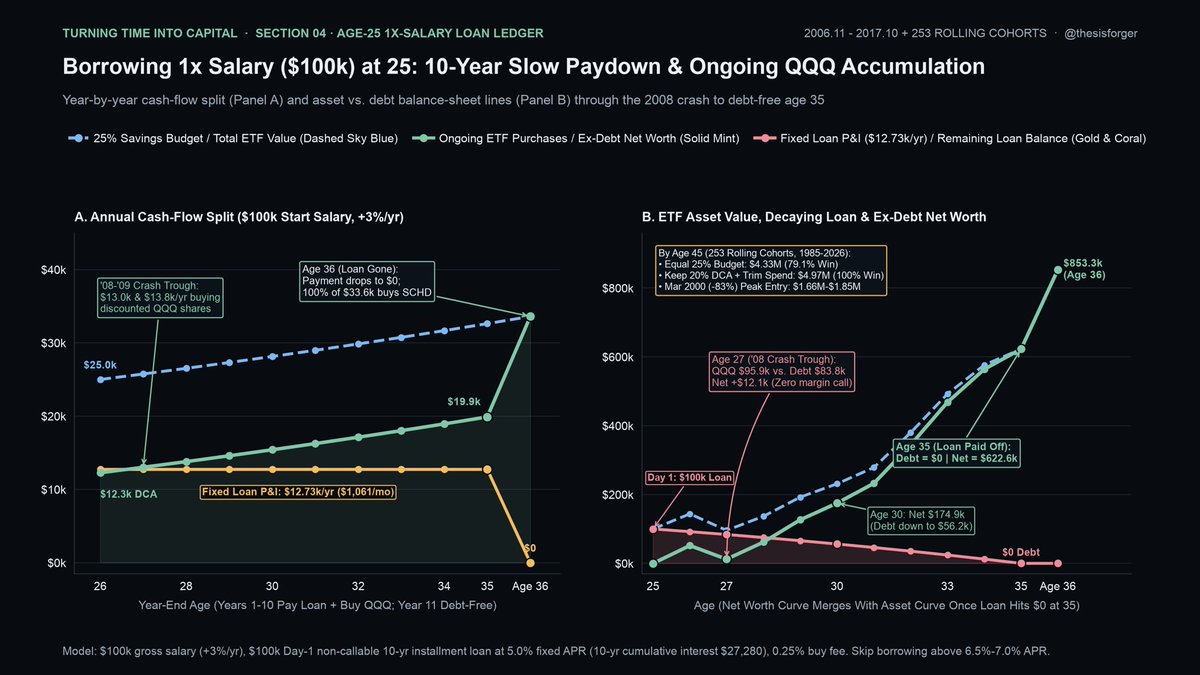
Across 253 rolling 20-yr cohorts, front-loading 1x salary into QQQ + steady paycheck DCA through -50% drops hit $4.33M-$4.97M by age 45. Holding long or trading the bounce?
Anthropic’s baseload is locked in custom ASICs, not SPCX: Anthropic already committed $392.5B into non-cancellable long-term contracts with Google TPU ($282.5B, ~41% lower TCO) and AWS Trainium ($110B). The $120.5B SPCX lease is just a flexible "peak-shaving" buffer with a 90-day exit option. With 62% of its workloads (inference/RL) portable to TPU v7/v8 in hours via XLA, Anthropic holds the leverage.
Rubin’s 3x compute jump & the duration trap: Citing a 7% short-term rental hike is static linear extrapolation. Once Rubin ramps up and delivers a 3x compute leap, unit compute costs will plunge, directly devaluing SPCX’s legacy fleet. Worse, SPCX faces a $40B debt wall (at 8.2%) in Jan 2027—backing 5.25-year rigid debt with 90-day cancellable leases means SPCX fears vacancy far more than Anthropic fears losing capacity.
$SPCX If Anthropic leaves, SpaceX gets scarce compute back, and that's the part the bears are missing.
On the Q3 call, Musk said short-term compute contracts are renewing at higher dollars per watt and SpaceX could rent its compute "several times over" if it said yes to everyone. The CFO added that new deals are pricing slightly above the high end of the $30 to $50 per watt range.
Demand is there. Google already pays SpaceX about $920M a month, hyperscalers and dozens of smaller firms are asking for capacity, and Grok and Cursor can absorb whatever comes back. Musk's stated goal is roughly a 50/50 split between internal use and renting to others.
Pricing is also moving SpaceX's way. GPU rental rates rose about 7% in November, and Anthropic's own S-1 says its short-term compute costs significantly more than its multi-year deals.
The 90-day exit cuts both ways. Anthropic can walk once the non-cancelable periods end in January and March 2027, but so can SpaceX, and SpaceX is the one holding the scarce asset.