A Socket pool names one hook program and a six-bit permission mask when it is created.
The dynamic-fee hook needs 19 (1 + 2 + 16). Neither the hook nor its mask can change later.
CA : XLBLxbY1Mr7aadnqAbmqSBXLEyUdjvUXtXCnz8Mpump
Socket update, shipped today:
Trade with plain SOL. The app wraps what a trade needs inside the same transaction and unwraps what comes back, so SOL leaves and arrives as SOL, with no wrapped SOL left in your wallet. Creating a pool, adding liquidity, withdrawing and limit orders work the same way.
Your SOL balance now counts native SOL, keeping 0.01 back for network fees.
A partial fill stops where the pool's liquidity ends, so the pool's price stays where trading left it.
On Create, ⇄ turns the starting price over along with the pair, and the starting price comes from the pair's deepest pool.
Routes are quoted at your current slippage setting, and every leg carries its own minimum.
Token pickers now tell screen readers which token is selected.
Plus a few bug fixes across Swap, Create and the API.
https://t.co/ZYs5R70yxl
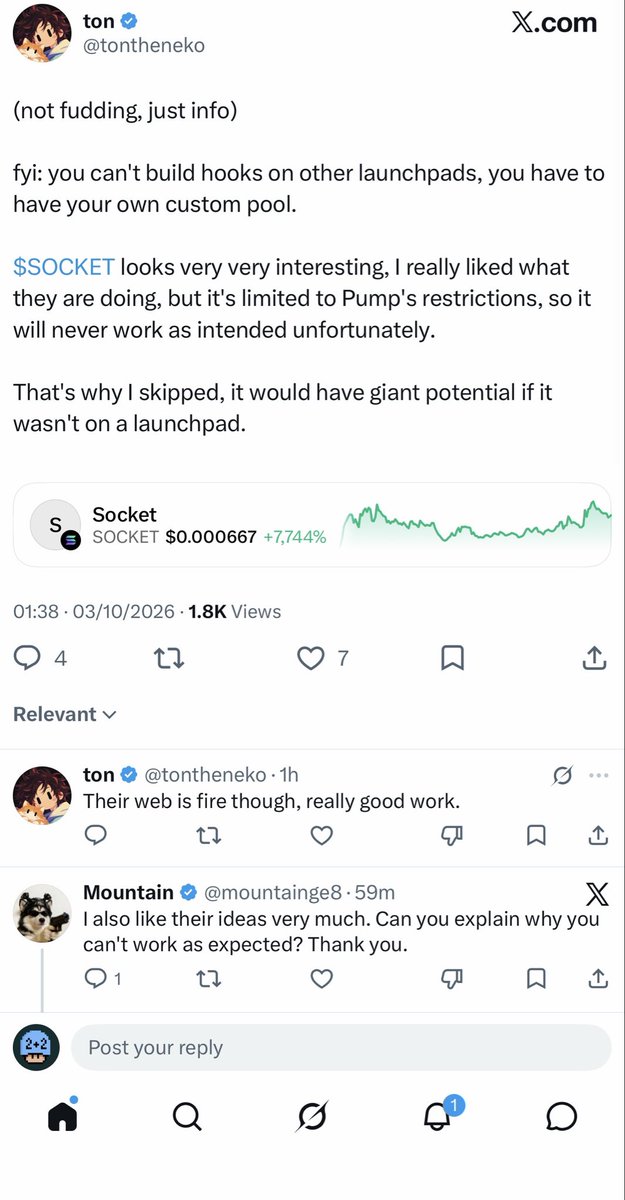
Appreciate the honest take, and you're right about one part: hooks need a pool of your own.
That's what Socket is. It's its own AMM program on Solana, and hooks run inside Socket pools, not inside pump's.
The token and the place it trades are separate things. SOCKET launched on pump because that's where most Solana tokens launch today, and it was the fastest way to get the tech in front of people.
But a launchpad doesn't own where a token trades afterwards. People open Meteora pools for pump tokens every day to earn trading fees, and Socket works the same way.
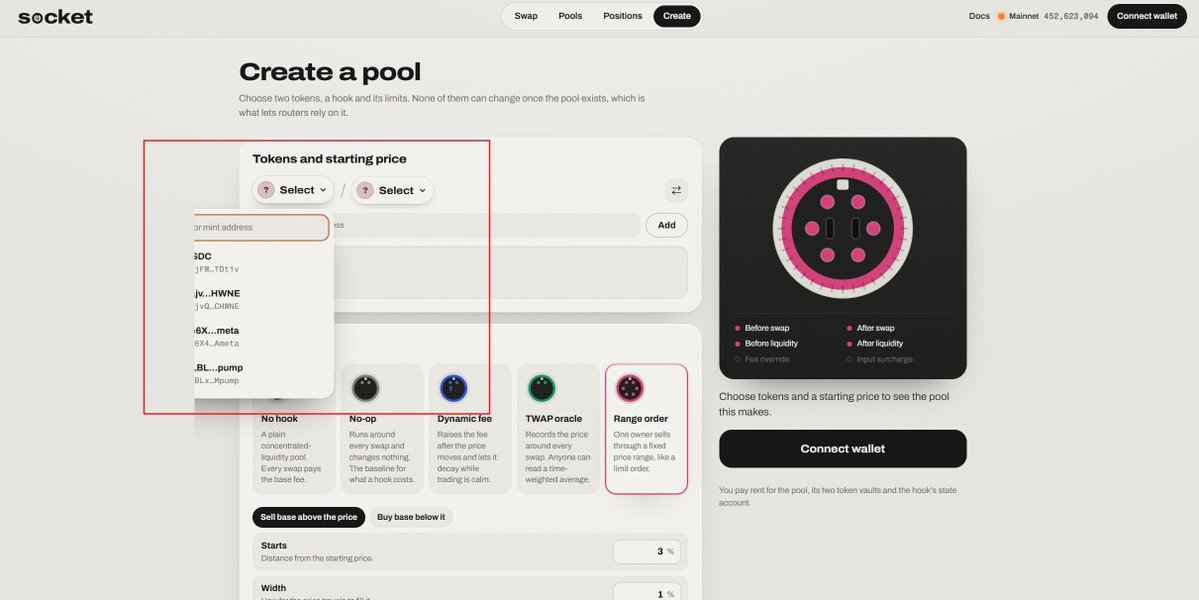
Any standard SPL token, wherever it launched, can get a Socket pool with a hook: a dynamic fee, a TWAP oracle or a range order from the app, or a hook you write yourself.
Shipped: routed swaps.
When it pays more, Swap now splits a trade across up to 3 pools of a pair, or routes it through USDC or SOL.
Pairs with no pool can trade through a route too. Every leg settles in one transaction.
Next: limit orders from Swap.
Shipped: pool stats.
Every pool now shows its 24h and 7d volume, the LP fees it paid over 7 days, and a fee APR on current reserves. All counted from on-chain swaps, priced in the pool's quote token.
https://t.co/bkSVRKTLls
Shipped: pool stats.
Every pool now shows its 24h and 7d volume, the LP fees it paid over 7 days, and a fee APR on current reserves. All counted from on-chain swaps, priced in the pool's quote token.
https://t.co/bkSVRKTLls
Shipped: Create now funds the pool in the same signature.
Pick a range around the starting price (±1%, ±5%, ±20% or custom), enter an amount, and "Create and deposit" opens the pool with your liquidity in it. Range orders go in with their pool too.
Shipped: Create now funds the pool in the same signature.
Pick a range around the starting price (±1%, ±5%, ±20% or custom), enter an amount, and "Create and deposit" opens the pool with your liquidity in it. Range orders go in with their pool too.
Next on Socket:
1. Create and fund a pool with one signature
2. Volume, LP fees and fee yield per pool
3. Token names and logos, with a verified mark
4. Multi-hop and split routes
5. A Jupiter adapter
6. Limit orders on Swap
7. Pool link previews
We put a lot of thought into this during the initial design.
We assumed early protocol fees would be small relative to the token's value. So we prioritized scaling and set it up so the fees go to LPs as rewards.
solana:XLBLxbY1Mr7aadnqAbmqSBXLEyUdjvUXtXCnz8Mpump is also the voting token for the DAO that sets Socket's direction, so we left this open to change later.
We can change it now if you'd like, but I think bringing in more trading volume should come first.
@thesocketdotapp I hope you do decide to direct some of the protocol fees towards the token (uniswap does 0.05% I believe)
As a holder it would give me even more incentive to create pools on Socket.
It would also give whales a reason to switch AMMs they can buy socket and create pools and some of the fees are directed back into their bags.
Just a suggestion, I think you should look into it
Next on Socket:
1. Create and fund a pool with one signature
2. Volume, LP fees and fee yield per pool
3. Token names and logos, with a verified mark
4. Multi-hop and split routes
5. A Jupiter adapter
6. Limit orders on Swap
7. Pool link previews
Next on Socket:
1. Create and fund a pool with one signature
2. Volume, LP fees and fee yield per pool
3. Token names and logos, with a verified mark
4. Multi-hop and split routes
5. A Jupiter adapter
6. Limit orders on Swap
7. Pool link previews
If a hook fails or breaks the rules, Socket cancels the whole trade. Nothing moves, and you only pay the network fee.
People who put tokens into a pool earn the trading fees.
https://t.co/uMUHcyX7v0
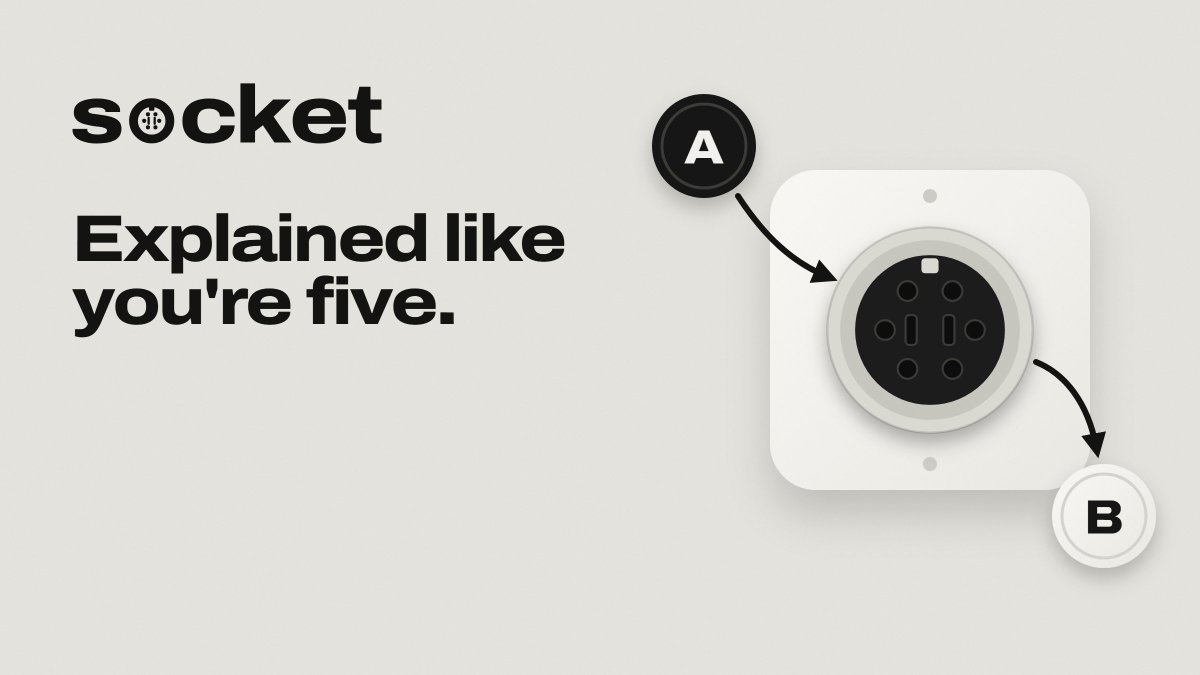
Socket, explained like you're five.
A trading pool is a box holding two tokens.
You put one token in, you take the other out, and the price shifts a little every time someone does.
Each plug's limits are set when its pool is made, like the highest fee it may charge, and nobody can change them later.
A hook never touches the tokens in the pool or in your wallet.
Every Socket swap passes the same 10 accounts: swapper, pool, two token accounts, two vaults, SPL Token, the hook account list, the hook program and its authority.
Hook accounts come from a list stored with the pool, at most 8.
A built-in hook adds one: its state.