Options trading is complex.
Greeks, share price, possible catalysts, earnings, dividends...
One has to consider multiple parameters simultaneously before placing a trade.
I am building a simple "Covered Call Evaluator & Log" spreadsheet that quickly allows to evaluate how likely a CC is to be assigned.
You can also log your trades and calculate total P&L.
You can grab it for free. Link in bio.
This is for educational purposes only. Not financial advice.
⚠️ Options Catalyst Brief ⚠️
US tariff proposals on 16 trading partners incl. China expected tonight; rates not public yet. Reuters: deal caps (China 20%) likely hold.
$TSLA $AAPL $AMZN 7–45d outlook: neutral/flat.
CSPs: gap risk until rates are known.
CCs: little change.
Not financial advice.
@evcortese Totally agree. Solid company and >7% dividend yield. This is definitely going to be one of my next bigger investments. Any other REITs you're looking at.
Going long a 30-day call looks way cheaper than going long a 120-day call. Usually, it’s the more expensive bet.
Say a stock is at $100 (30% IV) and you think it’s heading higher:
• 30-day $105 call: $165
• 120-day $105 call: $530
People divide the price by days left ($5.50/day vs. $4.42/day), which treats time decay like a straight line.
It’s not.
Theta accelerates fast in the final month. Out of the gate, the 30-day call bleeds ~$5.40/day and speeds up, while the 120-day call only bleeds ~$3.30/day.
Now watch a slow move:
• Day 30 ($103): You nailed the direction, yet the 30-day call expires at $0 (-100%). The 120-day call is still worth ~$565.
• Day 60 ($108): You close the 120-day call for ~$720 (+36%).
Call A ran out of clock, while Call B got paid.
More time buys patience, not safety—if the stock goes nowhere, the longer call loses more dollars. Give your thesis a cushion and exit before the final 30 days.
Not financial advice.
Hoping to make a quick buck by spending a few $100 on a long call?
Well, only if you gravitate towards cheap OTM calls (0.20–0.40 delta) for lottery-ticket leverage.
A more reasonable delta range is 0.5-08 since since it gives you e.g. a much higher POP.
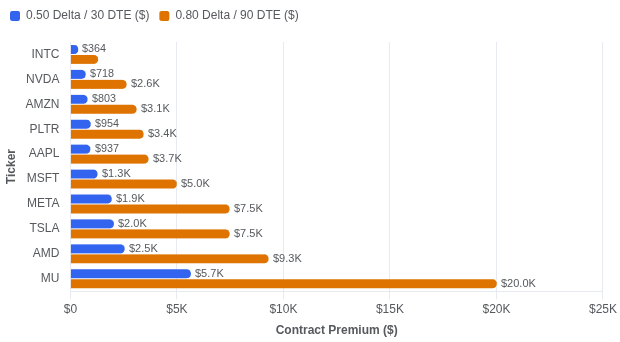
Below is a breakdown of estimated call premiums.
I'm using current market prices top 10 most liquid individual U.S. stocks.
Implied volatility baselines for more reasonable deltas (0.5-0.8) are based on Black-Scholes at 4.2% risk-free rate.
The average premium is roughly $3,587 per contract with a median of $2,371 at the midpoint of 0.65 delta and 60 DTE.
Not financial advice.
Covered calls and cash-secured puts are BOTH bullish-to-neutral strategies.
They in fact have the exact same P&L profile assuming same strike and expiration date.
See the math below.
Launches are catalysts. I learned this the hard way.
Back in Nov 7, 2025: $GOOG trades at $279.70.
I sold a Dec 5th $315 covered call. I meant to keep the shares.
Nov 24: The stock shoots up to $318.47.
What did I miss?
Gemini 3 was rumored for November.
On Nov 18: it launched.
$163 of premium in but ~$975 to close ... ouch!
Lesson learned.
Now I'm running a simple catalyst checker (Claude API) in my options trading tool so product launches show up before I place the next trade.