India’s first database-backed Legal AI. Income Tax • GST • FEMA • Company Law. Zero hallucination. 1M+ verified cases. Research to filing-ready drafts.
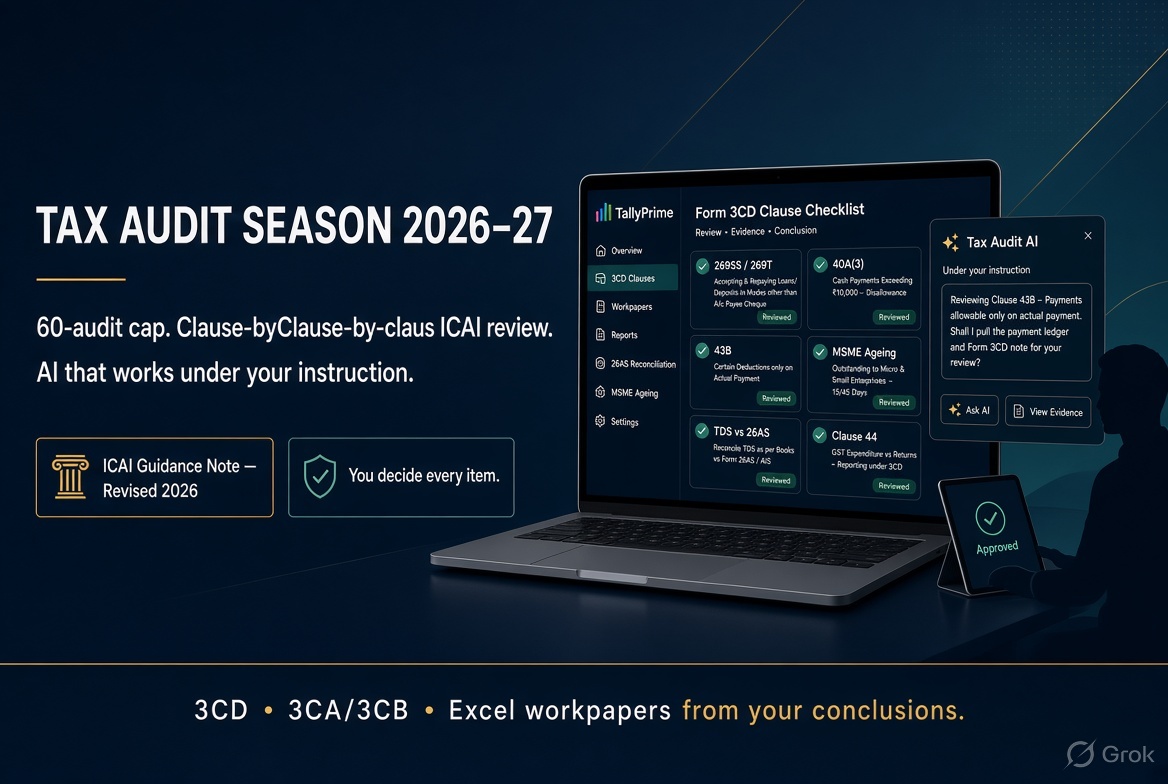
Tax audit season 2026-27 has two new facts: a ceiling of 60 audits per member per financial year, and ICAI's review board printing its findings under every clause of the Guidance Note.
Tax Audit AI answers both. It audits every Form 3CD clause from the client's live Tally books: 60 machine procedures compute the schedules (269SS/T, 40A(3), 43B, MSME ageing, TDS vs 26AS, clause 44 GST), an AI auditor works under your instruction against the ICAI Guidance Note — Revised 2026 edition, updated within days of release — and you decide every item. The 3CD, 3CA/3CB and Excel workpapers assemble from your conclusions.
Swipe through the 9 pages. Demo on your own client's Tally:
https://t.co/QlnaC2Bamq
#TaxAudit #Section44AB #Form3CD #CharteredAccountants #ICAI #TallyPrime #TaxCorpAI
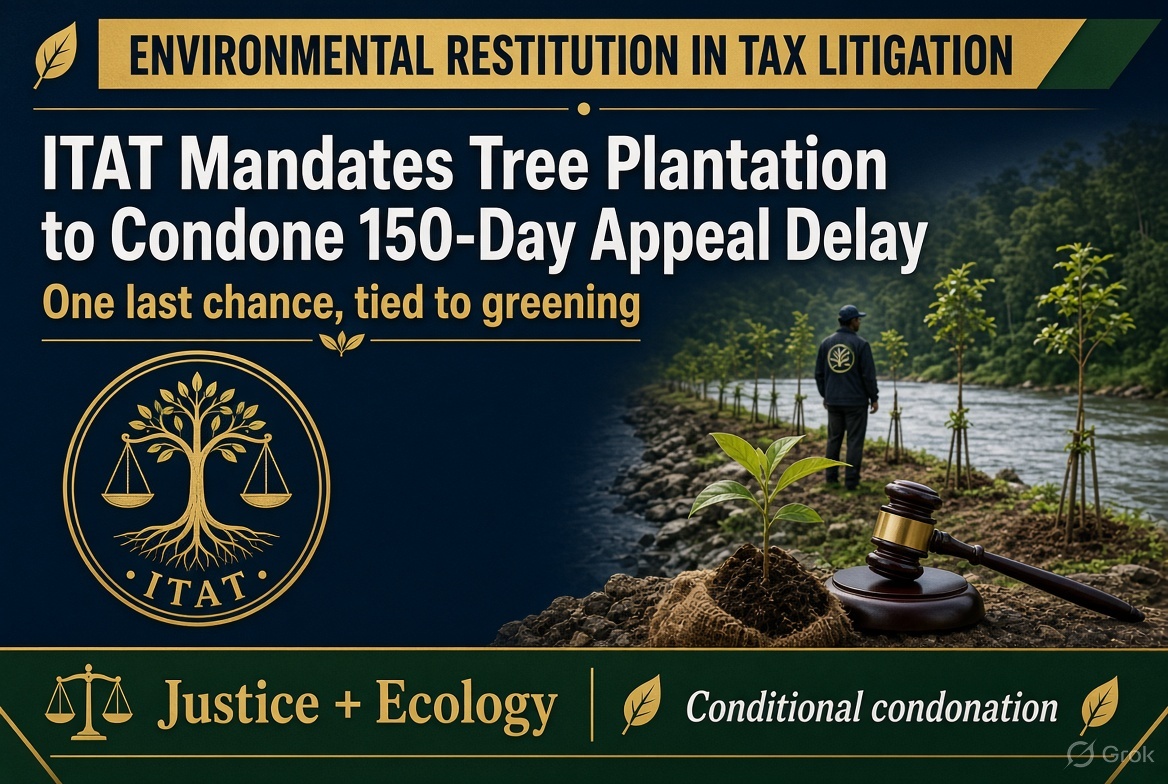
In a novel precedent, ITAT Chandigarh in Rajinder Singh Negi Vs ACIT condoned a 150-day appeal delay for an assessee in remote Himachal Pradesh but imposed a condition of planting 300 protected trees or 500 unprotected local trees as environmental restitution for the wastage of public resources. The substantive matter was remanded to CIT(A) for fresh adjudication. - https://t.co/vHJpMC3qJo
ITAT Ahmedabad in Dimple Manoj Sanghvi Vs DCIT deleted a ₹33.50 lakh addition under Section 69C, holding that handwritten family diary entries found at a relative's residence are insufficient to establish unexplained expenditure in the hands of a homemaker with no independent income. The Tribunal applied telescoping of the family member's recorded cash withdrawals against the diary entries. - https://t.co/7uOgZpYSml
In One Mobikwik Systems Ltd. Vs JCIT (OSD), ITAT Delhi held that payment gateway service fees retained by processors do not attract TDS under Section 194H, as no principal-agent relationship exists between the e-wallet operator and the payment processor. The decisive test is the legal authority to bind the principal — absent in standard payment gateway agreements. - https://t.co/Li9UhLFnQs
TaxCorp Tax Audit AI
Tax audit season 2026-27 has two new facts:
a ceiling of 60 audits per member per financial year,
and
ICAI's review board printing its findings under every clause of the Guidance Note.
Tax Audit AI answers both. It audits every Form 3CD clause from the client's live Tally books: 60 machine procedures compute the schedules (269SS/T, 40A(3), 43B, MSME ageing, TDS vs 26AS, clause 44 GST), an AI auditor works under your instruction against the ICAI Guidance Note — Revised 2026 edition, updated within days of release — and you decide every item.
The 3CD, 3CA/3CB and Excel workpapers assemble from your conclusions.
Swipe through the 9 pages.
Demo on your own client's Tally:
https://t.co/QlnaC2Bamq
#TaxAudit #Section44AB #Form3CD #CharteredAccountants #ICAI #TallyPrime #TaxCorpAI
Tax Audit for AY 2026-27: A Practical FAQ Guide Based on the ICAI 2026 Guidance Note and download Guidance Note on Tax Audit 2026 (Revised) - https://t.co/O3ShLCR5Be
Your client moved their own steel bars.
From their own factory. To their own godown.
Same GSTIN. Delivery challan in hand. No buyer. No sale. No consideration.
The Mobile Squad stopped the vehicle.
₹1,34,640 penalty.
A Tribunal just ruled in the taxpayer's favour — and its reasoning is elegant. But our senior tax editor has now written a detailed rebuttal arguing the Tribunal may have opened a door that was never meant to be opened.
❓ Can "tax payable on such goods" really mean zero when the goods themselves are fully taxable?
❓ What happens to Rule 138 enforcement if every intercepted vehicle can claim "it's just a stock transfer"?
❓ Does a non-obstante clause in Section 129 matter here — and did the Tribunal address it?
❓ Which provision actually governs transit interceptions — Section 129 or Section 122(1)(xiv)?
❓ And what does a 1983 Supreme Court judgment on excise duty have to do with all of this?
The answers — and the advisory framework for your clients moving goods between their own branches — are in the full analysis on https://t.co/qAysxV5UC0
https://t.co/paqgYQGv8B
⚠️ A word on AI-assisted research:
The Gujarat High Court flagged it. The Supreme Court has now raised the alarm. AI tools are producing fabricated case citations — and they're reaching courtrooms.
Every case cited above is real, verified, and traceable — because TaxCorp AI retrieves from a curated legal database, not from pattern-matching on thin air.
Zero hallucination. Database-verified. Always.
🔗
See how: https://t.co/ZjDfN4q2Bm
#GSTLitigation #Section129 #EWayBill #StockTransfer #GSTAT #IndirectTax #TaxCorp #CharteredAccountants #GSTCompliance #AIinLaw
A taxpayer blamed COVID-19.
The court said: the statute doesn't care.
Somewhere in India right now, a CA is advising a client on a Section 73 SCN response — confident in their argument. But there's a 30-day window they may be underweighting. Miss it, and no pandemic, no hardship, no writ petition will save you from a mandatory 10% penalty.
The Madras High Court just made that crystal clear.
But here's what worries us more than the ruling itself:
❓Are the citations in your legal opinion actually real?
The Gujarat High Court flagged it. The Supreme Court of India has now sounded the alarm too — AI tools are generating fake case citations that don't exist. Lawyers and CAs are unknowingly filing them. Courts are noticing.
TaxCorp AI is built differently.
Every ruling cited is pulled from our verified legal database — zero hallucination, database-verified. Our AI doesn't guess. It retrieves.
Because in tax litigation, a fabricated citation isn't just embarrassing. It's dangerous.
📖 Full analysis of this Section 73 ruling — including the exact advisory framework for your clients with pending SCNs — on:
https://t.co/6Lffm0ZV5E
🔗 See how TaxCorp AI works: https://t.co/ZjDfN4q2Bm
#GSTLitigation #Section73 #CGST #TaxCorp #TaxProfessionals #CharteredAccountants #IndirectTax #AIinLaw #GSTPenalty
The Karnataka High Court in Hukkeri Taluka Samagra Grameen Abhivraddi Sangh Vs State of Karnataka has reaffirmed a critical principle under GST: DRC-03 is merely a medium of payment; it is not conclusive proof that a payment is voluntary. For a payment to fall under Section 73(5) or Section 74(5), there must be demonstrable self-ascertainment or officer’s ascertainment, inclusion of applicable interest (and penalty under Section 74), and strict compliance with Rule 142(2) including the issuance of Form GST DRC-04.
Since none of these elements were satisfactorily established, and the payment had been made in the shadow of an ongoing investigation with no prior adjudicated demand, the Court directed refund of ₹53,97,352 along with 6% interest from the dates of deposit until refund. The decision dovetails with earlier rulings such as Union of India vs. Bundl Technologies, Sri J. Ramesh Chand vs. Union of India, and the CBIC’s own instructions, underscoring that “pay first, argue later” during investigation is not compatible with the statutory framework or constitutional safeguards.
Compliance Checklist
For assessees facing GST search/inspection/investigation:
Do not treat every suggestion of “voluntary payment” during investigation as obligatory; seek legal advice.
If you choose to pay via DRC-03:Ensure you have carried out a proper self-ascertainment of tax, interest and penalty (if applicable).
Keep detailed working papers showing how the amount was computed.
Record clearly if payment is under protest or without admission of liability.
After making DRC-03 payment:Check whether Form GST DRC-04 acknowledgement has been issued.
Preserve all electronic and physical evidence of filings and communications.
If you believe payment was made under coercion:Put the allegation on record at the earliest opportunity (e.g., in replies to SCN).
File a refund application promptly with a detailed chronology of events.
For GST officers:
Avoid any form of coercive collection during search/inspection/investigation.
When an assessee proposes voluntary payment:Inform them of the legal framework under Section 73(5) / Section 74(5) and Rule 142(2).
Ensure DRC-03 is backed by proper ascertainment and documentary basis.
Issue DRC-04 acknowledgement through the portal without delay.
Make sure that any demand or recovery is grounded in a proper adjudication order under the CGST Act to comply with Article 265 and Article 300A of the Constitution.