Introducing GLM-5.4: Generalized Coding with Our First Loop Transformer.
- Loops existing layers in the GLM-5 base model for deeper reasoning
- Pushes beyond traditional coding to video, games, 3D shaders, and CAD modeling
- Adds vision capabilities for stronger visual coding
API access will open after safety evaluation. Model weights will be released responsibly.
Tech Blog: https://t.co/dQrbKoamcN
@TeksEdge Got these numbers from the same card using Strata. Faster on decode but slower on prefill. Looks like there are more optimizations can be done.
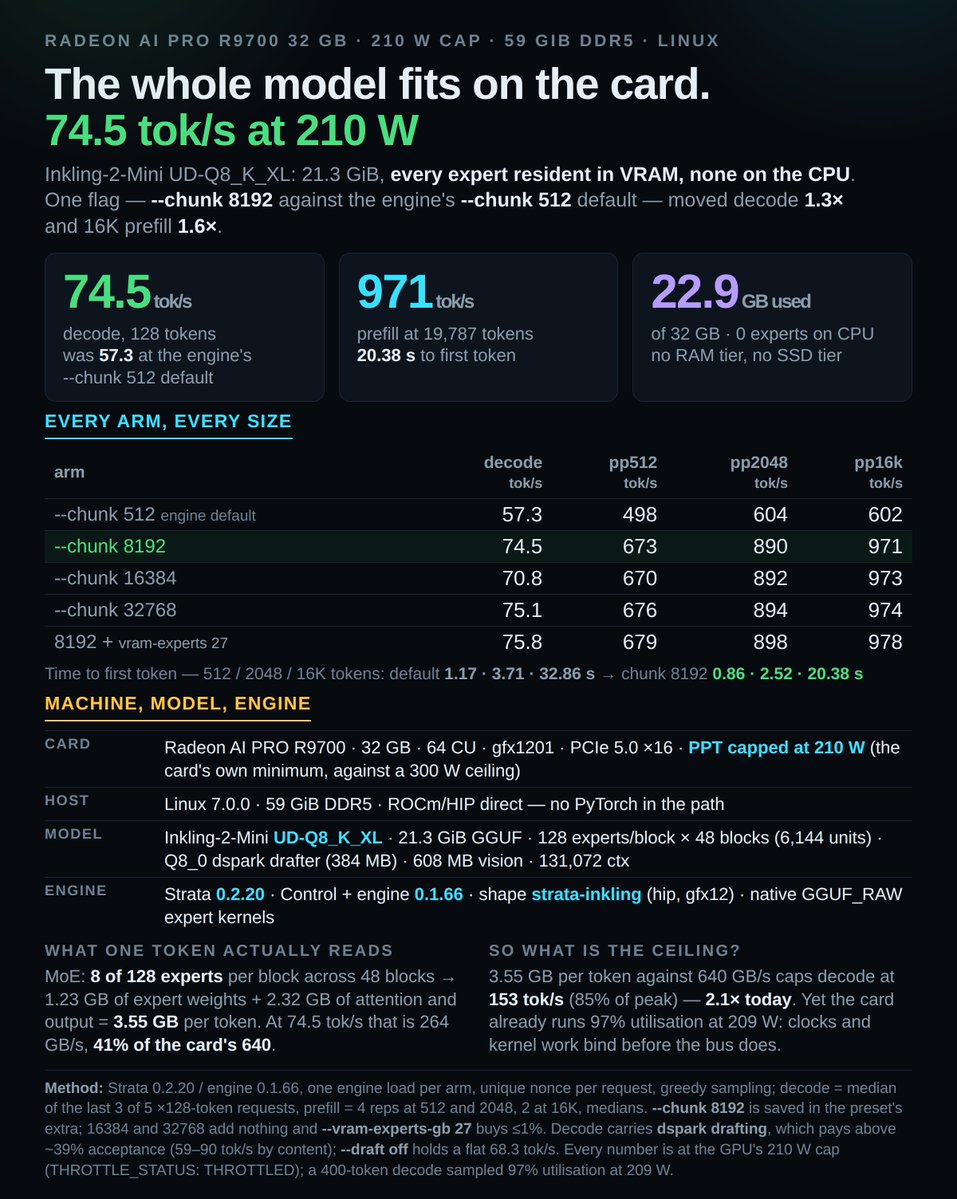
A 22.9 GB Inkling-2-Mini MoE fully resident in VRAM on a 210 W R9700: 74.5 tok/s decode, 971 tok/s at 16K prefill — the engine's 512-token default chunk was costing 30% of both.
@redStapler_twit Works well on AMD R9700. I am getting 75tps. Q4 does not buy anything for me. It runs at the same speed as Q8. I am using Strata, btw.
A 22.9 GB Inkling-2-Mini MoE fully resident in VRAM on a 210 W R9700: 74.5 tok/s decode, 971 tok/s at 16K prefill — the engine's 512-token default chunk was costing 30% of both.
Same 32 GB R9700, same box: Qwen3.8 IQ3_S needs 20 MB of expert weights per token and decodes at 80 tok/s. HY-4 Flash SQ-64 needs 36 MB and decodes at 44. Both sustain ~1.6 GB/s — the card isn't the bottleneck, bytes-per-token is.
⚕️New Medical Model!
📝 Remember when @AntLingAGI open-sourced its 124B medical AI model in October?
They just released something even better. ❤️🩹
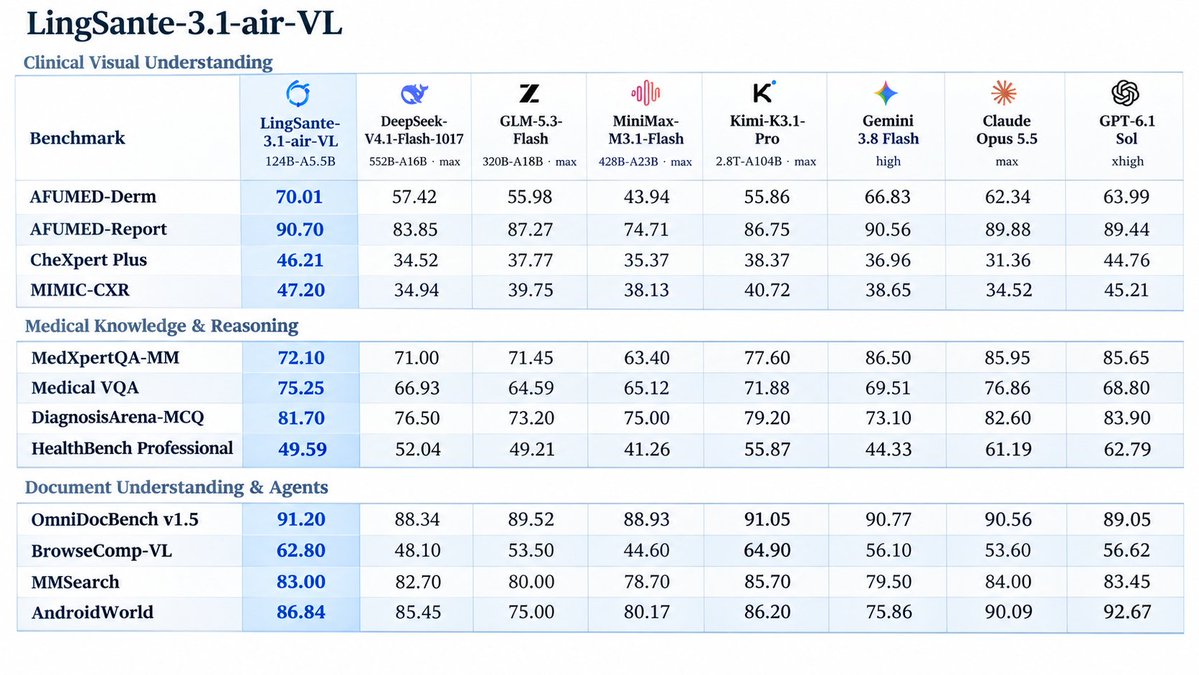
A 124B-parameter medical AI that can actually see 👀 medical images.
And the weights are open too. 🔓 ... and better than GPT 6.1 Sol in some benchmarks.
LingSante-3.1-air-VL is a new medical-specialized multimodal MoE.
It has 124B total parameters but activates only 5.5B per token.
And look at the reported clinical visual-understanding benchmarks against GPT-6.1 Sol and Gemini 3.8 Flash.
AFUMED-Derm
🟢 LingSante → 70.01 🔥
🔵 GPT-6.1 Sol → 63.99
🟣 Gemini 3.8 Flash → 66.83
AFUMED-Report
🟢 LingSante → 90.70
🔵 GPT-6.1 Sol → 89.44
🟣 Gemini 3.8 Flash → 90.56
CheXpert Plus
🟢 LingSante → 46.21 🔥
🔵 GPT-6.1 Sol → 44.76
🟣 Gemini 3.8 Flash → 36.96
MIMIC-CXR
🟢 LingSante → 47.20 🔥
🔵 GPT-6.1 Sol → 45.21
🟣 Gemini 3.8 Flash → 38.65
Unlike the earlier text-focused Ling-Sante model, this one is designed to work directly with medical images.
It can ...
🩻 Analyze chest X-rays and draft structured radiology reports
🔬 Interpret skin images across 120+ conditions
🥗 Analyze food photos and estimate nutritional content
📄 Read medical reports alongside clinical history
🔎 Use image-based medical search to retrieve supporting evidence
🤖 Interact with healthcare apps through GUI agents
Now the Localmaxxer details.
🧠 124B total / 5.5B active
👁️ Native text + image inputs
📚 256K context window
🔓 MIT license
✅ Open weights on Hugging Face
✅ SGLang and vLLM inference support
There's a catch.
The original weights are approximately 250GB, and the official serving instructions use 4× 141GB-class GPUs or 8× 80GB GPUs.
Can't wait to see the community produce optimized quantizations and benchmarks for smaller local systems.
Always remember this is a research model, not a FDA approved medical device. Its outputs require professional verification.
But this is a significant development for open-weight healthcare AI.
Image Source: Ant Ling
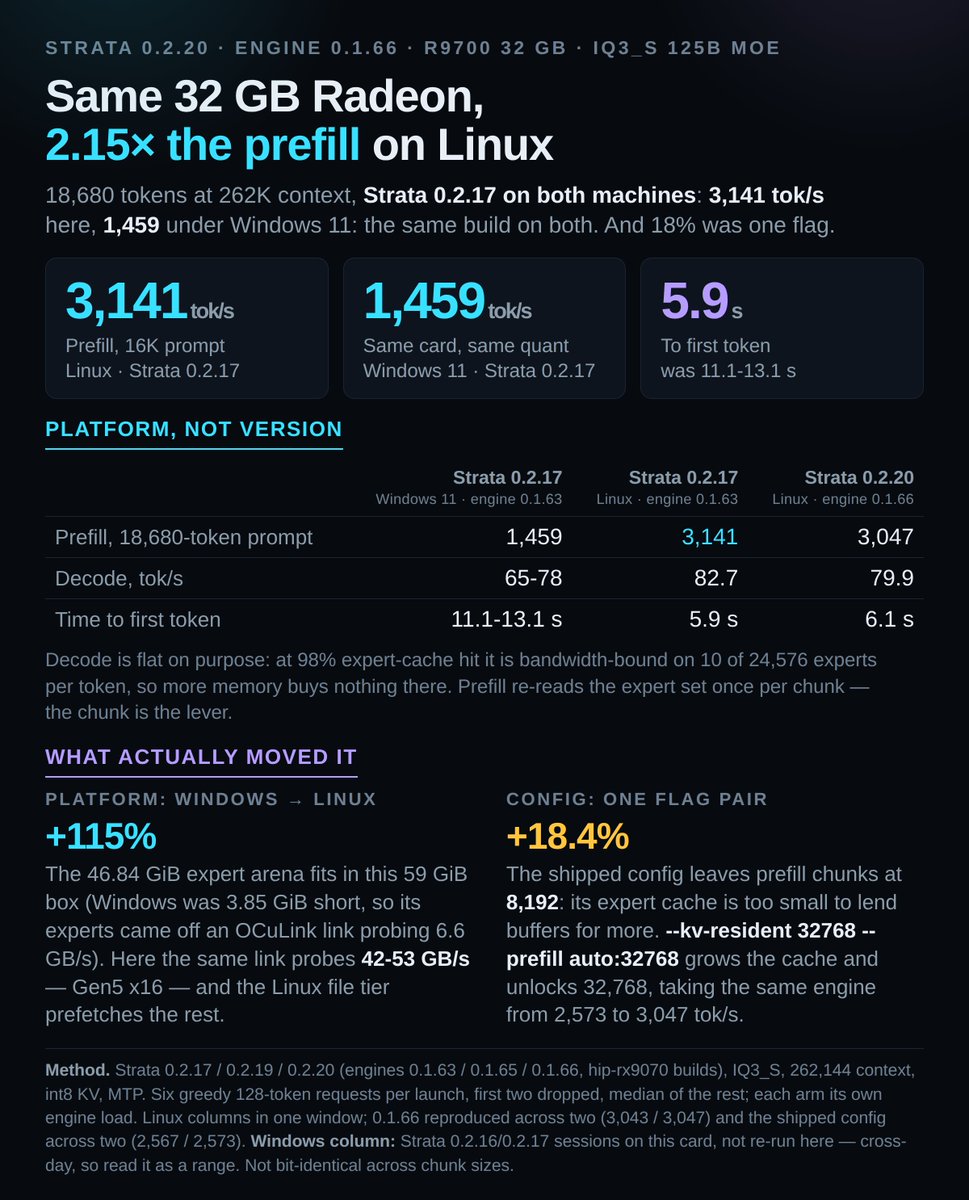
Same AMD Radeon AI PRO R9700, same Strata 0.2.17 (engine 0.1.63) on both machines, same IQ3_S weights. A 16K-token prompt: 1,459 tok/s on Windows 11, 3,141 on Linux = 2.15x. Decode didn't move (~80 both) — at 98% expert-cache hit it is already bandwidth-bound. Another +18% on prefill was one flag pair.
Same AMD Radeon AI PRO R9700, same Strata 0.2.17 (engine 0.1.63) on both machines, same IQ3_S weights. A 16K-token prompt: 1,459 tok/s on Windows 11, 3,141 on Linux = 2.15x. Decode didn't move (~80 both) — at 98% expert-cache hit it is already bandwidth-bound. Another +18% on prefill was one flag pair.
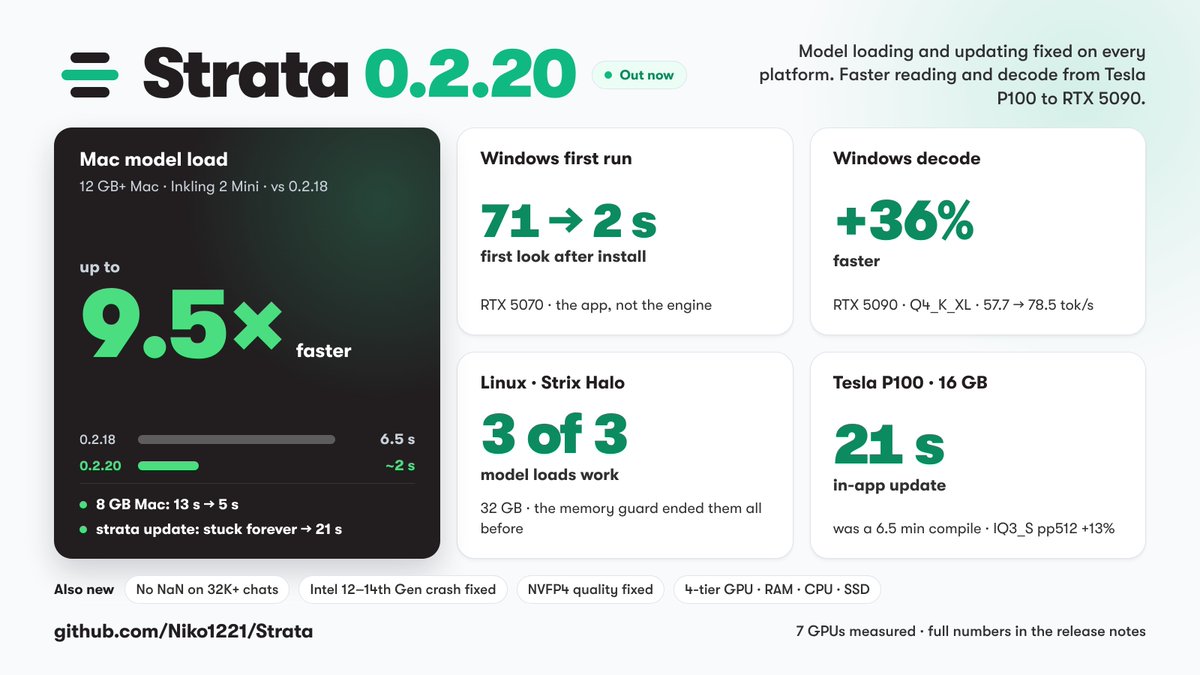
A lot of bugs fixed and improved performance on smaller gpu's and older devices! 🙌
All @UnslothAI quant's of Inkling 2 Mini are now fully supported! 🥳
See more at: https://t.co/1dEHm9dbbz
Today, we release LingSante-3.1-flash, an open-weight MoE model with 560B total parameters and 25B activations per token. It unifies diverse medical capabilities while retaining general capabilities, including complex medical reasoning, long-horizon workflow execution, and professional behavior alignment.
LingSante-3.1-flash moves beyond medical QA toward real-world healthcare problem. The model leads on HealthBench Professional (65.72), HLE (text-only, with tools: 72.22) and BrowseComp (with context: 94.10), outperforming GPT-6 Astra, Claude Opus 5.5 and Gemini 4 Argon on all three. LingSante-3.1-flash also performs well on professional long-horizon medical workflows, such as PhysicianBench (57) and EHR-Complex (74.40).
Together, these results establish LingSante-3.1-flash as the leading open-weight models for healthcare.
The weights are available. Explore LingSante and build with it.
More below ↓
This update is HUGE 👀
- Inkling 2 Mini is now supported in Strata 🥳
- 11,306 tokens/s on prefill and 4,087 tokens/s on output with RTX 5090 😨
- Qwen3.8-Flash-Next receives a 40% performance increase across all hardware we support 🥶
See more at: https://t.co/pRksU6D8T7
Everyone in Washington is obsessed with GPU export bans, yet almost nobody talks about the massive glass-jaw vulnerability sitting inside every single US AI data center: optical interconnects.
You can stack $50 billion worth of Nvidia Blackwell or Rubin GPUs inside a shiny new data center hall, and without high-speed optical transceivers to wire those racks together, they are nothing more than very expensive space heaters.
Right now, the White House and FCC are pushing restrictions on new Chinese optical transceivers on “national security” grounds, and US hyperscalers (Microsoft, Amazon, Google, Meta, CoreWeave, and Cisco) are quietly panicking behind closed doors. Here is why Beijing holds a massive counter-chokepoint if it decides to retaliate:
- China controls roughly two-thirds of the global optical transceiver market.
According to Counterpoint Research, Chinese manufacturers like Zhongji Innolight and Eoptolink account for around 66% of global optical transceiver production. Non-Chinese suppliers simply do not have the cleanroom scale or packaging capacity to replace that volume. Hyperscalers literally warned the White House that qualifying and scaling non-Chinese alternatives across their architectures could take up to 10 years.
- The Indium Phosphide kill-switch.
Even if you try to buy exclusively from American optical suppliers like Coherent, Lumentum, or Applied Optoelectronics, those companies still depend on indium phosphide (InP) to fabricate the lasers and photodetectors inside 800G and 1.6T transceivers. China dominates the global refining and supply of indium and gallium. If Beijing restricts indium phosphide exports in retaliation, it cripples the exact US optical manufacturers Washington claims to be protecting.
- There is no quick escape hatch
Washington’s backup plan is throwing subsidies at domestic photonics fabs and hoping Nvidia, Broadcom, and Marvell accelerate Co-Packaged Optics (CPO) via TSMC and GlobalFoundries to bypass pluggable transceivers altogether. The problem is that CPO still represents roughly 0.5% of data center optics today. Scaling it to replace millions of pluggable modules takes years, not quarters.
The reality of the AI supply chain is mutually assured bottlenecking. US firms like Broadcom, Marvell, Corning, and Amphenol dominate the DSP chips, ultra-low-loss fiber, and copper cables, while China dominates two-thirds of transceiver assembly and the upstream raw materials that make the lasers work.
Politicians love treating global hardware supply chains like a one-way light switch they can flip for cable news soundbites, completely oblivious to the fact that if Beijing flips its switch back, US AI data center buildouts freeze overnight.
Hy4-Flash is now supported in Strata 🙌
It has its own .strata quantisation checkpoints at 64GB, 96GB, and 128GB. You can run it with at least an 8GB GPU. A preview of something bigger I'm doing for local inference in the next few days.
@TencentHunyuan Hy4-Flash is a great model with some good long-horizon agentic tasks.
See more at: https://t.co/AU2SCnJ02H