The cost of completing a task matters more than the raw intelligence of the model running it.
That’s the thesis behind TwIL-8B, our new 8.8B reasoning model. Open weights. Runs on hardware you already own.
Against Qwen3.5-9B, it opens a 16-point lead on LiveCodeBench (81.6 vs 65.6) and tops MATH-500 (98.2 vs 96.6). Against Gemma 4 31B, 4x the size, it still wins on MATH-500 (98.2 vs 87.9) and AIME 2025 (88.3 vs 87.1).
Tiny by frontier standards. Does the reasoning work anyway.
Download the model on @huggingface: https://t.co/WN7B6XtwXr
Pretty amazing, proud of the @thewebAI intelligence team; just getting started.
Twil 8b is not a perfect model, but it’s a big step towards frontier intelligence on your devices.
What I have found it to be great at is controlled local coding tasks, tool use, and reasoning entailments for decision models.
🏁 BENCHMARKED: @thewebAI's TwIL-8B, an 8.8B open-weight reasoning model, just went 69/69 on my tests running on my 64GB M5 Pro Mac mini.
The 4-bit MLX build runs at 53.8 tok/s from a 4.9 GB file.
Full bf16 with the whole 128K context fits too, peaking at 40.5 GB on a 64GB machine.
Same scores on both builds, thinking on:
✅ Math 20/20
✅ Code 10/10
✅ Instruction following 10/10
✅ Harder math 8/8
✅ Harder code 5/5
✅ Tool calls 5/5
✅ Hidden fact at 32K and 64K: 8/8
✅ Hidden fact at full 128K: 3/3 (bf16)
4-bit speed by context:
- 512: 53.8 tok/s
- 32K: 26.6 tok/s
- 128K: 9.2 tok/s at 27.9 GB peak
bf16 speed by context:
- 512: 16.7 tok/s
- 32K: 12.6 tok/s
- 128K: 6.6 tok/s
@Davidstout called it "small enough to run on your own hardware."
I checked and it runs at full precision with the whole 128K context on a desk I own.
The cost of completing a task matters more than the raw intelligence of the model running it.
That’s the thesis behind TwIL-8B, our new 8.8B reasoning model. Open weights. Runs on hardware you already own.
Against Qwen3.5-9B, it opens a 16-point lead on LiveCodeBench (81.6 vs 65.6) and tops MATH-500 (98.2 vs 96.6). Against Gemma 4 31B, 4x the size, it still wins on MATH-500 (98.2 vs 87.9) and AIME 2025 (88.3 vs 87.1).
Tiny by frontier standards. Does the reasoning work anyway.
Download the model on @huggingface: https://t.co/WN7B6XtwXr
Just days after we released TwIL-8B, the Hugging Face research team is already pushing its capabilities further.
Today, @huggingface published new research exploring how reinforcement learning and lightweight LoRA adapters can turn reasoning models into capable AI agents.
They included @thewebAI TwIL-8B alongside models from Liquid AI.
The early results are encouraging.
Despite never being explicitly trained for agentic tool use, TwIL-8B is already outperforming the smaller LFM3-1.7B across all three agent harnesses in preliminary baseline evaluations.
Now they're exploring how much further those capabilities can improve through specialized reinforcement learning.
One base model. Many specialized capabilities.
This is a direction we strongly believe in at webAI. Intelligence should be adaptable, efficient, and increasingly capable without requiring ever-larger models.
But what excites me most is the collaboration happening across the open research community.
We built TwIL to push the boundaries of what smaller models can accomplish. Seeing the Hugging Face team build on that work almost immediately is exactly why open research matters.
Huge appreciation to the Hugging Face team for including our work and advancing this research.
The future of AI will be built by more than a handful of labs.
And we're excited to help build it.
Research: https://t.co/IEgSsGlEz1
Live training: https://t.co/9NU3CLcCOQ
Meet TwIL-8B, an 8B parameter model built on Granite 4.2. It's designed for reasoning, math, and code, and it's already getting love with 3.5k+ downloads. If you're into open models that punch above their weight, this one's worth a look.
Harness adapters training is now live!
We are training LoRA adapters on LFM2.5 / LFM3 from @liquidai and the recent Twil-9B model from @thewebAI using RL to make them more efficient and accurate on agentic tasks!
You can follow the training going live here: https://t.co/Li65iOX9Kr
https://t.co/tJ2hJuWtws
@thewebAI app is officially live for everyone.
Expert AI running on your laptop. The more powerful your device, the more it can do.
Download the app: https://t.co/B6H97CT9gJ
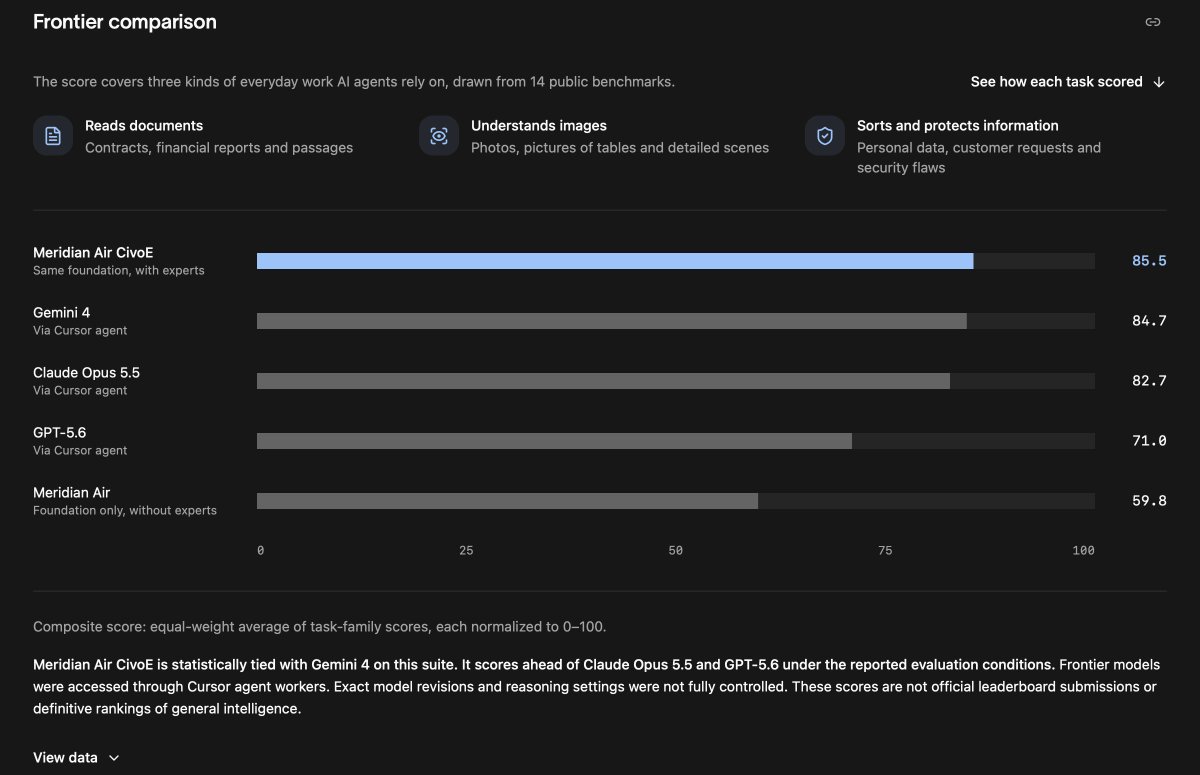
Today, we're announcing webAI Meridian-1 CivOE.
A 12B AI model that statistically matched Gemini 4 Argon and outperformed Claude Opus 5.5 in evaluation.
But the most important breakthrough isn't the benchmark.
It's how we achieved it.
Instead of endlessly scaling model size, we've built intelligence that adapts to the work through specialized experts.
Our results:
Meridian-1 CivOE: 85.5
Gemini 4: 84.7
Claude Opus 5.5: 82.7
GPT-5.6: 71.0
The same 12B foundation went from 59.8 to 85.5 through specialization. A 25.7-point improvement without making the foundation model larger.
We believe this represents a fundamental shift in how intelligence will evolve.
Just as software became personal, customizable, and accessible on everyday computers, intelligence is heading in the same direction.
Intelligence that adapts to your knowledge, your work, and your devices.
We're beginning the rollout of Meridian-1 CivOE with strategic partners over the next few weeks, before expanding access to all webAI users.
The future of intelligence isn't just bigger.
It's yours.
Read More: https://t.co/jPDLnkXKgA
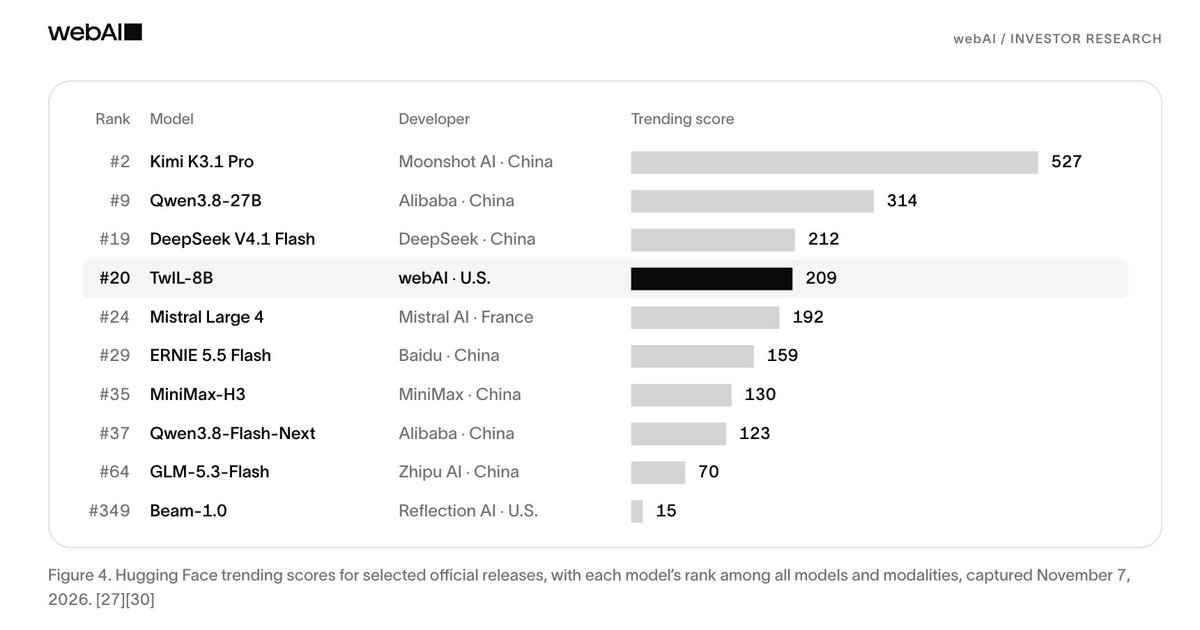
Thank you all for the incredible support. TwiL-8B hit #24 of 433,863 text generation models on Hugging Face in its first 7 hours.
We have more to share, and it’s worth waiting for. Tomorrow morning we’re releasing one more model, our best yet, and opening general access to webAI.
See you in the morning.
Release 2 of 4 today: webAI Air.
73% smaller. Nearly 99% of measured benchmark performance retained.
Air is our method for compressing AI models so more capable intelligence can run on everyday devices.
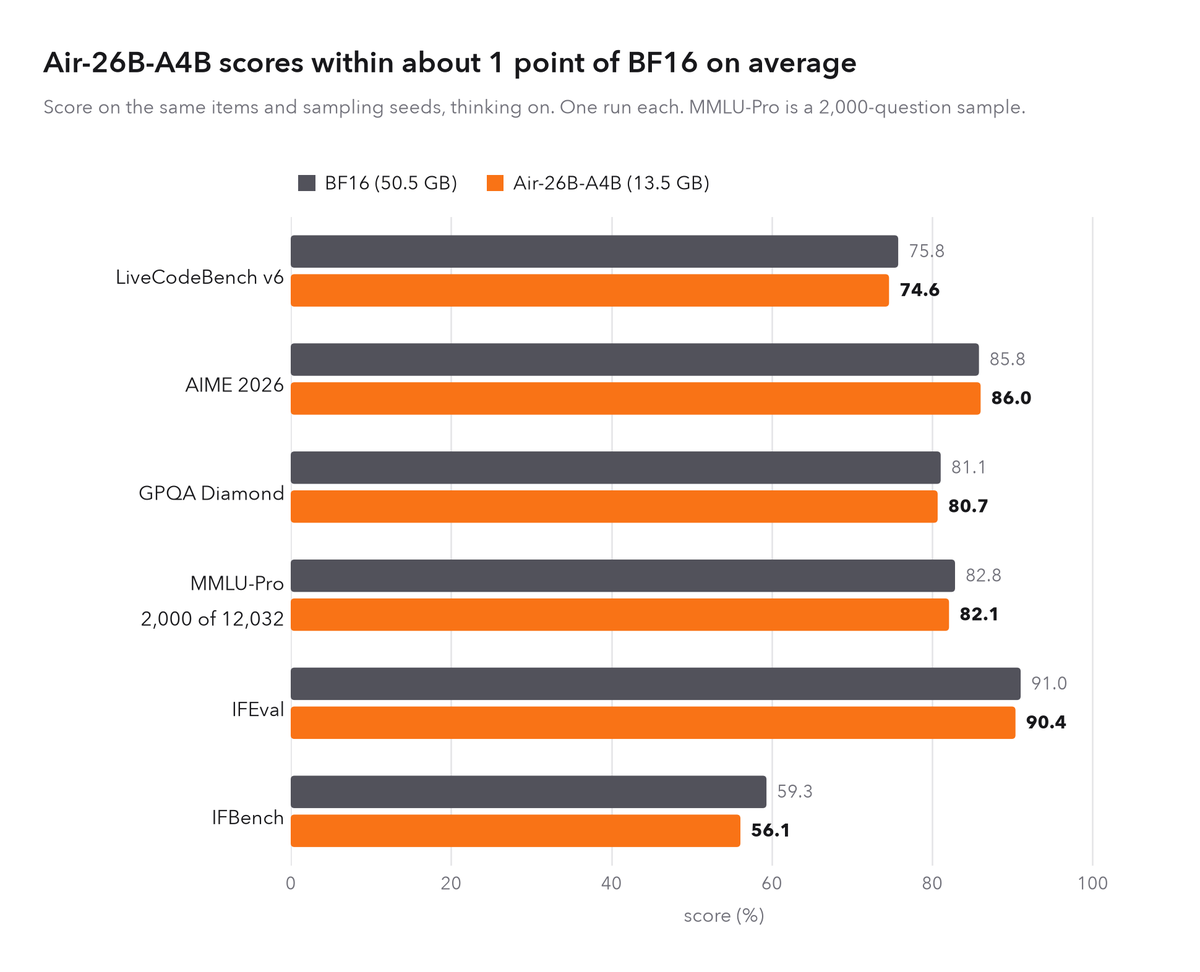
Our first release applies Air to Google’s Gemma 4 26B A4B. Compared with the original model:
* 73% smaller model file: 50.5 GB → 13.47 GB.
* 98.7% of the average benchmark score retained: 78.3 versus 79.3 across six benchmarks.
* 2.1× the generation speed: 60.6 versus 28.7 tokens per second in our DGX Spark tests.
Compared with Google’s own 4-bit version, Air is also 6.7% smaller, with 61% lower divergence from the original model’s predictions in our evaluation.
Useful intelligence is becoming smaller, faster, and easier to put to work. That changes the economics of AI and puts more of it on hardware people already own.
Make cloud AI optional.
Two more releases coming today.
@thewebAI's Intelligence Lab is open sourcing Gemma 26b 4a Air
2.6× closer to full precision
Significantly more faithful to the original model than Google's official 4-bit release (KL divergence: 0.068 vs. 0.176).
Nearly 4× smaller
Just 13.5 GB vs. 50.5 GB, with the full 128K context fitting in 16 GB of memory.
Almost no loss in intelligence
Scores 78.3 vs. 79.3 across 6 benchmarks, retaining 99.4% of original performance on knowledge, math, and coding.
Matches the original on real-world tasks
Nearly identical wIL scores (Track A: 0.502 vs. 0.508; Track B: 0.812 vs. 0.812).
HF: https://t.co/SsQ0AW1Idy
Modest intelligence is arriving faster than most people realize.
Today, we're open-sourcing TwIL-8B.
Just 8.8 billion parameters, yet approaching frontier-model scores on several difficult benchmarks:
• 93% of frontier performance on coding
• 92% on instruction following
�� 90% on contest mathematics
All from a model small enough to run on your own hardware.
But the benchmarks aren't the most important part of this announcement.
For years, the AI industry has focused on building the most capable model, regardless of the cost required to run it.
I believe that equation is changing.
The next era of AI will be defined by the cost of completing work. Not simply the intelligence of the model, but how efficiently that intelligence can accomplish the task.
If a model with 8 billion parameters can reliably complete the same work as one with hundreds of billions, why pay for the larger model?
As smaller models become more capable, intelligence becomes something we can distribute, specialize, and run across the hardware we already own.
That's the future we're building at @thewebAI
TwIL-8B is available today. Open weights.
And this is just the first of several announcements we're making today.
HF Link: https://t.co/3lrTfeLaeI
Your car sits parked most of the day. That doesn’t mean a taxi company should own it.
The same applies to AI.
Ownership buys autonomy, availability, and control.
Calling that “inefficient” is convenient when your business depends on selling access.