A New Model for Intelligence.
The next era of AI won't come from a single system in the cloud, but from a civilization of models owned by the people closest to the problem.
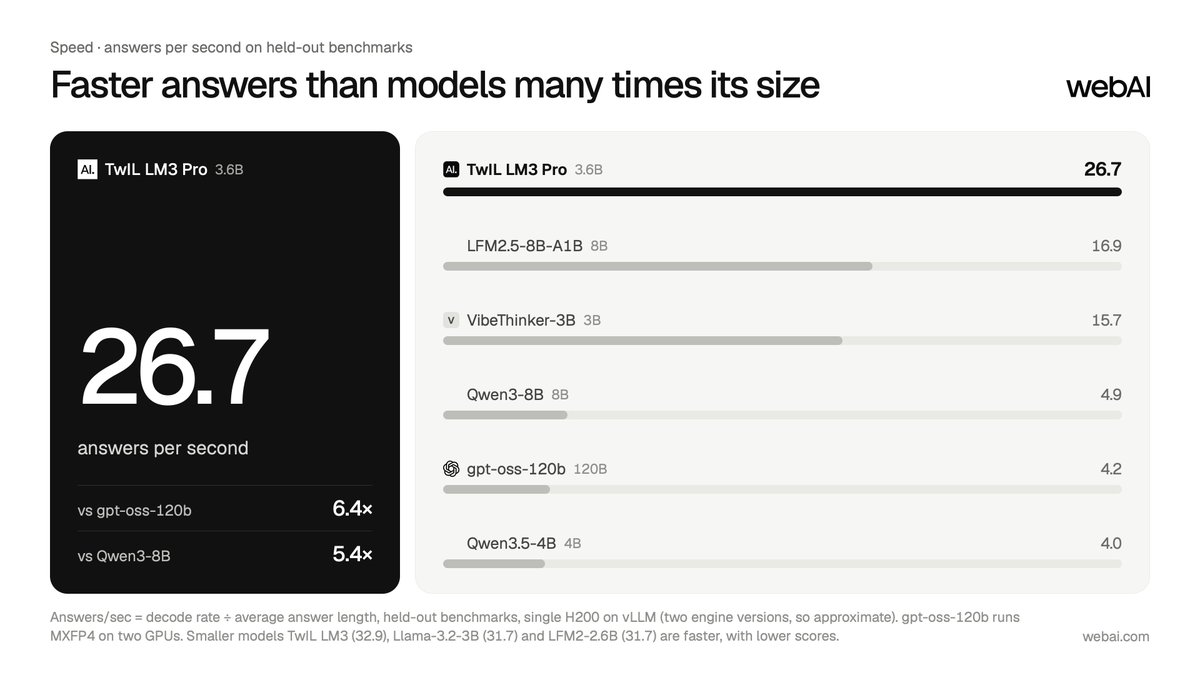
LLMs are getting more rambly. We built TwIL-LM3-Pro to go the other way.
Less than half the tokens of VibeThinker-3B and Qwen3-8B. 1.7x and 5.4x faster answers on general reasoning benchmarks.
Full benchmarks: https://t.co/dr1LDchxMr
Half a million downloads in a month. Today, our open source family takes another step forward.
Thank you for the incredible support behind our first-generation models. We’re excited to introduce TwIL-LM3-Pro.
At just 3.6 billion parameters, it brings powerful reasoning to everyday computers, with quantized builds that run locally. No cloud required.
In our evaluation:
Formal logic: Highest recorded headline score among the small models compared—beating China’s VibeThinker-3B by 35% and Qwen3.5-4B by 24%, and Liquid AI’s LFM2.5-8B-A1B by 47%.
Broader reasoning: 95% on SVAMP and 64.1% on MuSR, the highest recorded scores among the small models compared.
BIG-Bench Hard’s logic subset: 95.4%, compared with VibeThinker-3B’s 61.1%.
We believe AI is entering a post-training era. The advantage will increasingly belong to companies with the best pipelines and those that can produce capable, personalized intelligence faster and more efficiently, then put it on devices people already own.
That’s what we’re building at webAI. And we’re only beginning to share what’s coming out of our lab.
Coming soon: Meridian, our family of frontier-class models built to run on device. Our most advanced models will be available through the @thewebAI application.
Join the waitlist as we expand access. Proudly built in Austin, Texas. 🇺🇸
Jason Rathje, President of Public Sector at @thewebAI, discusses U.S. China AI competition, open source models, national security and the need to build resilient American AI supply chains.
$NVDA $AMD $AVGO $INTC $TSM
@MorganLBrennan
https://t.co/4Xe7pIbHWs
"A general model is only the beginning. Individuals and organizations need intelligence deeply specialized to them." — @Davidstout
Today we're partnering with Forge to bring private, specialized AI to enterprise customers.
Read the announcement: https://t.co/LF6VmYEua5
"More AI is not synonymous with more data centers."
@Davidstout, our CEO, in a new op-ed for the @dcexaminer on why the trillion-dollar AI data center build-out is a bet on the wrong future.
The future of AI is smaller, specialized, and local.
Read the full piece: https://t.co/CZ8cxlpnpN
"Many open models can now be powered by a phone or laptop. That has made the technology more accessible and even cheaper. Leading closed models are getting more complicated and requiring more computing power."
@Davidstout, our CEO, in a new @nytimes piece by @elitanjourno.
Open, small, and specialized is where AI is going.
Read the full piece: https://t.co/NQZNI4cl1W
I think the answer is not to slow down. It’s to invest in approaches our adversaries cannot easily replicate and cannot fully embrace without changing how they exercise power.
The frontier labs have built a paradigm around increasingly powerful centralized models and enormous concentrations of compute. My concern is that we’ve defined the competition around a playbook our adversaries can follow, rather than an advantage they will struggle to reproduce.
At @thewebAI we’ve been working toward a civilization of intelligence: distributed, specialized intelligence grounded in the specific, tacit knowledge of people, teams, and institutions. Our Intelligence Delivery Network is part of what connects that intelligence without requiring all knowledge and control to be centralized.
The distinction is not just distributing compute. It’s distributing the ability to understand, decide, and act.
Our strength is trusting people throughout the chain of command to exercise judgment not simply follow instructions. That principle of trust and decentralized execution is already foundational to our military doctrine. We should build intelligence that amplifies it.
Our bet is that this creates a fundamental dilemma for adversaries whose power depends on centralized control. They can pursue the same technology. But realizing its full value means empowering people and institutions to act without every decision flowing through the center.
That is much harder to replicate than a model. Copying the technology does not recreate the accumulated knowledge, relationships, and trust that make the system valuable.
We should not slow down to preserve a lead in a paradigm others can copy. We should invest in one that turns our greatest strengths into an enduring advantage.
On the 25th anniversary of September 11, we remember the nearly 3,000 lives lost, the families who still carry that day with them, and the heroes who ran toward danger to help others.
We're grateful to all those who have defended our country and freedoms, then and now.
We will always remember.
The most valuable AI company won’t be built around a single model. It will be built around the system that can create the next thousand.
The physical world won’t run on one giant model in the cloud. It will run on small, specialized models deployed everywhere.
At @thewebAI, that system is now producing N expert reasoning models every week and accelerating.
Meridian is next.
Introducing webAI Frontline.
Server-class AI. Running on a single iPad.
Every technical industry runs on documents nobody can actually search. Manuals, procedures, regulations that go thousands of pages deep. Frontline turns them into an expert you can talk to. Ask a question and get the answer, cited to the exact page it came from. Fully offline, running on the device in your hand.
AI that works where the work happens.
Explore Frontline: https://t.co/PGK2ouVftB
TwIL-LM3 has been downloaded nearly 80,000 times since we released it.
TwIL-LM3 judges reasoning. Give it a chain of logic and it can tell you whether the conclusion follows and the proof steps hold up, then explain in plain English. Specialist models like this usually run in the background. TwIL-LM3 can work directly with people while still handling the formal reasoning underneath.
Here's where developers, researchers, and teams are using it:
Judgment tasks — deciding whether a logical claim or proof step actually holds up rather than just sounding convincing.
Mixed products — anywhere the same interface needs to answer everyday questions AND handle formal reasoning without switching models.
Explanations — turning the output of a solver or formal reasoner into something a person can understand.
TwIL-LM3 doesn't replace a real verifier for safety-critical work, but for everything else it gives you a checkable answer.
It's fast, concise, and runs on your device.
Get the model on @huggingface: https://t.co/U7H7M0gkun
Big step for open multimodal retrieval:
webAI’s ColVec1.1 models are now natively supported in @huggingface Sentence Transformers.
Developers can load our 4B and 8B models directly through the new MultiVectorEncoder interface to search visual documents, images, PDFs, charts, tables, and complex layouts without relying on OCR-first pipelines.
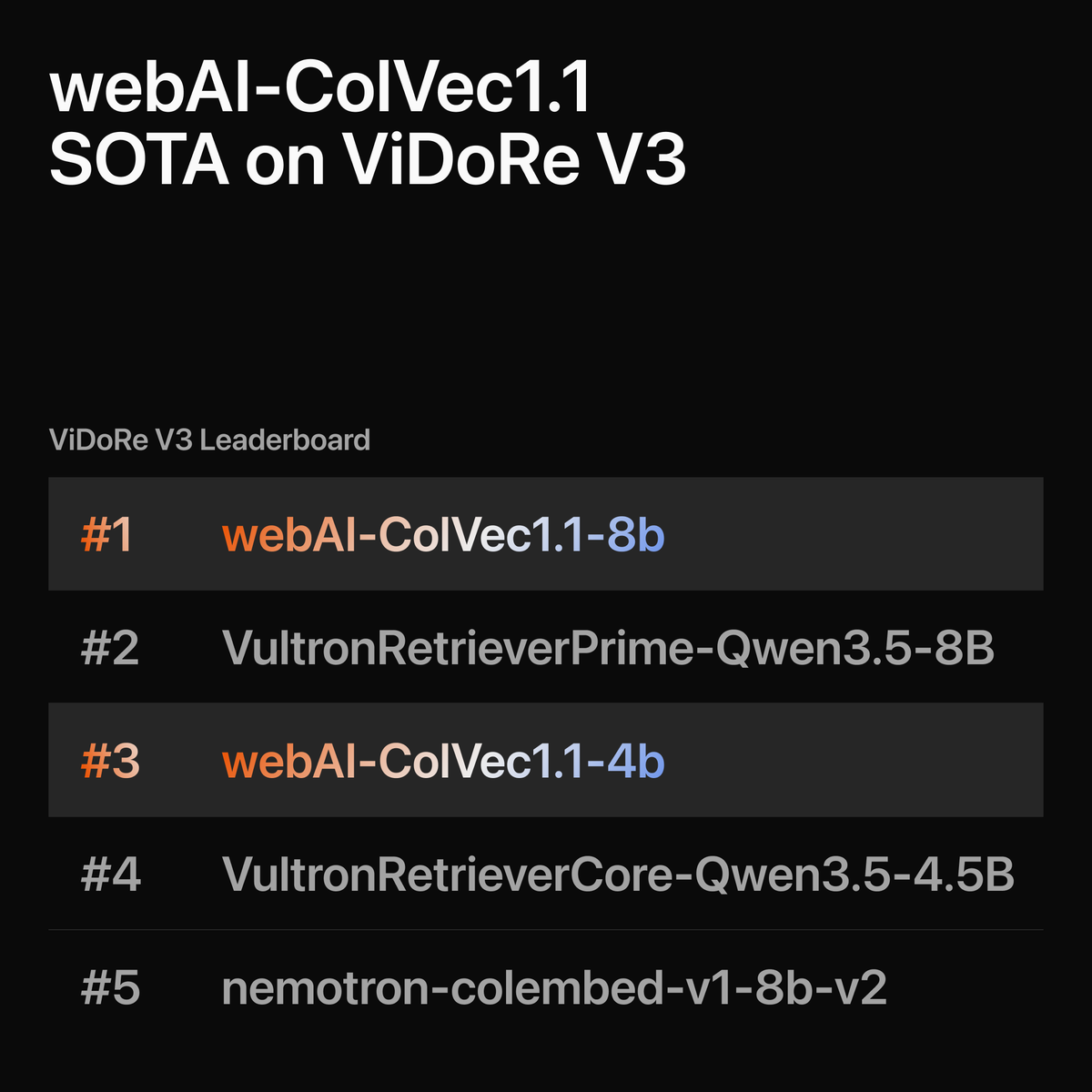
The 8B model currently leads ViDoRe V3, while the 4B model delivers the best published result in its size class.
State-of-the-art retrieval, now accessible through one of the most widely used embedding libraries in AI.
Huge thanks to the @huggingface and @tomaarsen and the Sentence Transformers teams for helping bring multi-vector retrieval into the broader ecosystem.
Available now.
General intelligence is a commodity. Expert Intelligence is scarce.
@thewebAI TwIL-LM3 crossed 60K downloads already—and it’s still climbing.
A pure formal-logic reasoning model is trending on @huggingface in a week when @Alibaba_Qwen, @AIatMeta, @nvidia , and others are releasing new models.
The demand continues to enforce our thesis: the future isn’t one giant model.
It’s networks of specialized models, collaborating at the edge. A web of AI.
TwIL is just one expert. More soon.
Hugging Face: https://t.co/sd6sGRHupZ
Episode 6 of The Block.
This week we're walking with Yash Sinha, Forward Deployed Engineer at webAI.
We talked about his work on the webAI app and client rollouts, plus why he's excited about foundation models used beyond language. Then even more caffeine at Fleet Coffee. ☕
Huge congratulations to Jason Rathje, President of our Public Sector team, for being named to the @Forbes 250 Most Successful Living Veterans list. 🎖️
See the full list: https://t.co/gK0gZf1yb3
Today, we’re excited to open-source TwiL-LM3, the first formal reasoning model from the webAI Intelligence Lab.
At just 3 billion parameters, TwiL-LM3 outperforms OpenAI’s GPT-OSS-120B on 4 of 5 formal reasoning benchmarks while running efficiently on consumer hardware. That’s 40× fewer parameters, 2.6× faster inference, and state-of-the-art performance in the reasoning tasks that power reliable tool calling, code generation, structured outputs, and AI agents.
TwiL-LM3 was trained using webAI’s proprietary reasoning pipeline on webAI-owned, verified datasets—not scraped internet data. We believe better reasoning comes from better training pipelines and higher-quality data, not simply larger models. Our approach demonstrates that efficient models can rival—and in many cases surpass—models dozens of times their size.
Designed for the edge, TwiL-LM3 runs on hardware people already own—from a Raspberry Pi to an iPhone—bringing advanced reasoning to millions of devices without relying on the cloud.
This is our first open-source release from the webAI Intelligence Lab, and it’s only the beginning.
Proudly built in Austin, Texas.
Article: https://t.co/ESW3D89xNX
webAI-ColVec1.1 is here.
New SOTA on ViDoRe V3. 75% smaller embeddings. 4x less compute per query. OCR-free visual document retrieval.
Multi-vector late interaction over rendered pages preserves tables, figures, and layout signals that single-vector embeddings destroy.
Full breakdown + models: https://t.co/0no6IBxzqj