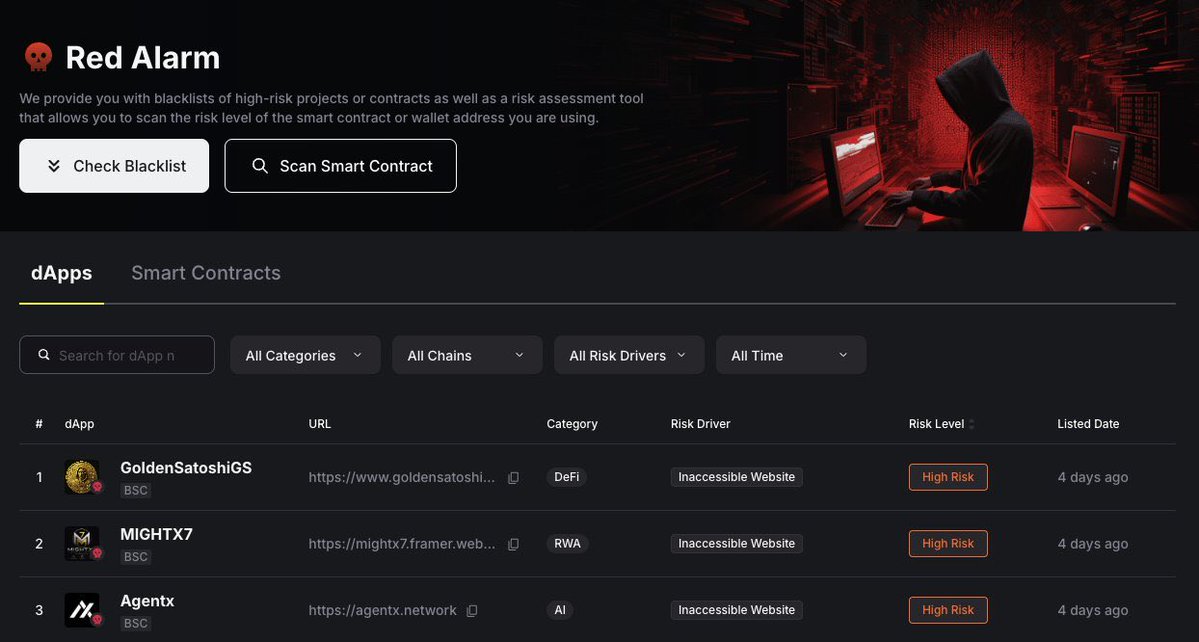
No one talks about how amazing DappBay’s Red Alarm is, because it saves you so much time when researching any dApp on BNB Chain
Been a great tool for me whenever I wanna make use of a dApp
It’s simple, head over to https://t.co/GXK8wXF7Ct, check for the dApp name and you get a risk assessment on it
It even shows the risk driver, like inaccessible website, so you know why something is flagged and not just that it is
Makes me wonder if @cz_binance has ever used this before 👀
Pretty amazing tool too @BNBCHAIN
there’s more to @zhao_cai_mao_ than meets the eye
what makes it interesting is that they’ve tied the meme to something tangible, with XAUT rewards already being distributed to holders
21.94 XAUT has gone out so far, and the cat is getting more eyes around BNB too
not a bad story for a meme
Okay so Binance's hot wallets lost a big chunk of funds Thursday evening
The way it went down is worth knowing.
Between 8:24 and 9:04 PM UTC, billions in ETH, USDT and USDC moved out to brand new addresses, and the funds got pushed onward within minutes of landing.
The first transfer was reportedly funded through Tornado Cash, which is a mixer built to hide where money came from.
Once that was flagged, Tether and Circle moved fast and froze more than $1.5B combined, which is the main reason a chunk of this is recoverable.
CZ said it looks like a hack, and Binance has only confirmed it's investigating.
So the full picture isn't out yet, but the pieces we have are clear enough.
Binance says user funds are completely safe, and CZ says he expects everything to be fully covered, so nothing to fret over right now ✦
halloween is all about tricks and treats, but the lucky cat has its own way of spreading good fortune
saw Zhao Cai Mao cross 5,500 holders on FOMO, alongside the launch of its official Chinese Telegram.
always nice seeing a community grow beyond the timeline.
@zhao_cai_mao_ 🎃
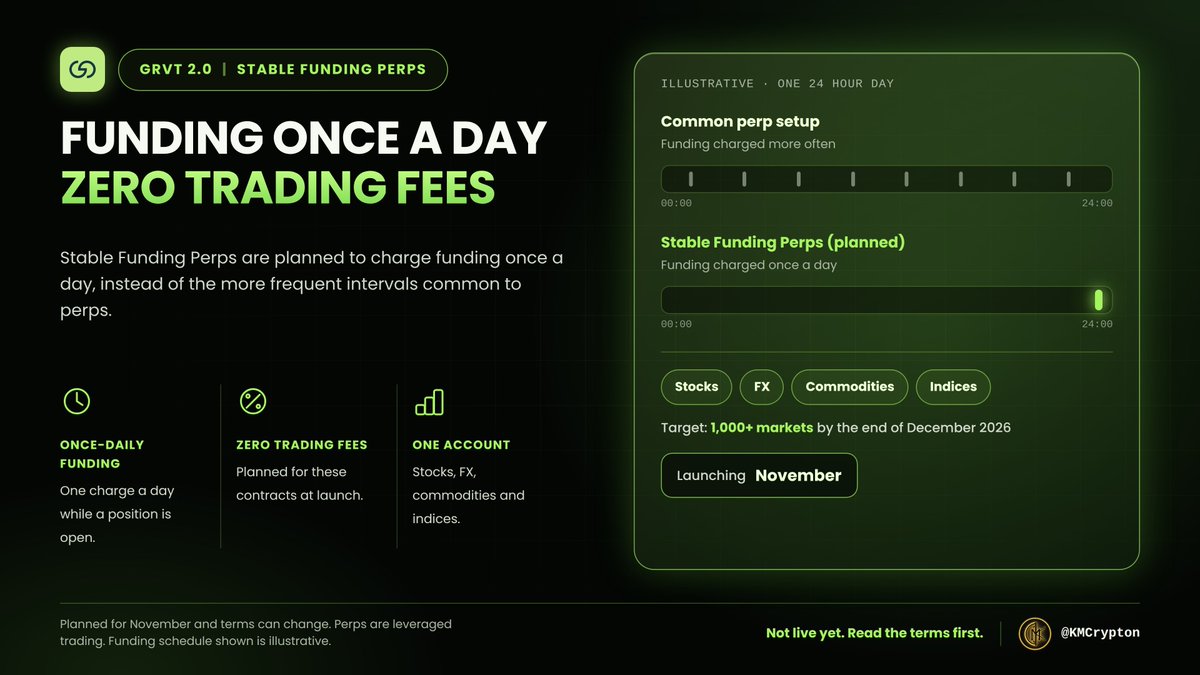
When it comes to perps, most people check the trading fee before opening a position, but the cost that can keep building after that is funding, cause it runs the whole time the position stays open.
On a lot of perp platforms it gets charged more often than once a day, so holding a trade keeps adding up in small pieces and it’s hard to keep track of.
@grvt_io is planning Stable Funding Perps with it charged once a day instead, along with zero trading fees, so what it costs to hold should be easier to see and plan around.
And it covers stocks, FX, commodities and indices from one account, with a target of more than 1,000 markets by the end of December, so it’s a different kind of perp product from the crypto only ones most of us are used to.
I’m not saying it’s less risky, cause perps are still leveraged trading and the terms can still change, and it’s planned for November so none of it is live yet.
But of everything on the Grvt 2.0 roadmap, this is the one I’m most keen to try, cause a cost you can plan around is something traders can actually work with ✦
There’s something about idle money in a trading account that never gets talked about enough, cause nobody sees it as a loss.
It just sits there waiting for the next setup, usually earning nothing, and we call it being ready.
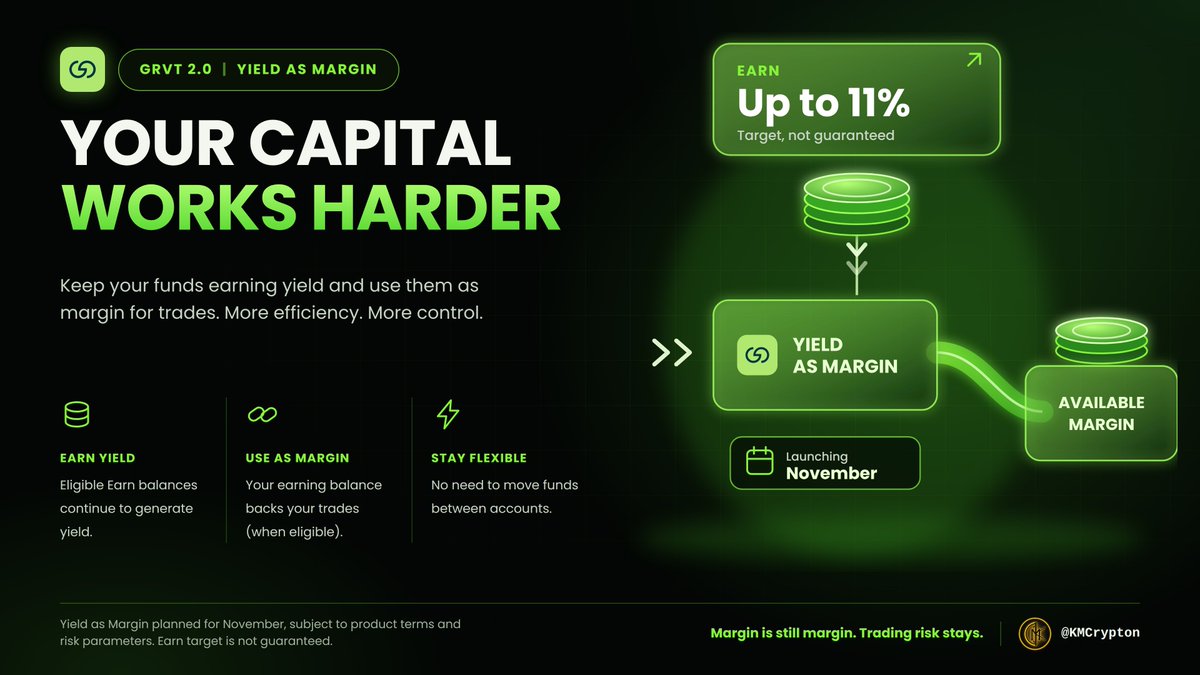
And that’s the part of @grvt_io’s 2.0 plan I keep coming back to, because it’s less about the yield number and more about the choice.
On most platforms you either keep funds in savings and pull them out to trade, or keep them in the trading account and stay ready while they earn nothing.
Yield as Margin, planned for November, is aimed right at that gap, where eligible Earn balances can back your trades while they keep earning.
But margin is still margin, so trading risk is still on the table, and yield doesn’t cancel out a bad trade.
Earn itself is planned for late October with a target of up to 11%, and it’s a target, not a guarantee, so I’ll be reading the terms and checking who supplies the assets when the partners get introduced at launch.
Honestly what makes this worth watching to me is that it goes after a real habit problem, as long as the risk stays clear to the person using it.
So I’m watching how it actually ships ✦
So I spent some time tracing the @grvt_io burn on Etherscan and honestly it checks out, 1.1M GRVT went to the zero address through the burn function.
And those tokens were bought on the open market first, close to 1% of circulating supply at the time, although that's of what's circulating, against the full 1B supply cap it's about 0.11%, so it's a solid first step.
The burn itself happened on Oct 19 at 2:14 PM UTC, in one Ethereum transaction anyone can open.
And that's where burn versus treasury matters to me, cause tokens sitting in a treasury can still be sold or spent later, but burned tokens are gone, and Grvt says nobody can recover them, not even Grvt.
Bitcoin kept the whole fixed supply culture alive with 21M and no more, and GRVT has its own hard cap of 1 billion with no inflation planned beyond it, so a burn only moves supply one way.
It's the first of five announcements leading to Grvt 2.0 by the end of November, and future buybacks are intended monthly, at the issuer's discretion, so I'm just watching how the next rounds show up ✦
To verify the burn yourself, visit: https://t.co/By6eO8oaQf
Token buybacks are completely meaningless if your protocol generates zero actual revenue
Pyth tripling its open-market buyback allocation from 33% to 100% works because oracle revenue is actually scaling
When real institutional data demand backs the tokenomics, you don't need token emissions to create a narrative
🎙️Ft. @mdomcahill@PythNetwork
So the Ledger situation raises a bigger question than the $86M + estimated onchain, although other tallies range from $72M to $93M, so it really depends on who's counting
And what we know is that Ledger is investigating reports from users who bought through CryptoBilis, a listed reseller, but the attack vector is still unknown as of now
There are reports of a possible hardware implant, but there's no confirmed forensic link between that theory and the wallet drains, so for now it's just a theory
And the thing is, onchain tracking only tells us where the funds moved and not how the attacker got access in the first place
Now if you use a hardware wallet, here's a few things worth checking
✦ Buy directly from the manufacturer, since even a listed reseller isn't a guarantee, and verify the seller on your own
✦ Never enter your recovery phrase into a website, app or form claiming to verify or secure your wallet
✦ If a device or its setup seems suspicious, don't put funds on it until official support has verified it
✦ If you think your recovery phrase is exposed, move your funds to addresses generated from a genuinely new phrase on a device you trust, cause restoring the old phrase on another device doesn't invalidate it
Ledger has advised buyers from CryptoBilis in the last 90 days not to set up their devices if they haven't yet, and for anyone who already did, it says to consider moving assets to a new device with a newly generated recovery phrase
And honestly the bigger lesson is that a hardware wallet protects your keys, but it can't automatically protect you from a compromised setup process or an exposed recovery phrase
So the important question is still unanswered, how did the attacker get access?
Most Web3 projects run on a broken model where equity holders and token holders are playing two completely different games
If the team and early investors can exit through equity growth without driving real value back to the token, the community loses every single time
Building infrastructure that actually lasts means removing that friction and aligning incentives from day one
🎙️@chesus Ft. @KenDicross@WireNetwork
Every trader has had that one trade where price wicked straight into their stop and then ran exactly the way they called it, and after a few of those you start wondering who else can see where your stops are sitting
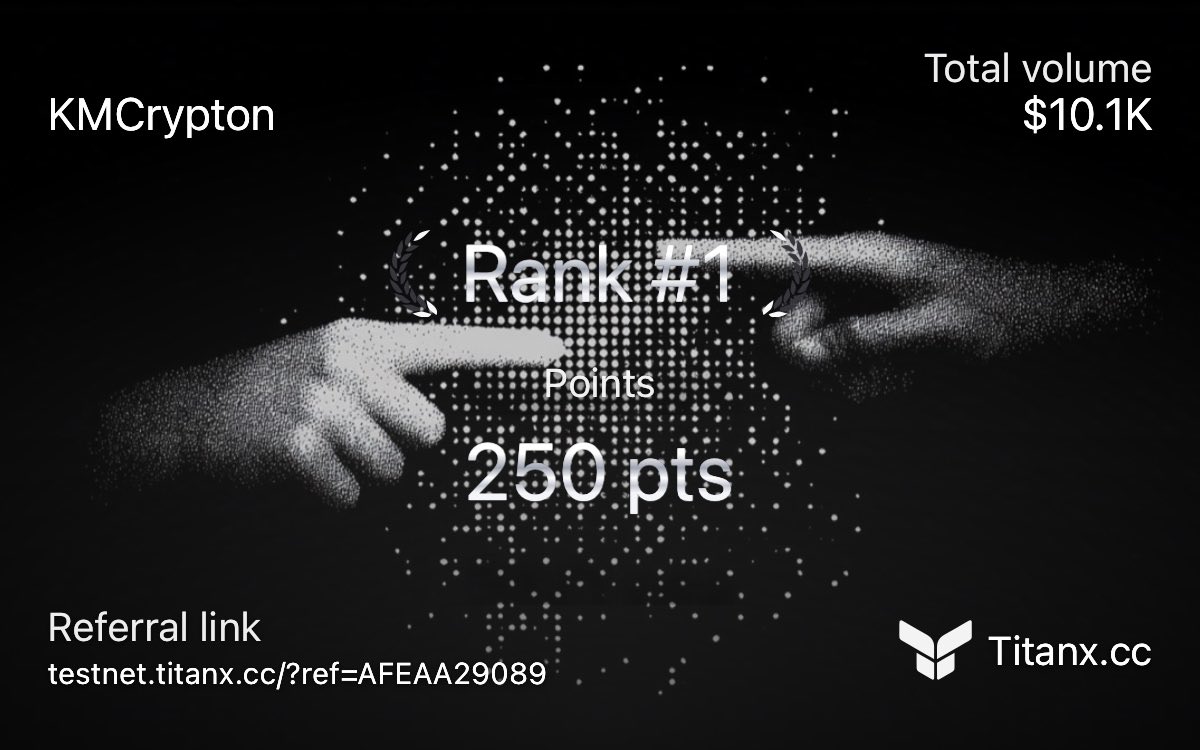
So that's why I jumped on the @TitanExchange_ testnet, a privacy exchange built on Canton, where no one else can see your positions
I placed some trades already and earning points, so I'm really excited for this one
Still early on the testnet so there's room to jump in and test it yourself: https://t.co/CSLjx3C9mn ✦
People only chose centralized exchanges because the decentralized alternatives couldn't compete on user experience
When decentralized infrastructure achieves UX parity, no one deliberately chooses the system where someone else holds the keys to their money
Self-custody and real authority over your assets win every single time the friction disappears
🎙️@chesus Ft. @KenDicross@WireNetwork
This week the QVPN Mini App dropped a 2X Booster for all users and I actually caught it while it was live.
The way it works is simple. When the Booster is active it doubles your mining output for that window. So instead of your normal daily $SHHH you’re getting 2x the amount just for mining during that period. No extra steps, just mine with the Booster and the multiplier applies automatically.
Combined with the Quantum Firewall game, which has you neutralizing noise packets to harden your shield and unlock daily rewards, the earning layers are actually starting to stack up. Sitting at 360 $SHHH lifetime now and the Booster events are what push those numbers faster.
What keeps me interested is the foundation under all of this. @QVPN_x is built on @diamante_io’s quantum resistant infrastructure, so the VPN you’re mining toward isn’t just another privacy tool. It’s built for threats most VPNs aren’t even thinking about yet.
Genesis Access still has spots open. Early users lock in the highest multipliers permanently, and premium VPN access is free at launch.
Genesis spots are still open but they won’t be for long. Get in here: https://t.co/QSkNmiyjjX
Most people still think BNB chains AI agent thing is just some stat they saw once and forgot
But the part that’s actually wild is these agents on BNB aren’t just bots running scripts in the background anymore
They got actual onchain identity now and reputation attached to them. Also, agents can be bought, sold, or hired like actual assets now. That’s the kind of agent economy just happening live on chain right now.
It’s a standard BNB built called BAP-578, and it stacks on top of ERC-8004 which is the identity layer Ethereum foundation made. So basically an agent isn’t just a wallet anymore, it’s tradeable and upgradeable, like it’s got its own track record you can actually go verify.
And the growth part is what nobody’s really talking about. Went from like 340 agents back in January to over 150k by April, and that’s not normal growth, that’s a 43,750% jump in like 3 months which is insane if you sit with it.
So while everyone has been staring at price charts, this has been quietly building up the whole time, and agent-driven trading hit $18m in a single day at its peak, and transactions crossed 500k+ in a day too.
Kinda one of those things you’re gonna look back on and go, how did I miss that?
@BNBCHAIN@cz_binance