India should not be content with being one of the world's largest football audiences. We must become a football nation. The goal should be clear: India must aim to qualify for the FIFA World Cup by 2034. This should be a national mission built on systems, talent and execution.
One BIG reform the govt can do without spending a rupee is starting appraisal system of bureaucrats like private organisations with KPI score & rating:
1 to 5 ( 1 outstanding , 5 poor) or A to D
And publish it on govt portal.
bureaucracy needs a major shift in mindset.
Every Indian should know what India got from this Indonesia visit. Especially the people who joke about the PM's foreign trips. :)
I read the full list of outcomes this morning. This is one of the biggest visits we've made to Southeast Asia in years.
Let me explain.
First, why Indonesia matters at all.
Indonesia is the fourth biggest country in the world by population. Around 28 crore people. It has the largest economy in ASEAN. It's the largest Muslim-majority country on earth. And it sits right on top of the busiest shipping lane in Asia.
Basically, if India wants to matter in Asia, we need Indonesia as a friend.
Now, what got signed.
One. Indonesia is buying Indian missiles.
They're importing our Astra air-to-air missiles. These are the missiles that performed well in Operation Sindoor. They're also adding more BrahMos batteries to their military.
For most of my life, India was known as the world's biggest buyer of weapons. We only imported. Now another big country is buying missiles made in India because they saw them work. That's a huge change in direction.
Two. India is investing in Indonesia's minerals.
Indonesia produces about half the world's nickel. Nickel goes inside every electric vehicle battery. Right now, Chinese companies control most of the nickel processing there.
India will now invest in nickel, steel and rare earth magnet manufacturing inside Indonesia.
Why does this matter?
Last year China restricted the export of rare earth magnets. Within weeks, Indian car companies started panicking because their production depended on those magnets.
When one country and that too China controls a material everyone needs, it can squeeze you anytime.
This deal means India will have its own supply in the future.
Three. The port. This is the biggest one for me.
India and Indonesia will jointly develop Sabang port.
Open a map and look at where Sabang is. It sits at the entrance of the Strait of Malacca. This is a narrow sea passage through which a huge share of the world's trade passes.
Most of China's oil imports pass through it too. China has openly worried about this passage for 20 years.
Sabang is only about 100 miles from India's own Great Nicobar port project. So India will now have a presence at both ends of the entrance to the most important sea passage in Asia.
Four. A small deal that shows deep trust.
India will help Indonesia build its own EVMs, voting machines designed for Indonesia.
Think about that. Elections are the most sensitive thing in a democracy. A country only takes help with its voting machines from someone it trusts completely.
And finally, about the medal everyone is posting about.
The Bintang Adipurna is Indonesia's highest honour. It started in 1959. It's so senior that Indonesia's own President receives it when he takes office.
Foreign leaders get it very rarely.
And look at the full sequence of respect here.
Prabowo Ji came to Delhi as our Republic Day chief guest in January 2025.
Yesterday he personally went to the airport to receive Modi Ji.
Today he gave him Indonesia's highest honour. Modi Ji dedicated it to crores of Indians.
One more thing that I find beautiful.
Both leaders are visiting the Prambanan temple in Yogyakarta.
It's a 1,000-year-old Hindu temple complex where the Ramayana is still performed as a dance.
Indonesia's national airline is called Garuda.
Our two countries have been connected for over 2,000 years. This friendship has very old roots.
Now, a nickel plant takes years to build. A port takes ten years. A missile partnership takes decades to grow.
None of these things provide an immediate, exciting change. They determine India’s position in 2040, the cost of our EVs, the safety of our maritime trade, and which countries purchase our weapons.
People judge the PM's visit by two days of photos. By that logic every trip looks like tourism, because the real results show up ten years later.
The world's largest democracy and the world's largest Muslim-majority democracy just became much closer partners. That's 170 crore people building together.
Our kids will still be benefiting from what was signed this week, long after everyone forgets the photos. :)
@iRohanSachdeva Stage 1 can be done through Instagram/Facebook/Twitter posting of AI generation of this kind of imagery with Indian perspective. Great thinking ✌
Ten years from now, India may look back and ask: how did we lose an entire generation to screens?
Everywhere you look, people are scrolling. In buses, trains, cabs, offices, traffic signals, while eating, before sleeping, and the moment they wake up. Reels have become the background noise of our lives.
And the saddest part is our children.
Many kids today won’t eat without a phone in front of them. They cry for reels, laugh at shorts, and grow up staring at screens instead of people, books, nature, and real life. We are handing them addiction in the name of entertainment.
AI is making this even more dangerous. Algorithms know what we like, what we fear, what keeps us watching. AI-generated videos, fake influencers, deepfakes, and endless personalized content are slowly trapping people inside a world that never stops feeding them distraction.
This is not just entertainment anymore. This is stealing our attention, our peace, our thinking, and our future.
When a country’s children cannot focus, when its youth are lost in endless scrolling, and when adults are too tired and distracted to think deeply, how will that country grow?
Social media addiction is not a small issue. It is a silent epidemic. India must wake up before our minds become the price we pay for cheap data, endless reels, and uncontrolled AI.
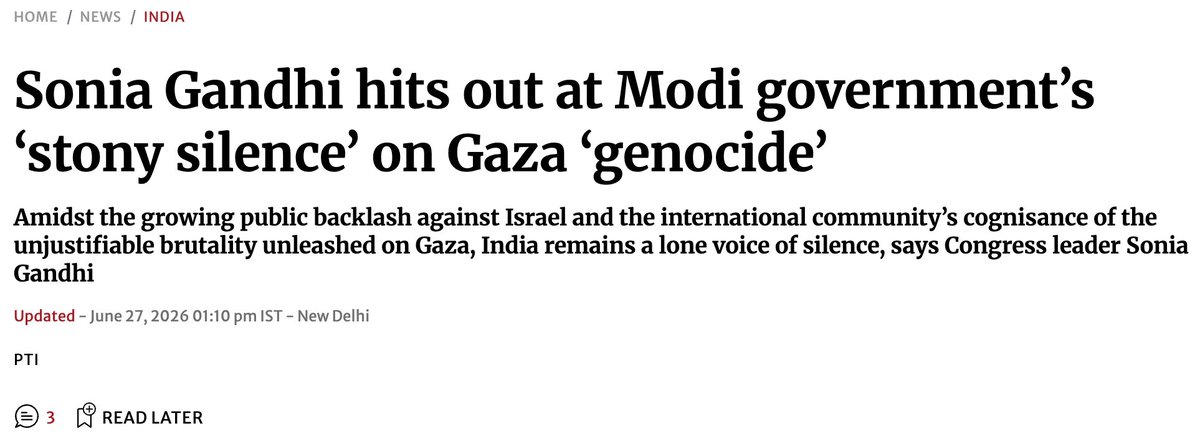
Sonia Gandhi has penned 3 opeds on Iran and Gaza.
She does not pen many OpEds.
Yet, 3 out of her last 7 OpEds have been dedicated to criticising the Indian Govt on Gaza and Iran for sentimental reasons
Not even related to Indian National Interests
It's just REEEEEing over 'Y u no feel sad for Gaza', 'Y u no cry over Khamenei' 'Y u no call it Gaza Genocide'
It's all just that.
This should be seen in the context of how strongly Congress leaders came out in defence of Muslim League politician Suhrawardy after West Bengal Govt changed the name of a road named after him.
There was no political mileage to be gained out of this but they did it anyway. In the same way that Sonia Gandhi's opeds won't help Rahul Gandhi win elections but she dit it anyway.
Why? Because the Congress party of today has ideologically transformed into the Muslim League.
Everything, including foreign policy and Indian interests in the domain of geopolitics, must be subordinated to the will of Muslim sentiments.
No wonder the Congress party is on a death spiral.
We built Delhi metro -271 stations with 8 million daily riders ( amongst top 10 globally) for just $8Bn
Our moon mission costed us just $75 Million
Built Largest biometric system in world for 1.4 Bn people -aadhar built with just $1bn
Worlds tallest railway bridge Chenab for $175 Mn
Codeveloped BrahMos missile-unique in the global arms market, combining a high top speed (Mach3)multi-platform launch versatility (air, ship, sub, land), and supersonic cruising, which sets it apart from both legacy subsonic cruise missiles and newer, more expensive hypersonic weapons for $4 million.
Our precision engineering, technology usage and frugality is unmatched.
Foreign media & brokerages claiming India has no technology, precision engineering play are biased and spreading propaganda…
The Geopolitics of the Guillotine: The True Reason India Was Partitioned
By @shreehistory
In the first installment of this investigation, the ledger of the empire was laid bare, revealing how Britain systematically extracted wealth from India across two world wars and defaulted on a £350 billion debt. Part Two of this story examines the physical and political mechanism used to guarantee that default would never be challenged. The retreat from the subcontinent was not a simple lowering of a flag. It was a meticulously calculated geopolitical guillotine, executed in two distinct stages, designed to permanently fracture the region and paralyze the newly independent state.
To prevent a unified, economically resurgent India from demanding reparations for the wartime extraction, Britain engaged in a strategy of systemic balkanization. This was achieved first by economically amputating Burma in 1937, and second, by lighting the political house on fire in 1947 through the abrupt creation of Pakistan, the deliberate fracturing of India into over five hundred independent sovereign entities, and the demographic weaponization of the military.
I. The First Cut: The Amputation of Burma (1937)
The blueprint for weakening the subcontinent began a decade before the famous partition of 1947. Throughout the early twentieth century, Burma was administered as a province of British India. This administrative union was highly beneficial to the broader Indian economy, because Burma was an economic powerhouse that consistently ran massive trade surpluses.
Burma was the rice bowl of the empire, exporting vast quantities of rice across the globe. It possessed massive, highly lucrative teak forests essential for imperial naval and railway construction. Most importantly, Burma held newly discovered and highly productive oil fields.
By the mid-1930s, Britain was beginning to panic over its balance of payments with India. The debts were accumulating, and the British Treasury realized that an India bolstered by Burmese exports could potentially offset its deficits and demand hard currency repayments. London needed to sever this economic shield.
In 1935, the British government passed the Government of India Act, which separated Burma from British India and granted it a distinct constitution as a separate crown colony, effective in 1937. While the British publicly framed this as a concession to Burmese nationalism, the underlying economic reality was far more cynical. By carving Burma out of India, Britain ensured that the lucrative revenues from Burmese rice, teak, and oil would no longer flow into the Indian balance of payments. Burma's export surpluses were redirected to settle British deficits directly with London. India was stripped of its primary economic buffer, leaving its balance of payments highly vulnerable to British manipulation.
Crucially, this territorial amputation should have been fiercely opposed by the Indian National Congress as an imperial division of the national inheritance. Instead, the INC played directly into the British design. Consumed with the pursuit of provincial autonomy within British India and willing to accept the British framing of Burmese nationalistic demands, the INC failed to mount a serious, unified political fight to keep Burma within the Indian union.
By accepting the first cut without a concerted fight, the INC allowed the first geopolitical domino to fall. This failure was not lost on the British establishment. The precedent was set. If the Indian leadership would passively accept the surgical amputation of a wealthy province, it emboldened London to believe they could execute a far more devastating division a decade later. The acceptance of Burma's separation signaled to the British that the territorial integrity of the subcontinent was entirely negotiable, paving the way for the second stage of the guillotine.
II. The Demographic Weaponization of the Military (1918-1945)
The physical enforcement of this division relied heavily on how Britain managed the Indian armed forces. For decades, the British military apparatus in India operated on a deeply sectarian "martial race" theory. The British systematically favored Muslims in the recruitment for the cavalry and the prestigious infantry regiments.
Prior to the massive wartime expansions, Muslims constituted the majority of the combatant ranks in the British Indian Army. This was a deliberate imperial design to keep the primary coercive arm of the state in the hands of a demographic minority that the British deemed politically reliable.
However, the sheer scale of human attrition required for the First and Second World Wars forced the British to drastically expand recruitment. Millions of Hindus were inducted into the army to fight in Europe, the Middle East, and Asia. This wartime necessity temporarily gave the Hindu soldiers a numerical majority within the ranks of the military.
To strip this newfound defensive advantage away, the British executed rapid and systematic disbandment of the army the moment the wars concluded. They did this suddenly once the First World War ended in 1918, and they repeated the exact same maneuver after the Second World War ended in 1945. By rapidly demobilizing the troops, the British deliberately removed the numerical advantage the Hindu soldiers had gained, ensuring they would not possess the organizational mass to defend their homeland in the event of a post-colonial conflict.
Meanwhile, the British ensured the officer class within the remaining Indian regiments remained disproportionately Muslim and heavily energized along religious lines. This was by design. When the partition occurred, these religiously motivated military elements formed the vanguard of the attack on India, specifically leading the tribal and military invasion of the Kashmir valley. As I have written about elsewhere, it was only through the fierce defensive leadership of the Kodandera family heirs, notably General K.M. Cariappa, that Kashmir was saved from slipping away into the hands of this British-engineered assault.
III. The 565 Kingdoms Problem: Legal Balkanization (1947)
With the military artificially balanced to favor a future conflict, Britain turned to the legal balkanization of the state. For over a century, the British Raj had governed through a dual system. There was British India, directly administered by the Crown, and there were the Princely States, over five hundred sixty-five semi-autonomous kingdoms ruled by local monarchs under the suzerainty of the British Crown.
When the British parliament passed the Indian Independence Act of 1947, it contained a devastating legal mechanism. It declared that British paramountcy over the Princely States would simply lapse upon the transfer of power.
This meant that the five hundred sixty-five princely states legally became fully sovereign, independent nations on August 15, 1947. The British offered no mechanism for their integration, drew no boundaries for them, and provided no legal framework to force them to join either India or Pakistan.
Britain deliberately left India not as one unified country, but as a chaotic archipelago of over five hundred independent sovereign entities scattered across the map, interspersed with the directly governed provinces. The legal reality was a balkanized nightmare. India was envisaged as a fractured, weak entity, doomed to spend years negotiating, coercing, and fighting to integrate these five hundred kingdoms.
IV. The Pakistan Experiment: A Geopolitical Counterweight
In stark contrast to the five hundred pieces India was left in, the Muslim League's demand for Pakistan was encouraged and structured as a single, cohesive geopolitical bloc, albeit divided into two wings.
The creation of Pakistan was the ultimate imperial insurance policy. A united, independent India would inevitably emerge as a major global power, capable of utilizing its vast population and resources to challenge British economic interests and demand the £350 billion in wartime reparations. By carving out a massive Islamic nation on India's western and eastern flanks, Britain created a permanent geopolitical counterweight.
The Pakistan experiment was designed to ensure the subcontinent would remain perpetually divided. It created a massive Islamic nation on the side, bound to compete with India for resources, territory, and strategic dominance. This rivalry would force India to divert massive portions of its newly independent budget away from economic development and debt recovery, and toward military defense on its new, long, and porous borders.
By keeping India and Pakistan in a state of permanent tension, Britain ensured that neither nation would ever possess the bandwidth or the unified diplomatic leverage to challenge the Treasury in London over the unpaid sterling balances. The balkanization of India into five hundred pieces was the immediate trap, and Pakistan was the long-term geopolitical cage.
V. The Ten-Month Acceleration: Leaving on the Boil
The final, most devastating element of this strategy was the timing of the exit. When Prime Minister Clement Attlee initially announced the British departure, the target date was June 1948. This timeline would have allowed the Indian leadership roughly a year to negotiate the integration of the five hundred princely states, establish administrative continuity, and conduct a proper financial audit of the wartime ledgers.
When Lord Louis Mountbatten arrived in March 1947, he abruptly advanced the date of independence by ten months, moving it to August 1947.
The official justification was the escalating communal violence in Bengal and Punjab. However, the strategic reality was that Britain wanted to leave while the country was on the boil. By accelerating the timeline by ten months, Mountbatten ensured that the Indian leadership would be handed a fractured, burning state with absolutely no time to prepare.
There was no time to negotiate the accession of the five hundred kingdoms peacefully. There was no time to properly divide the military, the civil service, or the physical assets of the treasury. There was no time to audit the £1.3 billion owed to India.
By advancing the date, Britain ensured that the announcement of the Radcliffe Line, which sliced through communities and provinces, would trigger immediate, unmanageable chaos. Millions of refugees were thrown onto the roads. The violence erupted precisely as the British were pulling out their final administrative personnel.
Britain did not stay to manage the fires they had lit. They deliberately left when the country was at the absolute peak of its boil, ensuring that the new Indian government would be entirely consumed by the sheer mechanics of survival.
VI. The Ultimate Victory: Resurgence of Truth
The two-stage partition of the subcontinent was a masterpiece of imperial geopolitical engineering. First, they amputated the economic shield of Burma to protect their balance of payments, a move unopposed by the INC. Then, they systematically dismantled the military's demographic balance to engineer a future conflict, legally shattered India into five hundred pieces, and carved out a massive Islamic counterweight in Pakistan. Finally, they accelerated the exit by ten months to ensure the powder keg exploded just as their ships left the harbor.
While the Indian leadership, led by Nehru and Patel, spent the critical years of 1947 and 1948 fighting to integrate the five hundred kingdoms, defending Kashmir from a British-energized military assault, and managing a massive refugee crisis, the British Treasury in London quietly finalized its default.
The geopolitical chaos was the perfect smokescreen. The strategy worked flawlessly in the short term. The country was broken into pieces, a massive rival was installed on its borders, and the unpaid wartime debt vanished into the fog of a British-engineered catastrophe.
Yet, the Mundaka Upanishad declares Satyameva Jayate, truth alone triumphs. This ancient civilizational aphorism becomes starkly evident when observing how India pulled herself together despite the labyrinth of malicious designs enacted by various imperial actors. Against the calculated arithmetic of default, the legal balkanization of five hundred kingdoms, and the violent trauma of an engineered partition, the subcontinent endured. The fires lit by the arsonists eventually burned out, but the foundation of the civilization remained.
To fully appreciate this resilience, Indians must reclaim and understand their history from their own viewpoint. For too long, the narrative of the subcontinent has been filtered through the ledgers and dispatches of the colonizer. Only by connecting these historical threads from an indigenous perspective can the modern generation recognize the profound civilizational values that have allowed them to thrive through centuries of extraction and orchestrated division.
The truth of this history is no longer a weapon for grievance, but a foundation for destiny. The era of merely surviving these geopolitical and financial assaults is finally over. Armed with the unvarnished truth of their own past, India has reached the threshold where it is no longer time to just survive. It is now time to thrive.
References and Further Reading
British Parliament. (1935). Government of India Act, 1935.
British Parliament. (1947). Indian Independence Act, 1947.
Cariappa, K. M. (1979). Indian Army: Some Memories and Reflections.
Jalal, A. (1994). The Sole Spokesman: Jinnah, the Muslim League and the Demand for Pakistan. Cambridge University Press.
Khan, Y. (2007). The Great Partition: The Making of India and Pakistan. Yale University Press.
Menon, V. P. (1956). The Integration of the Indian States. Orient Longman.
Myint-U, Thant. (2001). The Making of Modern Burma. Cambridge University Press.
Omissi, D. (1994). Indian Voices of the Great War: Soldiers' Letters, 1914-1918. Macmillan.
Tomlinson, B. R. (1979). The Political Economy of the Raj 1914-1947: The Economics of Decolonization in India. Macmillan.
All rights reserved. You must get written permission if you want to republish. Twitter/X users can share, repost, like, comment but please provide attribution to @shreehistory who did all this research.
Everyone working in Space tech must realise that this sector is one of few where India can truly win at a global scale. A country will need to spend decades of research work to match India. ISRO has already done that for India. Private companies must scale the ISRO legacy. US and China are ahead but the world will not solely rely on US (China is closed). India has a real shot at making global businesses in Space Tech. All the space companies must think global from day one.
Young people are entering a world with almost no aura left anywhere
There used to be aura everywhere: the New York Times, Harvard University, the Catholic Church, the Hollywood studio lot, Goldman Sachs, billionaires, the Pentagon, the United States Senate, the Peace Corps, the British Royal family, the trading floor. Places where you were a "made man" if you were on the inside and even on the outside made you feel a little special just to be in proximity to...
And even ignoring these big institutions, aura didn't need Latin mottos and mahogany desks and cufflinks, you could build aura by doing very normal things like being a teacher or accountant or a restaurant owner and living respectably in your neighborhood for 50 years and raising a family. You could have a local mythology. "She taught half this town how to read."
Now everybody's seen too much, nobody admires anyone anything, everything is "cringe," and the only way to have aura is to be hot on Instagram or become an astronaut
I feel bad for the youth
The 1978 Ranga-Billa case involved the brutal kidnapping and murder of teenage siblings Geeta and Sanjay Chopra in Delhi by career criminals Kuljeet Singh (Ranga) and Jasbir Singh (Billa).
The horrific crime shocked the nation, leading to a massive manhunt and the swift conviction of both killers, who were ultimately hanged in 1982.
The investigation was led by Inspector VP Gupta of the Delhi Police, with SI Ram Chander serving on the team. A bystander, who had tried to save the children, and later helped the police identify the killers by providing their descriptions was Babulal. The journalist who covered the case was Prabha Dutt.
Amazon Prime's series Raakh, which is based on this incident, replaces Inspector VP Gupta with SI Jayprakash Jatav, explicitly portrayed as a Dalit officer navigating institutional bias. Furthermore, SI Ram Chander is replaced by SI Javed Murtaza, Babulal by Saleem, and Prabha Dutt by Nisar, while a lazy hawaldar character named Mishra has been added to the narrative.
This isn't creative liberty. Creative liberty is meant to enhance a story, not distort historical facts to fit a specific ideological agenda. Another stark reminder of how easily history can be rewritten in plain sight under the convenient guise of creative freedom.
Emphasised that the Global South has immense expectations from the world. More than support, it seeks partnership.
We must move beyond the donor-recipient mindset and work as equal partners!
We must walk together and not merely alongside one another.
Partnerships must be linked to dignity, not dependency.
The truth is that FIFA is desperate to get India to play in the World Cup, has been for a while as we are literally the largest sports market with just a single sport dominating, the last fairly unexplored major market in sport.
They gave us the FIFA U17 World Cup on which I worked for that reason. The women's U 17 as well, they also wanted to give us the U20 tournament if our team continued to do improve, but the AIFF had imploded by then.
FIFA, like every world sporting body other than the ICC, wants to bring our huge audiences to their sport. It is our collective sports administration incompetence coupled with a clunky structure of sports being in the state list instead of the central list that is shooting us in the foot.
And why most major Indian sporting achievements have been individual, despite the system instead of thanks to the system.
Mleechas took over swathes of India by information warfare. The British vanguard to ending Mughal rule was information warfare. Hindus preserved their majority by information warfare. Heck, Hinduism was restored in predominantly Buddhist India by information warfare. Shankaracharya didn't have an army behind his back.
The Subcontinent has been sculpted by information warfare over millennia. And yet present-day UPSCjeets sitting in Delhi didn't even bother to build an agency dedicated to information warfare.
Ten issues that Government should address sooner than later:
1. Corruption among IAS officers, Babus
2. Delay in redressal of public complaints
3. Paper leaks & educational reforms
4. Pollution
5. Complacency among some ministers
6. Falling rupee, FII selling & HNIs leaving country
7. Judicial reforms
8. Manufacturing, make in India
9. Sending back illegal immigrants
10. AI