You’ve curated the sources. You’ve researched everything. You know exactly what you want to say.
You just can't get it out of your head and onto the page. We are building Almanac exactly for this.
Experience the beta version here: https://t.co/F7Q7Pfgz7y
Here are a few things you can do with Almanac👇
Culture doesn’t just live in museums, rituals, or history books. It lives in what people watch, replay, quote, imitate, and obsess over.🎞️
Entertainment is how culture travels, mutates, and sticks.
This week’s Almanac gets into how films, music, books, and media shape the way we see ourselves and each other. Link below!🔗
Why not open up microsoft copilot subscription to be used by third party applications?
> Microsoft becomes the infra and inference layer for AI applications
> AI application companies benefit from being able to tap into a large enterprise distribution
> Users benefit from being able to use any model that they like and also simplified payments/subscriptions
@satyanadella@Copilot
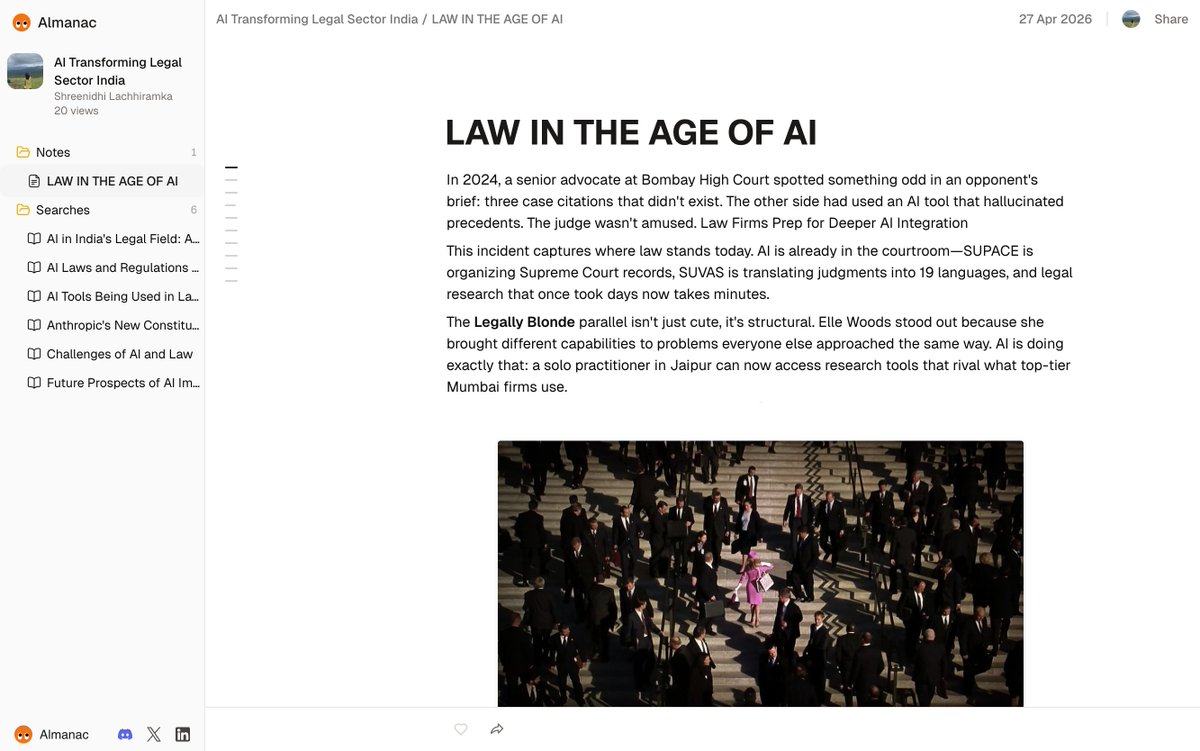
Everyone talks about open courts and equal law.
But the real divide shows up before you even enter one. Subscriptions, saved notes, AI that can turn one idea into five solid arguments while you’re still framing the first.
Same bare act, same facts, completely different prep.
That’s where things start leaning.
This week's Almanac gets into AI inside courts, the tools lawyers are actually using, the risks and where Indian law is heading next. Link Below!🔗
there’s a weird moment with most AI tools where you’re still in the middle of a thought and they’re already trying to wrap it up.
but some of the most important work happens exactly while -
> you’re still talking,
> sharing context,
> testing a thought,
> following a thread
that’s the part @thinkwithalma is designed for: working in the middle of the thought, not just at the end of it. more on this soon!
Recommendation systems feel like they should know you by now.
They track what you watch, when you pause, what you drop halfway, what you come back to.🔀
And still, what they suggest often feels slightly off.
Not because they lack data, but because they’re solving a different problem than you are.
This week's piece talks about why recommendations feel broken. Link Below!🔗
Six degrees of separation. The idea that any two strangers on earth are linked through just six social steps. It has inspired plays, parlour games, and a Facebook algorithm.💡
And there is something genuinely compelling about it. The mathematics holds up. The network science is real. There is a reason this idea has survived nearly a century.
But the closer you look, the more complicated it gets. This week's Almanac gets into it.
🔗Link below!
Sports feel like the one place where outcomes are actually earned. Clear rules, shared field, visible effort and first is first.
But the race doesn't start at the starting line. It starts years earlier, in who got access to coaching, nutrition, facilities, and time.
This week's Almanac is on why sporting meritocracy is a partial truth and why partial truths are the most convincing kind.
🔗Link below!
The cost of making things has collapsed.
You can generate something polished almost instantly. And yet, a lot of it feels interchangeable.
The constraint isn’t execution anymore. It’s judgment.🎯
This week’s Almanac explores why taste, the ability to decide what to keep, cut, and refine is becoming the new moat. Link below🔗
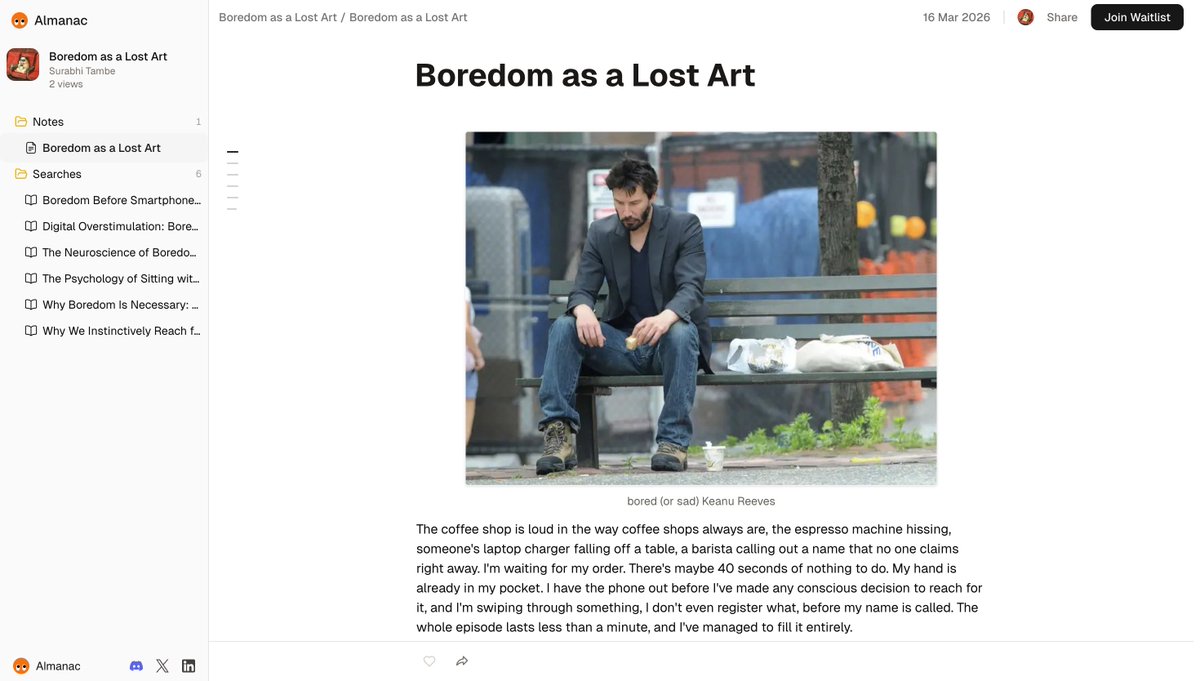
Every idle moment is now a problem to be solved, a gap to be filled before some uncomfortable feeling slips in.
But the idle mind was never broken. It was processing, connecting, wandering somewhere useful. 🧬
A new Almanac newsletter on what boredom actually was, what the neuroscience says it was doing for us, and what we've sort of lost by replacing it with an infinite scroll and a dopamine drip.
Link Below!🧠
Short answer: no. But people have found ways to live with it.
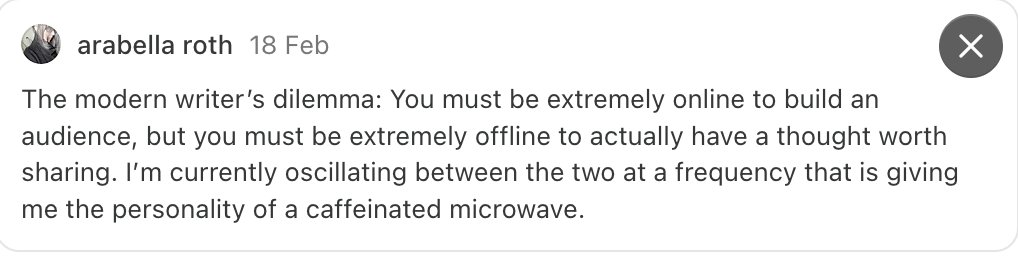
The problem is that platforms reward frequency, not depth. The more you post, the more the algorithm shows your stuff. But the more you post, the less time you have to think about anything worth posting. And the thinking itself gets scattered. Sources in dozens of tabs, highlights buried in PDFs, drafts living somewhere else entirely.
Cal Newport, a computer science professor who has written extensively about focus and distraction calls what happens next "audience capture": you check your output two years in and realise you've been writing for the algorithm, not for yourself.
So what have people tried? The most common move is making a newsletter your home base instead of a feed. One writer did the full social media grind. 3 posts a day, 4 platforms and their readership barely budged. They switched to email and grew from 12 to 8,000 engaged readers. Therefore, no algorithm deciding who sees your work.
Others go further. The "creator-monk" approach means deliberately not scaling writing essays that take months, keeping a small subscriber base, treating attention as something you protect rather than harvest. Newport has never used social media and sold close to 3M copies of his book Deep Work through word of mouth alone.
Every workaround has its own cost, though. Newsletters still need feeding. The monk path can turn into performance. And Newport's model requires writing something good enough that strangers recommend it unprompted, a brutal bar for most people starting out.
The other thing many of them are trying to do is keep a place where ideas can sit, develop, and connect before they ever become posts - the kind of workspace we're trying to build with Almanac.
The practical takeaway: writers who handle this best tend to do one thing in common, they pick a single channel they own (usually email), post on their schedule instead of the algorithm's, and accept that slower growth is the price of keeping their thinking intact.z