Assistant Professor of Physics at Chulalongkorn University, Bangkok. Work on the intersection of machine learning, quantum information, and statistical physics.
Working with AI models, I've arrived at what I consider the most significant pure-theory breakthrough of my research (in theoretical neuroscience) so far:
https://t.co/E0ylJ6LMts
Chaotic systems show what is colloquially called the butterfly effect, namely, a tiny nudge to the initial state grows exponentially in time. How fast the nudge grows depends on its direction. Each direction has its own growth rate, called a Lyapunov exponent, and the full set of rates is the Lyapunov spectrum.
The Lyapunov spectrum is a rich (and diffeomorphism-invariant) characterization of chaos, telling us how many directions are chaotic, how many dimensions the attractor occupies, and how fast the dynamics generate information.
In 1988, Sompolinsky, Crisanti, and Sommers (Physical Review Letters) introduced a nonlinear recurrent-network model of N randomly coupled neurons that becomes chaotic when the coupling strength exceeds a critical value. This network has since become a cornerstone of theoretical neuroscience, both as a model of the spontaneous activity of cortex and as the starting point for training recurrent networks on tasks. I have worked on this model for much of my research.
In the same paper, the authors obtained the largest Lyapunov exponent from the ground-state energy of a Schrödinger equation and named the full Lyapunov spectrum as an open problem. In 2023, beautiful work by Engelken et al. (Physical Review Research) computed the full Lyapunov spectrum numerically. However, an analytical calculation of the full Lyapunov spectrum has remained out of reach.
Four decades after the problem was posed, this paper derives the full Lyapunov spectrum at large N from a simple self-consistent single-site problem.
This calculation has three steps.
First, we lower every exponent by a constant s, which turns the question "how many exponents lie below s?" into the question "how many tangent directions decay?" We show that, if we drive the shifted tangent dynamics with a source and take the minimum-norm solution, the one-step response is the projector onto the decaying directions. Thus, the trace of this projector counts the decaying directions. This step is exact at finite N.
Second, to work with the minimum-norm solution, we cast it as the vanishing-regularization limit of the solution of a least-squares problem. This regularized solution in turn solves a dynamical system with one field running forward in time and another running backward.
Third, we apply the cavity method, that is, we add one neuron to the network, along with its forward and backward fields. The effect of the rest of the network on this neuron then reduces to the classical dynamical mean-field description of the activity of this neuron, plus two kernels that couple the forward and backward fields of this neuron to each other across time. Thus, the full Lyapunov spectrum follows from a single-site problem, which boils down to the self-consistent calculation of these kernels.
The resulting theory agrees closely with simulations for the Lyapunov spectrum, the attractor dimension, and the entropy rate, and recovers known results, including the Schrödinger equation of Sompolinsky, Crisanti, and Sommers for the largest Lyapunov exponent.
As a byproduct, the theory establishes analytically that the chaos is extensive, i.e., the attractor dimension and the entropy rate grow in proportion to N.
I had assumed that this problem was analytically intractable. After working independently for 100 minutes with Max thinking, GPT-6 Astra produced the initial derivation, yielding a self-consistent problem whose solution matched simulations of large networks.
I found this derivation intriguing, albeit complicated and somewhat mysterious (see AI Methodology in the paper). After investigating the structure of the proposed solution more deeply, together with AI models, I arrived at a physically transparent derivation.
I am excited to apply this approach to other network models, trained networks, and, more broadly, to high-dimensional systems to which Lyapunov analysis is relevant, including AI models themselves. Of course, as with any paper, I took care to write up the paper clearly.
A few broader thoughts...
Neural circuits are high-dimensional nonlinear dynamical systems, and such systems are notoriously hard to understand. I would frame the central problem of theoretical neuroscience as understanding how such systems function, process information, learn, and generate behavior.
Many people in the theoretical sciences are anxious about AI. However, in my field at least, we are nowhere close to fully understanding the high-dimensional computations unfolding in our brains. With AI, we could reach a level of understanding that so far we have only gestured toward. So, I am excited.
This is outrageous framing. Quite frankly, given the current tensions around AI and mathematics, this kind of announcement does not help.
After the recent Buckmaster/OpenAI dispute over scientific credit and provenance, the last thing we need is more promotional PR language that blurs the history of a research problem.
Meta presents its work by asking: “Can AI contribute when a problem is genuinely open and without an existing solution path?”
Seriously?! For the ellipsoid-fitting example, this is misleading and insulting. There was an established research programme, substantial rigorous progress, and by the time of their announcement, publicly available proofs of the exact threshold.
Let us be specific:
- In 2023, Antoine Maillard and Dmitriy Kunisky gave a statistical-physics derivation of the conjectured transition at n/d² = 1/4, using the replica method. Their analysis also predicted the geometry of the solutions and suggested directions for rigorous proofs. This was not a proof, but it was a detailed and successful theoretical picture, not an absence of a path.
https://t.co/F9CLHANv6G
- Afonso Bandeira and Antoine Maillard then rigorously established the sharp threshold for approximate fitting, using methods inspired by the statistical physics of disordered systems, using actually spin glass mathematical technics. Their preprint appeared in 2023 and was published in the Electronic Journal of Probability in 2025. Their Gaussian-equivalence framework provided a foundation for further work (including many of mine!). At this point, the "exact" fitting and removing the spectral restriction were the outstanding gaps, but these are technical problems, it was not about not discovering the threshold from scratch. https://t.co/V15hMsu3kv
- On 10 August 2026, Theodor Misiakiewicz and Garrett Wen posted a proof of the exact Gaussian threshold, explicitly closing those two gaps.
https://t.co/qdlrzO8q75
- On 12 August, Sofia de la Cerda, Aaron Potechin, Madhur Tulsiani and Jeff Xu posted another proof, establishing both sides of the transition up to a vanishing multiplicative factor. https://t.co/vHjN9BHUY3
- On 27 August, Frederic Koehler and Youngtak Sohn posted a broader universality theorem that includes the Gaussian threshold. https://t.co/zpuDGpSqVF
These were not researchers merely “on the verge” of solving the problem. THE PROOFS WERE ALREADY PUBLIC. Meta's announcement comes in October, and Section 3 of their paper begins:
“We use the groundbreaking approximate-fitting theorem of Bandeira and Maillard…”
Dear META: Those are your words. This is not simply a reference in the bibliography: your feasibility proof explicitly starts from their theorem.
How is that consistent with advertising this example through the suggestion that there was “no existing solution path”?
Yes, your social post mentions independent solutions, and your paper and blog identify the August results and describe your work as independently developed. That does not answer the objection to the framing. A generic acknowledgement of parallel work does not make clear that the exact threshold already had publicly available proofs before this announcement.
An independently developed AI-assisted proof, released after other proofs, should be presented as exactly that. Readers should not have to reconstruct the chronology to understand what is, and is not, new.
A new proof can contain valuable ideas. But a new proof and a newly solved problem are not the same claim. Nor does a problem being open when a project begins mean it is still open when the marketing campaign launches.
You say the aim is to “empower researchers”? Nothing more “empowering” than seeing years of collective research turned into the backdrop for a cheap marketing stunt.
Correct the announcement! Give the scientific history the same prominence as the product. Give Antoine, Afonso, Theo and all the other researchers involved the public credit they deserve.
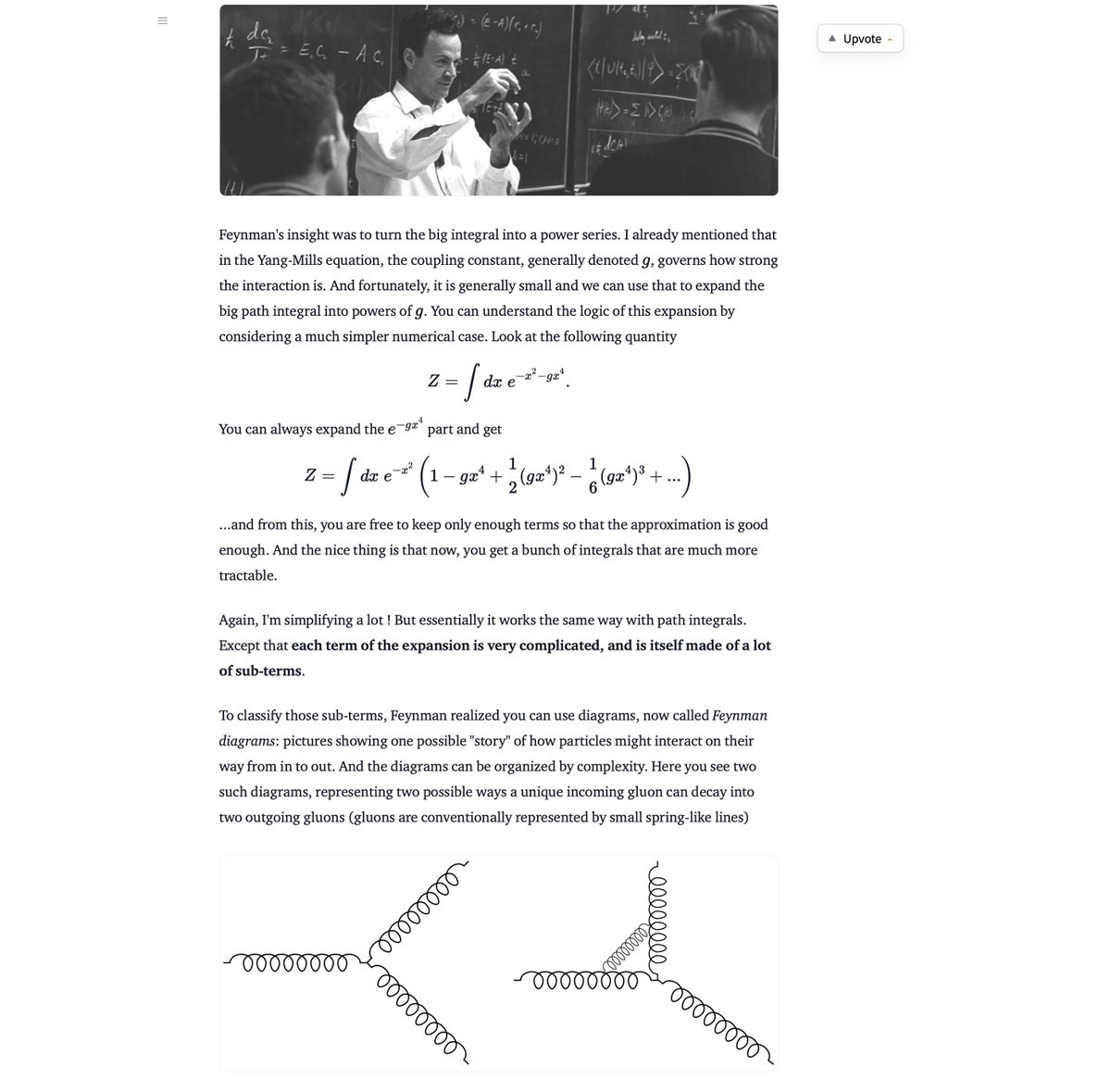
reading feynman lecturess as feynman intended: with accompanying ai-made demo sections for each chapter
rapid acquisition of knowledge is possible thanks to superintelligence
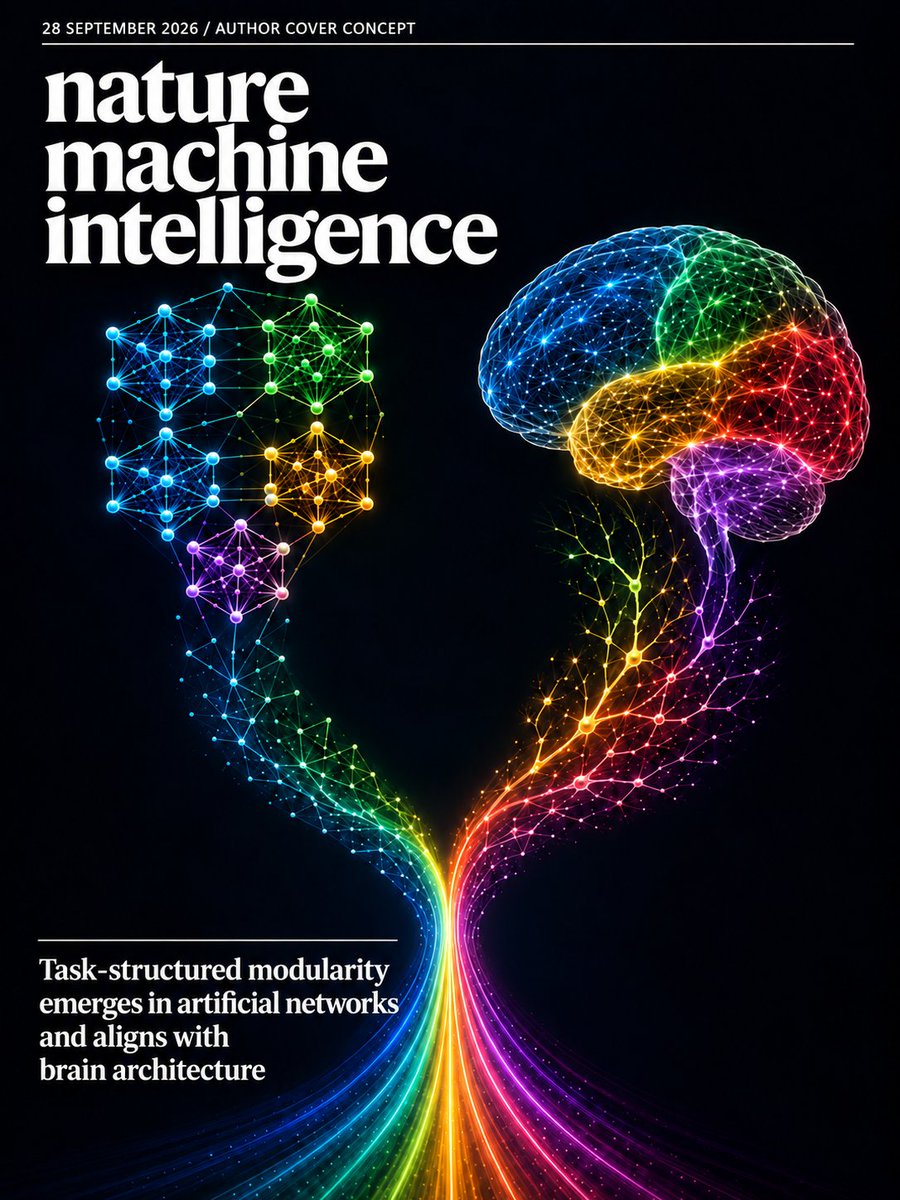
Why do neural networks become modular? Our paper is now out in Nature Machine Intelligence! @NaturePortfolio We show that multi-task learning promotes modularity under limited capacity and task demands help explain features of brain architecture in addition to the spatial constraints.
Great thanks to all the co-authors. @WHYWYH007@yifannnwu@DaniSBassett@marcelomattar
https://t.co/uqN91o2P5Y
Eigenvalues do not always tell the whole story of the matrix.
For normal matrices the pseudo-spectrum reveals hidden regions where tiny changes can produce surprisingly large responses.
We built recursive meta-intelligence, an AI that creates its own scientific instruments, turns them into persistent worlds that an agent ecology with hundreds of AIs inhabits, and uses those worlds to discover mechanistic principles in one of the hardest classes of physical problems: how complex hierarchical materials (nested structures of matter that give rise to new function through organization) evolve and fail. The AI reasons across enormous spaces of possible physical trajectories, where every rupture changes what can happen next, and compresses those histories into principles (which humans can understand and design with) - complex chains of causal events, highly nonlinear, and intricate.
Scientific superintelligence is tangible here - machine-scale exploration opening cognitive channels into complexity that has been extremely difficult for humans to traverse directly. AI builds the spaces in which its next level of reasoning becomes possible; a representation becomes an instrument, the instrument becomes an executable world, and that world becomes the substrate for further intelligence. Intelligence then grows by constructing new spaces to think in.
The task we explored started from a seemingly simple prompt to explore a biological material system - the AI then chose the representation, mechanics and experiments, built a fracture laboratory to push materials to their limit, tested hypotheses and generated scientific conclusions. The swarm explored a combinatorial universe in which architecture controls function and every rupture changes the future state of the material.
The AI discovered a compact principle that defines how multiscale material architecture can program the evolution of failure. Material placement and geometric order determine how forces redistribute, whether damage cascades or remains distributed, and whether function survives substantial flaws. For this discovery to happen the AI had to reason across long path-dependent histories, simulate alternative futures and compress them into generative invariants (model-based causal reasoning, counterfactual simulation and temporal abstraction applied to an evolving physical world). It is incredible to witness this transition to a new form of intelligence and capability through scaling swarms.
A lot of positive will come out of this because it expands the human epistemic horizon as AI can traverse thousands of possible histories and return mechanisms compact enough for us to understand, test and build from. Intelligence compounds through its artifacts!
A few lessons we learned:
▶️ Learning and discovery are flows through spaces of possibility. Early work has shown how backpropagation flows through parameters, reinforcement learning through action and consequence, and autonomous swarms through representations, instruments and executable worlds, bringing it all together. Flows create structure; structure redirects future flows in the recursive instrument.
▶️ Nonlinear physics actually defines a larger principle, where high-dimensional dynamics generate stable invariants; invariants become effective variables; those variables become the substrate for a new level of cognition.
▶️ Recursion then becomes level creation - one possibility space compresses into a principle, and that principle opens a larger space above it.
Our group discovered that reasoning models produce fractals when asked to solve hard problems. We can use nonlinear dynamics to probe the thinking processes of recurrent depth models on Sudoku, mathematics, and even ARC-AGI (1/N)
https://t.co/Q3u8OqylZf
The second is a https://t.co/8igrZbtH65. This is a very thoughtful post by Xiaoyu He, giving a very coherent and accessible summary of the case for AI-risk. It is very well written and definitely worth a read!
A couple of websites
I want to share a couple websites aimed specifically at mathematicians regarding AI-safety and AI-risk .
The first one I made myself: https://t.co/Ye2ZF5CmJj. This is designed to be a very high level and accessible resource describing some research agendas, collections of problems, and organizations in the field of AI-safety. I hope that for mathematicians considering directing some of their effort in this direction, this eliminates some of the friction. I plan to expand it quite a bit, but I hope it's already useful! I'd be happy and grateful to hear (constructive) feedback on it :-)
1/2
The most influential mathematician of his generation stands in a German lecture hall and explains a foundation he is rebuilding from scratch. Almost nobody watches it.
This is Peter Scholze at Bielefeld University, November 2025, opening lecture of a new public series called Ars Mathematica.
Scholze became a full professor at 24 and won the Fields Medal at 30. His work on perfectoid spaces reorganized entire areas of arithmetic geometry inside a decade.
Condensed mathematics is his attempt to fix something deeper: the way analysis and algebra refuse to sit together properly. He is proposing new foundations for how mathematical objects carry topology.
Watch how he pitches it to a general audience. No prerequisites assumed, no dilution, a working mathematician showing why abstraction opens rooms you could not otherwise enter.
A researcher I know rewatched the middle section twice and said it was the first time condensed mathematics felt like an idea rather than a rumour.
Free on YouTube from a university channel, subtitles on.
Some people prove theorems. He is replacing the floor.
gradient, divergence, and curl are three ways of asking three completely different questions about a field. the gradient asks: where does this quantity increase the fastest? divergence asks: is something flowing out of this point or flowing into it? curl asks: is the field trying to rotate something? once you understand the questions they’re answering, the equations stop looking intimidating and start feeling inevitable.
this is why vector calculus is so powerful. instead of describing individual numbers, it describes the behavior of entire fields. temperature across a room becomes a scalar field. wind becomes a vector field. electric and magnetic fields become mathematical objects you can differentiate. suddenly you’re no longer tracking one measurement at a time. you’re describing how reality changes everywhere, all at once.
almost every modern engineering discipline is built on these three operators. fluid dynamics, electromagnetism, robotics, aerospace, computer vision, graphics, and machine learning all rely on them. maxwell’s equations are written in terms of gradient, divergence, and curl. navier-stokes uses them. optimization uses gradients to learn. once you learn vector calculus, you stop seeing isolated equations and start seeing a common language for describing how the physical world behaves.
Maxwell’s equations for electrodynamics present unique numerical challenges. As a mixed hyperbolic-elliptic system, one’s algorithm must strictly preserve the hyperbolic part of the system under time evolution whilst ensuring that errors in the elliptic divergence constraints do not grow without bound.
Lanyon derived a perfectly hyperbolicity-preserving wave-propagation scheme for Maxwell’s equations in arbitrary dimensions, implemented it in ~8,500 lines of formally verified C, verified it in ~15,000 lines of Lean with 156 correctness theorems (including proofs of convergence, L^2 stability, reconstruction symmetry, 2nd-order TVD, etc., all down to floating point precision), and set up this simulation of an electromagnetic pulse interacting with a metal box. All in ~2 minutes.
Our symbolic theorem-proving and code-generation algorithms become more powerful every day. And you ain’t seen nothing yet!
OpenAI claims GPT-5.2 made a breakthrough in theoretical physics. Reactions ranged from "physics will never be the same" to "it's just a calculator"
As a former theoretical physicist, I tried to understand what actually happened, and the physics relevance of the discovery⬇⬇
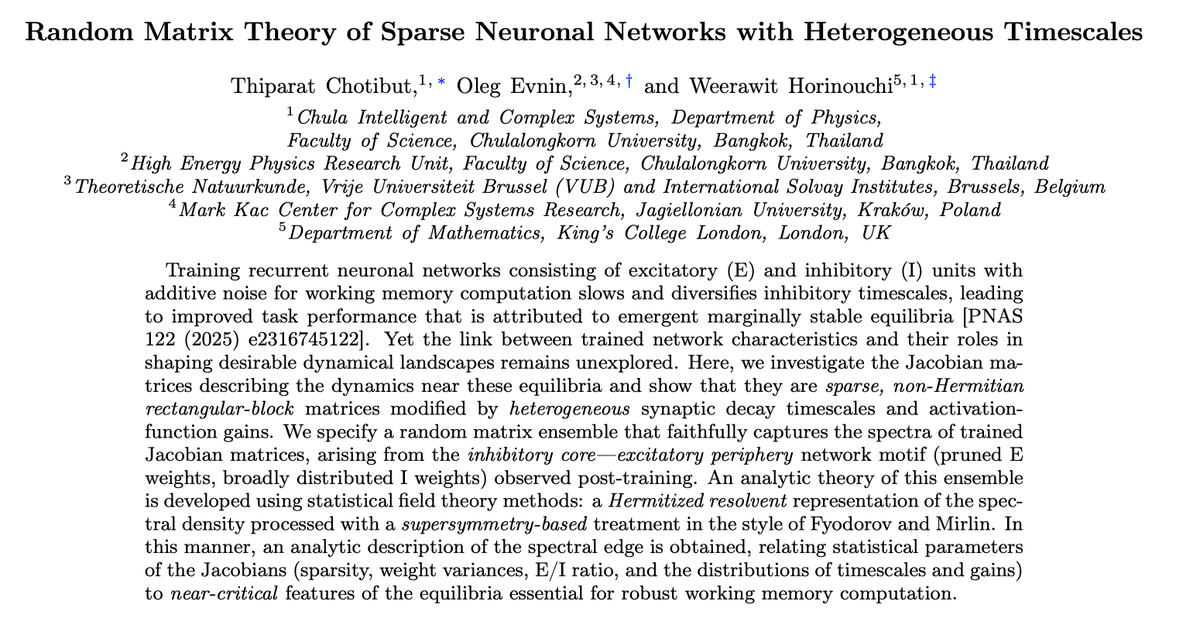
[n/n] Check out the paper for the full derivation and discussion! https://t.co/sUPQzwVJVI Happy to chat more about sparse, non-hermitian random matrices, attractors, or why physics needs to pay more attention to timescale heterogeneity. ⏳⌛️⏲️
[1/n] Excited to share our latest work, combining a rare mix of theoretical physics tools to answer a fundamental question in neuroscience:
How do cortical networks operate near criticality with improved working memory without requiring precise parameter fine-tuning? 🧠⚛️
[8/n] Takeaway: By adding realistic complexity (sparse, structured interactions and timescale heterogeneity), new functional mechanisms appear that were once invisible to standard RMT results. It’s a messy math problem, but the SUSY tools make it solvable.