EXCLUSIVE: "I told her personally" - An ex-Fine Gael Justice Minister said that in 2023 he privately raised a number of controversial books with then-Education Minister Norma Foley, including "What's the T?", telling Gript "I even named the books for her":https://t.co/5MldGKgw6R
@rtenews This young man was murdered. The police assumed the worst of him, handcuffing him while he was bleeding out, and ignoring his pleas for help. It was incompetent & grossly negligent policing. I note RTE news have labelled the potesters of this brutality as “nationalists”.
Completely skewed priorities. The whole point of a strong economy is it gives working people a higher standard of living - ability to save, buy a house, have kids, holidays etc. The economic framework is gone counter-productive for people due to unsustainable population growth.
This is sheer political ineptitude…
1. Such a referendum has no hope of being passed.
2. He’s opened the door to every group wanting its own dept.
3. He said the same about Defence in opposition and did nothing
#timesup!
https://t.co/uxhFI8VUyS
"You are not likely to see Henry Nowak’s words stenciled on a mural. No corporation will change its logo. The same establishment that made a few words immortal when spoken by a black man in Minneapolis has met the same words, spoken by a white boy dying on a British street, with what can only be described as a determined, institutional silence. That silence is not neutral. It is a statement. It tells you exactly whose suffering the system has decided counts, and whose does not."
The March Through The Institutions, which was the multi decade strategy of the founding fathers of Wokism, involved corrupting the permanent institutions of the State with your ideology so voters couldn’t reverse it. They started in academia. Then moved to NGOs, journalism and politics. Once inside politics they’ve corrupted all arms of the State, including Education and Justice. #HenryNowak died because police were enacting Woke ideology right there on the street. It’s a cancer.
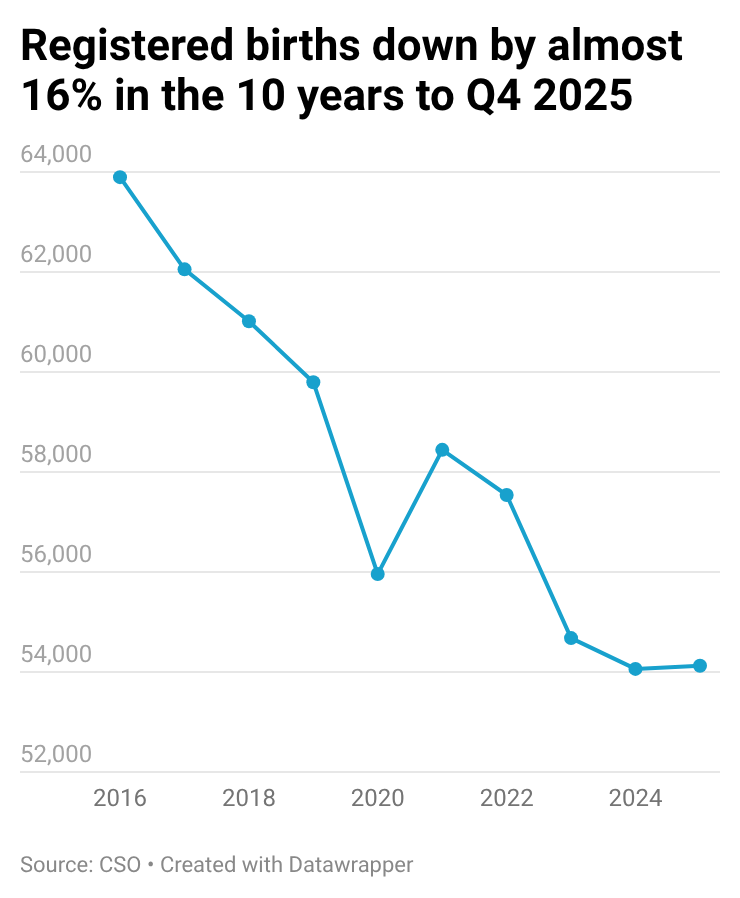
Irish birth and fertility rates continue to decline
The number of registered births in the State has fallen by almost 18 per cent in the last decade, according to Central Statistics Office (CSO) data.
A total of 65,909 births were registered in 2015, but this fell to 54,125 last year, according to the CSO’s Vital Statistics Yearly Summary for 2025. However, there was a small increase (63) in the number of births between 2024 and last year.
In the same time period, the fertility rate has dropped sharply, from 1.9 in 2015 to 1.5 in 2025.
https://t.co/WoTkfoJMS3
@IrishTimes The State should invest more in childcare for working parents (like what is done in other EU countries), but they seem to have little interest in that. The housing crisis is also causing major milestone delay. Overall society has become somewhat squeezed by lack of development.
Repatriating illegal migrants is just the start but we need to go beyond that. EU citizens who have not worked for years and are who dependent on welfare and people from other countries who have not assimilated into Irish society also need to be returned home.
The UK police officer who responded "I don't think you have mate" to a young man who told him he had been stabbed should face criminal charges for negligence and his role in Henry Nowak's death.
But he's only a symptom of the problem. The problem is their training, where they are trained - not even consciously - to see white people as the villains and minorities as the victims. That will take decades to unwind.
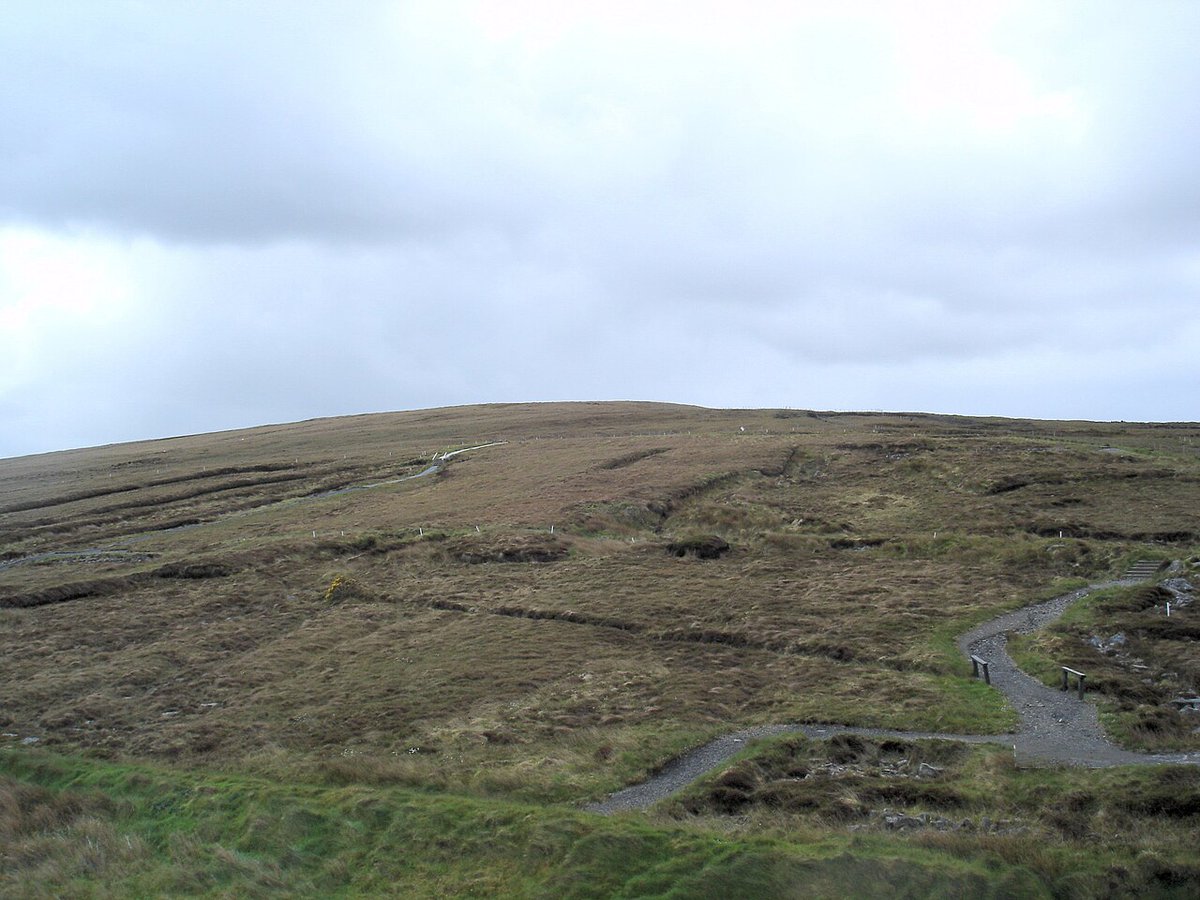
The most ancient fields on Earth, at about 5,500 years old, are in Mayo! The Céide Fields predate the Egyptian pyramids and similar agricultural systems anywhere in Europe by roughly 2,500 years. You would think theyd always been famous but it took a schoolteacher called Patrick Caulfield cutting turf in the 1930s to realise the miraculous heritage.
He recognised something in the strange linear piles of stones at the bottom of the bog. Firstly their configuration was not natural. But more importantly, they were underneath the peat, which meant they had been placed before the bog formed. And bogs take thousands of years. He told anyone who would listen that these layouts must be ancient, but nobody did feck all for 40 years!
Thankfully his son Seamus Caulfield came back, armed with an archaeology degree and a practical solution to analyse the blanket bog without destroying it. So Caulfield the younger developed a probing technique, pushing iron rods down through the peat to locate the hidden walls beneath. This painstaking, low-tech method was extraordinarily effective.
He mapped this ghost landscape of over a hundred kilometres of stone wall, two metres below the surface, preserved almost perfectly by the very bog that had buried them. The site in total covers around 12 square kilometres. Most of the walls are still underground and the bog is still growing.
The walls are long, parallel, some of them stretching over a mile and a half. They divide the land into rectangular plots ranging from four to ten hectares. Some authority measured this land, agreed on boundaries, and coordinated the labour to build them. The walls themselves ran between 90 centimetres and 150 centimetres wide and stood at least a metre high.
That kind of construction doesnt happen without rule of law, community organisation, and a shared idea of the future. Archaeologists estimate several hundred workers were involved. They cleared vast pine forests, oak, birch, hazel and alder, to open the land. They built the walls from the stone they cleared. They then kept cattle on the divided fields and, near what is now the visitor centre, appear to have grown emmer wheat in smaller enclosed plots.
Around 50 to 60 families lived here, perhaps 300 people in total, in round wooden gaffs about six metres across. They buried their dead in megalithic court tombs, the Behy court tomb still sitting within the complex. They made pottery comparable to finds across Stone Age western Europe. A primitive plough blade of stone, a saddle quern for grinding grain, a scattering of arrowheads.
Then over a century or two, the climate shifted and the land got wetter. The soil became waterlogged because an ironpan formed in the subsoil, sealing the moisture in. The people had to leave and blanket bog began to form across the hillside, smothering the walls and the houses and the tombs. The families moved a few miles south to the lower ground around Ballycastle and Killala Bay. They wouldve watched the bog creep over everything they had built, and there was nothing to be done about it. But that bog preserved their genius.
Seamus Caulfield spent years trying to get the site recognised, holding local fundraising meetings, encouraging communities across Mayo to contribute. Local children in Doohoma went door to door collecting money. Taoiseach Charles Haughey flew out to the site in 1990, but thankfully that aul hawk-faced-hoor didnt try to hock it stone by stone. His visit helped promote recognition and preservation.
The OPW came on board, money was found, and in 1993 the visitor centre opened. The building is pyramid-shaped, which is another matter I cant discuss. It houses a Scots pine recovered from the bog, around 4,000 years old and I highly recommend you visit this incredible site and contemplate how our ancient ancestors led such sophisticated lives which should rightly inspire pride.
Buy the Dublin Time Machine a pint and support the DTM Book
https://t.co/U7jtCrOTtb
O’Donoghue Warns Construction “Gouging” and Government Neglect Are Driving Housing Costs Out of Reach
Independent Ireland TD for Limerick County, Richard O’Donoghue, has warned that government inaction on soaring construction costs and fuel volatility is making it increasingly difficult to build homes and sustain local communities across Limerick and rural Ireland.
Deputy O’Donoghue, who continues to work directly within the construction industry while serving in Dáil Éireann, said suppliers are effectively “gouging” builders through constant price hikes on oil-based construction materials, placing enormous pressure on contractors, developers, and ultimately ordinary families trying to access housing.
The Limerick TD explained that many essential building products, including insulation, piping, silicones, and other core materials, are heavily dependent on international oil prices. As fuel markets fluctuate weekly, builders are left facing spiralling and unpredictable costs.
“The price of things at the moment are fluctuating on a weekly basis,” Deputy O’Donoghue said. “There are controls outside of the State, but I believe there’s a lot of gouging going on. The first thing that happens when oil fluctuates is transport costs rise immediately, and then every oil-based product follows.”
Deputy O’Donoghue said the Government has failed to grasp the compounding effect that fuel volatility is having on the construction industry and housing delivery.
“As someone actively involved on building sites, I can see firsthand the pressure local builders are under. Small contractors cannot continue pricing jobs when material costs are changing week to week. It is making housing projects harder to deliver and driving up the final cost for ordinary people.”
The Independent Ireland TD revealed that he recently challenged the Tánaiste and Minister Jack Chambers during an Oireachtas oversight committee meeting regarding the need for stronger intervention and fuel price stabilisation measures.
However, Deputy O’Donoghue said ministers continue to take a reactive approach instead of addressing the root causes of rising costs.
“The Government is completely disconnected from what ordinary workers and local businesses are dealing with. They are too focused on multinational corporations and headline economic figures while ignoring the people who actually keep communities alive.”
Deputy O’Donoghue stressed that lower and middle-income workers are the backbone of both rural and urban Ireland, contributing not only economically but socially within their communities.
“You can have a lower earner who is doing massive work within their local community,” he said. “Those are the people who keep towns and villages going. They create the communities that attract investment and international business into areas like Limerick.”
The Limerick TD is now calling for targeted Government action to reduce fuel-related pressures, support local builders, and deliver meaningful cost-of-living relief for workers and small businesses.
“If we continue to ignore the ordinary worker, we will damage the very foundation of our economy and our communities. Supporting local builders, tradespeople, and working families is essential if we are serious about solving the housing crisis and protecting rural Ireland.”
@RichardODonoghu@MichaelC_IND_TD@kenoflynnTD@ciaranmullooly
The father of a university student fatally stabbed by a Sikh man has described how he is “tormented” by thoughts of his son bleeding to death on the floor chained in handcuffs while police treated his murderer with “decency”
In body-worn police footage, Henry Nowaks’s final moments can be seen on camera for the first time ⬇️
https://t.co/TiZnHSEPYM
Significant loosening of rules around one-off housing will allow those who have an economic or social need to live in a rural location, including returning emigrants, to build a house. https://t.co/xofkKtdx76
This Sunday’s edition. Pick up a copy in-store, or subscribe to read it right now at https://t.co/u5ystSGUtr:
🗞️ Sinn Féin slumps in new Red C poll
🗞️ Irish intelligence team hit with job losses
🗞️ Davy loses second director to wealth manager