Welcome to SEEN in the Third Sector, the Sex Equality and Equity Network for not for profit & charities' staff. We focus on the protected characteristic of sex. We're open to anyone who works in the sector who shares our aims and values.
Women, leave Unison and join the @DarlingtonUnion!
As well as the sheer ignorance of this statement - complete misinterpretation of the law/guidance/code relating to workplaces (see @akuareindorf) - why would you still give your hard-earned £ to a union that centres a few men..?
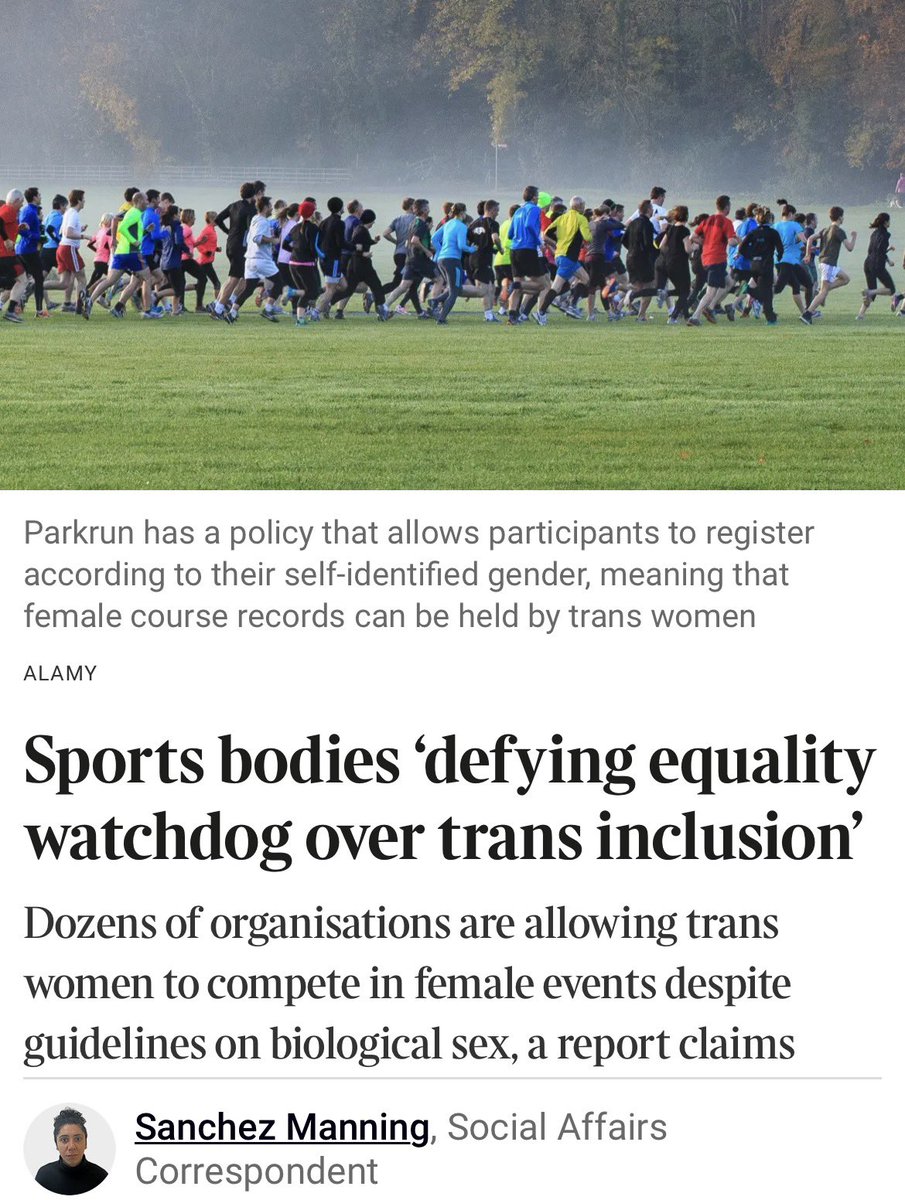
Launching today - ‘The State of Play’
“The law is clear. The science is clear. Public opinion is clear. If a category or an event is labelled as being for Females, Women or Girls then it must be for biological women & girls.”
Delyth Rennie, SEEN in Sport Policy Advisor 1/
After another depressing week of many, many politicians etc misrepresenting Equality law & guidance I have a modest proposal. All opining on this subject need to insert either a “the current law is ….” or a “my political opponents would argue that ……” and then an accurate
Well this is quite the roll of dishonour - MPs who don't understand that the law in question is the Equality Act, as interpreted by the Supreme Court. So who are trying to prevent statutory guidance on that law from being approved, because 🤷♀️
https://t.co/hi0EC3Frvj
I would like to set the supporters of this Early Day Motion an exam to check they understand legally what they are advocating for and against? https://t.co/KSqd4ERXFK
The Unions, whom their members look to for accurate legal guidance and representation, are showing they don’t understand the Equality Act , the status of the Statutory Code of Practice or the impact of For Women Scotland. Can female members expect any help?
You’re a woman who’s having migraines and blackouts. You’re afraid, worried, and it’s taken months to get an appointment with the neurologist in whose office you’re sitting, Dr. Jeffrey “Scott” Sloka.
When Dr. Sloka comes in, the nurse leaves, which is weird, but you’re here for a neurology appointment, so you shrug it off. The doctor asks you some questions, and then he tells you he needs to do a vaginal exam and a breast exam.
You don’t understand why, and he doesn’t explain. You want to refuse, but what if you make him angry? What if he refuses to continue the appointment? This is Canada; you waited for five months for this appointment, and your symptoms are getting worse — so you consent, even though you still don’t understand why he wants to examine you in this way.
Once you’re undressed, Dr. Sloka begins the exam by telling you to remove your gown and stand completely naked with arms and legs spread. The nurse still hasn’t come back, but the doctor proceeds anyway. He says something about checking for lumps, but that doesn’t make any sense; he’s a neurologist, not an ob/gyn.
Then you notice that he isn’t wearing gloves.
During the breast exam, he touches you in ways that make you uncomfortable, and that are not a part of an ordinary breast exam. The vaginal exam is worse: the exam lasts an exceptionally long time, and the doctor inserts his ungloved fingers. The nurse still hasn’t returned.
After the appointment, you feel dirty, soiled. You know deep down that you were assaulted, so eventually you work up the courage to file a report.
It opens a floodgate.
By the time the trial starts, Dr. Sloka has already lost his license, having pled guilty in front of the licensing board. He is facing 48 separate charges for the sexual abuse of his patients.
Woman after woman testifies to this man’s inappropriate behavior. Multiple women testify that Dr. Sloka touched them inappropriately and intimately while not wearing gloves; they describe vaginal exams, rectal exams, and breast exams involving contact that had nothing to do with checking for lumps. An underage girl cries as she describes being pressured into a vaginal exam while her mother was banned from the room.
48 counts. 48 victims. 41 women and girls who took the stand to testify about the abuse they endured.
And one more woman: the Crown’s key expert, Toronto neurologist Dr. Vera Bril. She testified that vaginal, rectal, and breast exams are “far outside our standard of practice,” and “far, far outside” of what neurologists typically do. She stated that these intimate exams were “not necessary” for treating or diagnosing the neurological issues presented by the victims. When the judge retires to deliberate, a conviction seems certain.
Except that’s not what happens.
The judge - Justice Craig Perry - discounts the testimony of all 42 women. He singles out Dr. Bril’s testimony in particular as suffering from “profound frailties,” and accused her of displaying “bias.” He dismisses the victims’ testimonies as well, citing “inconsistencies,” even though none of said “inconsistencies” touched in any way on ex-Dr. Sloka’s guilt.
He accepts ex-Dr. Sloka’s claim that the assaults were medically necessary exams, even though Sloka admits to having performed many of them ungloved, and cannot explain what these exams had to do with any of his victims’ symptoms.
In the end, Justice Craig Perry acquits ex-Dr. Jeffrey “Scott” Sloka on all 48 counts, choosing to believe a (male) defendant who had already admitted his guilt in front of the licensing board over 41 (female) victims and an expert (female) neurologist.
And they say the patriarchy is dead.
We used to be called "Pregnant Women" and "mum to be" now they can't even say these words
No man has ever been extremely sick because of group b steep
Yet here we are with a very important message to Pregnant women which can't name us
7,714 sigs is NOT enough on our petition
Well, well, well - this is very exciting. We are proud to have been mentioned in a new report by @AmnestyUK as one of 17 professional networks which the aim of supporting staff with GC views and to promote ‘sex equality’ between women and men in the workplace
My thoughts on the @EHRC guidance laid yesterday; this is not about non-existent "rights". It is about the safety of women - mothers, sisters, wives, daughters. We men need to hear their voices. Virginia Woolf : "Though we see the same world, we see it through different eyes".
My intro on @TimesRadio yesterday:
Where I live there are two different routes to and from the tube station. One, let’s call it Acacia Avenue, is quiet and residential. The other, London Road, is a busy major route with lots of traffic. At all times of the day, I automatically head for Acacia Road. It’s just much nicer.
The women in my family, on the other hand, will never willingly make that walk after dark. They live with an anxiety that most men find it hard to imagine, and frankly, rarely think about unprompted.
Last year 739,000 women were sexually assaulted in Britain. Virtually all such assaults - nine out of ten - are perpetrated by men. One in four women have been attacked at some time in their lives. Acacia Avenue is exactly the sort of place in which most women fear that they become vulnerable, and they are right.
As the author Virginia Woolf once wrote " Though we see the same world, we see it through different eyes".
I think this is the right context in which to understand the furore over the guidance being laid today by the government, over the meaning of the words man and woman when it comes to providing services and facilities in workplaces.
Many men think this is about a rather arcane dispute about who gets to use what loo. For their mothers, sisters, wives and daughters, it isn’t.
In a previous life, as Chair of the Equality and Human Rights Commission, I had a hand in writing this country’s equality laws, in particular the 2010 Equality Act. It never occurred to any of us that there could be any confusion or dispute over the meaning of the words man and woman. But it has taken a decade of campaigning, a Supreme Court judgement and now hundreds of pages of guidance to settle the issue.
This is not about so called trans rights, which are completely unaffected by this guidance, since no-one has ever had the right to walk into a changing room reserved for teenage girls.
What it does mean is that women and girls are guaranteed the protection they deserve, and that their safety, which we spent half a decade drafting law to ensure, is protected.
But the whole business illuminates some serious issues in our politics.
First that many of our institutions, in spite of the fact that they always knew what the right thing to do was, decided to ignore the fears of their women customers and employees, under pressure from noisy pressure groups. Instead, the people who were supposed to be the grown ups behaved as though the law said what campaigners wanted it to say, rather than what it actually said. They settled for what they hoped would be a quiet life.
In a democracy, there’s little point in Parliament deciding anything if the law is then made an ass by activists intimidating bosses in companies, schools, universities and the media into doing something different.
Second, at the heart of the campaign to undermine the Equality Act is an idea that we specifically rejected in 2010, so called self-identification. That is to say, that it should be up to the individual to decide whether they have what’s called a protected characteristic - are you male or female, are you black or white. The problem is that self-ID would destroy the operation of any law against discrimination.
Look, it would almost certainly have been to my advantage as a young man to self-identify as a handsome, white public schoolboy. None of those things is true of me. And at various points I am pretty sure it’s been to my disadvantage. It is certainly statistically likely to have been to my disadvantage.
But according to the logic of those who say that self-ID should be the rule and that anyone should be able to decide for themselves whether they are male or female, black or white or Asian, were I to complain about racial discrimination, it would be difficult for anyone prove that I’d been discriminated against because of my race since anybody to whom I’d lost out could just tell the courts that they too were black.
I know that sounds like Alice in Wonderland but you can google the case where a chap, both of whose parents are white, insisted he should get money from the Arts Council because he so identified with the black struggle that he considered himself black, and everyone should accept his point of view. In the United States and Brazil exactly such outlandish claims have been made and people rewarded to the disadvantage of people actually born into minority families.
I have even been told about firms who, when reporting their gender pay gaps have put men who just happen to like wearing dresses at weekends - nothing wrong with that, let me be clear - into the female column and told their women employees that they really haven’t got anything to moan about because statistically they are paid equally, and they should get back in their box.
So today’s guidance isn’t just another tiresome chapter in culture wars. It is , I hope, a halt to the efforts to undermine one of the most important pieces of legislation on the statute book, by people who, for their own reasons, would prefer us to be living in the 1950s world of Mad Men.
The NCVO Small Charity Week Assembly is on Monday 22/6.
Be part of an afternoon full of spotlight stories, discussions and connections, showcasing the importance of small charities. #SmallCharityWeek https://t.co/WaHEYotv5q
It's very good that the Code has been laid, but it's also important to be clear that it is not for lawyers or judges. It’s for members of the public who are not trained lawyers to help them to understand the law. The Code of Practice does not make new law; it merely provides authoritative guidance to the public on what the law is.
"At a time when human rights protections are being weakened across the board, a movement against the rights of **women** and LGBTI people is growing in the UK". How dare you say this @AmnestyUK ???
Well, well, well - this is very exciting. We are proud to have been mentioned in a new report by @AmnestyUK as one of 17 professional networks which the aim of supporting staff with GC views and to promote ‘sex equality’ between women and men in the workplace