We had an intense interview on Friday with Nathan Schneider @ntnsndr, co-author w @VitalikButerin of "Proof of Stake: The Making of Ethereum and the Philosophy of Blockchains".
Be sure to scroll down for highlight clips and resources!
https://t.co/amZH1Db500
Crypto is perceived as a threat to the dollar and the current system of government.
US voters are genuinely angry and fearful because the world has changed so rapidly. The majority of people feel left behind in a broken system with limited ability to improve their own situation.
The Ultra Wealthy, Wall Street, and Tech are easy targets for channeling all of the blame.
Crypto is now politically polarized. It shouldn’t be; but that won’t change w/o dialogue, narrative, and demonstrable non-financial use cases that improve people’s lives outside of our own bubble.
1/ On Governments & Public Blockchains
We spend so much timing talking about what stupid things governments should NOT do with blockchains, that we often forget to discuss what they SHOULD do
Governments should mandatorily use blockchains for their own spending
Spent a lot of time hearing from AI engineers and CEOs last few days.
I think AI may be a catalyst for crypto in this cycle.
I think AI is likely going to create large new demand for cryptography & blockchains. Two dimensions I see:
1. Notarizing authenticity in amidst an explosion of creation where you don't know whats real —
AI is going to create an explosion of images, audio, software. It will be hard to distinguish what's real from whats not. Amidst this, defending against spoofing, deepfakes, people copying work, verifying the creation/ creator/ person you're talking to will be important. Pub/ private key cryptography, zk proofs and the like can play a major role, and blockchains can deploy with standards at scale with implicit trust.
2. AI Agents need to transact, hold balances, store information, etc without behind a person.
Autonomous AI agents that can action projects and tasks will give rise to new needs. But Agents are not a person, and will you want them running around the internet with your credit card, social, and PII signing as you? How will they have a budget they can spend? How will they sign contracts? How will they escrow things with one another? etc. Blockchains, stablecoins, smart contracts, defi, and things not yet created will be natively useful.
Still developing thoughts here ofc and interested in the thinking of others. Overall, feeling increasingly convinced that these two disparate technologies are going to have intertwined futures, and that crypto is going to become a lot more important as AI starts to proliferate.
@ntnsndr Speed? Network states can form quite rapidly and scale very quickly, assuming alignment. A persistent and dynamic public ledger? Perhaps also modern notions of individual sovereignty absent a central authority figure - although that ones’s a bit slippery.
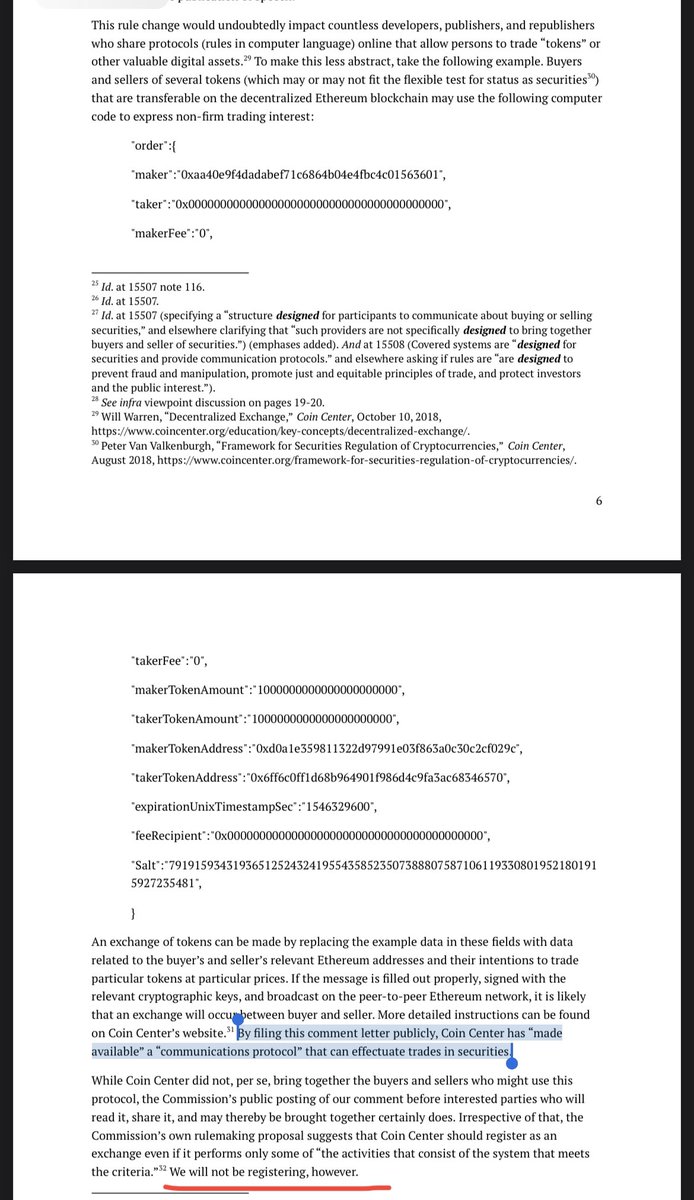
Coin Center made available a communications protocol that can effectuate trades of securities in a public comment letter to the SEC.
We will not be registering as a securities exchange
https://t.co/57m8OUCw71
It’s funny because the whole point is that you shouldn’t need to transport a hardware wallet, you can ultimately just reconstruct it by memorizing a key or passphrase.