America's biggest home builders are slashing prices.
Lennar has reduced its average selling price from $511k to $377k, a nearly 25% decline (inclusive of incentives).
DR Horton has cut from $415k to $366k, a 12% decline.
Four years ago, this would have been hard to imagine.
From 2019-22, Lennar sold homes for more than $100k above DR Horton, with prices for both builders surging.
Today, after four years of price cuts, they're selling homes for nearly the same price.
That's a remarkable shift, and reflects both a weakening U.S. homebuilding market and Lennar's more aggressive push to gain market share through lower prices.
To see where prices are heading in your area, search your ZIP on Reventure: https://t.co/zlKe2138Ij
Why would Saudi Arabia this morning allegedly refuse to allow US military aircraft to overfly their country on the way to Iran?
On paper, Saudi Arabia (Sunni) and Iran (Shia) are mortal enemies.
The reality is that in the 2026 oil market, the Saudis need the Ayatollah to stay.
Here are $44 billion reasons why.
If Iran sanctions are lifted, 160 million barrels of Iranian oil stored in floating tankers flood the market immediately. An additional 1-2 million barrels per day of Iranian production follows.
That pushes oil from $60 to $40.
Under $94, the Saudi welfare state is already upside down. At $40, it is insolvent.
Normally, Saudi would just cut production to save the price if an increase in Iranian oil came back to the market. They can't. Why? Because, setting Iran aside, a wall of supply is hitting the market in 2026.
If Saudi cuts, they just hand market share to the class of 2026. New, cheap oil that break even at $40.
The Class of 2026 (The Wall of Supply) in barrels per day and their breakeven prices:
Brazil: +400k ($35)
Guyana: +200k ($35-45)
Canada: +200k ($45)
US/Others: +200k bpd ($40)
Total new 2026 supply: 1 Million bpd. This new supply soaks up all 2026 oil demand growth and does is much cheaper than Saudi can.
So, how does Riyadh survive 2026 with oil at $60 and a $44 billion deficit?
They are doing three things:
Max out credit cards They issued $12B in bonds in Jan 2026 alone.
Pawn the jewelry: Selling more shares of Aramco to pay the bills.
Cancel the renovation: Neom is shrinking. "The Line" was supposed to be 170km. It is now just 2.4km.
So Saudi Arabia doesn't want an Iran war. But they also don't want an Iran peace. They need Iran to stay sanctioned, isolated, and offline.
It has nothing to do with Shia vs. Sunni. It has everything to do with solvency vs. bankruptcy.
The enemy of my sanctioned enemy is... my enemy.
- @morgan_downey
The Venezuela story everyone missed.
The U.S. just sold $500 million of Venezuelan oil.
But they deposited the money in Qatar.
Not the U.S. Not Venezuela. Qatar.
Here is why that satisfies detail changes everything you think you know about what just happened.
Venezuela owes $170 billion to international creditors. Bondholders. Oil companies. China. Everyone is owed money.
Any account in the U.S. or Venezuela would be immediately seized through litigation.
So the Trump administration parked the money in Qatar. A “neutral venue” where funds flow freely with U.S. approval and without risk of seizure.
This is not liberation. This is not regime change. This is not intervention.
This is the first operational deployment of a new architecture for sovereign resource capture.
The sequence:
- January 3: Capture the president
- January 6: Announce U.S. will “run” oil sector indefinitely
- January 9: Sign Executive Order shielding revenues from all creditors
- January 14: Complete first $500 million sale
Twelve days from military operation to revenue capture.
Iraq took six years to sign its first major oil contracts after 2003. Foreign companies operated under Iraqi law. Revenues went to Iraqi accounts.
Venezuela 2026: The U.S. government directly markets the oil, completes the sales, and deposits proceeds in accounts it controls in third countries.
This has never happened before. Never! Yup!
Not in Iraq. Not in Libya. Not in Kuwait. Not anywhere since 1945.
The Executive Order is the key document. It declares that Venezuelan oil revenues are exempt from all creditor claims, all legal judgments, all international arbitration.
With one signature, $170 billion in legal obligations became unenforceable.
The international legal architecture built over 80 years was bypassed through a domestic Executive Order and an account in Doha.
ExxonMobil’s CEO called Venezuela “uninvestible” at the White House meeting last week.
He is correct. And it does not matter.
When the U.S. government controls the revenue stream, shields it from courts, and promises to “make it real easy,” the old investment calculus is obsolete.
The template is now operational:
- Designate government as narcoterrorist.
- Deploy military to capture leadership.
- Install cooperative interim authority.
- Issue Executive Order voiding all prior obligations.
- Sell resources through U.S.-controlled channels.
- Deposit proceeds in jurisdictions beyond legal reach.
Any nation with vast natural resources, a government whose legitimacy can be contested, and insufficient military deterrence just watched this template execute in real time.
Venezuela has 303+ billion barrels of proven reserves.
The largest on Earth.
The U.S. now controls the revenue stream.
This is not a story about Trump or Maduro or intervention ethics.
This is the birth of a new imperial architecture that renders the post-Westphalian legal order irrelevant through financial engineering and offshore banking.
The 21st century will not be shaped by international law.
It will be shaped by whoever controls the accounts.
Read the full article - https://t.co/TS1Nz2BiSp
Trump's "beautiful" healthcare calculus: Millions lose coverage so billionaires gain tax breaks. The cruelty isn't collateral damage—it's the design.
Today's Senate vote ensures 22M Americans face 114% premium spikes ($1,016/yr) starting Jan 1 while OBBB's $1T Medicaid cuts accelerate. Yet the top 1% pocket $72K annual tax cuts—a 120:1 wealth transfer. 7.3M will lose coverage by 2026.
This isn't fiscal policy. It's class warfare with actuarial tables.
Treasury just turned in the worst October budget deficit in history -- worse than the Covid spending orgy.
Taxes actually jumped by 24%. But spending soared by over $100 billion -- with a Republican Congress.
Nothing stops this train.
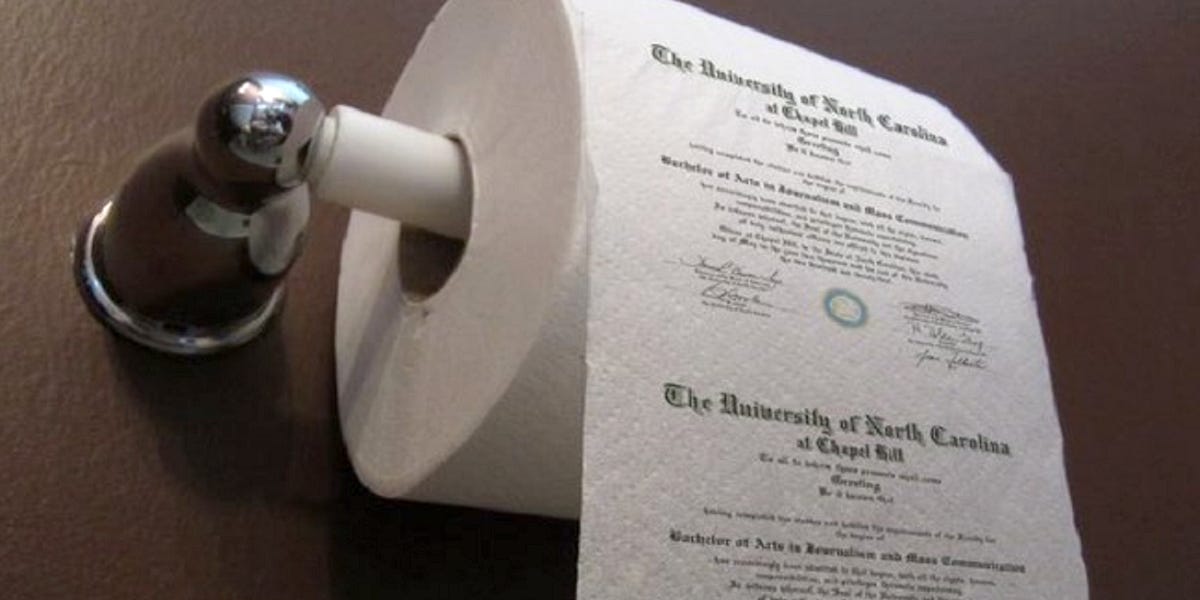
THE AI JOB MASSACRE NOBODY'S TALKING ABOUT: YOUR COLLEGE DEGREE JUST BECAME TOILET PAPER
Let's cut through the BS: AI has eliminated 77,999 jobs in 2025 across 342 tech companies.
37% of companies using AI say the technology replaced workers in 2023 because "they were no longer needed."
And in 2024, 44% using or planning to use AI say employees will "definitely" or "probably" be laid off.
But here's what makes this different from every other tech revolution: major tech firms reduced new graduate hiring by 25% in 2024 compared to 2023.
These aren't positions getting automated - these are jobs that no longer exist.
The con everyone's selling: "AI will create new jobs!"
Sure. While 85 million jobs are projected to be displaced by 2025, 97 million new roles may emerge. Sounds great until you read the fine print:
77% of new AI-related jobs require master's degrees, and 18% require doctoral degrees. Your four-year degree? Worthless. The new entry point is a PhD most people can’t afford.
What's actually happening: A major tech CEO revealed that 30% of company code is now AI-written. At the same time, over 40% of recent layoffs targeted software engineers.
Companies are dissolving copywriting divisions and replacing substantial portions of their coding staff. More than 80% of digital marketers already fear AI will replace content writers - and they're right.
Occupations at highest risk: computer programmers, accountants, auditors, legal and administrative assistants, customer service reps, telemarketers, proofreaders, credit analysts.
Notice a pattern? White-collar, college-educated, once-stable careers - the exact jobs your parents told you were "safe."
The demographic timebomb: 79% of employed women in the U.S. work in jobs at high risk of automation, compared to 58% of men.
Globally, 4.7% of women’s jobs face severe disruption from AI versus 2.4% for men.
In high-income countries? Nearly 10% of women’s jobs are at highest risk compared to just over 3% for men. This isn't just job loss - it's systematic wealth destruction along gender lines.
The prediction nobody wants to make: Leading AI executives warn that AI could eliminate half of all entry-level white-collar jobs within 5 years.
Other global tech leaders back this projection, forecasting potential impact to half the global workforce by 2027.
We're not talking about a gradual transition. We're talking about 14% of workers already displaced by automation or AI, with estimates that AI could replace the equivalent of 300 million full-time jobs worldwide.
January 2025 saw the lowest job openings in professional services since 2013 - a 20% year-over-year drop. 40% of white-collar job seekers in 2024 failed to secure even an interview.
You're seeing the early days of something unprecedented: an entire generation locked out of the careers they trained for, watching AI do their jobs better, faster, and for pennies on the dollar.
The social contract was "get educated, work hard, build a career." AI just voided that contract.
And nobody - not universities, not politicians, not companies - has a plan for what comes next.
Sources: FinalRoundAI, AIPRM, SSRN, Fox Business, Goldman Sachs, National University, AIMultiple, WORK ON PEAK, Nexford University
Unrealized losses at banks remain historically elevated:
Unrealized losses on investment securities for US banks reached $337.1 billion in Q3 2025.
This marks the 14th consecutive quarter of losses, matching the 2006–2009 streak.
Furthermore, this figure is ~6 times higher than the peak seen in 2008.
Such pressure comes as elevated bond yields continue to drag down the value of bank securities.
Meanwhile, the number of banks on the FDIC Problem Bank List rose to 53 last quarter, or 1.3% of the total.
Unrealized losses remain an issue for banks.
BREAKING: The Federal Reserve Just Blinked
December 1, 2025 will be remembered.
After draining $2.4 trillion from the financial system since June 2022, the Federal Reserve has officially ended Quantitative Tightening.
The number they do not want you to see: The Overnight Reverse Repo Facility has collapsed from $2.3 trillion to near zero.
The liquidity buffer is gone. Completely exhausted. The Fed had no choice.
This is not a policy preference. This is a forced retreat.
What the headlines will not tell you:
The Fed ended QT in 2019. Repo markets exploded. Rates spiked above 10% overnight. They swore it would not happen again.
It almost did.
Balance sheet frozen at $6.45 trillion. Rates cut to 3.75%. Reserves hovering at $2.89 trillion, dangerously close to the $2.7 trillion stress threshold identified by Governor Waller himself.
The post-pandemic monetary experiment is over.
Three years of attempted normalization. $9 trillion peak to $6.45 trillion floor. And now, the Fed holds.
But here is the question no one is asking:
What happens when the next crisis hits and the balance sheet is still $6.45 trillion? When rates are already falling? When the ammunition is already spent?
The answer: They print. Again.
This is not bearish or bullish. This is structural.
The Federal Reserve has demonstrated, for the second time in six years, that balance sheet reduction has a hard ceiling. The system cannot tolerate it.
Fiscal dominance is no longer theory. It is observable reality.
December 1, 2025: The day the Fed confirmed that the exit door from extraordinary monetary policy does not exist.
Position accordingly.
🚨🇺🇸 THE BILLION DOLLAR TIME BOMB NOBODY SAW COMING: WHY THE COSTCO TARIFF LAWSUIT COULD TRIGGER ECONOMIC CHAOS
Costco just filed a lawsuit that could blow up Trump's signature economic policy, and most people don't realize how catastrophic this could become.
This isn't about whether tariffs are good or bad policy.
This is about a legal time bomb that could force the administration to refund hundreds of billions of dollars and trigger economic chaos.
Here's what's happening.
Costco and dozens of other companies are suing the Trump administration not just to challenge the tariffs, but to protect their right to refunds if the Supreme Court eventually rules the tariffs were illegally imposed.
The twist is they're not waiting for the Supreme Court to rule first.
They're filing preemptively because of an obscure customs deadline called "liquidation" that could permanently lock in their tariff payments even if the court later declares those tariffs unconstitutional.
Think about that for a second.
You could be forced to pay a tax, the government could be told that tax was illegal, and you still might not get your money back because of a procedural deadline.
That's exactly what Costco is trying to avoid.
The company notes in its lawsuit that under current customs rules, once entries are "liquidated," meaning the final tariff computation is complete, importers may lose their legal right to recover refunds even if the underlying tariff is later found unlawful.
There's a December 15 deadline looming that could do exactly that.
This is unprecedented because companies usually wait for court rulings before filing refund claims.
But the stakes are so high and the legal landscape so uncertain that major corporations are jumping in now.
Costco is just the biggest name so far.
Revlon, Kawasaki Motors, and dozens of smaller businesses have filed similar lawsuits in recent weeks.
If Costco wins any injunction or gets any relief whatsoever, it's open season.
Every retailer, every importer, every company in America that's been paying these tariffs will have a roadmap to sue.
The Trump administration has built its entire economic strategy around tariffs.
This isn't a side issue or a minor policy experiment.
Tariffs are generating tens of billions of dollars per month.
They're central to the administration's claims about economic strength, negotiating leverage with China and other trading partners, and funding priorities without raising income taxes.
Trump has literally suggested eliminating federal income tax entirely and replacing that revenue with tariff collections.
Now imagine the Supreme Court rules against the administration.
Not only would future tariff collections stop, but the government would have to refund every dollar already collected.
We're talking about hundreds of billions of dollars that have already been spent, already allocated, already baked into budget projections.
The administration would have to find that money somewhere, and it's not like there's a rainy day fund sitting around.
Federal deficits are already at historic highs.
The bond market would freak out. Interest rates would spike.
Wall Street would face immediate chaos trying to reprice everything based on a suddenly massive hole in government revenues.
The White House knows this.
Their statement on the Costco lawsuit basically admits it, saying "the economic consequences of the failure to uphold Trump's lawful tariffs are enormous."
That's not spin. That's an acknowledgment that this could be catastrophic.
What makes this even more significant is the timing and the legal arguments.
Lower courts have already ruled against the administration multiple times, finding that Trump didn't have authority under the International Emergency Economic Powers Act to unilaterally impose these tariffs.
The Supreme Court heard arguments on November 5 and put the case on a fast-tracked schedule, but hasn't said when they'll rule.
During those oral arguments, several key justices appeared skeptical of the administration's position.
They're letting the tariffs stay in place while they decide, but the legal tea leaves aren't looking great for Trump.
This puts the administration in an impossible position.
They can't back down on tariffs without admitting their entire economic strategy was built on shaky legal ground.
But they also can't stop the lawsuits, and every day that passes with companies paying tariffs under protest is another day of potential refund liability if the Supreme Court rules against them.
The tariff debate has always been about who really pays.
Trump argues other countries pay through lost exports and negotiating concessions.
Others argue American consumers and businesses pay through higher prices.
The Costco lawsuit exposes a third possibility that nobody really considered: American taxpayers might end up paying for all of it through a massive budget crisis if the legal foundation collapses.
Costco has tried to navigate the tariff situation as well as any major retailer.
The company has rerouted products, front-loaded inventory purchases, consolidated suppliers, and selectively absorbed costs on important items like pineapples and bananas while raising prices on less essential goods like flowers.
Their CFO said earlier this year they're "doing everything we can" to mitigate the impact.
But even with all those strategies, Costco is now going to court because the uncertainty has become untenable.
That tells you everything about where we are.
When one of America's most successful retailers with legendary pricing discipline decides the legal risk is too high to just wait and see what happens, that's a signal.
This isn't political posturing. This is corporate survival.
The Supreme Court will rule eventually, probably within weeks or months given the accelerated schedule.
But the damage is already being done.
Every company that files one of these protective lawsuits is publicly betting that Trump might lose.
Every dollar of tariffs collected under these circumstances becomes a potential refund liability.
The longer this drags on, the bigger the potential crisis becomes.
Trump put everything on the line with this tariff policy.
If it survives legal scrutiny, he'll claim vindication and point to the economic metrics he wants people to focus on.
If it doesn't, we're looking at potentially the biggest economic policy reversal in modern American history, with consequences that could define the rest of his presidency and reverberate through financial markets for years.
The Costco lawsuit isn't just another legal challenge to another Trump policy.
It's a stress test of whether the entire tariff strategy can survive contact with constitutional reality.
And right now, major corporations are preparing for the possibility that it can't.
Source: Reuters / CNBC / Yahoo Finance
THE WORLD’S LARGEST FINANCIAL SECRET JUST DIED
For thirty years, Japan exported the cheapest money in human history.
Near-zero rates. Infinite liquidity. Trillions borrowed in yen, deployed into every asset class on Earth.
This week, that era ended.
Japanese 10-year yields hit 1.86%. Highest since 2008.
The Bank of Japan signals December rate hike. Probability: 76%.
And Bitcoin, the so-called “digital gold,” collapsed in perfect lockstep with the yen.
Not because of crypto.
Because the $20 trillion carry trade that secretly funded global markets for three decades is now reversing.
THE NUMBERS
$4.5 trillion in Japanese foreign portfolio investments.
$1.1 trillion in US Treasuries held by Japan alone.
$646 million in crypto liquidations within hours.
Bitcoin: $97,000 to $86,000 in days.
THE TRUTH NO ONE WILL SAY
Bitcoin is not a hedge against monetary chaos.
It is a leveraged bet on infinite Japanese liquidity.
When the world’s largest creditor nation repatriates capital, the most speculative assets die first.
August 2024 was the warning. One BOJ hike erased $500 billion in global market value.
December 2025 could be the main event.
WHAT COMES NEXT
If BOJ continues normalizing, expect:
Forced liquidations across risk assets.
Treasury market stress as Japan sells.
Dollar volatility as carry trades unwind.
Crypto serving as the canary, not the shelter.
THE PARADIGM SHIFT
We are witnessing the end of the greatest hidden subsidy in financial history.
Thirty years of suppressed Japanese rates inflated every bubble you have ever known.
That architecture is now collapsing.
Bitcoin moving with the yen is not a glitch.
It is the revelation.
THE IMPOSSIBLE JUST HAPPENED
The world’s largest corporate Bitcoin holder is now worth less than its Bitcoin.
Stop and read that again.
Strategy holds 650,000 Bitcoin. Worth $55.9 billion today.
Its market cap: $45.7 billion.
Wall Street is valuing the company at negative $10.2 billion.
This is not a drill. This is the first sustained NAV inversion since the model began. The machine that accumulated 3.1% of all Bitcoin that will ever exist is now priced as if the Bitcoin itself is worthless.
Here is what they are hiding from you.
The company just created a $1.44 billion emergency cash reserve to pay dividends. For the first time in five years, the CEO admitted Bitcoin sales are possible as a “last resort.”
The stock has collapsed 57% since October 6. The premium that funded every purchase has evaporated. The reflexive flywheel that turned $250 million into a $56 billion treasury has reversed into a vortex.
In 44 days, MSCI will decide whether to expel Strategy from global stock indices. JPMorgan estimates $8.8 billion in forced selling if exclusion proceeds.
The math is merciless. $8.2 billion in debt. $7.8 billion in preferred stock. $16 billion in total obligations against a $45.7 billion shell.
At $74,436 average cost, the company sits 15% above break even. One sustained drop erases every gain since 2020.
This is not about one company. This is about whether corporations can hold sound money without being destroyed by the very system they sought to escape.
The largest experiment in corporate Bitcoin adoption is breaking in real time.
January 15, 2026.
Mark the date.
The reckoning has begun.
BREAKING 🚨: U.S. Banks
Fed Reserve just pumped $13.5 Billion into the U.S. Banking System through overnight repos 🤯 This is the 2nd largest liquidity injection since Covid and surpasses even the peak of the Dot Com Bubble 👀 Probably Fine, carry on
🚨 STARTING DECEMBER 16TH, META WILL BEGIN READING YOUR DMs - EVERY MESSAGE, PHOTO & VOICE NOTE FED INTO AI FOR PROFIT
Meta is rolling out a new policy that lets them use your private conversations to train their AI - unless you manually opt out.
That means:
• Every DM you’ve ever sent
• Every photo
• Every voice memo
• Every private chat with friends, family, partners, clients
• Even messages people send to you
All of it can be fed into their AI models.
And yes - they made the opt-out process intentionally confusing and desktop-only so most people won’t do it.
This video explains exactly how to stop it.
If you don’t do this, Meta can legally use every private thing you’ve ever sent to train their AI - starting December 16th.
This is not a drill.
Would YOU trust Meta with your private DMs?
Chris Whalen @rcwhalen believes market liquidity will disappear beginning November 28th
He's suggesting a REPO crisis as big banks close their lending books and liquidate positions.
Still don't believe the 1929 crash was orchestrated?
Look at what the Federal Reserve did to cause it.
They expanded money supply by 34% in the 20s to create a private credit bubble, then they shrank it by 33% to collapse it.
The Fed increased the money supply by 44% in 2020...
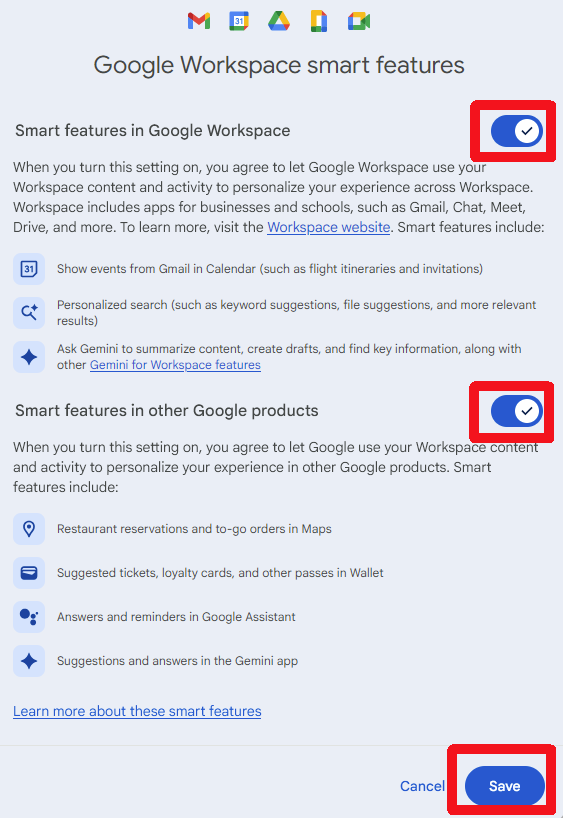
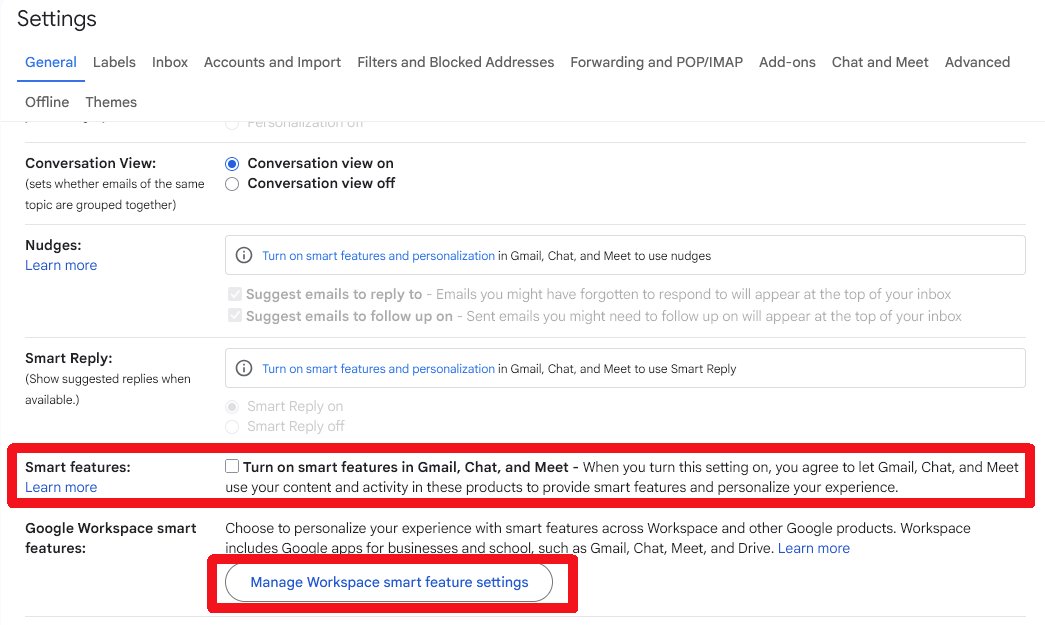
IMPORTANT message for everyone using Gmail.
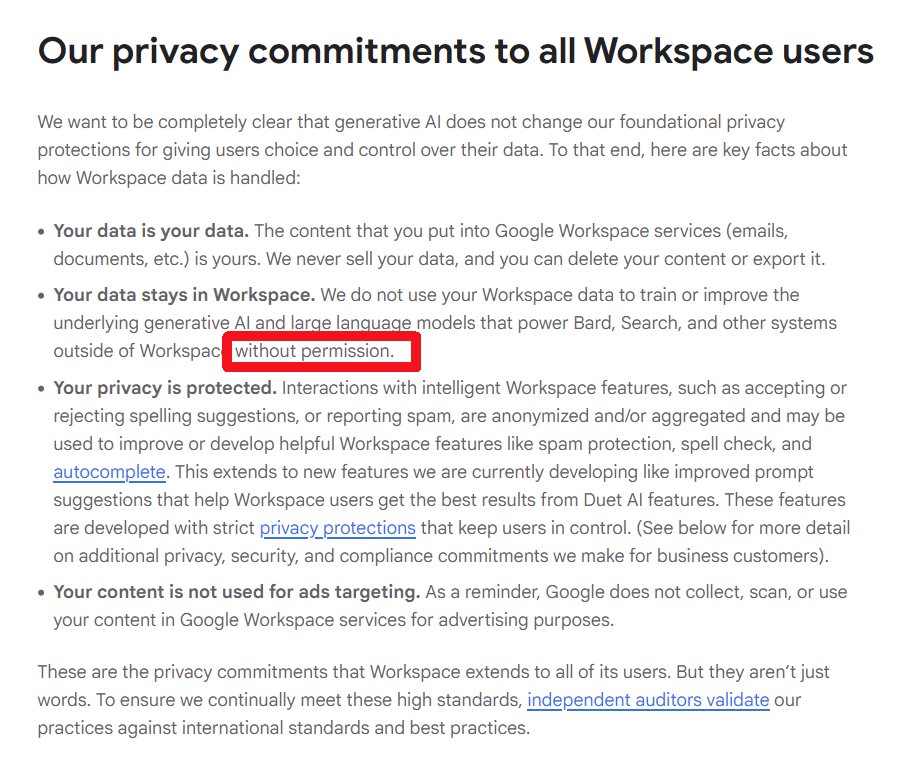
You have been automatically OPTED IN to allow Gmail to access all your private messages & attachments to train AI models.
You have to manually turn off Smart Features in the Setting menu in TWO locations.
Retweet so every is aware.
THE GLOBAL FINANCIAL SYSTEM JUST BROKE IN TOKYO
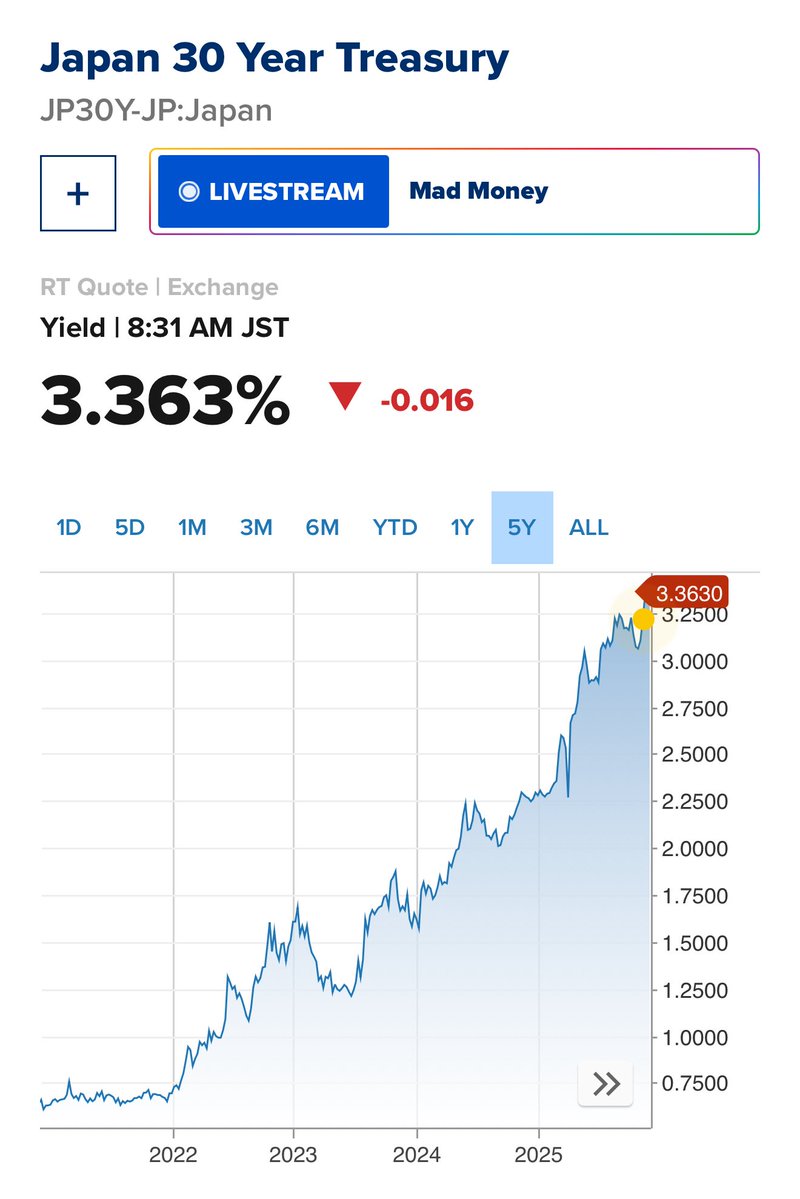
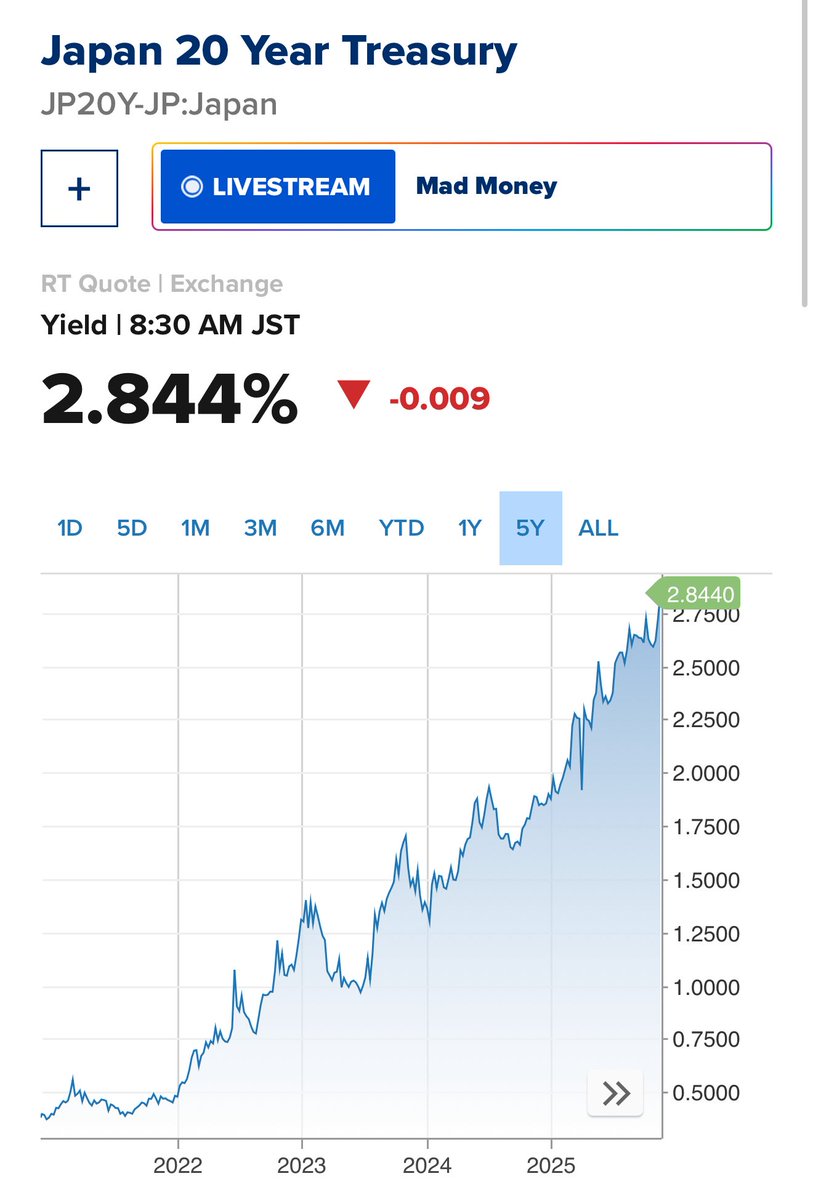
Japan’s 30-year bond yield hit 3.41% today. That number means nothing to you. Here’s why it should terrify you.
Japan owes 230% of everything it produces. It’s the most indebted nation in human history. For 35 years, they kept the lights on by borrowing at near-zero rates. That era ended this morning.
Here’s What Just Happened
Core inflation is running at 3.0%. Government bond yields are spiking to levels not seen since 1999. China just conducted its 25th military incursion near Japanese waters this year. Japan is now forced to spend 2% of GDP on defense … nearly 9 trillion yen annually.
The Bank of Japan is trapped between two impossible choices: raise rates and trigger a debt collapse, or keep rates low and watch inflation destroy savings. They chose door number two.
Why You Should Care
Every major bank, hedge fund, and institution on Earth has borrowed yen at cheap rates and invested it elsewhere for 30 years. This “carry trade” could be worth anywhere from $350 billion to $4 trillion. Nobody knows the real number because it’s hidden in derivatives.
When Japan’s system breaks, this money unwinds. Fast.
The last time we saw a preview … July 2024 … the Nikkei dropped 12.4% in a single day. The Nasdaq fell 13%. That was a small tremor. The earthquake is coming.
The Math Is Simple!
Japan’s government pays interest on $9 trillion in debt. Every 0.5% increase in rates costs them $45 billion annually. At current yields, debt service will consume 10% of all tax revenue. That’s the death spiral threshold.
The yen is trading at 157 to the dollar. If it strengthens to 152, the entire carry trade becomes unprofitable. Unwinding begins. Emerging market currencies could drop 10-15%. The Nasdaq could fall 12-20% as funds are forced to sell.
What Happens Next
December 18-19, the Bank of Japan meets. Markets are pricing 51% odds they raise rates another 0.25%. If they do, volatility explodes. If they don’t, inflation accelerates and the problem gets worse.
There is no way out. Japan’s fiscal dominance is now permanent. They must keep the yen weak to service their debt. This means the free money that powered global markets since 1990 is ending.
The Bottom Line
Interest rates worldwide are going up 0.5-1.0% permanently. Not because of inflation. Because the world’s largest creditor nation can no longer subsidize global growth.
Your mortgage, your car loan, your credit card … all repricing higher. Stock valuations built on cheap money … all compressing. The everything bubble … all deflating.
This is not a recession. This is a regime change. The largest liquidity engine in financial history just seized up, and most people won’t understand what happened until their portfolios are down 30%.
Tokyo broke the world today. You’ll feel it tomorrow.
Read the full data driven deep dive article -
https://t.co/enhJeYNeo1