She kept finding women in laboratory photographs from the 1800s. Then she read the published papers—and every single woman had vanished. Someone had erased them from history.
Yale University, 1969.
Margaret Rossiter was a graduate student studying the history of science. She was one of very few women in her program.
Every Friday afternoon, students and faculty gathered for beers and informal conversation. One week, Margaret asked a simple question: "Were there ever any women scientists?"
The faculty answered firmly: No.
Someone mentioned Marie Curie. The group dismissed it—her husband Pierre really deserved the credit.
Margaret didn't argue. But she also didn't believe them.
So she started looking.
She found a reference book called "American Men of Science"—essentially a Who's Who of scientific achievement. Despite the title, she was shocked to discover it contained entries about women. Botanists trained at Wellesley. Geologists from Vermont.
There were names. There were credentials. There were careers.
The professors had been wrong.
But Margaret's discovery was just the beginning. Because as she dug deeper into archives across the country, she found something far more disturbing.
Photograph after photograph showed women standing at laboratory benches, working with equipment, listed on research teams.
But when she read the published papers, the award citations, the official histories—those same women had disappeared. Their names were missing. Their contributions erased.
It wasn't random. It was systematic.
Women who designed experiments watched male colleagues publish results without giving them credit. Women whose discoveries were assigned to supervisors. Women listed in acknowledgments instead of as authors. Women passed over for awards that went to male collaborators who contributed far less.
Margaret realized she was witnessing a pattern that stretched across centuries.
Women had always been present in science. The record had simply pushed them aside.
She needed a name for what she was documenting.
In the early 1990s, she found it in the work of Matilda Joslyn Gage—a 19th-century suffragist who had written about this exact phenomenon in 1870.
In 1993, Margaret published a paper formally naming it: The Matilda Effect.
The term captured something that had been hidden in plain sight for generations. Once you knew the term, you saw it everywhere.
Her dissertation became a lifelong mission.
For more than 30 years, Margaret researched and wrote her landmark three-volume series: Women Scientists in America. She examined letters, institutional policies, individual careers. She gathered undeniable evidence that women in science had been consistently under-credited and structurally excluded.
Her work faced resistance. Many dismissed women's history as political rather than academic. Others insisted she was exaggerating.
Margaret didn't argue emotionally. She presented data. Documented cases. Patterns repeated across decades and institutions.
Eventually, the evidence became undeniable.
Her research helped restore recognition to scientists who had been erased:
Rosalind Franklin, whose X-ray work revealed DNA's structure—credit went to Watson and Crick.
Lise Meitner, who explained nuclear fission—omitted from the Nobel Prize.
Nettie Stevens, who discovered sex chromosomes—received little credit.
Cecilia Payne-Gaposchkin, who discovered stars are made of hydrogen—initially dismissed.
And countless others whose names had nearly vanished.
Margaret changed the narrative. Science was no longer just the story of solitary male geniuses. It became a story of collaboration that included women who had been written out.
The Matilda Effect became standard terminology. Scholars used it to examine how credit is assigned, how authors are listed, who receives awards, who gets left out.
Imagine stepping into your classroom in Nazi-occupied Brussels and seeing your young pupils marked for death. That was the reality for Andrée Geulen in the summer of 1942.
Just 20 years old and newly qualified as a teacher at a girls’ boarding school, she watched Jewish students arrive wearing the compulsory yellow stars sewn onto their clothes, symbols of humiliation and danger imposed by the German occupiers.
The sight shook her deeply. Some Jewish children simply stopped coming to school. Others sat quietly, heads down, trying to disappear. Andrée refused to let the hatred go unchallenged. She instructed every girl in the class, Jewish and non-Jewish alike, to wear aprons over their uniforms the next day, covering the stars so no child stood out as different or targeted.
That small act of solidarity marked the beginning of something far larger. Word of her courage reached the Belgian resistance, and soon she was approached by the clandestine Committee for the Defence of Jews. They asked if she would help hide Jewish children from deportation and almost certain death.
The work demanded heartbreaking choices. Andrée visited desperate parents in Brussels, explaining the grim truth: trains were carrying entire families to camps from which few returned. She asked them to entrust their children to strangers for safety. “Give me your child,” she would say. “I cannot guarantee you will see them again, but I can promise they will live.”
Some parents agreed at once. Others agonised for days. A few could not bear to part with their families and stayed together until the end.
When consent came, Andrée took over. She removed the yellow stars, gave the children new Christian names and forged papers, then smuggled them across the city, often by bicycle or tram, past German checkpoints where a single mistake meant arrest or worse.
She placed them in convents where nuns raised them as orphans, in farms, monasteries, and private homes run by brave Belgian families who risked everything.
For three years she balanced teaching by day with this secret work by night, maintaining coded lists of every child’s true identity and hiding place, records that could reunite families after the war or doom hundreds if discovered.
She personally helped hide around 300 children, part of a network that saved more than 2,000 in total.
She never wavered, even as colleagues were arrested and friends vanished. Somehow she survived to see liberation in September 1944, aged 23.
The war’s end brought new challenges. Using her lists, Andrée tracked down the hidden children and facilitated reunions with any surviving relatives. Some were joyful embraces after years apart. Others were wrenching: toddlers who no longer remembered their birth families, children who preferred the only parents they had known, or orphans learning no one was coming back.
Andrée spent decades supporting these survivors as they built lives, married, and raised families. She attended their weddings, held their grandchildren, and remained a quiet presence in their stories.
She always insisted she had done nothing extraordinary, that anyone might have acted the same. Yet most people looked away to stay safe. Andrée chose otherwise. A young teacher who refused to ignore the yellow stars went on to save hundreds of lives through years of quiet, daily bravery.
Those choices echoed across generations, creating thousands of descendants who owe their existence to one woman��s refusal to stand by.
Andrée died on May 31, 2022.
In 1989, Yad Vashem recognized Andrée Geulen as Righteous Among the Nations.
May her memory be for a blessing.
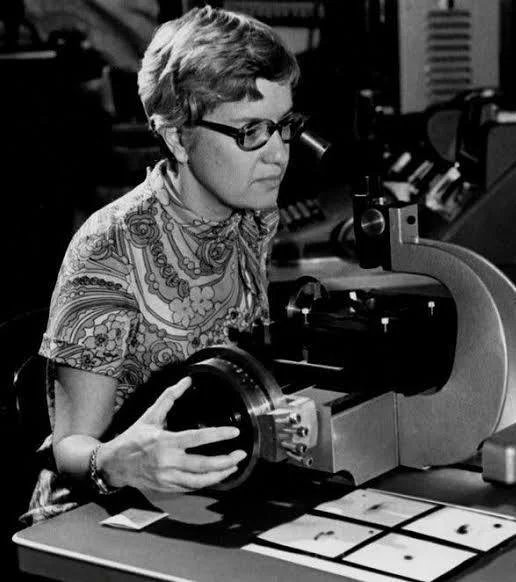
How many times have men used the “but we have no Ladies toilet” excuse to keep women out of the workplace? The Carnegie Institution tried this in 1965 with Woman of the Day astronomer Vera Rubin when she applied to observe at the Palomar Observatory.
She cut out a little paper skirt, taped it over the stick man on the door of the men’s room, said, “There. Now you have a ladies' room”, and stayed until her retirement in 2014. Sometimes direct action is the only way.
Vera made several discoveries and changed our understanding of the universe - “We’re out of kindergarten, but only in about third grade”, she said - but she nearly gave up for the usual reasons.
Born OTD in 1928 in Philadelphia, she was ten when her family moved to Washington. Fascinated by the stars she could see from her bedroom window, she made a telescope out of cardboard with her father’s help. “Even then I was more interested in the question than in the answer. I decided at an early age that we inhabit a very curious world."
Her high school teacher advised her to stay away from science. It wasn’t ladylike. She ignored that and chose Vassar because Maria Mitchell, who’d discovered a comet, had taught there and graduated in 1948, the sole astronomer in her class.
Princeton, her choice of collage for her PhD, barred women from its astrophysics graduate programme - it finally lifted the bar in 1975 - so she enrolled at Cornell instead.
While Princeton was busy gazing at its male navel, Vera was busy observing deviations from the Hubble Flow (the expansion of the universe, where galaxies move away from each other due to the stretching of space itself), and although her theory was wrong, her research showed that the galaxies were indeed moving.
When Vera drove to Pennsylvania through a snowstorm with her three week-old baby beside her to deliver her paper to the American Astronomical Society about the rotation of the universe, “senior astronomers” ripped her work to shreds and it was reported in the Washington Post as “Young Mother Has Own Theory of Universe”.
It so shook her that she thought about giving up but astronomy was her life. She enrolled at Georgetown University for her PhD studies and when her supervisor,
respected astrophysicist George Gamow, met with her at nearby George Washington University, they had to talk in the lobby because women weren’t allowed in the offices.
Her dissertation concluded in 1954 that galaxies clump together. She was right, by the way, but the idea was so controversial that it stood alone for over twenty years.
Deciding to avoid the contempt of “senior astronomers”, Vera looked for “a problem that nobody would bother me about” and discovered one: the expansion of the universe isn’t uniform and most of it is invisible.
In fact, she found that the outer parts of galaxies spin just as fast as the inner ones. Normally, you’d expect the outer parts to move more slowly, as planets do further from the Sun, but they don’t. This "flat rotation curve" meant galaxies should fly apart because the visible stars don’t have enough gravity to hold them together.
Her work suggested there must be a lot of invisible mass - dark matter - holding them together and she calculated that galaxies have 5 to 10 times more mass than the light we can observe from stars. Furthermore, she found that some stars move in the opposite direction to the rest of the galaxy. By proving that galaxies move and rotate in unexpected ways, revealing the presence of dark matter and how galaxies might form through mergers, Vera reshaped our understanding of the universe.
Why wasn’t she nominated for the Nobel Prize? Good question, very good question. In fact, she was widely thought “to have been snubbed” for it. Her findings are widely accepted but they also upset Newton’s Law and the Theory of Relativity.
Vera died in 2016, aged 88.
“We know very little about the universe…I personally don’t believe it’s uniform and the same everywhere. That’s like saying the earth is flat…I don’t know if we have dark matter or have to nudge Newton’s laws or what.”
“Don’t let anyone keep you down for silly reasons such as who you are and don’t worry about prizes and fame. The real prize is finding something new out there.”
@YaekoGames For me a bit too much fire-like things happening in the game (explosions, that fast moving effect)
Can you try an electric discharge effect instead? White/blue arc or flash, maybe even moving along the track border?
@YaekoGames Make their name include a color and a fruit and paint their vehicles this way, e. g.
- Red Cherry (all red)
- Blue Banana (blue and yellow)
- Pink Kiwi (pink and brown)
@PP_Vortex Schon von anderen beantwortet, aber hier ein anderer Ansatz:
Watt ist nur eine kürzere/bequemere Schreibweise für Joule pro Sekunde, die Leistung könnte auch als 570 J/s angegeben werden.
Nach 1h konstanter Leistung: 570 J/s * 3600s = 2052 kJ (Kilojoule), da ist 570Wh bequemer.
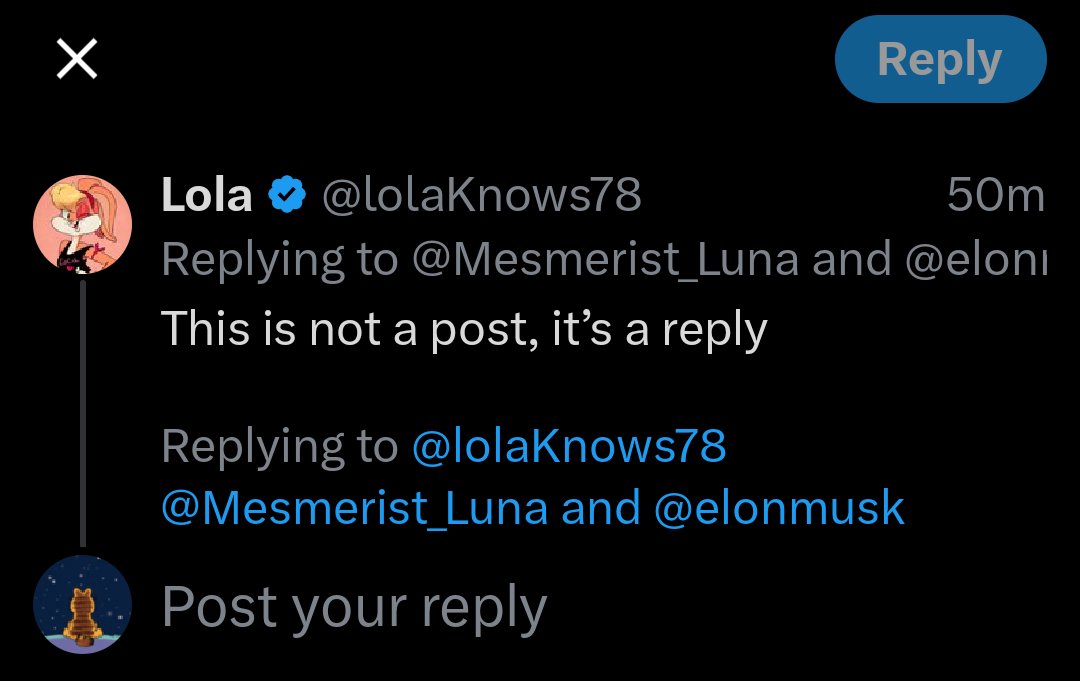
@lolaKnows78 @Mesmerist_Luna@elonmusk "Post your reply" 😁
(yes, "'technically correct' is the best kind of 'correct'", but technically Elon used the verb "to post", not the noun "post")
@lolaKnows78 @Mesmerist_Luna@elonmusk "Post your reply" 😁
(yes, "'technically correct' is the best kind of 'correct'", but technically Elon used the verb "to post", not the noun "post")