That it’s OK for your answers to be shittier if the problem you’re working on is more important is not only wrong, it’s also very much *not* a hot take within academia.
But people like to pretend it is as cope when their paper get rejected.
If I were cynical, I'd argue that the negative weight issue has been so readily embraced by the profession precisely because it never posed an existential threat to the current practice of applied econometrics.
I find it weird how much digital ink has been spilled on the (minor) TWFE negative weight issue.
When the *obvious* problem with the DiD literature is that people barely ever have enough pretreatment data to be able to meaningfully reject the parallel trend assumption.
Yes, in industry, you do stupid things like creating PowerPoint slides, as opposed to academia, where you do important things like creating Beamer slides.
An alternative outcome is you might become motivated to stay in academia, e.g. when you realize you can achieve more important things by creating ideas than by creating PowerPoint slides.
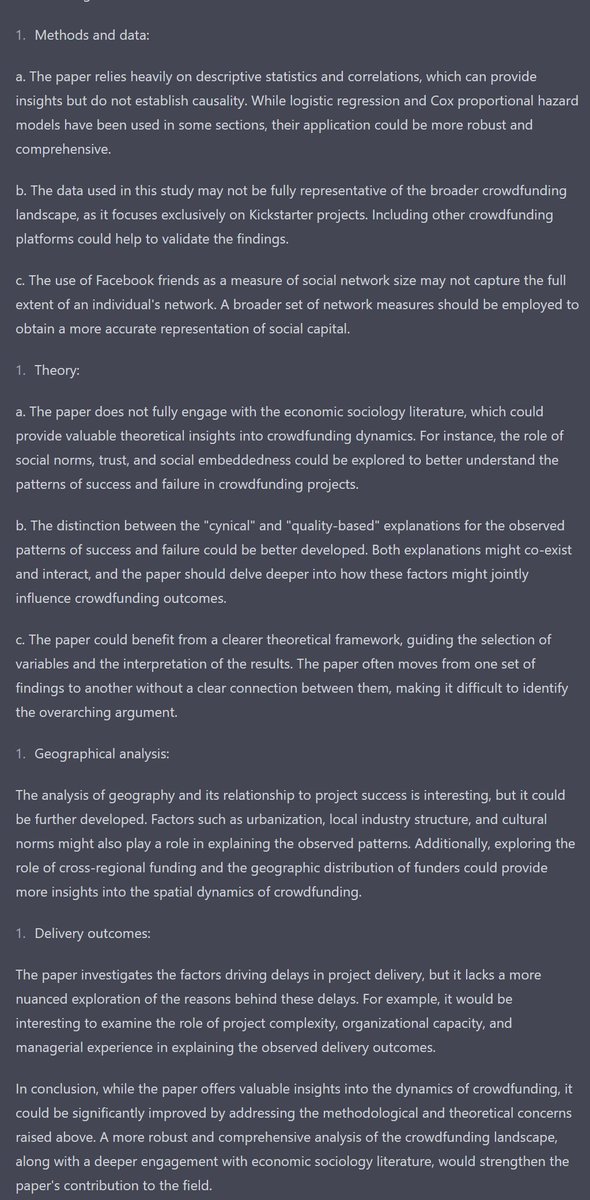
I agree it's a completely reasonable report. In fact, I've seen much worse. But that's kind of the problem. Taking peer review seriously would require engaging with papers in a way that's not done, and frankly not doable for researchers given how academia currently works.
Not sure how to feel about this as an academic: I put one of my old papers into GPT-4 (broken into into 2 parts) and asked for a harsh but fair peer review from a economic sociologist.
It created a completely reasonable peer review that hit many of the points my reviewers raised
All of these comments are incredibly broad, superficial and unspecific.
"Correlation is not causality."
"How can we be sure it generalizes to other samples?"
"XYZ needs more discussion, maybe a model."
"XYZ could be further developed."
"Should engage more with the literature."