Business-politics relations, social policy, industrial relations, taxation. Associate Professor in Business and Public Policy at Roskilde University, Denmark.
Why do some trade unions support the EU’s Directive on Adequate Minimum Wages, while others oppose it? Eriks Ozols, Stefan Ivanov Hristov and I investigate this question in a new article in Economic and Industrial Democracy.
https://t.co/y7UiNPqZXY
🧵A thread (1/7)
Dutch and Danish employers' associations prefer the status quo in welfare state programs to radical reforms, argue Mikkel Mailand and Frank Tros in this paper: https://t.co/FQW9hWc8VC
Capitalism and Democracy in the West
Peter A. Hall has a forthcoming book that traces changes in the relationship between capitalism and democracy in Europe and the US since 1945.
The core of the argument can be read in this article: https://t.co/xcyfBP6clT
Mann’s Sources of Social Power
Is human history driven by economic, ideological, political or military power? This is the overarching question of this ambitious survey of history by sociologist Michael Mann.
I am rereading the work with a focus on Mann's ideas about the state.
Great piece by Peter Osborne on Habermas and his biography by Müller-Doohm, from 2017. Very insightful on Habermas’s life, career and work, from someone very close to the heritage of Critical Theory.
https://t.co/GNIrunyu7x
Für mich ein Klassiker: Der Essay "Die neue Unübersichtlichkeit" (1985), in dem Habermas drei Reaktionsmuster auf die Krise des Sozialstaats identifiziert: Legitimismus, Neokonservativismus, und Wachstumskritik.
https://t.co/XjzDuIEuBD
Capitalism, State, Democracy
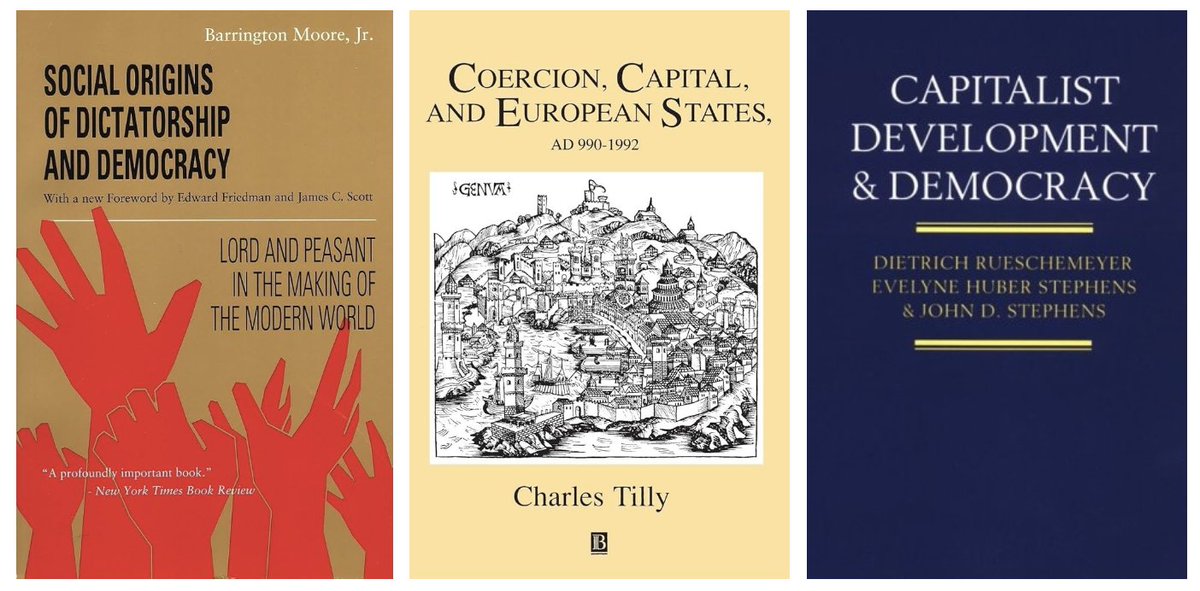
This week my graduate seminar focuses on two macro-transformations, capitalist development and state formation, and their impact on the prospects of democracy. These works launched an approach to the study of democracy I call power structure theory.
Why do unions in Denmark and Sweden—unlike many of their European counterparts—oppose EU involvement in wage-setting? Eriks Ozols, Stefan Ivanov Hristov, and I examine the roots of this opposition in our article in Economic and Industrial Democracy.
https://t.co/y7UiNPrxNw
An Interview with Charles Tilly
Philosopher @dlittle30 conducted an interview with Tilly that covers many of his signature interests: state formation, historical sociology, big questions, causal mechanisms. A real treasure.
See the interview here: https://t.co/U4qdCWB4qv
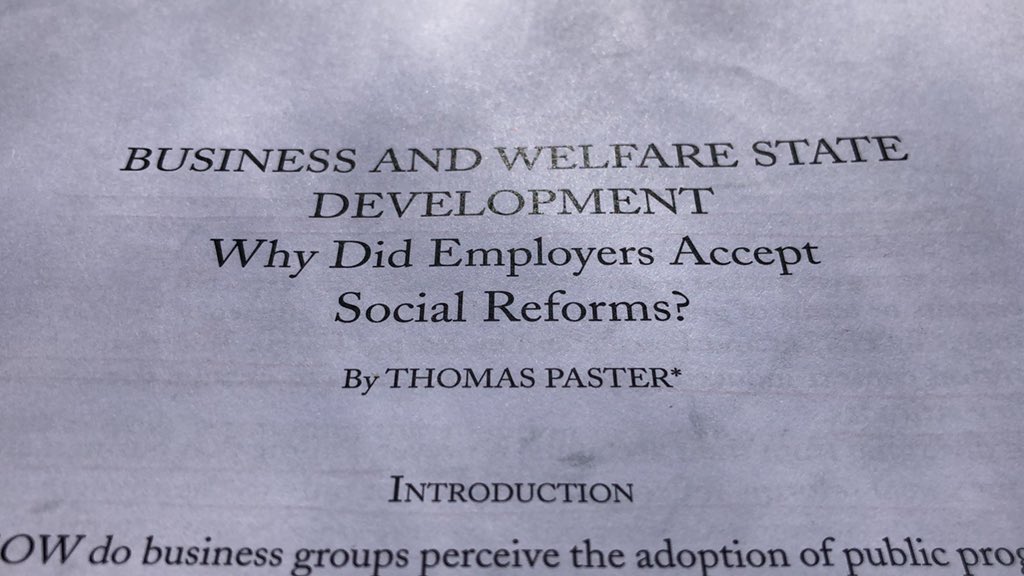
Revisiting a modern classic by @thomas_paster: simple and elegant explanation of why employers become proactive in welfare policies. Simple asnwer; they face a radical opposition. Reformist movements are instead faced with containment strategies.