Yesterday, we shipped Opus 4.8, Anthropics latest frontier model, to nuwacom. Should you now default all your chats and agents to it?
By no means. A year or two ago, "just pick the latest model" was maybe a decent heurisitc. But this has changed. Models tend to excel at different things, they have strength and weaknesses, and become more like specialized tools.
In turn, selecting be best tool for the job becomes the challenge. And besides output quality, cost needs to factor into the equation as well.
I, for instance, use Sonnet 4.6 for most everyday work, including basic coding. I use Mistral for translations (mostly ENG <-> DE). I only use Opus for complex tasks that require the large context window and the output quality surplus, e.g. complex coding or writing tasks. For quantitave analysis, GPT-5.5 is my go-to.
Being thoughtful about model use is both economically sound and improves output quality.
What are your preferred models for which task?
Say you want to create a glossary explaining your product's terminology for a skill to use it.
Say you have more than 25 terms to explain in there.
Would you create a glossary_index.md with only the terms, pointing to a glossary_term.md that contains the actual definitions or is that over-optimization?
At how many terms would you opt for a nested structure?
@paulg I contest there is such a thing as a good and honest AI-supported writing process.
Would you still feel tricked if you found out, after reading a thoughtfully and deliberately crafted message, that it was co-produced with AI?
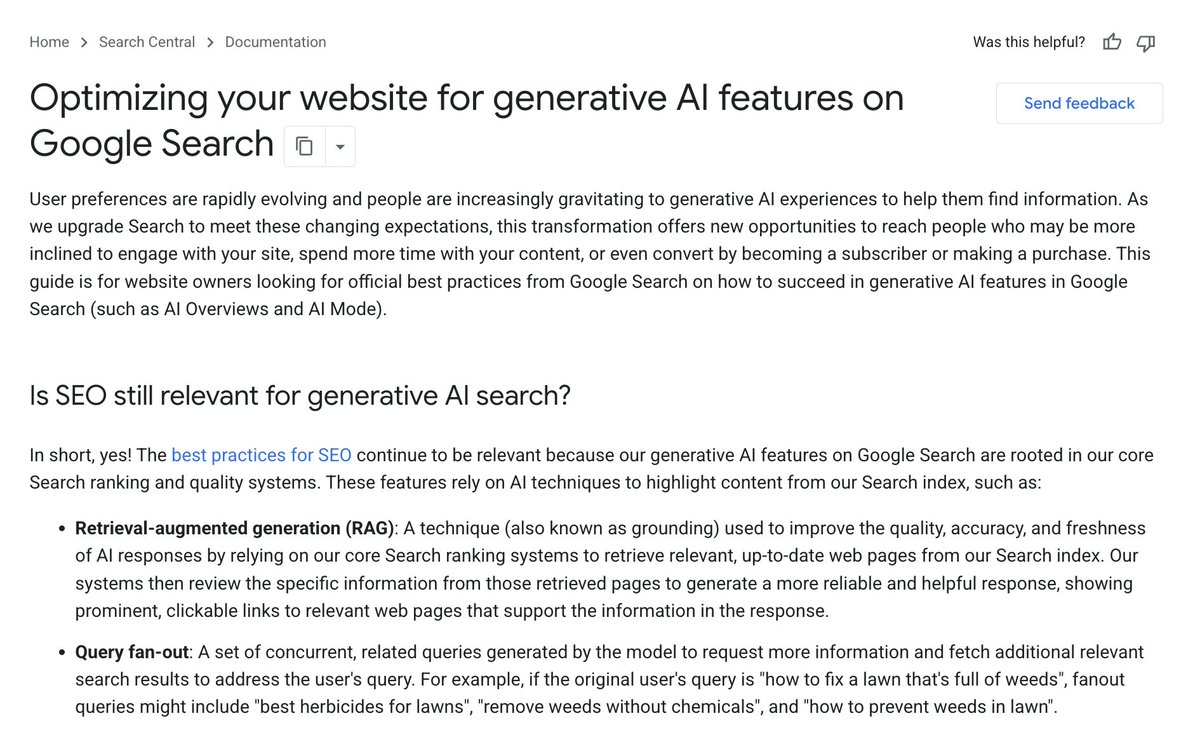
🚨 JUST IN - Google published a long piece about "Optimizing your website for generative AI features on Google Search" 👀
A lot in it https://t.co/22t75EtwUH
🧵
Introducing: the Notion Developer Platform
New building blocks that help you (and your coding agents) sync any data source, build any tool, and orchestrate any agent.
Follow along 👇 https://t.co/wxZDYxBrqK
@mschoening Meine Mama hat mir schon Anfang der 90er Jahre mitgegeben: "Form follows function". Wird leider allzu oft vergessen, ob im Analogen oder Digitalen.
In yesterday's CRO Orgs article I mentioned - somewhat in passing - that I foresee more enterprise software to be highly customizable.
I'm not talking about custom dashboards but about proper application logic, workflows, even architecture.
Of course, this will be powered by AI. Tell a software how you want it to behave and how you want to work and the components that need to be revised will change according to your need.
The software will make sure you end up with a sound logic and then it will write, and deploy the code to give you what you need.
Importantly, I think this will be doable by business users, not engineers.
Do you have examples of products that already do this?
Vor ein paar Wochen saßen meine Söhne (3 und 5) und ich beim Frühstück. Sie wollten "mit Papas Handy" eine eigene Geschichte machen.
Also haben wir angefangen: Wer sind die Figuren? Was passiert? Welche Abenteuer erleben sie?
Daraus ist Schokolade geworden — ein kleines, sprechendes Flugzeug aus Vollmilchschokolade. Und seine Freunde Dami und Samy, die durch einen magischen Spiegel in fantastische Welten reisen.
Wir haben jeden Satz zusammen erdacht. KI hat bei Text und Illustrationen geholfen. Das letzte Wort hatten immer wir drei.
Ich habe die Geschichte jetzt auf einer kleinen Website veröffentlicht. Mein Ziel war es, alles ganz reduziert und optimiert fürs Vorlesen (am besten auf einem Tablet) zu halten.
Schaut gerne mal drauf:
👉 https://t.co/FYxL0ISLUy
Wenn ihr sie mit euren Kindern lest: ich freue mich über jedes Feedback 🙏
(Die Seite ist nagelneu — Fehler und Verbesserungsvorschläge gerne direkt an mich)
Mein neuester Artikel darüber, warum GTM Teams mit KI nicht auf Effizienz, sondern Relevanz optimieren sollten, ist nun auch auf DE online:
https://t.co/FGBxw0xctg
@brendanjshort Couldn't agree more.
And btw/not btw: writing - and the clear thinking that derives from it - is arguably the single most important skill you need to use AI effectively.
In recent GTM history, advantage went to whoever could reach the most people.
When relevance becomes scalable, the variable shifts: how well do you understand the people you're trying to serve?
Most teams are still running the old race.
Full piece: https://t.co/EkqjLR0TZu
Two ways to get this wrong.
1. Pseudo-relevance at scale. Longer briefs, miinterpreted LinkedIn post references in line three. That's still slop.
2. Thinking AI does the understanding and humans greenlight the output. Real customer understanding is still a human domain.
That is such a smart design choice and way of collaborating with AI on a team level.
I hope Claude Code et al. take note and making setting up a comparable interaction model as simple as choosing a template.