PT1 - The GTMfund Welcome Reception.
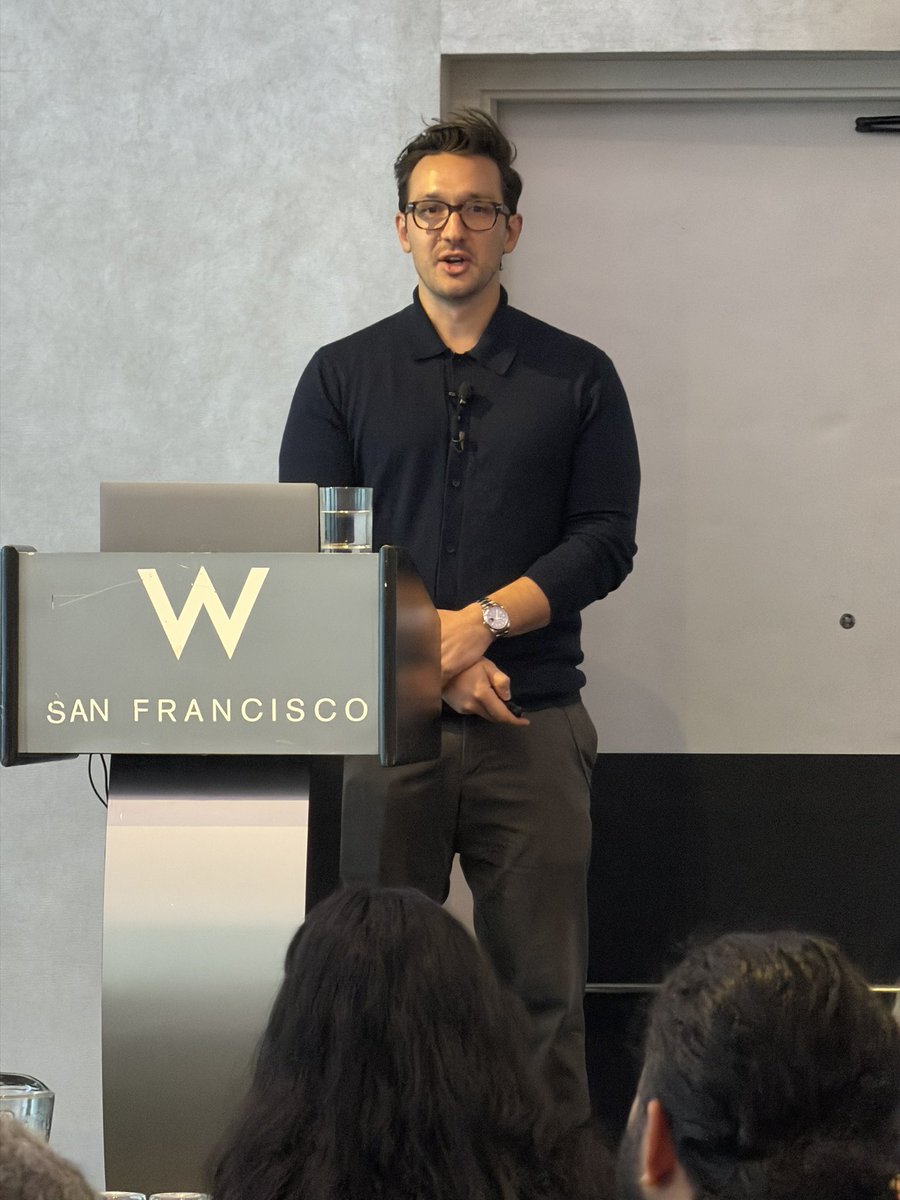
On Thursday, 150 GTM leaders, investors, and founders came together the night before our AGM.
We got to hear on stage from two people in the community. They sell into very different sides of the AI market, so they see it from different angles:
@mikemolinet (Founder, Dock) - entrenched in everything AI agents.
Fun fact: Dock is how we've built our media agent team at GTMnow.
@boborado (Chief Commercial Officer, Lambda) - sells compute to AI labs and enterprises.
Fun fact: Lambda has a robot that hangs around the office, cleaning desks and doing dishes.
What an evening! Thank you to everyone who was part of it.
And a big thank you to our sponsors: @airspeedhq, @AngelList, @cartainc, Accord.
PT2 (the AGM) is coming next.
What an incredible week at the @GTMfund Annual General Meeting and LP retreat.
This was our 2nd AGM and 5th annual LP retreat and definitely our best ones yet. So great to see old friends along with many new faces.
Our theme this year was “Everything Compounds”. We’ve been in business for 6 years, we’re on Fund III now, and everything we do has compounded in an incredible way.
From deal flow, to LP community, to media, our ability to support, to the team quality, everything has leveled up significantly.
Thank you to our founder session CEOs Jeffrey Morgan from Ollama, Tucker Dordevic from Austin Sensing Company, and Brandon Terry from Village.
Sophie Buonassisi and Yoon Li put on an amazing few days of programming and our team knocked it out of the park.
Excited for the next one!
Nichole Wischoff (@NWischoff) says her worst investments came from backing great ideas with the wrong founders.
After investing in promising startups, she'd sometimes discover a much stronger team pursuing the same idea just weeks later.
Nichole on why patience matters in venture capital:
“The worst deals we've done are B+ founders with A+ ideas.”
“We've made that investment and three weeks later there's a way better team.”
“We share our top 15 deals a month that we see and they share theirs back. And so I think every month we see anywhere from 300 to 500 deals.”
Nichole Wischoff: Why Silicon Valley Is Bad for Early-Stage Investors via Trailblazers Podcast
In 2016, on Tuesday, looking at data rolling in, I told the then-global head of rates at JPM that Trump would win.
It was not, shall we say, a consensus call at the time.
So I want to talk a little bit about what I'm seeing right now, since the timeline is going crazy.
On a trading desk, it matters more to be right than to be popular, and it matters more to be right than to predict what you want to happen.
I have the curse of being a mathematician by training. So I still have the muscles, even if I don't use them as much.
Right now I would say this:
1 - Anyone who thinks they know anything with high confidence you should immediately discount in this election cycle.
2 - The error bars on races, especially the swing races in the Senate, are likely so large that polling may not be particularly predictive.
3 - There are conflicting cross factors that really are making a mess out of some of the traditional polling which is causing this.
Namely, what I'm seeing is a few things that gives me major heartburn.
First, non-response rates to polls are now so high I think it's impossible to know if we have a representative sample of any subgroup. We can 100% get the aggregate weighting correct to voter turnout, but when you model your R sample at 10% crossover votes and get 4%, or your I sample at mildly D leaning at +2% but instead get +10%, it means all your re-weighting was an exercise in false specificity.
Second, we have major conflicts in the data. People are claiming they did not vote for Trump in 2024 when we are pretty sure they did, and we are getting R samples in some swing states where if the sample is correct about the sides voting in 2024, Harris would be president (she's not, if you've been in a coma). At the same time, we have young people looking maybe way more like they did in 2022 than 2026, and we know we are missing a large chunk of that sample because they never fucking answer the phone, so the net result is... ... ...? Yeah, nobody knows.
Third, mutually combative forces. Anti-incumbency is a thing in mid-term elections, it's also a thing in American politics where "fuck the guy in charge I hate it here" seems to be stronger than partisanship in an increasing number of cases. This means that helps Dems in red states but hurts Dems in blue states? The reverse would be true for Republicans. These kinds of forces produce compression.
Fourth, social media and Twitter are not the real world, but the distortionary forces here are influencing the polling landscape, where I would imagine the most media-connected people are also the ones taking polls, which leads to the invisible sample also being the ones in a different discourse bubble than the ones on here.
The punch line is simple: take any error bar and triple it. Quadruple if you're in Maine or something. We don't know anything, and any confident prediction about Dems taking the Senate or Republicans holding the House are almost certainly wrong. Not in their specific outcome, but rather, in good process. All pigs are fish therefore 2+2 = 4 type thinking.
Right now, depending on how you want to torture the data, you can see any outcome from R/R to D/D and any middle state. We've had large polling misses meaning we should be favoring Dems (NJ governor, anyone?), Rs being underweighted in the past meaning we should favor them (IA, anyone?), and just internal polling that was way off (El-Sayed way up in the primary, anyone?).
Anyone giving you a confident hot take here, in short, is full of it. Even the early voting is not uniform, and while the information content there is not always high, there is usually not zero, and if you're looking at data from GA vs. OH, you aren't getting the exact same vibes, much less some other places.
In short: national politics is getting weirder, polling is getting harder, the parties are fragmenting internally, and nobody knows shit yet.
Good news, though: they'll all claim they were right after the fact. What you should do is track both predictions and process to see who is really worth listening to over time.
🎙️ Watch now: debut podcast available on all platforms.
Episode 1. Satya Nadella on “Confession with Ali Partovi”
– The interview question he still thinks about decades later
–"We won the browser war, only to lose the web"
– His son Zain and how his empathy journey began
… and much more with Microsoft CEO @satyanadella.
(0:00) “You need more empathy”: a job interview gone bad
(0:27) Welcome to Confession
(1:06) Growing up in India
(4:13) “See the world through his eyes”: the birth of his son Zain
(11:27) “I didn’t care. I didn’t listen”: failing as a manager
(16:07) “It haunts me”: lacking the courage to speak up
(19:50) “We didn’t understand that the economic value is all in search”
(26:19) Ali: “I was essentially fired… I’ve never told anyone”
Super excited to see our LPs, founders, and partners at the GTMfund AGM in SF this week, starting with the Thursday night welcome reception.
We've been in business for about 6 years now and it's incredible to see the entire thing compound the way it has.
i am short companies whose margins depend on the cost of performing verifiable work.
i am long companies whose margins depend on owning very very consequential outcomes.
this applies to both public/private markets.
@HarryStebbings Absolutely. Founder quality above all. Even better if it's the right market and they've proven an ability to hire other great people.
And once you're on the rocket ship, be the first one in and the last one out of the office every day. It matters.
T-Mobile CTO in new post on @SpaceX acquiring nationwide low-band spectrum to help turn Starlink into a major U.S. mobile carrier:
"Some are calling it the "last critical piece" needed to compete with the national wireless carriers. I can tell you there's a big difference between owning spectrum and delivering a great mobile experience to millions of customers.
A few things worth keeping in perspective:
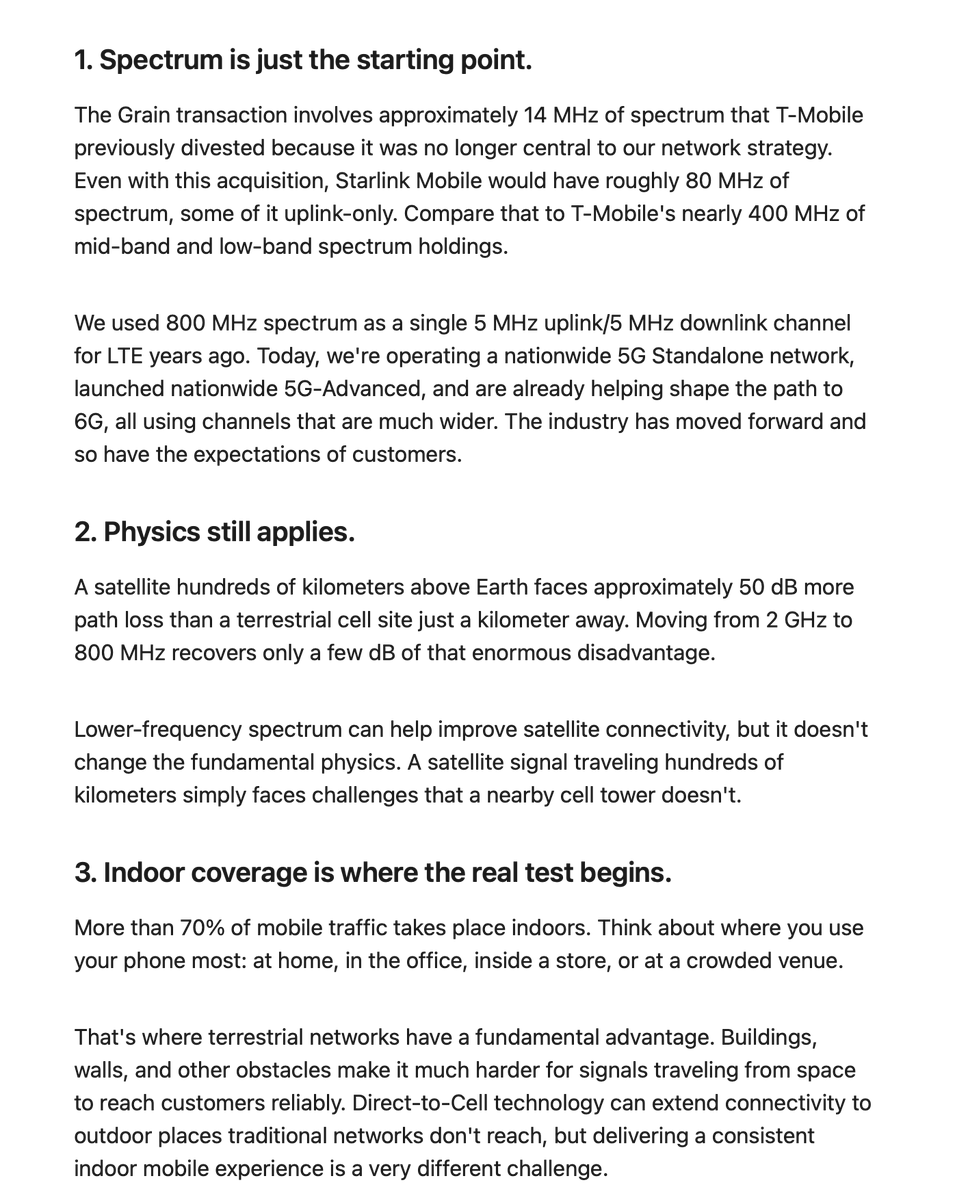
1) Spectrum is just the starting point.
The Grain transaction involves approximately 14 MHz of spectrum that T-Mobile previously divested because it was no longer central to our network strategy. Even with this acquisition, @Starlink Mobile would have roughly 80 MHz of spectrum, some of it uplink-only. Compare that to T-Mobile's nearly 400 MHz of mid-band and low-band spectrum holdings.
We used 800 MHz spectrum as a single 5 MHz uplink/5 MHz downlink channel for LTE years ago. Today, we're operating a nationwide 5G Standalone network, launched nationwide 5G-Advanced, and are already helping shape the path to 6G, all using channels that are much wider. The industry has moved forward and so have the expectations of customers.
2) Physics still applies.
A satellite hundreds of kilometers above Earth faces approximately 50 dB more path loss than a terrestrial cell site just a kilometer away. Moving from 2 GHz to 800 MHz recovers only a few dB of that enormous disadvantage.
Lower-frequency spectrum can help improve satellite connectivity, but it doesn't change the fundamental physics. A satellite signal traveling hundreds of kilometers simply faces challenges that a nearby cell tower doesn't.
3) Indoor coverage is where the real test begins.
More than 70% of mobile traffic takes place indoors. Think about where you use your phone most: at home, in the office, inside a store, or at a crowded venue.
That's where terrestrial networks have a fundamental advantage. Buildings, walls, and other obstacles make it much harder for signals traveling from space to reach customers reliably. Direct-to-Cell technology can extend connectivity to outdoor places traditional networks don't reach, but delivering a consistent indoor mobile experience is a very different challenge.
4) Capacity matters just as much as coverage.
One satellite beam can cover an area served by hundreds of terrestrial cell sectors. Those terrestrial sectors provide the network density needed to support millions of customers streaming video, making calls, working, gaming, and using data simultaneously.
Covering a geographic area is one thing. Delivering the speed, responsiveness, and capacity customers expect from a modern 5G-Advanced network is another.
Direct-to-Cell has an important role to play in extending coverage. But it is a complement to terrestrial networks, not a replacement for the capacity of a dense 5G-Advanced network.
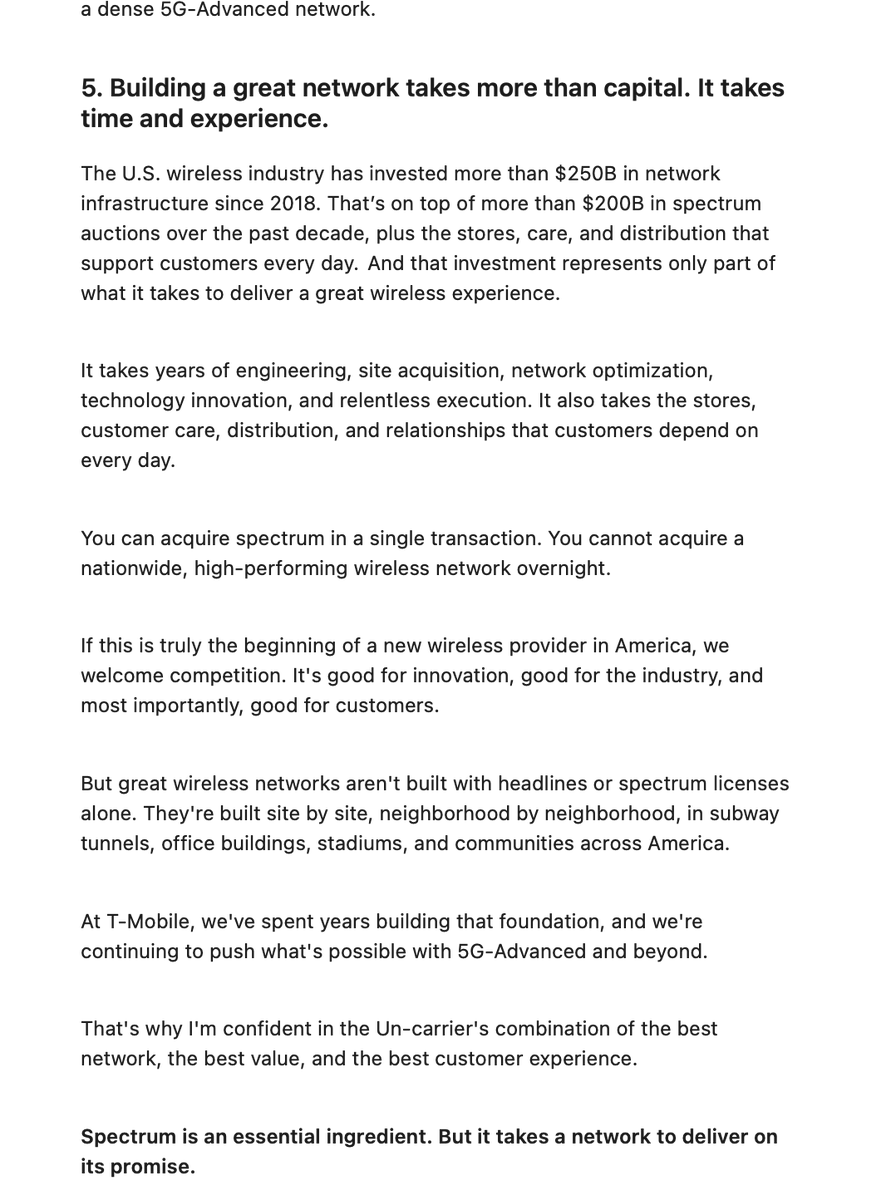
5) Building a great network takes more than capital. It takes time and experience.
The U.S. wireless industry has invested more than $250B in network infrastructure since 2018. That’s on top of more than $200B in spectrum auctions over the past decade, plus the stores, care, and distribution that support customers every day. And that investment represents only part of what it takes to deliver a great wireless experience.
You can acquire spectrum in a single transaction. You cannot acquire a nationwide, high-performing wireless network overnight.
If this is truly the beginning of a new wireless provider in America, we welcome competition. It's good for innovation, good for the industry, and most importantly, good for customers.
But great wireless networks aren't built with headlines or spectrum licenses alone. They're built site by site, neighborhood by neighborhood, in subway tunnels, office buildings, stadiums, and communities across America.
Spectrum is an essential ingredient. But it takes a network to deliver on its promise."
As we’re all talking about misleading math on X today, here’s an ask for VCs and founders:
If multi-tranche rounds are the new standard, then sharing the valuation for each tranche should be the standard too—instead of misleading employees and the public into thinking a company raised a massive round all at a massive valuation.
The structure matters. The amount of capital raised at each price matters. And the blended economics matter.
Maybe this happened in previous boom cycles too, but it feels particularly prevalent now. More importantly, it makes me much less likely to trust the numbers coming out of a company if they’re not willing to be honest about this
Ok that's all
The best tactics in GTM are hard or manual. Always have been. Hard is a moat. When AI makes everything an easy button, everyone can do it, and then it's noise.
Was just speaking to a room of 30 Bay Area tech founders. Asked: “if I gave you a thousand shares, for free, of Anthropic, openAI or SpaceX, which would you choose?”
Two thirds took Anthropic. One third took SpaceX. Not a single taker for OpenAI.