@DiegoTalksAi@itsolelehmann People overestimate Obsidian in the stack. Think it's because the graph view. You can generate a better, custom graph tool with an LLM.
Been working on a Design Systems LLM logic for existing products for the last few weeks. It takes a lot of hands on work. One of the TLDR results is: the "design.md" magic does NOT work. No one shot Skill is feasible. Don't trust them, use as inspiration only.
43% of designers spend more than half their time vibe coding.
37% do zero.
I just finished going through 1,478 survey responses for our State of Prototyping report.
Designers spending about half their time vibe coding is the smallest group at 12%.
People aren't easing in. They're either all-in or they haven't started.
Design engineers make up 80.9% majority vibe coding.
IC designers: 35.0%.
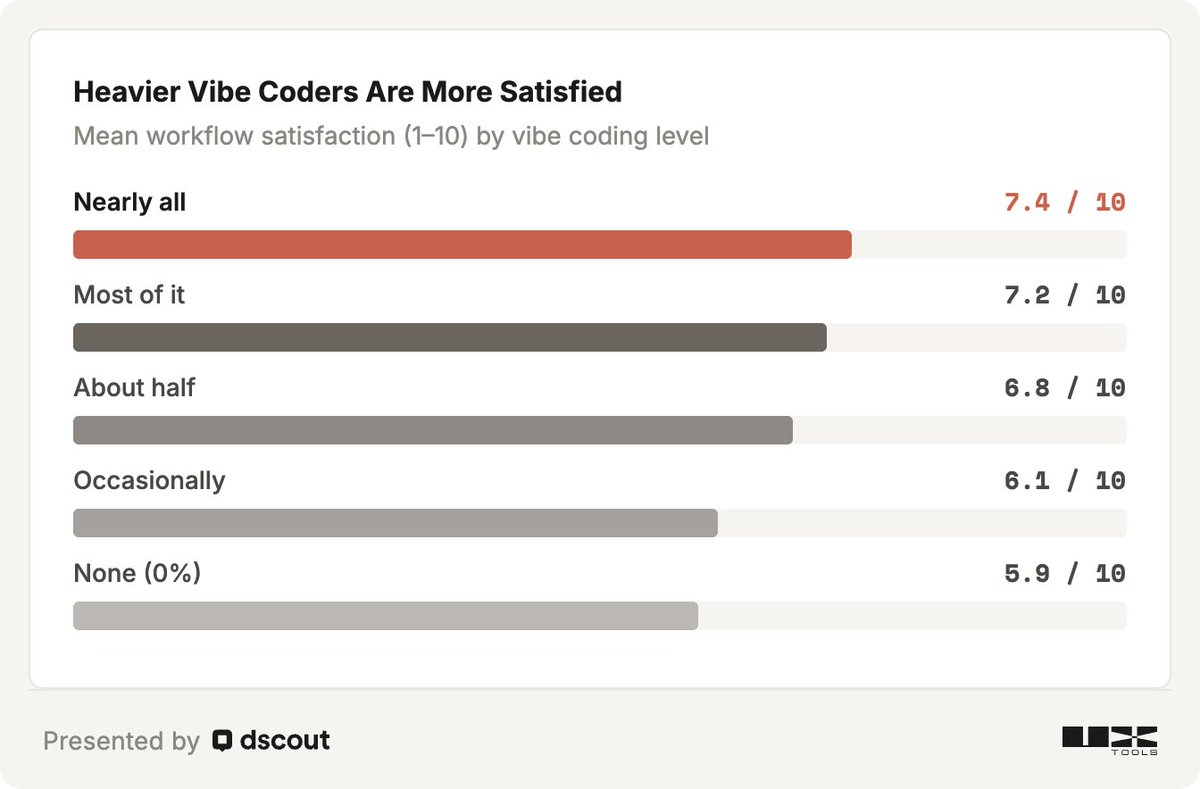
Workflow satisfaction tracks with them:
- No vibe coding: 5.93/10
- Heavy vibe coders: 7.39/10
Full report, raw dataset, and open API available thanks to @dazl_dev, @framer, @MagicPathAI, @dscout, @magicpatterns, and @mobbin.
@designertom Thank you for this, well put. I was always drawn to game design. I ended up in UX, but now I can finally start experimenting. Lower rev is fine with lower costs. Niche target groups could be served.
Watching @Claude making annotations on my web app in real time is rewarding and a little deceptive.
Opens browser, scrolls through everything, clicks on
elements, and writes design critique annotations directly on the UI.
Stack: Agentation (by @benjitaylor) + agent-browser (headed browser CLI) + Claude Code skill.
Made 15 annotations on my new university tool: broken visual hierarchy, misleading empty states, competing with CTAs... and fixed all 11 in one pass.
Super useful, but Claude still misses deeper issues around value proposition and user flow (this was made with gstack, btw). Senior UX designers are still very much needed to orchestrate this.
@CiaoQuirkTax Haha, true 🙏 I wasn’t active here. Mostly reading, follow all kinds of creators to catch all the resources, tools I can try. Managing my lists is a challenge.
I built a Claude Code skill to fight "Brain Fry" (more decision fatigue, more errors from managing AI threads).
Every unclosed terminal session is an open loop you're tracking in your head.
/close is a ritual that gives AI sessions a definite ending:
🔊Introducing Voxtral TTS: our new frontier open-weight model for natural, expressive, and ultra-fast text-to-speech
🎭Realistic, emotionally expressive speech.
🌍Supports 9 languages and accurately captures diverse dialects.
⚡Very low latency for time-to-first-audio.
🔄Easily adaptable to new voices
Interesting times for anyone whose entire workflow lives inside one company’s product. Figma is still THE tool, but the new narratives and vibes on the market is a refreshing sight. Let's hope, there will be a real competition.
Look at that, Figma’s stock dropped 8,8% after Google introduced updates to its “vibe design” tool Stitch, promising an AI-native work and design system as markdown rules (more thoughts on this later) The space is in frenzy mode.
According to @toolbenders annual survey, Figma was sitting at 82.3% penetration (Penpot at .3%). Google is not on the list. But that was in 2024-25. The former king, Sketch is around 2%.