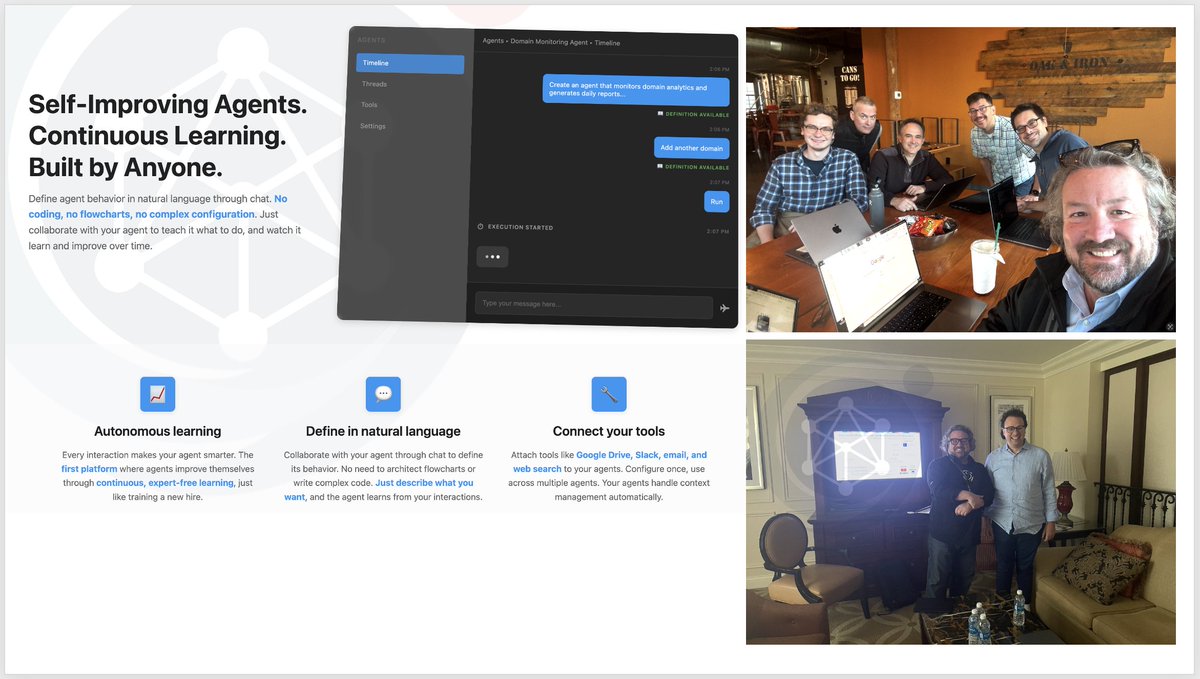
A couple years ago I had a conversation with 𝐃𝐚𝐫𝐢𝐨 about the future of AI and specifically Large Language Models (LLMs) and their potential capabilities...
https://t.co/i5s4yLhHhu
𝐀𝐧𝐭𝐡𝐫𝐨𝐩𝐢𝐜 just dropped an important essay on 𝐫𝐞𝐜𝐮𝐫𝐬𝐢𝐯𝐞 𝐬𝐞𝐥𝐟-𝐢𝐦𝐩𝐫𝐨𝐯𝐞𝐦𝐞𝐧𝐭, and I think it is a serious contribution to one of the defining questions in AI. Though there is a critical distinction worth making.
https://t.co/GwjqXuHQWH
Open-weight models have overtaken closed models on OpenRouter.
69.1% of token volume now goes to open-weight models. 30.9% to closed.
Competition is a discovery procedure — and developers are discovering the value of open models.
🧵
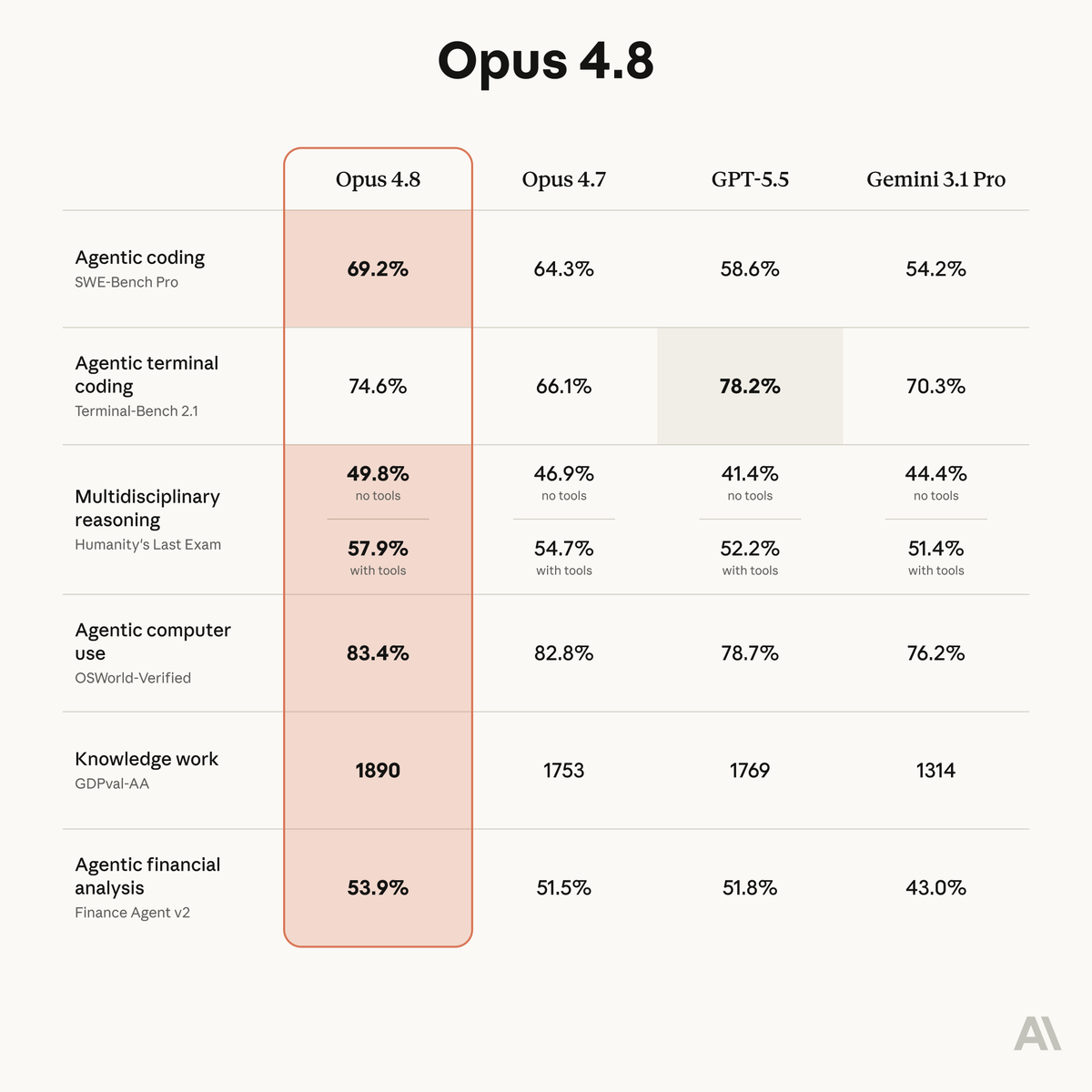
Introducing Claude Opus 4.8: it builds on Opus 4.7 with sharper judgment, more honesty about its own progress, and the ability to work independently for longer than its predecessors.
Available today at the same price.
State of Enterprise AI 2026: @levie on Tokenmaxxing, The Rise of Headless, and AI-Proofing Your Job
00:00 Intro
01:18 Silicon Valley engineering vs. everyone else
05:35 Are enterprise CIOs actually bullish on AI?
08:51 Tokenmaxxing & why your AI bill is about to explode
11:34 The myth of falling token costs and AI spend escaping IT budgets
17:37 The $5B startup hiding in AI compute
18:14 The mosaic of models inside every enterprise
21:28 Why coding works and the rest of knowledge work doesn't
25:53 The Bob and Sally problem: access control breaks agents
30:31 Will enterprise AI really take 10 years to roll out
32:24 The capability overhang: why faster models slow diffusion
34:23 Data is the bottleneck (it always was)
39:02 The rise of internal forward-deployed engineers
41:23 Why the AI doomers are wrong about jobs
43:43 Headless software is inevitable
46:14 What replaces per-seat pricing
47:37 How Box itself is going headless
49:42 How the org chart actually evolves
1:00:33 Future-proofing yourself as an enterprise employee
1:06:40 Are we all just going to work for OpenAI and Anthropic?
1:07:11 Where startups can still win as the labs move up
ALL-IN POD IS LIVE! 🚨
Massive show
Gavin Baker (@GavinSBaker) subs in for Sacks to talk:
-- Andrej Karpathy Joining Anthropic: Impact on the AI Race?
-- SpaceX S-1 Breakdown: The $2T Case, Elon Web Services, Datacenters in Space
-- Nvidia’s Big Beat and Shock Selloff
-- Why America Has Turned on AI
-- Trump Pulls AI Order
-- Market Update: Inflation, Bond Crisis?
-- Did the US-China Summit Flop?
(0:00) Gavin Baker joins the show!
(0:30) Andrej Karpathy joins Anthropic; hypergrowth and profitability
(12:42) Why Americans have turned on AI, anti-human perception
(27:22) Trump pulls AI EO, US-China AI relationship, dystopian AI layoffs
(45:19) SpaceX S-1 tear down! Three major businesses and the case for $2T
(1:11:22) Nvidia smashes earnings but stock falls, why people are shorting chips
(1:22:25) Market update: Flashing red signals, oil, inflation, yields up
(1:32:45) China trip flops, or was progress made behind the scenes?
Today I probably tried one of the coolest tools since @OpenAI's chatgpt app. If you have not heard of @suno, you definitely need to check them out. Made some computer science nerds sound pretty cool - https://t.co/LmBFLZ7Vpt
New blog: The AI industry is debating "model vs. harness"... but that framing is already becoming outdated.
We mapped out the 4 generations of AI agent architecture:
Gen 1 >> Copilots (reactive, session-based)
Gen 2 >> Agent Runtimes (autonomous, RAG, tool aware)
Gen 3 >> Agent Operating Systems (persistent, context-rich)
Gen4 >> Cognitive OS (the harness teaches the model)
The real shift isn't smarter models or smarter wrappers. It's when execution becomes the source of future intelligence.
Read the full breakdown 👇
https://t.co/XhgGHSl3MA
#AI #AIAgents #LLM #GenerativeAI #MachineLearning #ArtificialIntelligence #AgenticAI
𝐏𝐮𝐛𝐥𝐢𝐜 𝐬𝐞𝐫𝐯𝐢𝐜𝐞 𝐚𝐧𝐧𝐨𝐮𝐧𝐜𝐞𝐦𝐞𝐧𝐭... It’s 10pm. Do you know where your agent is?
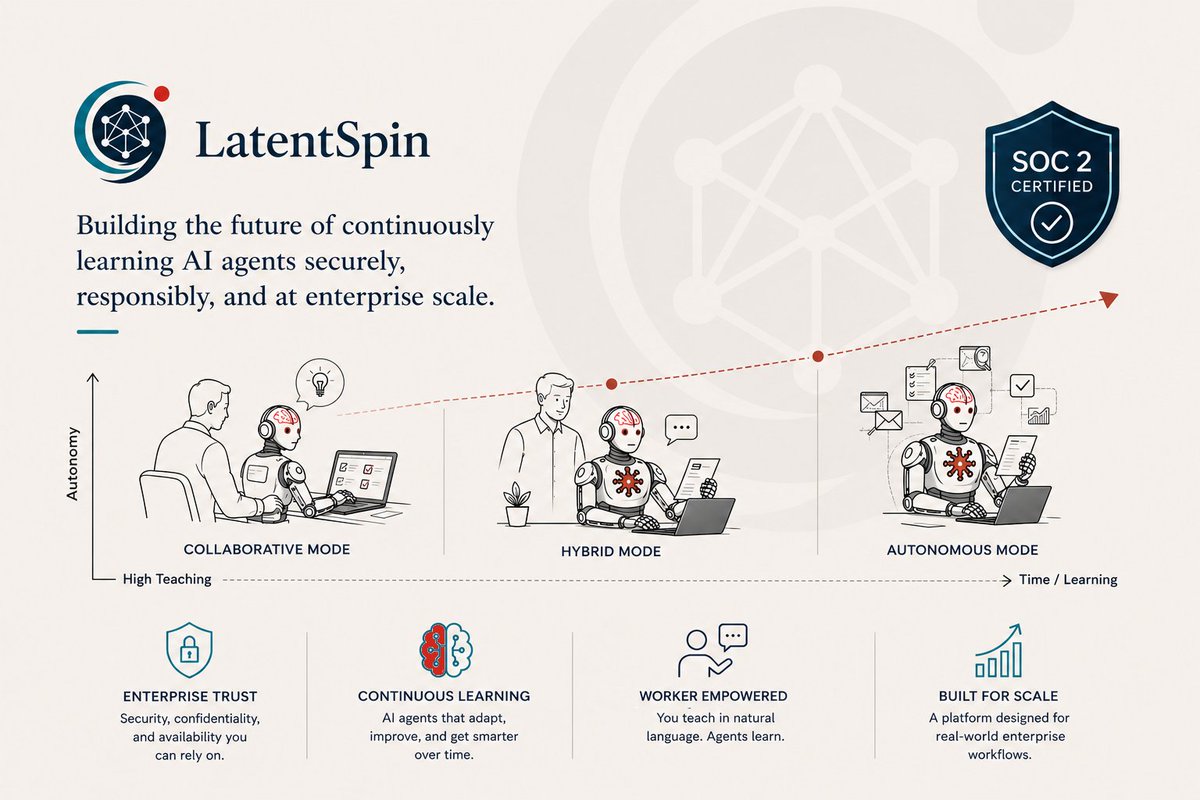
Good parenting starts with Trust, Responsibility and Maturity. With that said, @LatentSpin 𝐢𝐬 𝐧𝐨𝐰 𝐒𝐎𝐂 2 𝐜𝐞𝐫𝐭𝐢𝐟𝐢𝐞𝐝... We’re building the future of continuously learning AI agents, securely, responsibly, and at enterprise scale.
𝐋𝐚𝐭𝐞𝐧𝐭𝐒𝐩𝐢𝐧 enables knowledge workers to teach agents in natural language, helping them move from collaboration to autonomy as they learn, adapt, and improve over time.
𝐄𝐧𝐭𝐞𝐫𝐩𝐫𝐢𝐬𝐞 𝐀𝐈 will not just be about smarter models. It will be about trusted systems that can learn safely inside real workflows.
𝐏𝐫𝐨𝐮𝐝 𝐨𝐟 𝐭𝐡𝐞 𝐭𝐞𝐚𝐦 𝐟𝐨𝐫 𝐫𝐞𝐚𝐜𝐡𝐢𝐧𝐠 𝐭𝐡𝐢𝐬 𝐦𝐢𝐥𝐞𝐬𝐭𝐨𝐧𝐞!
#KnowledgeWorkers #AgenticAI #ContinuousLearning #LatentSpin
The jump from AI tools to AI "coworkers" isn't just about better prompts. It’s about how agents learn.
In our latest blog, @ThomasHazel explores how agents are moving beyond execution to actually choosing, using, and teaching models.
The era of the active-learning agent is here.
Read more: https://t.co/zGR77DFMFN
#AgenticAI #LLMs #LatentSpin #MachineLearning
𝐓𝐡𝐞 𝐭𝐡𝐫𝐞𝐞 𝐛𝐢𝐠 𝐩𝐥𝐚𝐲𝐞𝐫𝐬 right now are 𝐂𝐨𝐝𝐞𝐱 (OpenAI), 𝐂𝐥𝐚𝐮𝐝𝐞 (Anthropic), and 𝐂𝐮𝐫𝐬𝐨𝐫 (SpaceX/xAI). Each has its own style and benefits. Codex focuses on execution, Claude focuses on reasoning, and Cursor focuses on keeping you in the flow - https://t.co/d6XF3ERiIS
Just read this.. Crazy numbers.
Anthropic added $35B of ARR in twelve months.
From $9B at the end of 2025 to $44B in May 2026. The curve is so steep investors are submitting allocations within 48 hours for a $50B round at a $900B+ valuation. That would top OpenAI.
$35B ÷ 365 = $96M of new ARR added every single day.
All about enterprise replacement. Procurement teams are swapping SaaS renewals for Anthropic API spend.
Introducing Claude Opus 4.7, our most capable Opus model yet.
It handles long-running tasks with more rigor, follows instructions more precisely, and verifies its own outputs before reporting back.
You can hand off your hardest work with less supervision.
Another week on the road meeting with a couple dozen IT and AI leaders from large enterprises across banking, media, retail, healthcare, consulting, tech, and sports, to discuss agents in the enterprise.
Some quick takeaways:
* Clear that we’re moving from chat era of AI to agents that use tools, process data, and start to execute real work in the enterprise. Complementing this, enterprises are often evolving from “let a thousand flowers bloom” approach to adoption to targeted automation efforts applied to specific areas of work and workflow.
* Change management still will remain one of the biggest topics for enterprises. Most workflows aren’t setup to just drop agents directly in, and enterprises will need a ton of help to drive these efforts (both internally and from partners). One company has a head of AI in every business unit that roles up to a central team, just to keep all the functions coordinated.
* Tokenmaxxing! Most companies operate with very strict OpEx budgets get locked in for the year ahead, so they’re going through very real trade-off discussions right now on how to budget for tokens. One company recently had an idea for a “shark tank” style way of pitching for compute budget. Others are trying to figure out how to ration compute to the best use-cases internally through some hierarchy of needs (my words not theirs).
* Fixing fragmented and legacy systems remain a huge priority right now. Most enterprises are dealing with decades of either on-prem systems or systems they moved to the cloud but that still haven’t been modernized in any meaningful way. This means agents can’t easily tap into these data sources in a unified way yet, so companies are focused on how they modernize these.
* Most companies are *not* talking about replacing jobs due to agents. The major use-cases for agents are things that the company wasn’t able to do before or couldn’t prioritize. Software upgrades, automating back office processes that were constraining other workflows, processing large amounts of documents to get new business or client insights, and so on. More emphasis on ways to make money vs. cut costs.
* Headless software dominated my conversations. Enterprises need to be able to ensure all of their software works across any set of agents they choose. They will kick out vendors that don’t make this technically or economically easy.
* Clear sense that it can be hard to standardize on anything right now given how fast things are moving. Blessing and a curse of the innovation curve right now - no one wants to get stuck in a paradigm that locks them into the wrong architecture. One other result of this is that companies realize they’re in a multi-agent world, which means that interoperability becomes paramount across systems.
* Unanimous sense that everyone is working more than ever before. AI is not causing anyone to do less work right now, and similar to Silicon Valley people feel their teams are the busiest they’ve ever been.
One final meta observation not called out explicitly. It seems that despite Silicon Valley’s sense that AI has made hard things easy, the most powerful ways to use agents is more “technical” than prior eras of software. Skills, MCP, CLIs, etc. may be simple concepts for tech, but in the real world these are all esoteric concepts that will require technical people to help bring to life in the enterprise.
This both means diffusion will take real work and time, but also everyone’s estimation of engineering jobs is totally off. Engineers may not be “writing” software, but they will certainly be the ones to setup and operate the systems that actually automate most work in the enterprise.