Assistant Professor of Graphic Design at Mt. St. Mary’s University. Fellow at Halkyon Thinkers Guild. Founder of TypeThursday. Devotee of the Beautiful. ﷽
The Net (212): What Violence is to the State, Betrayal is to the Social
Michelle Garner
https://t.co/Ao5eX59J7d
Andrew Luber
https://t.co/vTSObChEhl
Michael Deklerk
https://t.co/auq1ScbDUf
Javier Rivera
https://t.co/WRdJqHs3ye
@4confusedemoji@er1enney0ung@grok Many thanks. Dali had a relationship with Thom at the end of his career around catastrophe theory. Dali’s last works centered around the topic. https://t.co/MIsiJ6BY8t
I am coming to think that the question of the UNIVOCITY OF LOVE, as proposed by Jean-Luc Marion in terms of a nonmetaphysical renewal of the Augustinian tradition (and self-consciously departing from the Scotist metaphysics of a univocity of being), forms the decisive horizon of intellectual controversy for contemporary theological reflection. It seems that the most formidable contemporary opponents to Marion’s doctrine can be counted as three: William Desmond, @johnmilbank3, and @pickstockc.
Marion himself elects the 20th-century Lutheran theologian Anders Nygren as his greatest opponent, but it seems that in an important sense, Desmond has developed a metaphysical language (one he calls “metaxological”) for cashing out an ontological distinction in the respective voicing of Eros and Agape (the two most decisive candidates for indicating a plurivocity of love) that is consistent with Catholic hamartiology, while Nygren’s critique of Eros hinges on the Lutheran hamartiology of total depravity (Catholics instead affirm a constitutive created openness of Eros to grace). Milbank and Pickstock, meanwhile, offer bracing critiques of any attempt to submit the task of thought to univocity as such. But does a resolutely nonmetaphysical univocity fall to their critiques of its metaphysical variant?
Already in 1997’s “The Word Made Strange,” Milbank prophetically discerned an unspoken horizon of univocity at work in Marion’s controversial 1982 classic “God Without Being.” As if on cue, in 2003’s “The Erotic Phenomenon,” Marion comes forward to elect a supposition of the univocity of love as the horizon of his thinking, a univocity that he notably situates, however, as resolutely beyond being. In 2008’s “In the Self’s Place,” Marion works to ground this conception of a univocity of love in the doctrine of love on display in the texts of St. Augustine of Hippo, which he fastidiously distinguishes from all metaphysics, in a rigorously nonmetaphysical interpretation of the biblical horizon of creation as beyond being and so irreducible to any system of causes ontologically discernible in the nous.
Notably, however, in the same text, Marion explicitly admits an analogia proportionis, as it is called in the Thomist tradition, at work in the thought of St. Augustine between love and physis or nature, in his doctrine of “the weight of love.” This doctrine of the weight of love would seem at the very least to occupy the PLACE of a metaphysics, and precisely an analogical one at that, of the type advocated by Milbank and Pickstock against univocal metaphysics (drawn out importantly in their reading of St. Thomas Aquinas, and also in critiquing the apparently Scotist drift of scientistic metaphysics through early modernity to the present). It is here significant that the greatest 20th century advocates of a metaphysics of the analogia entis, the German language Catholic school of Erich Przywara, Hans Urs von Balthasar, and Ferdinand Ulrich, expressly situate the analogia entis as a metaphysics of the creation ex nihilo, a biblical doctrine that Marion instead interprets as finally nonmetaphysical. Is it not perhaps the case that analogy is at once the Christian horizon of metaphysics (from the standpoint of being) and beyond metaphysics (once we approach the analogy between love as supernatural and nature as bearing its weight beyond being)?
Much depends on how we interpret Aristotle’s doctrine of nature and so ultimately his physics as well as metaphysics, as all sides must inevitably concede, given the centrality of the Aristotelian reference for the Thomist metaphysics of analogy. It is here that we must ask: IN ARISTOTLE’S OWN TERMS, to what extent is supernatural love ultimately “para physin,” against nature? Is it a “force” that contradicts the pull of natural weight? St. Thomas famously demurred: grace perfects—does not destroy—nature. But what of fallen nature already destroying ITSELF in sin? Is hamartiology beyond metaphysics?
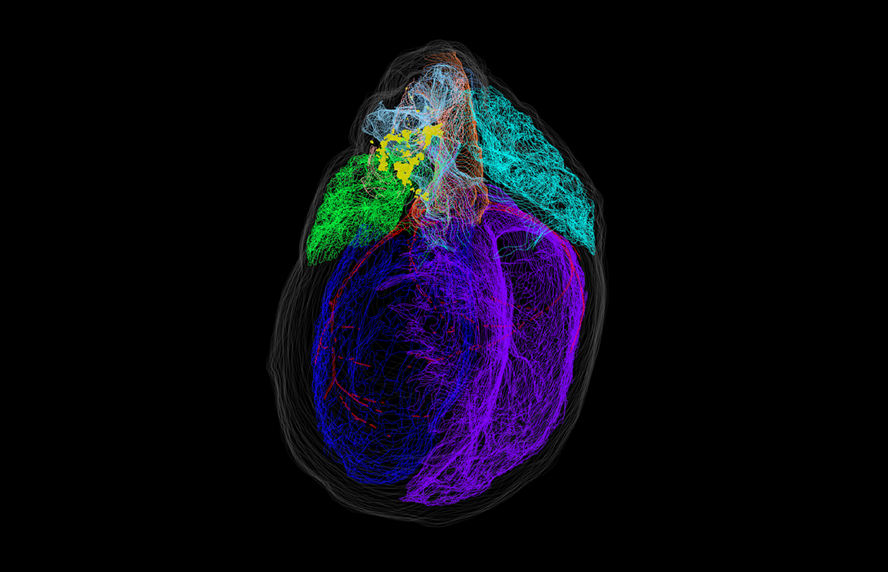
The heart is not a pump. Or rather, it is a pump in the same way that a smartphone is a flashlight.
Yes, it performs that function. But it is so much more.
The heart possesses its own intrinsic nervous system, containing approximately 40,000 sensory neurons, called sensory neurites, that form what cardiologists now call the heart's "little brain".
The heart generates the largest electromagnetic field in the body. Its electrical field is approximately 60 times greater in amplitude than the electrical activity generated by the brain.
The magnetic field produced by the heart is more than 100 times greater in strength than the field generated by the brain and can be detected up to three feet away from the body in all directions using SQUID-based magnetometers.
HeartMath Institute research has demonstrated that the timing between pulses of the heart's magnetic field is modulated by different emotional states, and crucially, that these magnetic signals have the capacity to affect the physiological systems of individuals around us.
This is not metaphor. The heart broadcasts electromagnetic information about your emotional state into the environment at the speed of light, and the nervous systems of other people act as antennae, tuned to and responsive to these signals.
To the contrary, Ps.-Dionysius's 'analogy' (he is the first Christian author to consistently use the Greek word ἀναλογία) is indebted to Origen of Alexandria, who, in On Frist Principles, frames the essential proportionality of the 'seeds of reason' (logoi spermatikoi) under the un/created difference of the world proceeding from as created by God.
The problem isn't that machines seem to be able to replicate something like human intelligence (an admittedly very interesting technical achievement).
The problem is that many humans don't seem to be capable of exercising anything beyond something like machine intelligence (no nous, only a bit of dianoia, a challenge which a cultural, political, and philosophical, not technical).
The problem isn't that machines seem to be able to replicate something like human intelligence (an admittedly very interesting technical achievement).
The problem is that many humans don't seem to be capable of exercising anything beyond something like machine intelligence (no nous, only a bit of dianoia, a challenge which a cultural, political, and philosophical, not technical).
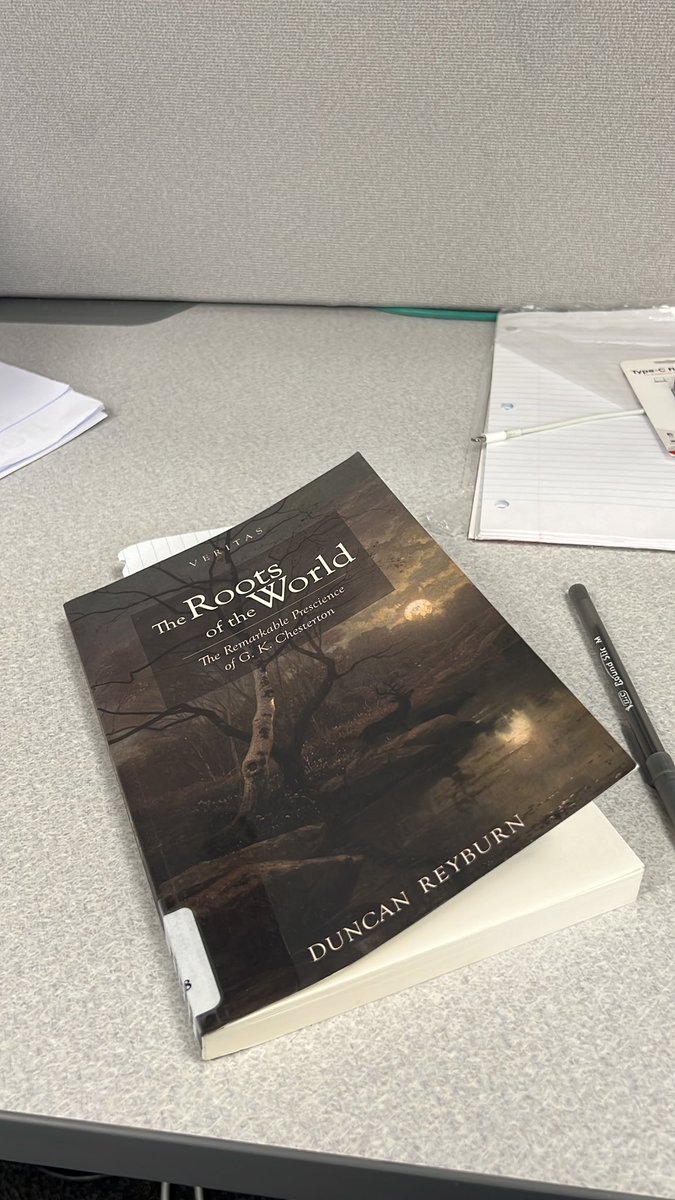
30 pages into @duncanreyburn’s “The Roots of the World” and I am captivated. The metaxy of tradition and modernity; presence and absence; thought and fact is lovely to read.
Huge shout to my friend from an undergraduate philosophy program who started working out every single day, not for health benefits or to become conventionally attractive or whatever, but because -- and this is a direct quote -- he was concerned that otherwise he might "become lost in the world of signs and forget the things they signify". I have thought about this every single time that I've worked out since.
First you're attracted to one beautiful body, then you come to appreciate all beautiful bodies, then you see that the beauty of the soul outweighs that of the body, and then finally you realize that what you were really attracted to was the Form of Beauty all along.
Dear compatibilist friends, I have a question for you: Suppose it turns out that quantum randomness in my brain makes it 50/50 whether I choose tea or coffee (which could be the case if the brain is a classically chaotic system). Is that still compatible with my choosing, say, tea? If "yes", could you please say a bit more to counter the intuition that the randomness undermines this being a genuine choice?