Charting the change in the jobless unemployment rate (first derivative) on the horizontal axis and the change in the change (second derivative) on the vertical axis visualizes business cycles. Expansion months are in blue, recession months in red.
Thanks to our wonderful colleagues for putting together this video https://t.co/YLfBPVgokf that highlights our research on the ZLB https://t.co/2tvh7SxetY.
The underlying data is available via the Center for Monetary Research at SF Fed: https://t.co/IYiJJFhB60
Fascinating paper on where 6000 global elites went to college. Billionaires, CEOs, heads of state, central bankers, etc.
In a word: Harvard.
Fully 10% of global elites went to Harvard. Elite US schools are over-represented (23% IvyPlus), but nobody comes close to Harvard.
🧵
I shared more of my thoughts today at @Stanford@HooverInst - thanks to Senior Fellow @JohnHCochrane for the terrific conversation. You can watch the event here: https://t.co/RXNDOTme9C
Just how much has the cooling economy reduced inflation? A recent Economic Letter by Regis Barnichon and Adam Shapiro found that recent inflation dynamics can be at least partially explained by patterns of excess demand in the economy.
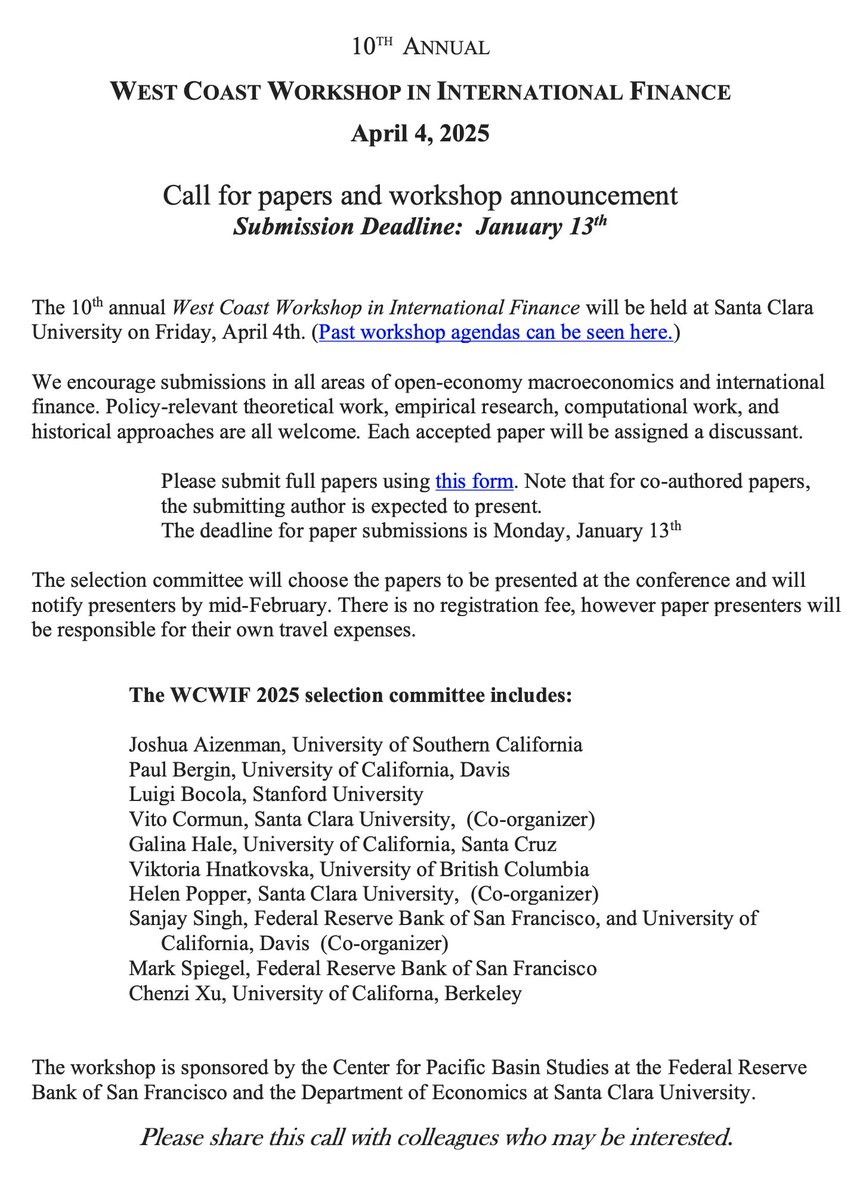
Call for Papers: 10th Annual West Coast Workshop in International Finance will be held at Santa Clara University. Submission deadline: January 13, 2025.
Pdf here: https://t.co/tjGd6aep5P
#EconTwitter@sffed@VitoCormun
🚨Call for Papers🚨
Together with the Bank of Canada and the Chicago Fed, we're organizing a Conference on #FixedIncome Research and Implications for #MonetaryPolicy on May 22-23, 2025, in San Francisco.
If you have a new paper that might be a good fit, please submit it by January 31!
More details: https://t.co/WNkfwXgHSy
#EconTwitter @sffed
Having to update my website always feels like having to go to the dentist. I dread it beforehand - but then I'm so happy when it's done. Here's the product:
https://t.co/EBIbiOZ7tY
This has been a while in the making but now we're live! You can check out our research, events and data products at https://t.co/hjI2So4Lqc and subscribe to our mailing list to stay in the loop. Thanks to @sylvainecon@ThomasMMertens and @pascalpaul for making this possible!
SF Fed research: The unemployment rate has been a very good near-term predictor of recessions.
"The jobless rate does not currently signal an impending recession" but it does suggest "the business cycle is at a maturing stage" when expansions often end https://t.co/TSaAUAXpAr
Jobless unemployment falls during months to the left, bottom out at 12 o'clock, and rise to the right. Recessions tend to occur AFTER jobless unemployment troughs. See my recent Economic Letter how this can be used to predict recessions: https://t.co/Cui9MFStQN
Charting the change in the jobless unemployment rate (first derivative) on the horizontal axis and the change in the change (second derivative) on the vertical axis visualizes business cycles. Expansion months are in blue, recession months in red.
Is there another way to predict recessions? Our latest Economic Letter suggests that the jobless #unemployment rate as a predictor is almost as accurate as the Treasury yield curve but more accurate in the near term: https://t.co/RUvG5QycTW | #SFFedResearch#EconTwitter
Do we know when a recession will happen? Our latest Economic Letter discusses the jobless unemployment rate as an advance predictor of recessions: https://t.co/RUvG5QycTW | #SFFedResearch#EconTwitter#Unemployment
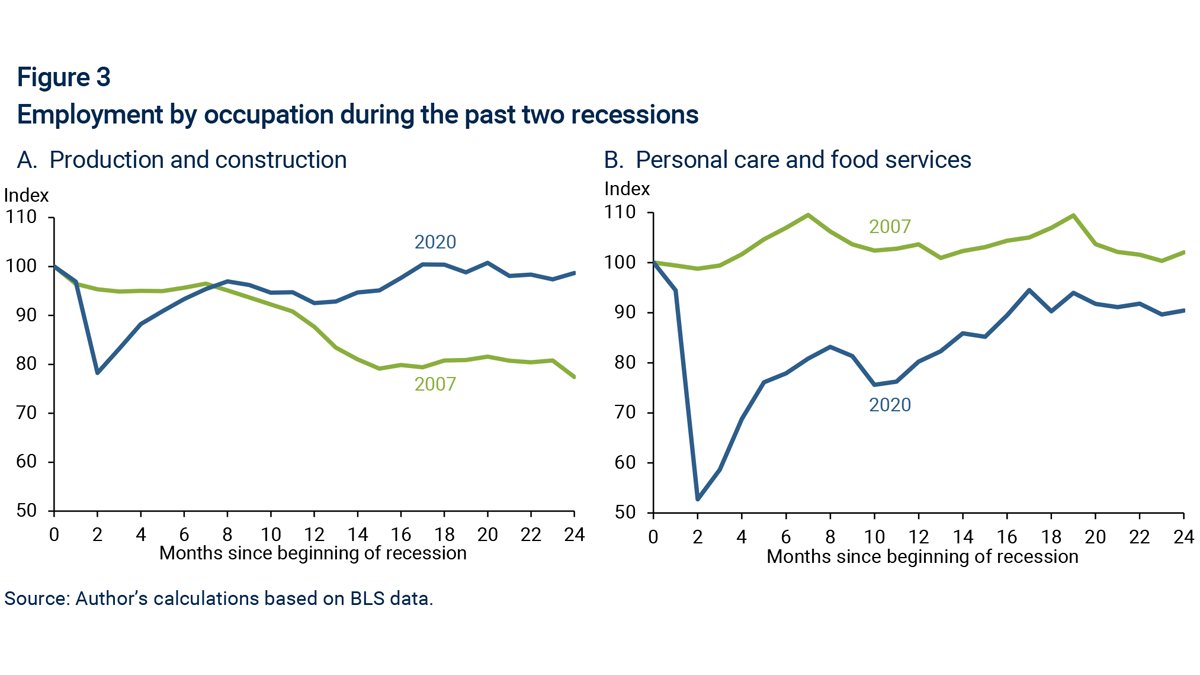
Service occupations and jobs with close social contact were hit the worst by the pandemic recession. Our latest Letter discusses how unemployment across occupations differed from historical patterns: https://t.co/9EsxnAff16 | #SFFedResearch#EconTwitter#Unemployment#Jobs
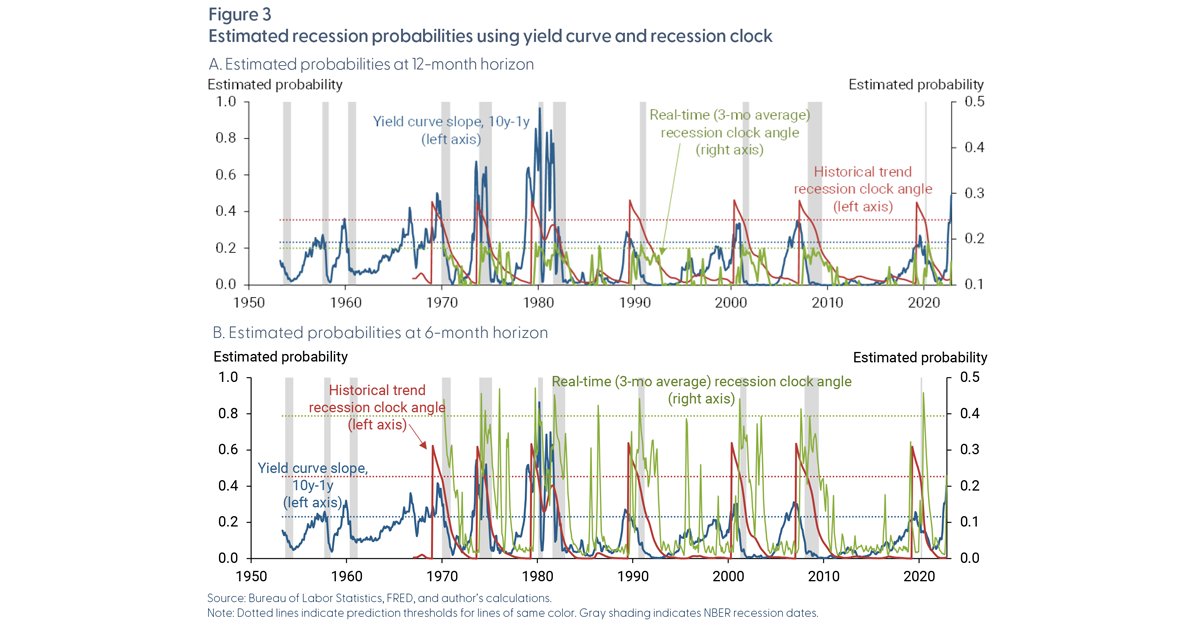
Recession indicators from the yield curve are sending mixed signals. @michaelbauer_hh and I are sorting through them in today's SF Fed EL: https://t.co/hn8aK5w3vm. We argue in favor of the 10y-3m spread.
With the yield curve quite flat in some parts, here are links to SF Fed Economic Letters I wrote with @michaelbauer_hh: https://t.co/7rc8GlK7hq and https://t.co/xfL2Wr9KSy. Thanks to @MaryDalyEcon for highlighting our research.
"It’s really important not to rest our views on one metric. It’s a preponderance of evidence.” @MaryDalyEcon on the recent, brief inversion of the yield curve. Read more from our economists in a previously posted economic letter: https://t.co/vcmdkuRCyL
@CBER_UNLV@WoodsGoods
The correlation between uncertainty shocks and changes in inflation expectations has turned negative over the past 25 years. In a recent paper, we argue that the lower bound on interest rates is the key factor behind it.