Senior Fellow @BrookingsFP. Contributing writer @TheAtlantic, Formerly Biden NSC, Author of All Measures Short of War, co-author of Aftershocks. Views my own.
Some news. I have a short Penguin special (just 25,000 words) coming out as part of a @LowyInstitute paper series on April 28. It's called Inflection Point: Biden, Trump, and the Future World Order.
It's partly a memoir with reflections on my time in the Biden administration and partly an analysis of Trump's second term.
The key argument is that there are now two America's: 1) an internationalism that focuses on a post-neoliberal global economy, strategic competition and tech, and 2) an America First movement that builds on Trump's second term.
These two Americas will compete for the foreseeable future but never destroy the other. The world will need to hedge against this volatile fluctuation.
Pre-order here. Just $6.99 for the Kindle version and $10 for the paperback.
https://t.co/9AUwG0gHEj
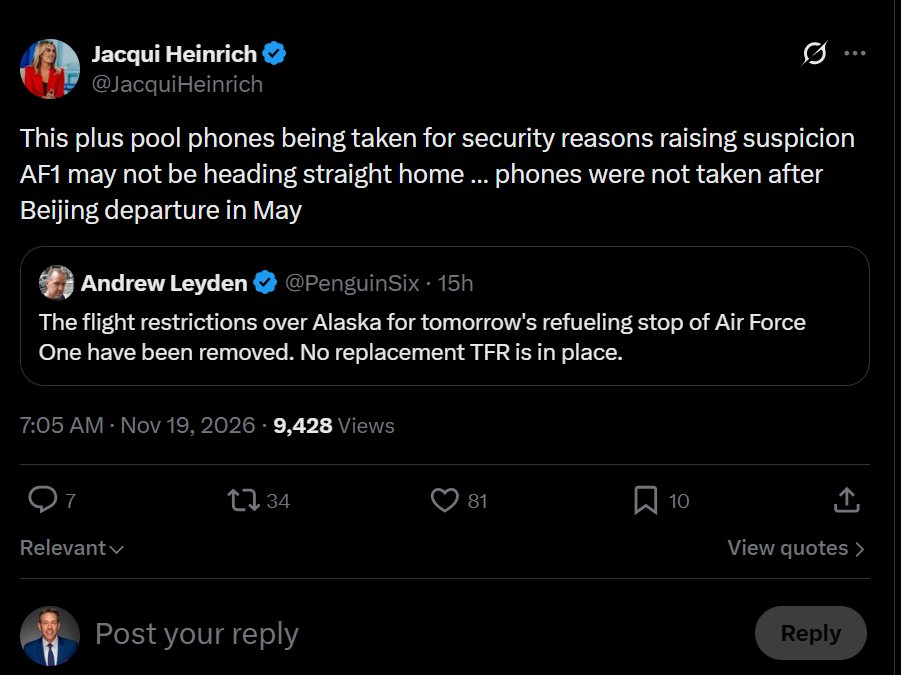
Where is President Trump and Air Force One going?? There are signs that POTUS is NOT headed right back to the U.S. right now.
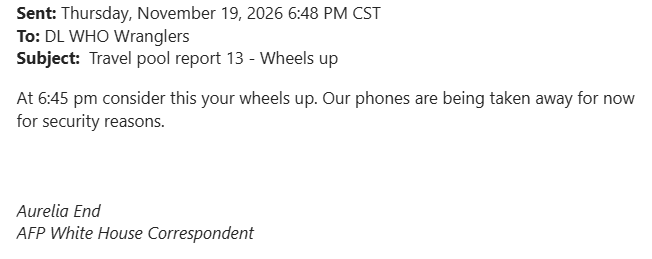
Government officials asked reporters flying with the President to hand over their phones as they boarded AF1 to leave China.
And the TFR (temporary flight restriction) over Alaska put in place in anticipation of AF1 refuel and flyover has been removed.
@7NewsDC
The Information: In recent months, Jeffrey Kessler, the official overseeing the U.S. Bureau of Industry and Security, has pressured staff to expedite the approval of sales of Nvidia’s H200 graphics processing units to China, according to three people with knowledge of the matter. In some cases, Kessler directed staff at BIS —an agency under the Commerce Department—to approve the exports over objections from other U.S. government departments, two of those people said.
In a thoughtful piece, @thomaswright08 warns that some calling for a meaningful debate on China policy (which we should have) seem to argue with strawmen rather than policy as it was, and they tend to be light on specific areas of contrast. This makes it harder to have a real debate.
“Critics of strategic competition tend to compare their preferred strategy to a straw-man version of it, rather than the managed competition approach that was pursued during the Biden administration. This makes it very difficult to have a real debate that reflects the nuances and complexities involved….A common theme of these pieces is that the default U.S.-China strategy in Congress and much of Washington is all-out competition that eschews coexistence and diplomacy.”
He puts forward ten questions to help heighten the policy contrast.
https://t.co/5BSnXhNkew
NEW: The Department of Commerce just published new AI and semiconductor export control regulations that close some major loopholes in existing export controls. The regulation includes new rules to: (1) counter Chinese smuggling of AI chips; (2) restrict Chinese companies from renting access to AI chips; and (3) block Chinese chip designers from making AI chips at TSMC.
These rules are a major step forward. They still contain some key gaps that need to be filled urgently in a follow-up rule, namely, they do not block Chinese companies from buying AI chips inside the United States or renting access to AI chips at US-based data centers. However, this rule will help and is the first good-faith effort to actually close loopholes in export controls in a year and a half. Hopefully more will follow.
1. Countering Chinese smuggling of AI chips. The rule expands export controls on AI chips to five new countries: Singapore, Malaysia, Thailand, Indonesia, and Brazil. It does not block AI chip orders to these countries, but requires a US government review (unless it is a US company that meets certain requirements). This is a massively needed step. Singapore, Malaysia, Thailand, and Indonesia have been the second, fourth, fifth, and eighth biggest importers of AI chips this year.
The rule doesn’t cover Taiwan itself, where chip smuggling is a massive issue (exports of AI chips to China are still not illegal under Taiwanese law), and still doesn’t prevent AI chip sales to Chinese companies in the United States, which somehow remain legal. Ultimately, large orders of AI chips by untrusted companies in any country should require a license to fully combat smuggling, as Chinese companies will move to buy AI chips anywhere there isn’t a license requirement. But this is a start.
2. Restricting Chinese companies from renting access to AI chips. The rule creates a new remote access control that restricts companies from providing Chinese companies with remote access to AI chips. It requires a US export license to provide Chinese companies with access to 12 million TPP or more (equivalent to ~200 of the most advanced Blackwell chips, or ~800 H100 chips). This applies to chips already shipped, as well as all future shipments. Some of these requirements even apply retroactively; Commerce says existing rules already barred data supplying a majority of a data center’s compute to Chinese companies, and tells companies that violated this to self-disclose. This effectively kills the business of neoclouds like Megaspeed that exist to provide remote access to large amounts of AI compute to China.
The biggest gap is the remote access controls do not apply to data centers in the United States. So Chinese companies can legally train on large numbers of Blackwells at data centers in Northern Virginia. This gap should be closed immediately with a new rule that uses Commerce’s US persons authority to capture this activity. The rule also exempts recommendation algorithms, so impact will depend on enforcement. Last, new authorities included in the text of the AI Overwatch Act would strengthen Commerce's ability to enforce these controls--that bill should pass immediately.
3. Blocking Chinese chip designers from making AI chips at TSMC. The rule closes loopholes in existing controls that Chinese companies are likely exploiting to illicitly make AI chips at TSMC or Samsung. Specifically, it now requires any Chinese chip designer who is seeking to make a 16/14nm or more advanced chip at TSMC/Samsung to get a U.S. export license, and restores old rules that weren’t being enforced until now that require any untrusted company anywhere in the world to get a license to make an AI chip at TSMC or Samsung. This is a significant upgrade.
Overall, this is a major step forward to countering Chinese smuggling of and access to advanced AI chips. The work here is not done, as there are some critical loopholes that remain open and need to be closed in a follow-up rule (namely those related to activities inside the United States). Commerce should move extremely quickly to close these. But this is the first time in over 18 months that the administration is starting to take export controls seriously, and does represent a meaningful step forward.
Last, the fact that the Commerce press release says this rule was “written by and at the direction of the Department of Treasury and the National Security Council” is remarkable and unprecedented. I have never seen a BIS rule that was not written by BIS. That implies that Commerce was dragged kicking and screaming over the finish line by the White House and Treasury, and instructed to publish this rule rather than the rumored weaker one that it preferred. Remarkable.
Jensen Huang was not just the CEO of the world’s most important semiconductor company. He was also one of Donald Trump’s closest and most influential advisers on AI. @thomaswright08
https://t.co/CiAr7M95sc
There are all sorts of potential repercussions from Jensen Huang’s resignation. It might tank the economy; the Alice Huang investigation may worsen ties between US and China; a competitor could challenge Nvidia’s place atop the chip market.
But it could also, as @thomaswright08 lays out, provide an opportunity for a reset.
https://t.co/1x2qofqMhC
Jensen Huang’s abrupt departure from Nvidia “should force a fundamental rethinking of America’s AI strategy,” Thomas Wright argues. https://t.co/MHtCxJnJpQ
📸: Benjamin Fanjoy / Getty
The Scandal Is Bigger Than Jensen Huang
I argue the most alarming revelation in this mess may not be that America’s most influential AI executive was involved with a suspected Chinese spy—but that senior administration officials were warned about the danger and nevertheless continued relying on him.
American strategy has come to depend, to an extraordinary degree, on powerful private-sector actors whose incentives the government cannot simply assume will align with the national interest.
The power of these individuals is fast escaping the reach of the institutions responsible for guarding against technological and geopolitical risks.
The lesson of this scandal is not simply that these people are fallible. It is that we need institutions capable of checking their influence and managing the consequences of their mistakes before these individuals become too powerful to be held accountable.
Read it in @TheAtlantic here: https://t.co/pUl0eEX9Gt
Enjoyed this by @thomaswright08 and plan to quote liberally 😉in an upcoming talk. It did reinforce my sense that we have few well-defined foreign policy schools, but rather overlapping vibes, waiting to harden around charismatic figures who will then (re) define the schools.
Some Substack thoughts on getting to a better debate on US-China strategy. Includes a correction/ clarification on how I described @jessicacweiss’s views on deepening economic ties in my recent Foreign Affairs piece. https://t.co/I55NPnYroz
Lots going on tonight. One of the races I'll be watching closely is Colorado's 4th district. My friend and former NSC colleague @EileenforCO is running against Lauren Boebert. Boebert won it by 11, and Trump by 18, in 2024 but I have a feeling about it.
Today, we released the National Policy for Nucleic Acid Synthesis Screening to protect American biotechnology innovation while reducing the risk of misuse.
This policy establishes a new, government-wide screening requirements for synthetic DNA and the equipment used to make it. It will ensure companies selling nucleic acid sequences and synthesis equipment know their customers and prevent the malicious use of these materials and tools.
This policy strengthens our Nation’s biosecurity posture by establishing rigorous U.S. government-wide procurement screening and physical security standards for synthetic biology. It replaces outdated “self-attestation” systems with robust, independent verification. It creates a dynamic, SI-powered screening layer that assesses the biological risk from nucleic acid sequences, allowing the U.S. to anticipate and prevent malicious use and help stop dangerous gain-of-function research.
@NIST will issue rigorous new screening standards and @HHSGov and @USDA will certify synthetic biology providers. Together, these measures will strengthen American biosecurity, safeguard responsible innovation, and establish a global standard for safe and transparent synthetic biology tools and research.
Really outrageous. Hegseth purged many of America’s finest and most experienced generals and admirals for reasons we don’t yet know. The damage done to the military is profound and generational.
I felt like Rubio was considering this ever since his Acropolis speech on western civilization. That seemed like a farewell / legacy speech with images he wanted in the locker for the future.
Secretary of State Marco Rubio is weighing whether to leave the Trump administration, people familiar with the matter said, as he considers his next moves following Republicans’ midterm elections wipeout this week.
From @SalehaMohsin@nat_droz@jendlouhyhc@annmarie and me
https://t.co/GgZIzvl3uk
Listen to the latest episode of “The Foreign Affairs Interview,” featuring @KoriSchake and @thomaswright08 in conversation with editor @dankurtzphelan:
https://t.co/eikO7E1oJA
Excited to announce that Planet AI is generally available! You can 'ask the Earth' 💬🌎
Today's AI models have read the internet, but they haven't seen the world. The @planet AI app changes that. You can now ask questions directly to a 10+ year, 3,000+ layer archive of daily satellite imagery.
During beta, we've seen:
🌾 Farmers boosting crop yields
🚒 First responders tracking disaster paths
🛡️ Security teams uncovering emerging risks
🌲 Park rangers halting illegal deforestation in real time
We're putting satellite intelligence into more hands, helping more people see what's happening on Earth and make better decisions. Search. Analyse. Act.
What questions do you have? Try it now: https://t.co/4WV7PWdveG