Next up was my other colleague from the funding coordination team, @sonkiski
She started by laying out the problem in stark terms; just 3000 OS developers created 8.8 trillion in value, but only get an average of $3200 a year for their effort
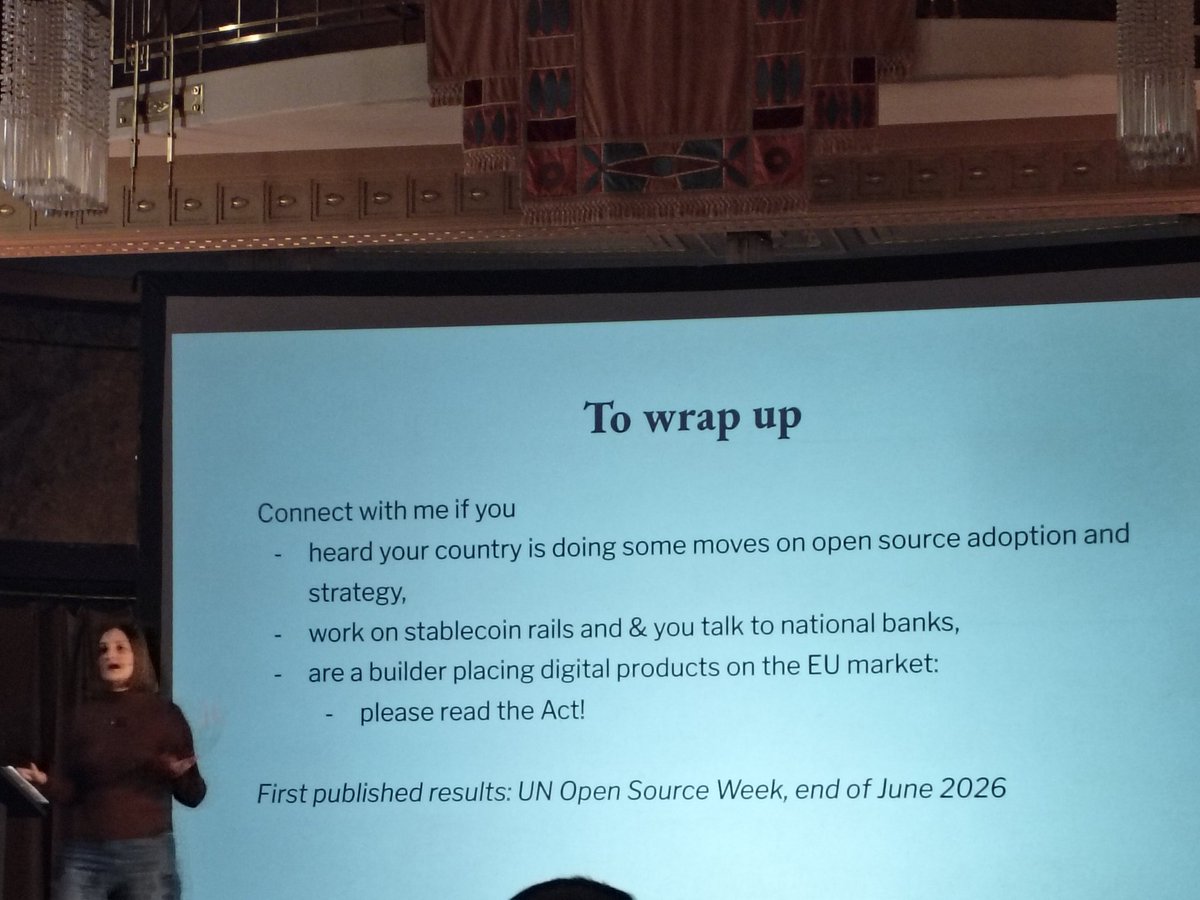
She then digs into government as a solution to this issue, specifically looking at different European programs to fund OSS & the new cyber resilience act forcing digital product owners to make public their software dependency graph
By analyzing an OS funding program from schleswig holstein, she found that majority of the dependencies were outside the EU jurisdiction. So channeling the funds would either require high maintenance overhead or else a consultant who manages it
This is where she believes that Ethereum can add value, by becoming the rails thru which gov programs distribute funding to dependencies
She tested this hypothesis through interviews with government software funding agencies. Most initially responded that Ethereum was a volatile coin and were unaware of stablecoins entirely
Since all governments want to see pilots, she concluded with an example of UNICEF deploying funds through @dripsnetwork , an already live initiative
Her full research is coming out in time for UN OS week in NY, love the detailed research done so far
Next up was the final talk from the funding coordination team @ethereumfndn , the always cheerful @MartinBreiten
He started with the 3 goals of our team:
1. increase net new funding supply for Ethereum PG
2. reduce ecosystem dependence on EF for funding, and
3. Effectively match funding supply with demand
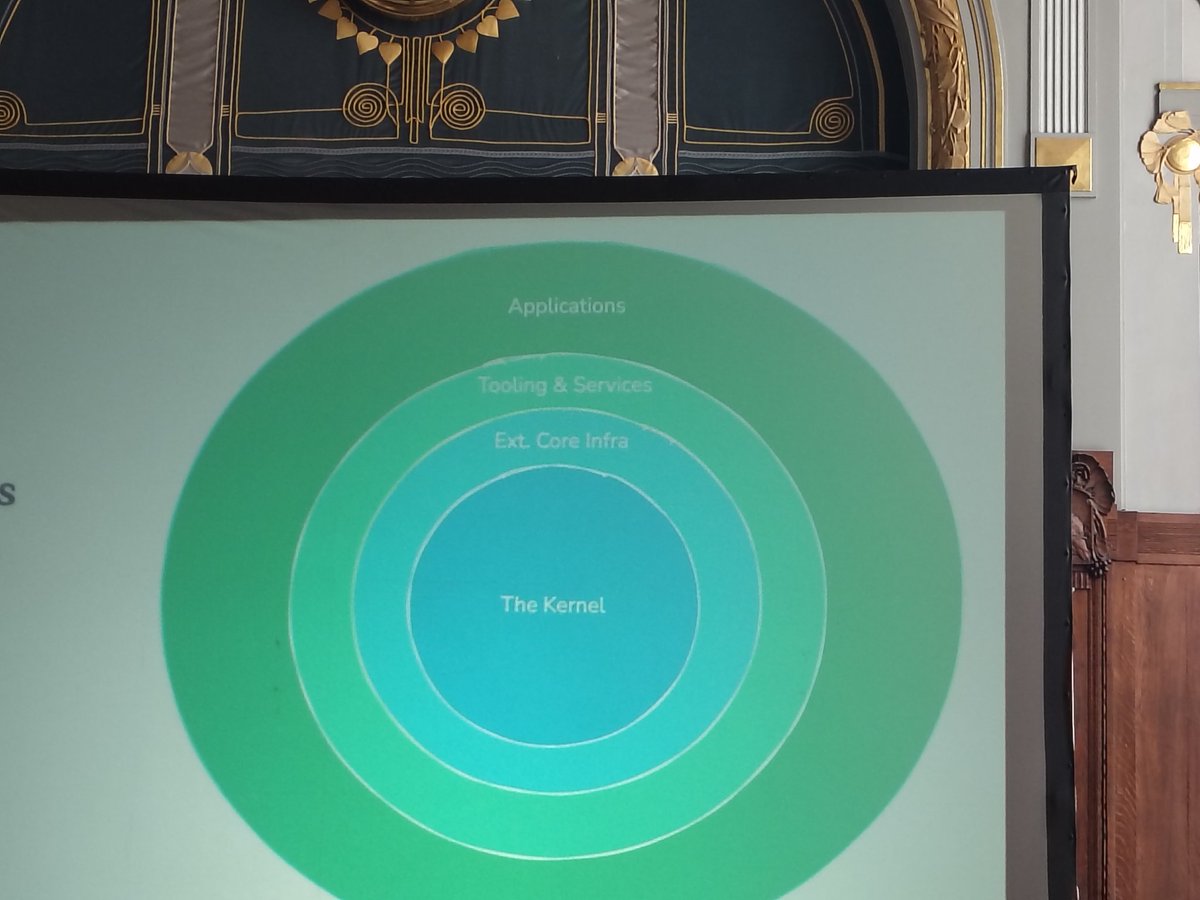
His focus is on the last objective, which he approaches by defining the Ethereum kernel & all its critical functions ensuring uptime, reliability & accessibility
The reason for his focus on the kernel is we aspire to a 1000 year timeline with a finite runway, an inherent contradiction in need of untangling
The other reason for his focus here is that it's not enough for the ethereum kernel to get funded , but it must also be neutral no strings attached funding
1. The first part of the kernel is client diversity, which has become synonymous with Ethereum in recent times, a non negotiable
2. Multiple clients automatically imply need for coordination b/w them, so that is added to the kernel
3. Short term & long term research for deciding what clients work on in the first place
4. And finally security, which consist of specs, testing, languages & wallet infra so users aren't rugged
Now, how much does all this cost? $18 million a year for the world computer to keep running , assuming slower dev cycle than now & a $1 million bug bounty
Philosophically, he sees the kernel as being permissionless access at all times , while tangibly that means regular cadence of hard forks for scaling, increased security to store value & data, verifiable via open source, etc
The kernel used to be smaller, has got bigger in recent times, and is expected to become small once more as we move towards ossification
He came up with this categorisation on the basis that the further out the stack we go, the less important neutral funding becomes
He ends with a clear call to action: increase more neutral funding, allocate it to the kernel
Raul just gave a talk @EthPrague on the ideas outlined in his blog post around making public goods projects sustainable by structuring their ambitious research goal as deliverables clients pay for
He stated with the overall purpose of the funding coordination team @ethereumfndn that I'm part of: increasing total net funding for PGs & decreasing EF dependence
The main issue so far has been ad hoc, cyclical grants based mostly on volatile tokens. Teams are unable to plan long term & grant funding distorts incentives to satisfy criteria for renewal instead of the product
Odin aims to address this gap by working in the trenches with selected teams. All the way from defining their ideal client profile to finding leads for them to documentation of processes
In many ways, odin is a no brainer for the EF. If we are giving a large grant to a team, may as well also embed one of our staff to ensure that teams are well placed to move beyond EF funding in the future
This is part of a greater mission we have been working towards at the funding coordination team here at the EF. We're spinning this up as an initiative called support.eth, using it to fund public goods (greater part of scholarships, salaries and institutional work).
The challenge is that most donees are happy to allocate as long as part of the staked principal is allocated to their protocol, which kind of goes against being a donations/pay it forward campaign.
DeFi United worked because it brought in lots of publicity to an otherwise hurtful situation and turned a negative branding moment into a positive one (aka marketing funds public goods). Part of my work within the team is figuring out whether we can fund this initiative using mechanisms embedded into interactions of a protocol, frontend or whatever tooling where part of funds are foregone to fund this initiative. Something @nounsdao have recently shifted towards.
Once you raise a meaningful amount, it becomes easier to generate returns from yield while actively avoiding using the principal.
The credit facility idea is interesting but I think it is premature. It would essentially require operating like an IMF, lending from the endowment and expecting repayment, which is a massive operational and legal challenge. There is also a moral hazard risk where protocols know there is a backstop and have less incentive to prioritise security. You could end up rewarding teams that donate but cut corners, incentivising maximum extraction rather than responsible behaviour.
A better solution in my view is actually tackling the underlying problem, which is security in DeFi. That is largely driven by public goods funding work w/ things like social coordination, better auditing infrastructure and shared security standards that address the root cause rather than just cushioning the fallout
@0xdusk_eth "capital is deployed to generate yield, and that yield — not the principal — is directed toward funding builders and public goods."
bullish on this new transition and happy to help out however possible. I have a couple ideas worth exploring around embedded mechanisms too.
The version that scales is the decentralized, pre-committed one. A staker network detecting exploits in real time and proposing state overrides to the sequencer within seconds, rather than a Security Council assembling hours after the fact. We need to formalize this process.
https://t.co/6hieDQWo5i
@bsturisky That's one protocol. What happens when Lazarus infiltrates Ethereum's core dependencies? What happens when there's a bug in the compiler? All of defi is at risk
Agree with this thesis but who will fund and legitimise the successor entities on a recurring basis?
Imo validators are the natural answer. They are the only credibly neutral body that does not reintroduce the centralisation the EF is trying to dissolve. The problem is there is no formal decision making structure yet as hey just collect yield
VRR (by @devanshmehta@clesaege) is likely the first step toward changing that as it's elective, non-coercive redistribution of validator rewards to public goods. So qhat if entities had to pitch to the network for recurring funding and only got it if validators agreed?
The walkaway test will be passed; what governs after is the more interesting question imo
@Elliot0x The "silo problem" happens because sharing benefits competitors without compensating the sharer. Breaking it means making detection and disclosure the paid layer, not the externality
DeFi security has a public goods problem
Protocols fund their own audits and bug bounties but the shared layer between them (incident response, threat intelligence, common security primitives) runs on volunteers and goodwill
Until we fund that layer like infrastructure instead of charity, we're going to keep watching the same script play out
@mattaereal this is greatly articulated. Insight 3 in particular "security is maintained by informal coalitions of actors without sustainable incentive structures" is the version of the argument I was trying to make in funding terms. Will share this more broadly.
The version that scales is the decentralized, pre-committed one. A staker network detecting exploits in real time and proposing state overrides to the sequencer within seconds, rather than a Security Council assembling hours after the fact. We need to formalize this process.
https://t.co/6hieDQWo5i
The Arbitrum Security Council has taken emergency action to freeze the 30,766 ETH being held in the address on Arbitrum One that is connected to the KelpDAO exploit. The Security Council acted with input from law enforcement as to the exploiter’s identity, and, at all times, weighed its commitment to the security and integrity of the Arbitrum community without impacting any Arbitrum users or applications.
After significant technical diligence and deliberation, the Security Council identified and executed a technical approach to move funds to safety without affecting any other chain state or Arbitrum users.
As of April 20 11:26pm ET the funds have been successfully transferred to an intermediary frozen wallet. They are no longer accessible to the address that originally held the funds, and can only be moved by further action by Arbitrum governance, which will be coordinated with relevant parties.
One thing I'd add is that a lot of the social machinery you're describing already exists in pockets (SEAL, threat intel sharing between teams, post-incident collaboration) but runs almost entirely on goodwill and unpaid time. Treating that layer as genuine infrastructure means funding it like infrastructure, which is part of what I was trying to get at here: https://t.co/tZT47INQDQ
with stablecoin markets beginning to become illiquid, the situation is now entering a more dangerous stage imo
to break down the driving factors:
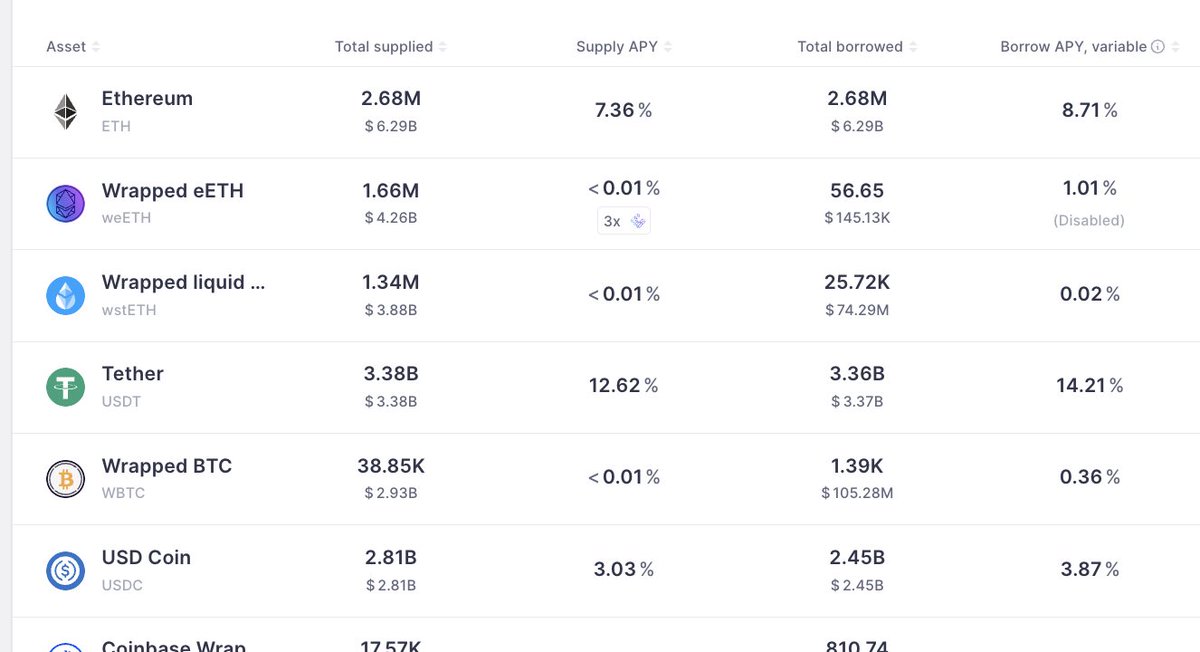
the ETH market is ~16.5% backed by rsETH, and rsETH backed loans could see up to 10-15% haircut in emode if losses are socialized equally on mainnet & external chains, leaving 2-3% residual haircut for ETH suppliers after wiping out umbrella
ETH suppliers are naturally incentivized to get out ASAP to avoid this, so utilization is pinned at 100%, and borrow rates are not high enough to incentivized repayment of unrelated LST loops (wstETH, weETH) to free up liquidity
because it is impossible to withdraw ETH, users borrowing stables like USDT against ETH collateral cant unwind their position even when the rates for stablecoin borrowing start to spike, which severs the typical incentives scheme keeping these markets healthy
now we have 2 unhealthy incentives based on the markets becoming locked at 100% utilization
1) ETH holders cannot unwind their positions to maintain healthy LTVs, and liquidators cant withdraw/sell collateral to close positions atomically, meaning that ETHUSD price drop could potentially cause bad debt
2) users supplying USDT have a perverse incentive to max-borrow other stablecoins as a way of exiting, the position has positive carry (for now) so the optionality has low cost, while if conditions worsen they can get at least 75% of their position value out of the market
bottom line is, for these pooled/rehypothecated lending markets to function properly, liquidity must be preserved AT ALL COSTS. recent slope2 changes nerfing Aave's max borrow rates are having a negative effect and significantly increasing the risk of cascading market failure
going through the backlog of talks at ethcc, first one on the list was @MartinBreiten defining the ethereum kernel
it started with a provocative question: if all ethereum public goods funding ceased tomorrow, what are the essential components that need to still be up and running?
as a starting point, its good to define the core layer and then the amount of neutral funding it requires
building the etheruem kernel starts with the execution and consensus layer. in recent years, client diversity has become a core feature of ethereum, so some coordination b/w them is needed. finally, we have security & testing to ensure nothing breaks in hard forks, and research to figure out the direction we build towards in the first place
the total cost for all 5 components?? $16 million.
this is what we need currently for ethereum public goods funding, assuming funding is perfectly matched to needs
(note: this number is one persons deeply researched opinion with consultations from protocol experts)
the surrounding infra like indexers, languages & compilers, wallets, etc can come from non neutral funding sources (as a lot of it already does).
our challenge is coming up with $16 million each year from parties without vested interests, an essential step if we care about 100% uptime, CROPS alignment (censorship resistant, open source, private and secure) and ethereum itself passing the walkaway test so it can run without anyone actively working on it
Thrilled to speak at @EthPrague for the first time about Project Odin: helping critical @ethereum public goods teams build lasting sustainability, with the long-term goal of becoming Frontier Research Contractors.
Come find me if you build infra the ecosystem depends on 👇