@ChristofferBN@Andrea25633402@ZReitano In Fourier: a group of obese hypertensive smoking diabetics/MetS with a history of clinical CVD (MIs or strokes). comparable to original poster?
@Tellit007 What do you think drove such a high median Apob of 119? The "low insulin" high Apob group had plenty of occult IR.
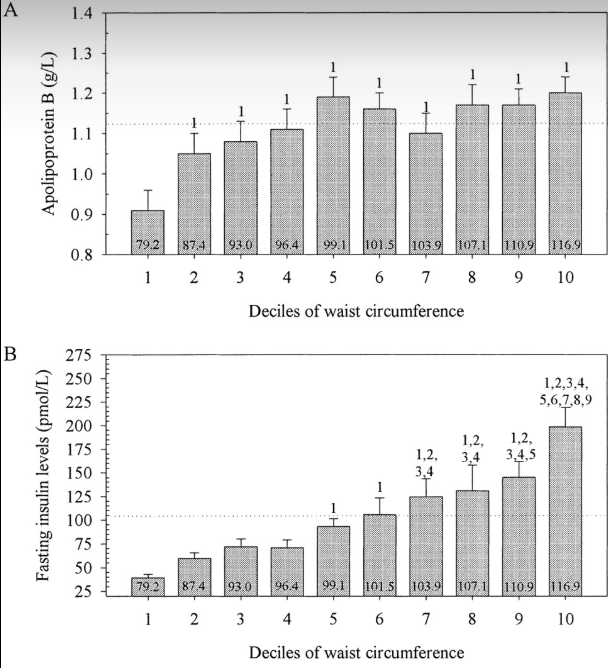
In another Quebec study cohort (n=185), an Apob 119 meant you had a waist circumference of at least 100 cm (approx).
https://t.co/egyRhtHtsG
@NutritionMadeS3 Any calorie deficit will shed visceral fat (after the body consumes ectopic fat first of course). Why the need for hokum (polyphenols, good carbs bad carbs, proteins, fats)? Because there'd be no point to nutrition advice if calories (and PFT) were all that mattered.
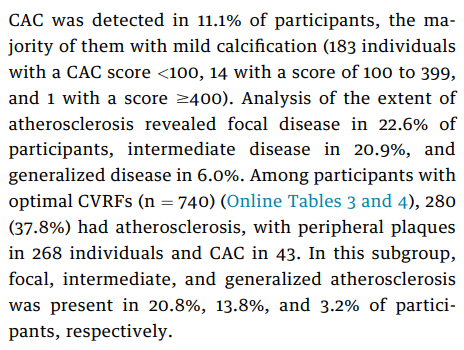
@ChristofferBN Among cvrf-optimal group 94% had CAC zero.
Hx of smoking wasn't analyzed as a predictor of (femoral) athero. what % of these Spaniards smoked 25 yrs prior?
also PESA? Such a selective approach to your analysis. true of ARIC, bogalusa, MESA as well
https://t.co/sxlan1JTW4
@Lpa_Doc In the study you are citing with 88% reduction in CVD (pcsk9 lof) Ldlc isn't 5 but 100-103. Only 20 times larger. And similar to about 50% of MIs.
@MichaelAlbertMD 5% weight loss is sufficient to get this patient below his PFT. exceeding one's PFT is what drives the systemic inflammation (aka IR). Researchers once felt the same about bariatric surgery (it 'instantly' remitted T2D). Dr Taylor showed low calories had the same effect.
@ChristofferBN@SteHaller Do rabbits develop fatty liver when fed cholesterol / fat rich (unnatural for herbivores) diets? Do lab studied primates as well (gain weight leading to fatty liver)? Or are these studies calorie controlled?
@MohammedAlo 38 mg/dl is the standard deviation of distribution of LDLc in the general population. if such an increase represents 1.2 fewer years of life, pretty much 2 years are all most people can expect from high vs low LDLc as 68% are within that range. 95% is within 2-4 yrs.
@MichaelAlbertMD The mentioned Stemi registry, 15% w/o risk factors have a median systolic BP of 140. The criteria for Htn includes plenty with at least 1 risk factor.
I wonder why these 'risk free' studies miss so many? Also true of natureCT? avg bmi 27
see table 2 https://t.co/aMaRgiv599
@Tellit007 Pesa did not exclude former smokers (injury to femoral arteries, the main artery bed with subclinical atherosclerosis?). 95% had CAC=0 among CVRF optimal. And included 20% with A1cs in pre/diabetic range. On superficial inspection seems like a pure LDLc sample.
@whohead1@jasongordo626@grok@Tellit007 You'd rather try to insult me by calling me names? You seem easily frustrated . "No one doesn't think..." Agreed but this started because Tellit stated 111 was driving athero in NatureCT(a very LDL purist position as opposed to multifactorial)
@whohead1@jasongordo626@grok@Tellit007 I responded to the point that Interheart found that 50% of first MI risk was driven by apob/apoa ratio. The first part of your attached document.