The founding of Tallahassee
In June 1823, Florida’s territorial council authorized Governor William P. Duval to select the site for the fledging territory’s capital. Two commissioners, one traveling from St. Augustine and one from Pensacola, met at the confluence of the St. Marks and Wakulla rivers. They trekked 20 miles north, arriving at a Native American settlement they deemed a suitable location. The territorial government approved the site and adopted the Muscogee name of “Tallahassee” for the new capital city. More information: https://t.co/E0enHxYgdx
I never met Gordon Wood, but I have a story about him.
In one of my grad school seminars, we read Wood’s Creation of the American Republic. The sheer erudition and evidentiary depth of the book bowled me over.
Back then, before kids and before life accelerated to warp speed, I used to call my mother every Sunday to catch up. Lots of times, we ended up talking about what I was reading that week in my grad seminars or for leisure. Mom had an omnivorous mind, and she was always looking for something else to read. She was a true intellectual—curious about almost everything, always eager to integrate new arguments or ideas into her existing schemas of how the world worked or to have those schemas challenged and changed.
When we talked that particular Sunday, I think I tried to describe to her part of Wood’s argument about the relationship between the state constitutions during the Articles of Confederation era and the federal Constitution. Maybe I was tired, maybe I didn’t completely understand her questions, but the end result of the conversation was that Mom had questions about Wood’s argument that I didn’t answer satisfactorily. I told her that she should probably just read the book, and we said goodbye.
She did eventually read the book, but the next Sunday, Mom started our conversation by saying, “Well, I had a lovely conversation with Gordon Wood this week.” For a split second, I thought she was joking, but then I remembered who I was dealing with. I started to sweat. “How?” I asked. A whole variety of unlikely scenarios in which the foremost historian of the American Revolution and my mother, who lived in Wichita, Kansas, might have met ran through my mind. “Oh, I just looked up his office phone number on Brown’s website and called, and he picked up!” Mom said. I decided I would have to find another profession.
As it ended up, Gordon Wood spent about an hour on the phone with my mother answering her questions about the Constitution. Ever since, I’ve had a soft spot for the man when I imagine him picking up the phone in Providence and finding Becky Elder from Wichita on the other end of the line. His generosity in that moment spoke very well of him.
Rest in peace, professor.
Shaking from the recent M6.1 earthquake offshore of Cuba was felt in Florida, where earthquakes are not commonly felt. Did you feel it? (If you're in the area and did not feel it, that's data too!)
https://t.co/qpvppLHKj2
On Sunday, my friend Gordon Wood was struck and killed in a car accident. Gordon taught history at Brown Univ. and was among the most accomplished historians America has produced. He won the 1993 Pulitzer Prize for The Radicalism of the American Revolution, and his earlier book The Creation of the American Republic, 1776–1787 took the 1970 Bancroft Prize. He also received the National Humanities Medal.
He was, in my view, the finest historian of America's founding—which makes it all the sadder that he did not live to see the nation's 250th birthday. His reputation reached popular culture, too. Matt Damon's character in Good Will Hunting invokes him by name in the famous bar scene, accusing a Harvard student of simply "regurgitating Gordon Wood, talking about [...] the pre-Revolutionary utopia and the capital-forming effects of military mobilization."
I feel fortunate to have collaborated with Gordon on several projects. In a 2019 anthology I compiled, he wrote an essay on the possibility of a shared American narrative. He centered his argument on equal rights as "the most radical and most powerful ideological force" the Revolution unleashed. "This powerful sense of equality is still alive and well in America," he wrote, "and despite all of its disturbing and unsettling consequences, it is what makes us one people."
When I needed jacket blurbs for my new book Lincoln's Compass, coming out this November, I turned to Gordon. The fit was natural: the book argues that Abraham Lincoln took the Declaration's claim that "all men are created equal" as his guiding moral compass—and that he refocused the nation on that claim. Gordon, ever the gentleman, offered generous praise.
He was, in many respects, the dean of American historians. He will be very hard to replace.
History is made as Pope Leo XIV becomes the first Pope to address the Spanish Parliament, saying:
“I come before you as the Bishop of Rome and Shepherd of the Catholic Church, aware that the mission entrusted to the Successor of the Apostle Peter, as the pricinple and foundation of the unity of the bishops and the faithful, places the Holy See in a special way in dialogue with peoples and with states.”
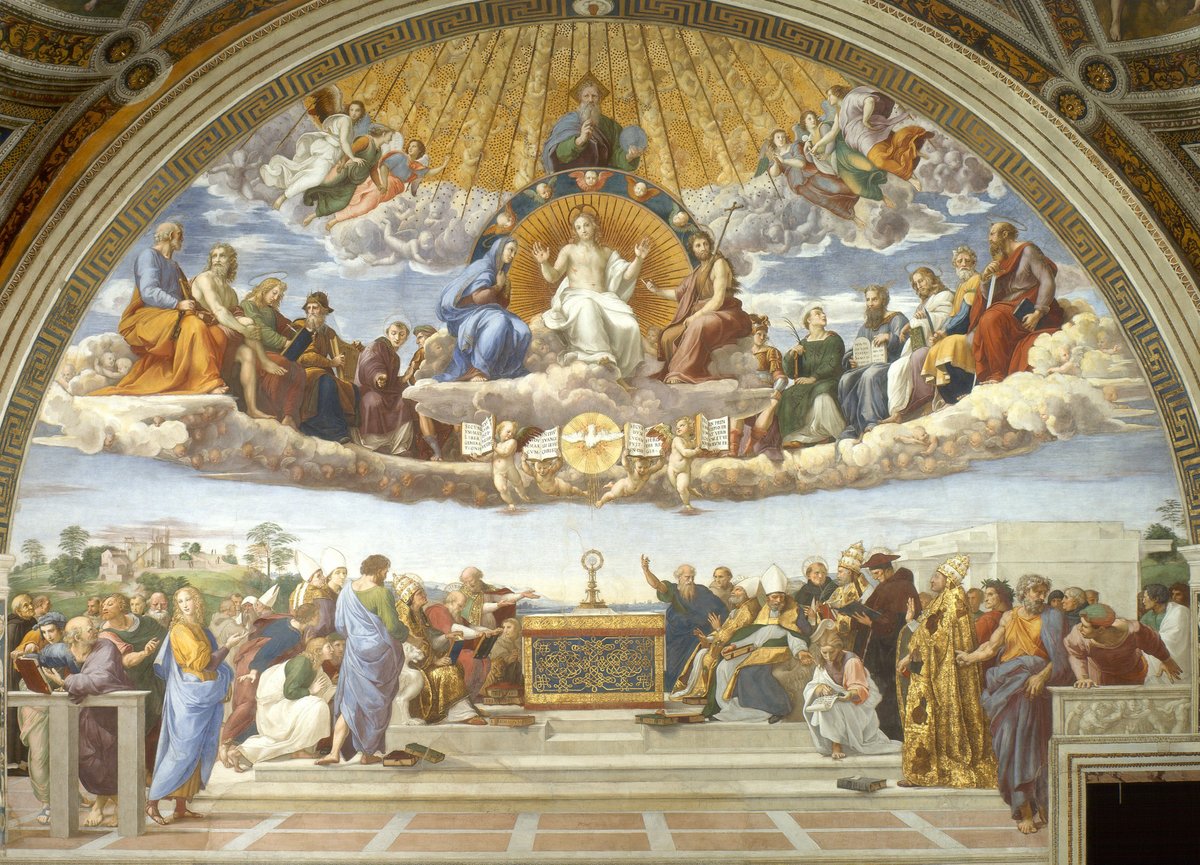
Happy Sunday and observance of Corpus Christi!
Factus est Dóminus protéctor meus, et edúxit me in latitúdinem: salvum me fecit, quóniam vóluit me.
The Lord came to my support. He set me free in the open, and rescued me, because He loves me.
Image: Disputa by Raphael
Go ask a normal American student why school matters and you will hear something about college, career, or money.
Go ask a classically educated student the same question and you will hear words like wisdom, virtue, truth, beauty, or God.
That is the difference between education as workforce preparation and education as human formation.
America has spent generations funding the first vision while wondering why the second kind of person disappeared.
#Bolsena è la Città dell'Infiorata e del Miracolo Eucaristico. Le origini sono antichissime risalgono al III secolo a.C.
Da non perdere l'Infiorata del Corpus Domini domenica 7 giugno la e la Festa delle Ortensie dal 12 al 14 giugno.
https://t.co/hsdlPTj6EU
#VisitLazio
The Women of Charity (Wamama wa Chitemwano)from our Parish warmly welcoming Fr. Robert Carlton from the Archdiocese of Chicago in the United States. In our culture, it is traditional to welcome visitors in this way.
USA. Summer. It is 95 degrees outside, and I am shivering inside a sandwich shop.
I have discovered how Americans forge strong souls.
Outside, the sun is trying to kill everyone. Inside this small restaurant, it is winter. My breath does not fog, but it is thinking about it. A man near me is eating a cold sandwich while wearing a jacket. In summer. Indoors.
In Japan we would simply turn it down. Americans do not turn it down. And now I understand them better than they understand themselves.
This cold is not an accident. This cold is a gift.
The owner has built, inside his shop, a second season. He invites you in from the brutal heat and hands you the one thing the sun has denied you all day: a reason to be cold. To endure it is to be tempered. You walk in soft and sweating. You walk out sharp and clear, a slightly stronger person than you were.
So I did not complain. I removed my outer layer and offered it to the woman at the next table, who was hugging herself. She said, "Oh, no, I'm fine, thank you." She was not fine. Her lips were blue. But she, too, understood the training. She would not break first. I respected her deeply.
The owner asked if everything was okay.
"It is perfect," I said, through my teeth, which were chattering. "Thank you for the winter."
He said, "...I can turn the AC down if you want?"
I told him no. A man does not ask the mountain to be shorter.
I stayed two hours. I ordered a hot coffee to survive. Then a second one, to hold. By the end I could no longer feel my hands, but my spirit had never been clearer.
So now, on the hottest days, I seek out the coldest rooms. I sit. I shiver. I sharpen.
And when I finally step back out into the summer heat, and it wraps around me like a warm bath, I feel it.
Reborn.
A man who has survived the winter, in August, indoors, for the price of a sandwich.
One of the worst things about social media is it's made some people think that literally everything that happens in their life should be 'content' for public consumption.
Instead of living life, they're always thinking about clicks, views, and validation from strangers.
Today is the Feast of St. Boniface, Apostle of Germany, First Bishop of Mainz and Martyr. His felling of Donar's Oak, a sacred tree of the Germanic pagans, led to the conversion of many and is one of the most significant moments in the history of Christianity.
Ora pro nobis





![JoshuaClaybourn's tweet photo. On Sunday, my friend Gordon Wood was struck and killed in a car accident. Gordon taught history at Brown Univ. and was among the most accomplished historians America has produced. He won the 1993 Pulitzer Prize for The Radicalism of the American Revolution, and his earlier book The Creation of the American Republic, 1776–1787 took the 1970 Bancroft Prize. He also received the National Humanities Medal.
He was, in my view, the finest historian of America's founding—which makes it all the sadder that he did not live to see the nation's 250th birthday. His reputation reached popular culture, too. Matt Damon's character in Good Will Hunting invokes him by name in the famous bar scene, accusing a Harvard student of simply "regurgitating Gordon Wood, talking about [...] the pre-Revolutionary utopia and the capital-forming effects of military mobilization."
I feel fortunate to have collaborated with Gordon on several projects. In a 2019 anthology I compiled, he wrote an essay on the possibility of a shared American narrative. He centered his argument on equal rights as "the most radical and most powerful ideological force" the Revolution unleashed. "This powerful sense of equality is still alive and well in America," he wrote, "and despite all of its disturbing and unsettling consequences, it is what makes us one people."
When I needed jacket blurbs for my new book Lincoln's Compass, coming out this November, I turned to Gordon. The fit was natural: the book argues that Abraham Lincoln took the Declaration's claim that "all men are created equal" as his guiding moral compass—and that he refocused the nation on that claim. Gordon, ever the gentleman, offered generous praise.
He was, in many respects, the dean of American historians. He will be very hard to replace.](https://pbs.twimg.com/media/HKTRZYnXkAAoZO7.jpg)