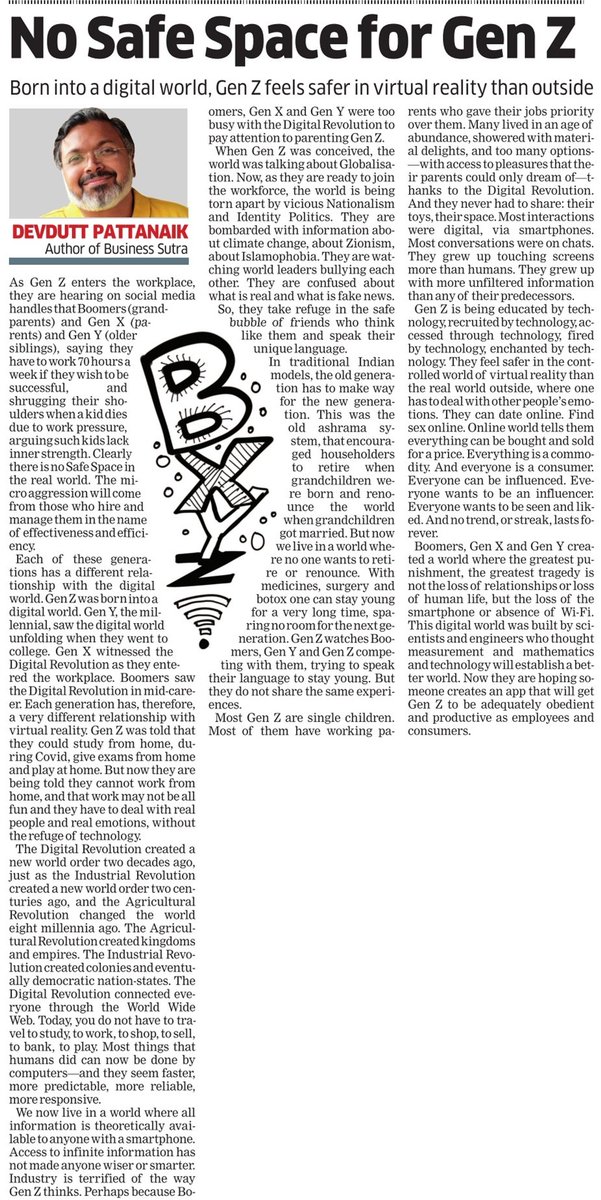
As Gen Z enters the workplace, they are hearing on social media handles that Boomers (grandparents) and Gen X (parents) and Gen Y (older siblings), saying they have to work 70 hours a week if they wish to be successful, and shrugging their shoulders when a kid dies due to work pressure, arguing such kids lack inner strength. Clearly there is no Safe Space in the real world. The micro aggression will come from those who hire and manage them in the name of effectiveness and efficiency
Read more ....No safe space for gen Z https://t.co/fVZ4WeydVs
Loving this re-release era of Hindi films. Amazed it took this long for multiplexes to discover this idea already tested in smaller centres. Murder, Gupt etc have had many re-runs in town theatres over the years.
A dedicated full-time re-release theatre venue is not a bad idea.
Here's some really granular parsing of Lok Sabha election results in Chennai. @VigneshJourno, @SambaviParthy and I triangulate booth level voting (Form 20) and guideline value for areas (a proxy for income) to find out how different classes voted in the capital city. (1/n)
Reasons why there's anger against non-Kannada migrants in Bengaluru —
Hear me out before you pass on your comments, and let me know your thoughts:
Bengaluru as a city was founded nearly five hundred years ago and was planned to a large extent. It was meant to be a city for pensioners later but eventually became India's Silicon Valley.
How did this happen?
It was given a right push from the beginning, which mostly has to do with able administrators like Sir Mirza Ismail, Sir M Vishveshwariah and Maharajas of Mysuru like Nalwadi Krishnaraja Wodeyar, Jayachamarajendra Wodeyar and Rani Vani Vilas who established educational institutes, R&D centres and invited industrialists to set up their bases in the city by offering large sums of money and land.
Skip to the 21st century, Bengaluru's political class felt that it was about time India had its own California — a Silicon Valley — if you will.
S M Krishna pushed for industries to come to Bengaluru and invited foreign companies to set up their IT hubs in 'ooru, which offered many things beyond its pleasant climate — women's safety, entrepreneurship, a talented workforce and friendly locals who could speak any language that suits you.
Over the years, not only has Bengaluru created some iconic institutions, but has also put India on the global map. While most Indian cities like Kolkata and Chennai hung on to their past glory, Bengaluru surged past Delhi and even inspired many other states to develop cities on similar lines — Pune, and Hyderabad.
Over the years, many locals started migrating abroad for better opportunities and started selling their land to whoever bid the highest. As a result, the native population began to descend. On the other hand, it was not just your Tamil migrants who took refuge in the city.
Malayalis arrived in hordes, dotting bakeries, retail marts and real estate companies. Telugu migrants dominated the paying guest scene, while also getting into the construction business and learning the local language quickly.
Meanwhile, an aspirational population in the north which was young eyed Bengaluru for more opportunities. Today, lakhs of them have settled in the city, buying properties and whatnot.
But only a handful of them speak Kannada. Imagine waking up to Suprabhata in the morning, having filter coffee with your friends at Maiyas, then going for a small walk in a nearby park all while spreading smiles and head nods at anyone even remotely familiar to you.
Bengaluru, unfortunately, is no longer the same. You call for a cab, and the driver calls you "bhaiya". You call a restaurant to book a table, and they either address you in English or Hindi. Kannada has become a third option for citizens here, and some migrants are making it worse for everyone by remaining adamant against learning the language and adapting local mannerisms and customs.
Bengalurigas will speak to you in broken Hindi, invite you home for a cup of coffee and show you all the places around. That's how nice people were. It is no longer the same. People are very rude, they drive rashly and blast Bollywood music from their woofers.
Roads are congested, there are hardly any trees left and the drains are overflowing most of the time.
In contrast, a few entitled non-locals in Bengaluru who say things like "we pay taxes which is why the city developed" should realise how this would make one feel. We put the effort into learning Telugu or Tamil if we travel to the other states, or Hindi, if we go up north.
But asking to be respectful of our traditions, culture, customs and language seems to be a bit too much to ask for.
Bengaluru was not built in a day, and most certainly won't fall within one.
This narrative will only embolden rogue elements hiding behind the Kannada flag.
'Ooru was built over centuries by noble kings, able administrators and visionary political leaders who were native to the land. Policies which pushed us to lead the IT-BT revolution were also introduced by locals.
Initial insecurity was not addressed effectively both by the political class and the non-resident locals.
Today many locals, including non-Kannada natives have turned sympathetic towards justifying hatred against migrants from the north working in the city.
Do I sympathise with the sentiment? — beyond the point. Most of my friends (and myself) have left the city. I do not want to go back and see it in its current condition.
It needs to be decongested. It was never meant for twenty million people. Youngsters flocking from northern Karnataka are now forced to do menial jobs instead of having dignified ones in the city because there's no development anywhere in the state but Bengaluru.
You need visionaries today, more than ever.
Mark my words: these reservations being scrapped or implemented do not matter. But things are no longer going to be the same from now. This will only get progressively worse, but the city is not going to shut down.
Press division photo from 1957.
"A View of the childrenʼs park in subsidized industrial labour colony built by the Hindustan Aircraft Factory for its workers in Bangalore."
My piece in today's Mint Special Issue on thinking about the next 25 years, on migration.
In a week where Karnataka just passed a brazenly anti-constitutional job-reservation-for-locals policy.
#OneNationOneLabourMarket
Do you know how many slums exist in Bengaluru? How many of them are not even recognised as slums?
Watch this video that will introduce a different world that exists within the global city Bengaluru
#BookReview essay by Michiel Baas brings Srivastava’s work into conversation with three recent ethnographies that discuss the omnipresence of men in Indian #PublicSpace, and to situate their analyses within the context of a rapidly changing or new #India
https://t.co/NjiVklye6U
If you are in your late 30s and are not on a career track to be a general manager in a blue chip company, and still hopping jobs, it’s going to be progressively difficult.
You are unaffordable, your core skills can be matched by someone 8 yrs younger to you, the only thing you can bring to the table is people management & experience of handling crisis. You will have to work with younger people, who will change their minds very quickly about stuff, and as per them you bring inertia.
By this time, society & parents would have forced you to be tied up with Home loan EMIs. Which often makes you swallow your pride on rough days at work. Followed by winning fake arguments on the drive back home or in the shower. LinkedIn a minefield, algorithm designed to make you feel like a loser, by showing every outlier in your peer group, who’s congratulating himself under the banner of “We” (We did it)
The belt feels a bit tighter, all the good health earned by diet & exercise is marred by the job related stress. As per parents, and society, you have made it, but when you try to sleep at night, you know, you haven’t.
Blore is blessed ! To have the privilege of an accessible water body..
actually might be a great idea to map of how much of Blore is within a walking distance from a water body. @rajbhagatt@srinualavilli
The best place to relax is near water.
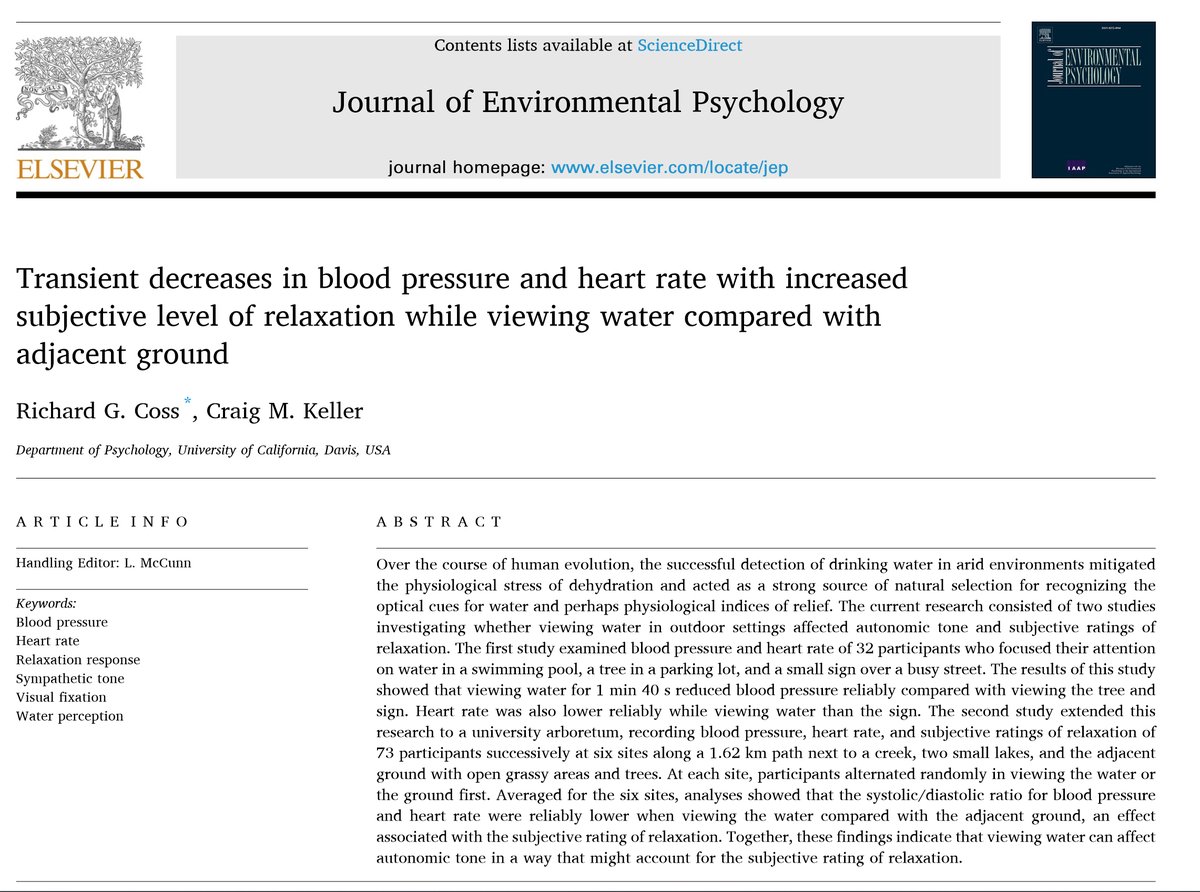
After just 2 minutes of viewing water outdoors, blood pressure and heart rate drop. It's more calming to look at a lake, pool, or stream than trees or grass.
Beaches are popular for a reason. Wider bodies of water bring more tranquility.
The best place to relax is near water.
After just 2 minutes of viewing water outdoors, blood pressure and heart rate drop. It's more calming to look at a lake, pool, or stream than trees or grass.
Beaches are popular for a reason. Wider bodies of water bring more tranquility.
Completed Man's Search for Meaning by Victor Frankl. The book was in "to be read" list for long. Took more than usual time to finish as in between the reads I felt that I'll break down. I suggest everyone should read it once. Few quotes from the book in this thread.
1/n








![Rainmaker1973's tweet photo. The complexity of the human brain and its functions in a neat infographic map
[zoomable version: https://t.co/4KyqZPcgRB]
https://t.co/xSmZ7Vc3zH](https://pbs.twimg.com/media/F3wTXj9WcAAkpyE.jpg)