1/2
AI did not create the structure producing its concentration. It inherited it.
Most of that architecture was already in place before the current generation of large language models arrived.
The personal computer, independent software, and the open internet had once broken a pattern that every major infrastructure technology fell into. That escape rested on three separations:
- The machine could be changed without losing the software.
- The software could be bought without permanent dependence on the vendor.
- A company could reach customers without permission from whoever owned the layer underneath.
Over the following three decades, those separations were gradually reversed.
- Computing recentralised around shared cloud infrastructure.
- Ownership dissolved into subscriptions.
- Technical capability migrated outward into vendor and consulting ecosystems.
- Distribution narrowed to gated storefronts.
- And the account began joining those dependencies into a single enforceable system.
The system worked well. Prices fell, services improved, access broadened.
What was harder to see was that it increasingly shaped not just which companies won, but which kinds of products could be recognised, financed, bought, staffed, and built.
2/2
AI arrived inside this already-formed structure and added something SaaS and cloud had not yet produced: industrial-scale infrastructure costs colliding with a technology that erodes the revenue base meant to pay for them.
That changes the balance fundamentally.
The full article traces how the escape was reversed through cloud infrastructure, software ownership, organisational capability, distribution, identity, institutional response, and the narrowing of what the market can recognise.
The Silicon Industrialists — Part 3: The Return of the Bind
https://t.co/vJgZq2savN
1/2
AI did not create the structure producing its concentration. It inherited it.
Most of that architecture was already in place before the current generation of large language models arrived.
The personal computer, independent software, and the open internet had once broken a pattern that every major infrastructure technology fell into. That escape rested on three separations:
- The machine could be changed without losing the software.
- The software could be bought without permanent dependence on the vendor.
- A company could reach customers without permission from whoever owned the layer underneath.
Over the following three decades, those separations were gradually reversed.
- Computing recentralised around shared cloud infrastructure.
- Ownership dissolved into subscriptions.
- Technical capability migrated outward into vendor and consulting ecosystems.
- Distribution narrowed to gated storefronts.
- And the account began joining those dependencies into a single enforceable system.
The system worked well. Prices fell, services improved, access broadened.
What was harder to see was that it increasingly shaped not just which companies won, but which kinds of products could be recognised, financed, bought, staffed, and built.
Six predictions filed before Microsoft, Apple, and Amazon reported. All six held. The score matters less than what it reveals: three separations in how investment, demand, and infrastructure costs are disclosed prevent investors from seeing the system. https://t.co/fNVLWbg3kS
Microsoft and Apple are on opposite sides of AI's "supplier financing its own demand" pattern. The article examines this dynamic and makes six predictions based on this divide. https://t.co/lFY6qrFyfW
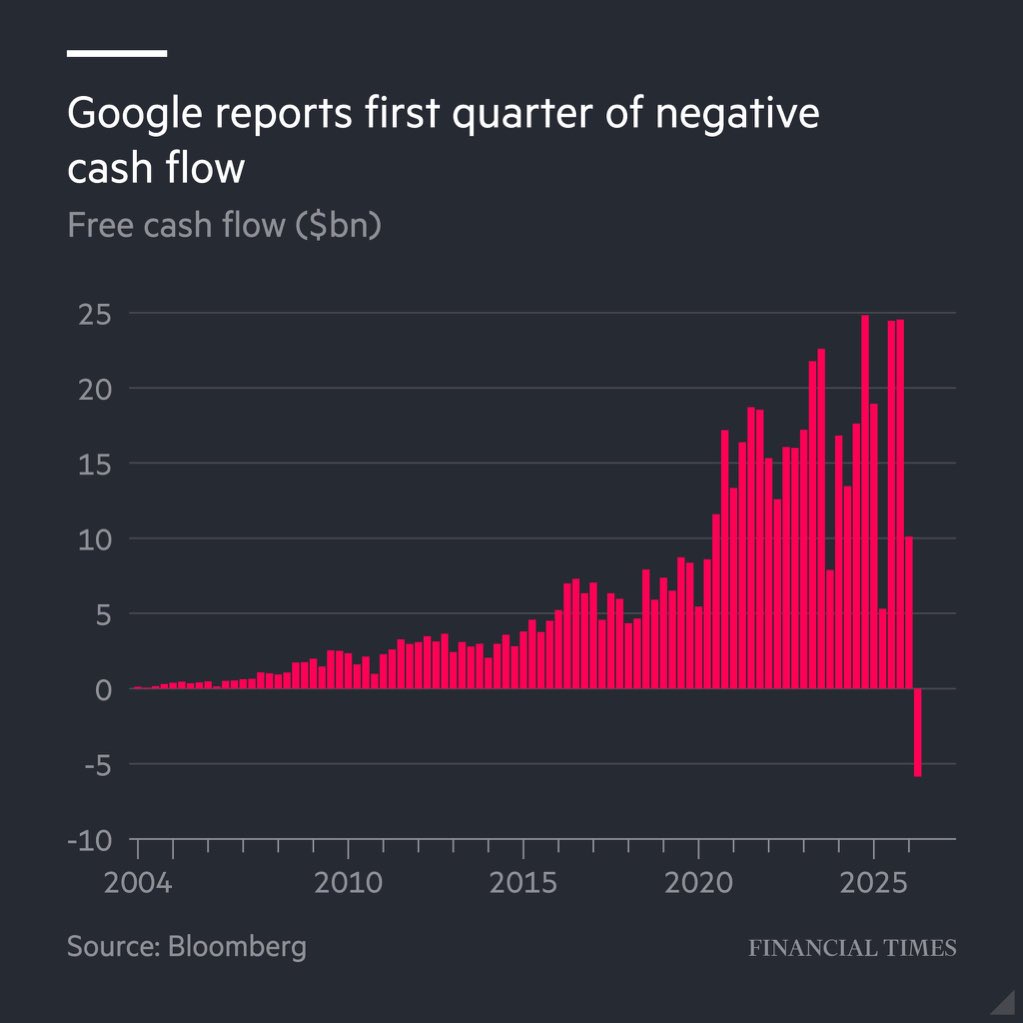
Buying is probably not a good idea. Total revenue was up 24%, cloud revenue surged 82%, and they still burned $5.9 billion in cash. AI infrastructure capex hit $44.9 billion in a single quarter, nearly double last year. Management raised full-year capex guidance to $205 billion and said 2027 spending "increases significantly." They've also issued $20 billion in new debt and announced an $85 billion equity raise.
This is the company Warren Buffett picked eight days ago specifically because it had the strongest revenue base to survive the AI spending race. And although this is true that revenue is still not enough.
When the best-positioned company in the industry can grow revenue 24% and still go cash-flow negative because infrastructure spending outpaces everything the business generates, and management tells you it's going to get worse. That's not a buy signal but the market discovering that AI's economics are industrial, not software.
4/4 The question worth asking structurally here is this. What happens when the companies funding the infrastructure can't capture the value it creates, the revenue signal from actual AI usage is softening, and the beneficiaries are priced at the ceiling of their historical range?
This is a cost structure question that has little to do with whether this is a bubble or not.
1/4 Here is the thing. Burry's charts tell a clearer story when you read them together.
The hyperscaler basket (Chart 3) is flat since January 2025. The companies writing the capex checks (Microsoft, Google, Amazon, Meta) have returned nearly nothing while the semiconductors and "AI winners" riding on top of that spending returned 120-200%.
3/4 Chart 1 puts semiconductor valuations at ~30x forward P/E which is the same ceiling it hit in late 2024 before pulling back. The relative ratio to the S&P is at the identical red-circle level. The pick-and-shovel layer is priced at the top of a 15-year range for the second time.
For twenty-five years, Microsoft treated Xbox as a strategic business. It absorbed six-year loss cycles, took a billion-dollar hardware charge, conceded an entire console generation to Sony, and responded with $76.2B in acquisitions. The posture was always more capital, more patience and more time.
Then in 2026, four months separated new leadership from a public memo disclosing a 3% internal "accountability margin". Suddenly they were judging performance on a metric that had never been voluntarily published before. And next we started to see studio closures and a worldwide price increase followed within weeks.
Every previous Xbox crisis was worse on at least one dimension but none of them triggered this kind of response.
The article looks at what changed and why the only voluntary window into internal economics opened for Xbox, while everything related to Microsoft's AI capital allocation remains visible only through aggregated segment reporting.
2/2
The article traces the pattern through three industries, follows the escape through three openings, and asks what held the ladder in place and why it is no longer there.
"The Silicon Industrialists - Part 2: Tech's Great Escape" https://t.co/BbrF4vabFJ
1/2
What if the dot-com bubble is the wrong comparison for AI?
The recovery everyone points to wasn't a natural correction. It was engineered by specific institutional decisions that no longer exist. Before software, every major infrastructure technology followed the same sequence AI is following now. They had massive capital expenses before demand, consolidation, and the owner of the foundational layer capturing everything above it. Railroads, electrical grids, and telephony all passed through it.
The personal computer, independent software, and the open internet broke that pattern for the first time. Each break was designed by people who understood that once the owner of the infrastructure controls the layers above it, the loop closes and stays closed.
A consent decree that opened monopolised science. An unbundling that separated software from hardware. A conditioned privatisation that built the open internet before anyone could close it. These were three interventions with one function. To prevent the owner of the foundational layer from controlling what could be built on top of it.
The result was one of the largest economic booms in modern history. And when the dot-com bust came, the open substrate survived. The recovery happened because the conditions were structural. But none of these conditions exist for AI.
@mohbii Yes, but the twist here is that AI is also dissolving the revenue models of the customers who are supposed to pay for the infrastructure. Railroads didn't destroy the value of the cargo they carried but AI does.
What if we've been analysing AI with the wrong economic model? 1/2
The entire industry treats AI as software, with SaaS margins, seat pricing and API subscriptions. But AI's cost structure looks nothing like software. Instead it looks more like railroads, oil fields, and electrical grids. Frontier models need specialised chips, industrial-scale data centres, dedicated power infrastructure, and hundreds of billions in capital before a single customer arrives. And the marginal cost of serving the next user scales with every query. The SaaS perpetual motion machine with its 75 to 85 percent margins is being replaced by 19th century industrial economics wearing a software logo.
At the same time, AI is dissolving the revenue mechanisms that are supposed to pay for all of it. Seats matter less when agents do the work. Implementation fees shrink when implementation becomes automated. Code becomes a disposable output of intent. AI is eating the pricing systems it was supposed to plug into at a dizzying speed.
These two forces collide inside every company, investment and strategy in the AI economy. The result is a double bind that pushes the most transformative technology in a generation toward regression.
2/2
The article traces how that double bind plays out through the infrastructure owners who can't stop funding the labs that depend on them, the venture funds deploying civilisational rhetoric into back-office automation, the startups that begin at the frontier and end up as enterprise middleware, and the open-source projects whose independence turns out to be structurally impossible.
"The Silicon Industrialists - Part 1: AI's Gilded Age" https://t.co/DkCEBE1XWb
Today, we see AI services as something that completes a task and disappears.
But in the future, those that will matter the most will be the ones that stay. The accounting autopilot that closes your books every quarter. The procurement service that handles your vendors. The compliance system that manages your exceptions.
AI autopilots don't disappear when the task is done. They come back next quarter carrying every decision, override, and exception from the last one. After three years the autopilot knows your operations better than you do.
The risk isn't data training. Most enterprise providers disclaim that credibly. The risk is the vendor becoming the only party that can explain how the work was done.
This final instalment completes the "Who Holds the Keys to the Agent Web" triptych from authentication capture, through commerce capture, to the post-transaction layer where the record settles
Link below.