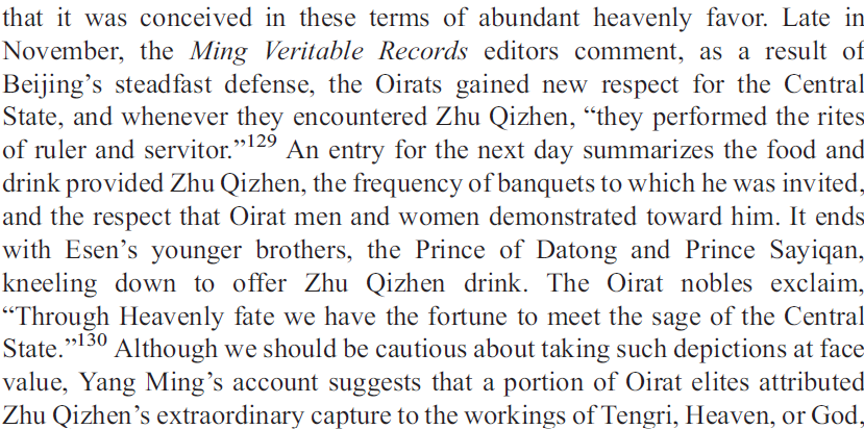
After the Battle of Tumu, the Oirats were surprised to find Yingzong Emperor surrounded by dead bodyguards, but completely uninjured.
When they brought him to Esen, the Yingzong Emperor identified the Oirat nobility by name, and thus Esen knew he was the emperor.
A serving girl saw an unusual glow in the emperor’s tent at night. She asked Yingzong if there were any special rituals he performed at night, but Yingzong replied “sleep.”
It seems like superstition, but in hindsight, the Oirats were correct about Yingzong's fortune. Eventually, Yingzong was restored in a coup, but he didn’t have to do anything. Then he survived two coup attempts, and fought many defeats and victories against Bolai khan.
Esen and Bayan Temur believed of his fortune, but most of the other Oirats didn’t respect Yingzong until after the Defense of Beijing.
This was how nobility treated each other. When Altan’s grandson fled to the Ming in the 1500s, they similarly gave many banquets and gifts.
@gunsen_history Matteo Ricci wrote similar things about Ming horses, despite same contradictory text evidence of cavalry charges.
Wonder if these are intentional exaggerations.
Ricci also wrote about people being completely peaceful and docile, a few years later, an armed robber broke his leg
@amonius56@IyerDharmapuri@n30n5223434 Yongle is somewhat overrated but he had no interest in xinjiang
Qing at its strongest was better than Ming, but Qing at its worst lost easily to Japan (with number advantage), Ming at its worst could still (ugly) win against Japan that had a more experienced and 5x larger army
Also the rise of coastal economy in southeast. Trade routes through SEA displaced the Silk Road in wealth and importance. High frequency of maritime commerce. Merchants dominated politics in the south.
These were not present in times of Han dynasty. History was not static.
There were many changes after Han. Spread of Buddhism, mass settlement of south china, meritocracy increase starting from Song, more developed painting, porcelain, and other arts, prose literature (ie novels) in mid Ming and then to Qing, pike and shot, and so on and so forth
The difference between history and events: history can be compressed, events cannot.
History - the grand dialectic sweep of human evolution - ended in China around the mid-Han dynasty*. Events continued interminably.
*ᴬⁿᵈ ᵐᵃʸ ʰᵃᵛᵉ ʳᵉˢᵗᵃʳᵗᵉᵈ ʷᶦᵗʰ ᵗʰᵉ ʳᵉᵖᵘᵇˡᶦᶜ
And other points left out. Such as the civilizational conflict between Central Plains and the southwest Bai and Yi. Tang stalemate with Nanzhao, Mongols defeated Dali but had to keep their elites due to guerillas, Ming wiped out elites in bloody wars, Qing crushed petty chiefs
Unfortunately, it seems there is no more information on the Arughtai clan after Toghto's excellent performance in 1465. They probably assimilated into Beijing people.
If they were lucky they became commoners. If they were unlucky, Li Zicheng killed them with rest of Ming nobles
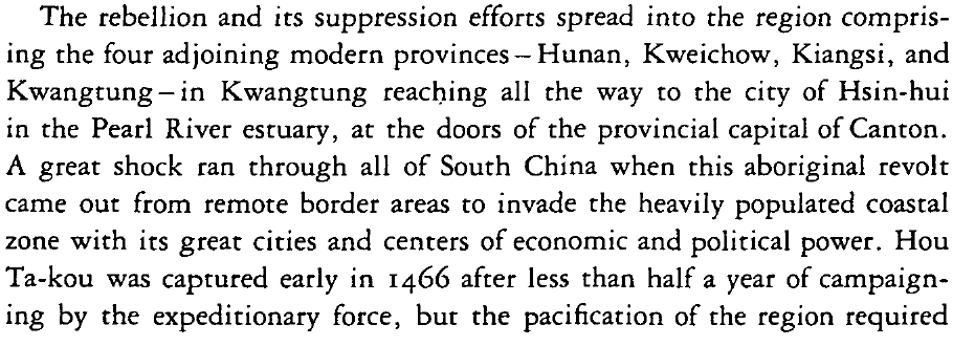
During the 1400s, increasing Han and Zhuang settlement in the south put pressure on the Yao tribal people.
In 1464, the Yao had an "uprising," attacking Guangxi, Hunan, Guizhou, and Guangdong, and easily defeating local Cantonese armies.
In 1466, the Beijing army suppressed them.
Han Yong was promoted to an administrator of Guangdong. Zhao Fu and Toghto Bolod received titles of nobility.
After this win in 1465, Zhao Fu later defeated the Jurchens in 1467, but the Mongols defeated him in 1472 and he was fired.
https://t.co/ZTPPdtYALL
However, tensions escalated. Esen khan pressured the Jurchens to raid Ming and Joseon, up to 97 times in one year. In 1467, the Beijing army and Joseon army launched an invasion of Manchuria. The Beijing army had 50k men divided into 5 columns, and Joseon also had 10k men