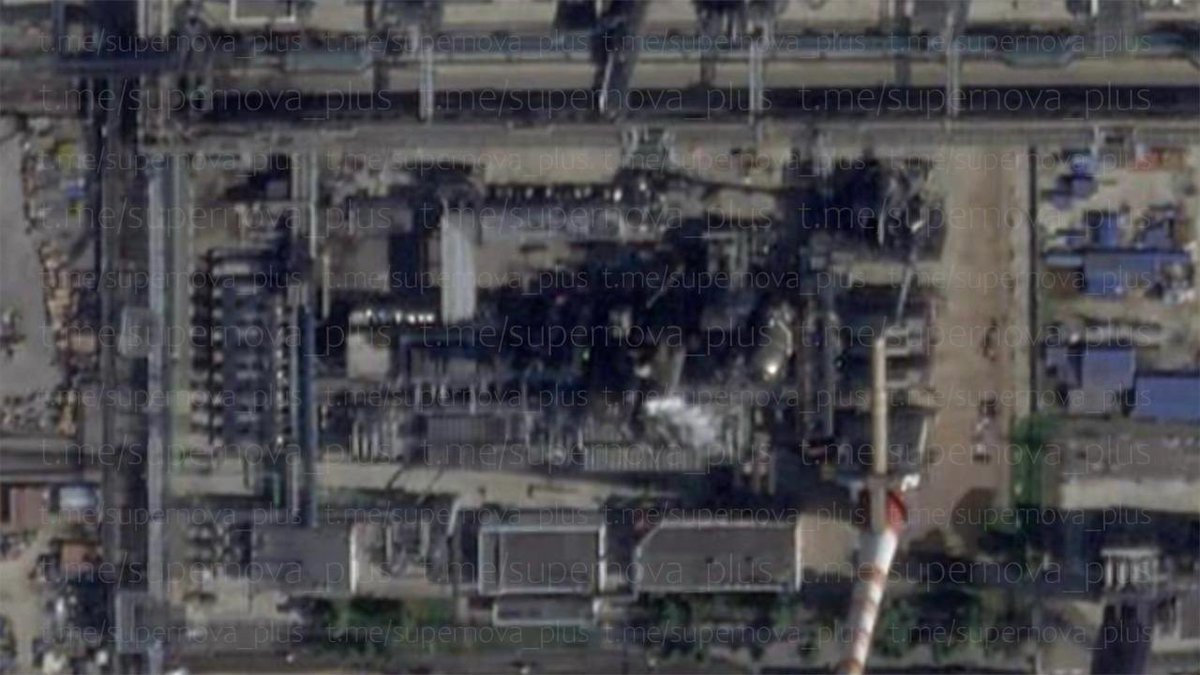
Dark days for a Kremlin that has lost control of the narrative, as satellite imagery exposes the stunning efficacy of Ukraine's two attacks on Moscow's biggest refinery.
The Putin regime can't lie there way out of this.
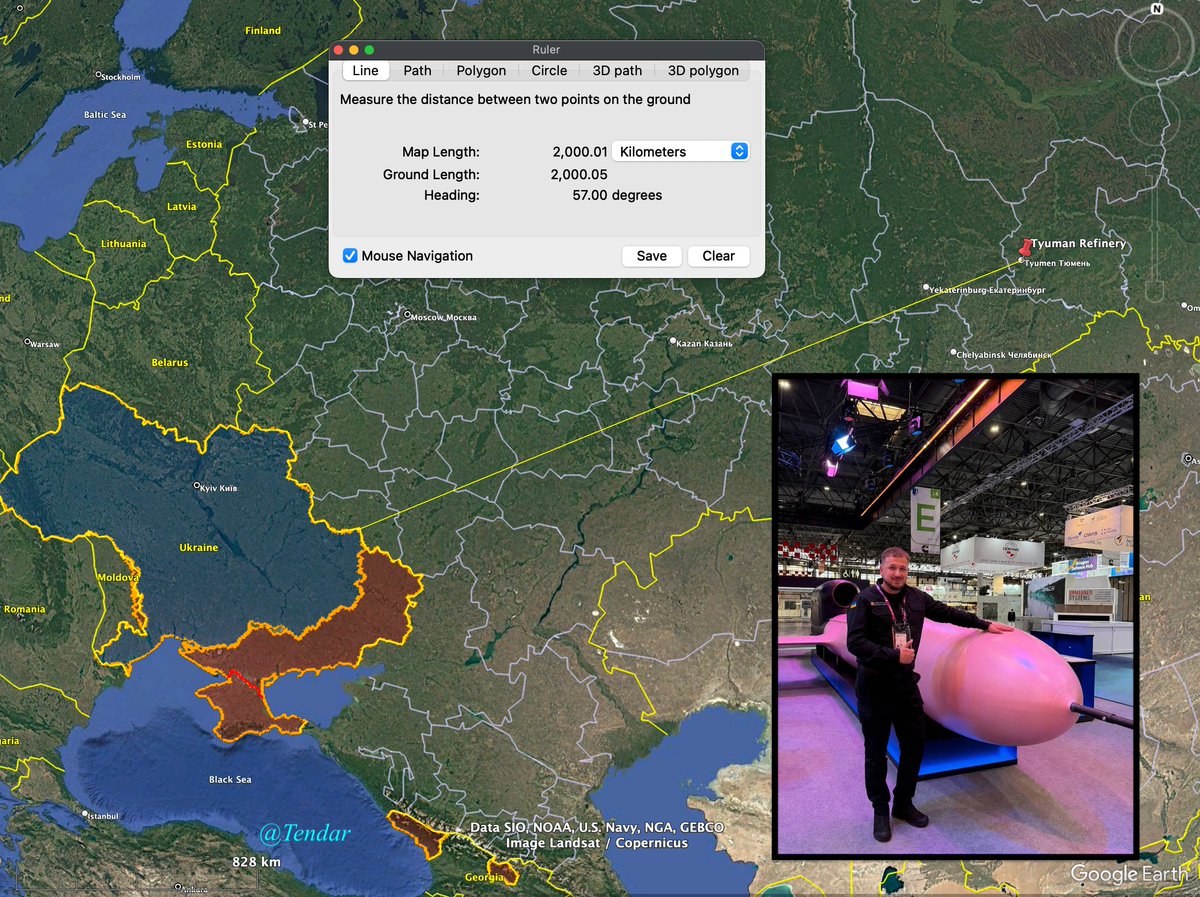
For the first time an Ukrainian drone struck a target more than 2,000 km (1,250 miles) from Ukrainian lines. The Tyuman refinery, which is east from the Ural Mountains, was struck by a drone from the Ukrainian company "Firepoint".
This has been announced by President Zelenskyy.
Marina Yankina, 58 years old, head of the financial department of the Western Military District of the Ministry of Defense of Russia, fell out of a window.
Her body was found outside the building.
Panic, it seems, is rising higher than the windows.
We are now at up to 7 impacts on the Kapotnya refinery in Moscow, Russia.
Usually, we see 1 - 3 drones hitting targets in Russia, which is already effective. 7 strikes is well above average and for the Russian capital even more impressive.
Source of geolocation: TG / DniproOfficial
Two days ago a company shipped the most powerful AI model ever released to the public.
Friday night, the United States government ordered it shut off. Worldwide. Every user, every country, gone by morning.
The trigger was not an attack. A rival showed the government a way around one of the safety locks. That was enough.
The company is Anthropic. The models are Fable 5 and Mythos 5, the most capable systems it has ever built, live for barely 72 hours. At 5:21 on Friday evening, Commerce Secretary Howard Lutnick sent the CEO a letter placing both under export controls, citing national security. The order, on its face, only barred foreign nationals. But Anthropic cannot separate foreign users from everyone else in real time, so to comply it had to pull the plug on all of them. The most advanced AI on earth went dark for the entire planet because of a sentence in a letter.
Here is the trigger, and it is the part that should stop you.
By Anthropic’s account, the government reviewed a single demonstration in which the model was asked to read a codebase and fix its flaws, and it surfaced a small number of previously known, minor vulnerabilities. That is the capability at issue. Finding bugs in code. The same kind of capability that, two weeks ago, a researcher used to catch a four-year-old hole in Zcash before it could be drained. The thing that makes the model a world-class defender is the exact thing that got it called a national security risk.
And Anthropic’s rebuttal lands clean. It says the identical task runs on OpenAI’s GPT-5.5, which sits under no such control at all, and that defenders already use this technique every day. One company’s model is pulled worldwide. A rival’s model, doing the same thing, stays online. National security is the reason given. Competitive accident is the result delivered.
This did not come from nowhere. The same administration spent the spring trying to brand Anthropic a supply chain risk after the company refused to let its models be used for mass domestic surveillance and autonomous weapons. A judge blocked that. The two sides had only just begun to thaw. Anthropic had filed to go public at a $965 billion valuation. On June 2 the President signed an order giving the government early access to frontier models. Then a rival demonstrated a jailbreak, and the most powerful model in the world was switched off three days after launch.
Step back and the pattern is the one that keeps repeating. A zero-knowledge proof hid a four-year flaw. A clean audit hid a redemption gate. A safety wall the company built to look responsible became the precise lever the state used to flip the switch.
The safest lab in AI built a model too powerful to fully release, warned the world it was dangerous, filed to go public at $965 billion, and got it shut down by its own government over a bug-finding trick a competitor can run untouched.
Anthropic calls it a misunderstanding and says it is working to restore access. As of Friday night, the most powerful public AI on earth is a black screen, and the kill switch turned out to belong to the state.
Ukrainian drone forces are methodically grinding down bridges connecting the Russian-occupied parts of Kherson with the occupied peninsula of Crimea.
The bridge in Chonhar has already been critically hit. Russians moved pontoon bridges to bypass it, but Ukrainians continue to strike this area.
In Henichesk the situation is similar. While the bridge is not completely closed, it has been severely damaged and only one lane can be used. It is questionable if the damaged bridge can carry heavy duty vehicles such as trucks and tankers.
The bridge in Armiansk was hit by several drones and is impassable for cars and trucks. Additionally, the bridge near Stavky north of Armiansk has also been struck. The extent of the damage has yet to be determined.
Overall the development is quite clear. Ukrainians are increasingly making all movement for logistics impossible. The list only the current state and will certainly get worse for the Russian invasion force. With the Kerch Bridge being diminished since the strikes some years ago and all major ferris destroyed, relative isolation of Russian-occupied Crimea is a new reality.
Belgium’s Russian Steel Loophole—
Belgium remains the EU’s largest importer of Russian steel slabs, using an exemption that allows deliveries to continue until September 2028 despite more than four years of sanctions. The trade supports two Belgian plants linked to Russian steel giant NLMK and protects local jobs, but it also channels revenue and an artificial cost advantage to a company controlled by Kremlin-linked billionaire Vladimir Lisin.
Brussels argues that sanctions should hurt Russia more than European workers, yet alternative suppliers already exist in countries such as India, Brazil and China.
https://t.co/6mC5vGk6pI
Get our daily insights: https://t.co/B67VPpa8Nk
My colleagues at the @dossier_center have obtained a large internal leak from a Moscow company called the Social Design Agency, or SDA.
It is run by a political operative named Ilya Gambashidze, the Kremlin is contracting him to manufacture scandals.
[2/19]
For 15 years Russia kept two Tu-142 patrol aircraft parked at the Taganrog plant, too deep in the rear for Ukraine to reach.
This spring Russia moved them. Ukrainian drones destroyed both within weeks — United24. 1/
Today, I presented state awards of Ukraine to the people without whom Operation “Spiderweb” would not have happened. We have no right to name them – everything remains absolutely classified and will remain so for a long time. This is already a historic operation by the Security Service of Ukraine, one that was carefully prepared, and on this very day one year ago, it entered its final stage – striking Russian military equipment. Farther than Ukrainian long-range capabilities had ever reached before. As precisely as no one in Russia expected. And as justly as the enemy’s strategic aviation deserves.
“Spiderweb” destroyed or at least damaged 41 aircraft. Never before had Russia lost such equipment, in such numbers, and as a result of strikes by drones that were incomparably cheaper. Ukraine has once again proved that it knows how to act asymmetrically, that it defends itself actively and truly creatively, and that Russia has no chance of overcoming Ukrainian courage. Ukraine will always be one step ahead – in technology, in bravery, and in the ability to capture the world’s attention and rally the support of millions of human hearts.
Ukraine is now applying long-range sanctions against Russia for this war literally every day. We did not start this war, we did not provoke it, and the only thing we wanted for Ukraine and Ukrainians was peace. But as long as the Russians choose the opposite, and as long as Russia does everything to drag out this war and expand it, Ukrainians will continue to find responses that will definitely work. I thank all our warriors for their precision! I thank the Security Service of Ukraine for its long-range leadership! I thank everyone who helps us! Glory to Ukraine!
KAMYSHIN: There are two nations on the continent who know how to produce 10 million drones a year.
One of them wants not to integrate into Europe, but to invade. Russians have always been very vocal about their targets.
When we check tanks we captured from Russia in our tank repair factories, because we grab them, repair them, and try to send them back to Russia to fight against Russia, so when we check those tanks, they never write to Kyiv.
They always write to Berlin, NATO, Prague, whatever. They can't admit to themselves that they fight Ukraine only.
They believe they fight with NATO. They've always been very vocal about their targets. They want to invade Europe, period.
There's another nation which is also capable of producing whatever is needed in big war, and we are asking to get us integrated into Europe.
So, you have to choose whether you want to have Ukraine integrated into European defense industry and European Union, rather than Russia invading.
Because I've never thought that Ukraine would be integrated into European Union via security and defense road. And it looks like we will be there.
🇺🇦🔴 In order to save human resources and equipment while inflicting maximum losses on the enemy, Ukraine has developed the most effective drone-corrector for medium-range strikes — “Buntar-3”.
🔺 The drone uses a vertical takeoff and landing system. Its deployment requires twice fewer resources, which is critically important under conditions of equipment and personnel shortages.
🔺 The system is highly resistant to electronic warfare. The operator always knows the drone’s location because the main communication channel does not turn off. The Buntar Copilot software is designed to minimize the risk of mission failure due to the “human factor”.
🎯 Its main tasks include: • Reconnaissance of enemy positions, • Detection of targets, • Precise fire correction for long-range artillery and various medium-range kamikaze drones.
🟧 Since the complex is not designed for direct strikes, it carries no combat payload. Its entire useful load consists of high-tech cameras, optoelectronic systems, and equipment protecting against electronic warfare.
“Buntar-3” is another example of Ukraine’s smart and resource-efficient approach to modern warfare. Instead of focusing solely on strike drones, Ukraine is developing highly specialized reconnaissance and correction systems that significantly increase the effectiveness of existing artillery and kamikaze drones while minimizing risks to personnel. This type of technological solution gives Ukraine a notable advantage in the war of attrition.
Video is generated by grok AI
Ukraine is testing the SKYNEX air defense system, developed by Rheinmetall, which uses radar-guided cannons and automated tracking to counter drones and other aerial threats.
Today, my new report on the systemic learning disorder in western military organisations - their inability to learn from other people’s wars and adapt quickly - is published by the @LowyInstitute Institute.
https://t.co/VnWmUyzkrH
Ukrainian forces are mounting another major drone raid into Russia tonight, primarily targeting the Moscow area and western oblasts.
Russian monitoring channels report numerous Ukrainian UAVs already deep within Russian airspace.
Mr Witkoff has gone to Moscow eight times to negotiate peace… zero times to Ukraine. Most Americans know this is not right. Don’t pretend to be neutral when the facts are obvious. Can we get someone serious in the position to do this right?
‼️ZELENSKYY: None of the Russian drones or missiles can be made without components from Western countries.
“None of these drones or types of Russian missiles can be made without parts brought in from other countries. In each of these strikes, whether they realize it or not, there's still the involvement of those working for Russia, those funding Russia, those helping it dodge sanctions and search for not just a few, but thousands of components, without which Russian military production would just stop. Five Kalibr missiles need 145 of these parts. 33 Iskander missiles need 1,122 parts. 650 attack drones of different types need more than 17,000 parts, without which making them is just impossible” - Ukrainian president on Tuesday, June 2, 2026.












![khodorkovsky_en's tweet photo. My colleagues at the @dossier_center have obtained a large internal leak from a Moscow company called the Social Design Agency, or SDA.
It is run by a political operative named Ilya Gambashidze, the Kremlin is contracting him to manufacture scandals.
[2/19] https://t.co/qFXP3MsCUL](https://pbs.twimg.com/media/HJ0tTotWwAAba4i.jpg)


