So-called age verification for social media is spreading across the world, framed as an effort to create a safer internet for children. In reality, age verification lays the foundation for a fully controlled internet.
The age verification rush must be slowed down, and politicians need to recognize the consequences of different types of legislation and systems.
Age verification is the wrong approach to fix “the social media problem”
The big tech social media companies are bad. Their business model is bad; it is based on mass surveillance and manipulation, and they cooperate with governments in mapping entire populations. But age verification is fundamentally the wrong approach to preventing children from using big tech social media platforms. Introducing age verification is based on coercion; the state forces social media companies to verify their users’ identities. But the big tech social media platforms already know which of their users are children. Their business model depends on knowing this. They know how old users are, and they know exactly what type of person they are. As age verification is based on coercion, politicians could instead force platforms to stop doing the things politicians consider harmful to children, or force them to block children (again, they know who they are) from using their services. But instead, politicians seek to massively invade everyone’s privacy and undermine democratic rights on a global scale. In other words, the latter is the real objective – they do not want to protect children; they want to impose control.
Slippery slope of age verification
It is undeniable that age verification threatens freedom of expression, risks increasing mass surveillance, and is likely to lead to censorship. It will not only shrink the online world and reduce young people’s right to privacy (for example, if VPN services were to be restricted); but also risks becoming a significant step toward a controlled internet for everyone.
Most age verification is identity verification
Most countries are now considering introducing age verification systems, meaning that everyone would have to identify themselves either to the service/website they want to use or to a third party capable of linking them to their activity on that service or website. This is not age verification but identity verification, and the consequence is therefore that freedom of information is restricted (you can no longer visit regulated websites anonymously) and that you can no longer post anonymously on social media. This is a major problem in countries like the UK and Germany where the police conduct raids on people’s homes for posting content on social media that the authorities dislike. Or in the United States, where authorities are trying to pressure tech companies into revealing the identities behind accounts protesting ICE. Social media identity verification removes important tools for activists in countries where criticizing those in power is dangerous.
Restrictions on app store or operating system level
Some countries are looking to impose identity verification at the app store level or even within the operating system itself. This is an exciting experiment, since this is possible to circumvent using open-source operating systems. Some countries are already looking to include open-source systems. Since open-source systems cannot be controlled, politicians would ultimately need to ban devices that are not controlled by the state. The end point: telescreens like those in Orwell’s 1984, devices that both monitor you and broadcast only the information approved by the state.
The Zero-Knowledge Proof (ZKP) alternative and the EU
The EU has presented its own age verification app as “completely anonymous”. The idea is to use Zero-Knowledge Proof (ZKP) cryptography to break the link between the age credential issuer (EU governments) and the regulated services/sites. Currently, the EU app does not have ZKP functionality, contrasting Ursula von der Leyen’s claim that the app ”is technically ready to be used”. But more importantly, the app is currently designed to always function without ZKP technology; if ZKP is unavailable, the app falls back to a non-ZKP model. Even if fully developed ZKP technology could be implemented in the future, it would remain an optional extra feature that countries may choose to disable and that the EU could remove at any time.
Read more on our site.
https://t.co/wTVKHMS1zg
La cosa es cada vez peor:
No pasaron 3 minutos entre que llegó la policía, lo esposaron, se desmayó, le quitaron las esposas y murió, como yo había entendido.
Fue una puta hora.
En lugar de llevarlo a un hospital a 4 minutos de allí, lo tuvieron una hora.
En el suelo.
Esposado.
Arrastrado al principio y burlándose de él.
Una puta hora.
Le leyeron sus derechos estando él ya semiinconsciente, agonizando.
E incluso así tardaron 3 minutos más en quitarle las esposas.
Hijos de la grandísima puta!!
Male officer: "He says he's been stabbed."
Female officer: "We have to check, don't we?"
Male officer: "No."
I worked in emergency care for years... YOU ALWAYS CHECK, even if you think the patient is unreliable.
The guy is on the ground and clearly in respiratory distress, telling you he's been stabbed. What the fuck is wrong with you to automatically assume he's lying?
That's gross disregard for human life and as far as I'm concerned as a non-law person; it's criminal negilence. 💀
‼️🇨🇭👁️ La Suisse voulait faire passer une nouvelle loi de surveillance...
Elle visait les entreprises proposant des services privés comme :
- Les VPN
- Les e-mails chiffrés
- Les messageries sécurisées
1. Demander une pièce d’identité à chaque nouvel utilisateur (passeport ou permis de conduire)... Plus possible de s’inscrire sans donner son vrai nom !
2. Garder les données des utilisateurs pendant 6 mois (adresse IP, quand on se connecte, etc)
3. Pouvoir déchiffrer les messages ou données si la police le demande !!
Proton (l’entreprise suisse qui fait @ProtonMail et @ProtonVPN) a dit clairement : "Cette loi est pire que celle des États-Unis"
Résultat Proton a commencé à déplacer une partie de ses serveurs hors de Suisse !! (en Allemagne notamment) par précaution.
Mais l’entreprise reste basée en Suisse pour le moment
Ensuite beaucoup de monde s’est opposé à cette loi (d’autres entreprises, des associations et des politiciens)
ILe gouvernement suisse a donc revu sa copie et a atténué le projet !
- La version la plus sévère de la loi n’a pas été appliquée
- Proton a quand même commencé à diversifier ses serveurs !
- La réputation de la Suisse comme pays qui protège bien la vie privée a pris un coup
La surveillance de masse n'est qu'une question de temps ⏳
Una izquierda que se vanagloria de aprobar un Estatuto que obliga a sus trabajadores a trabajar 45 h semanales, 17 horas seguidas y más, y con posibilidad de semanas de 80h.
Vaya vaya...
Este tuit de abajo es mentira.
Vamos a seguir haciendo guardias de 24 horas.
Me parece increíble e incomprensible que se afirme algo así.
Reconozco estar profundamente decepcionado.
@nosoloviernes2 Porque subir el SMI solo es una redistribucion de los trabajadores mas productuvos a los menos que, además, crea barreras de entrada para los trabajadores menos cualificados que no esten ya trabajando.
@trol_azo No es que lo crea porque sea moralmemte correcto, es que es la consecuencia mas probable de querer seguir manteniendo las pensiones con nuestro sistema piramidal sin crecer lo suficiente.
Wow. Disappointing to say the least.
The App Store Accountability Act replaces parental authority, forcing every family - every citizen - into a government mandate with no flexibility and substantial data privacy and protection concerns.
Parents already have the power to control what apps their children download, when and how long they are on the app, regulate in-app purchases, and more. The tools available for FREE are very robust and getting better all the time.
The ASAA is a DIGITAL ID and it is unconstitutional.
@Mary_E_Rayburn@reddit_lies They detect the works that were used ro ttain AI as AI generated, as they are similar to those things AI produces. Its a circular fallacy.
Henry's stab wounds were so severe that he would have died whatever the police did, but at the same time his injuries were so slight that the officers didn't notice them and decided it was a good idea to handcuff him.
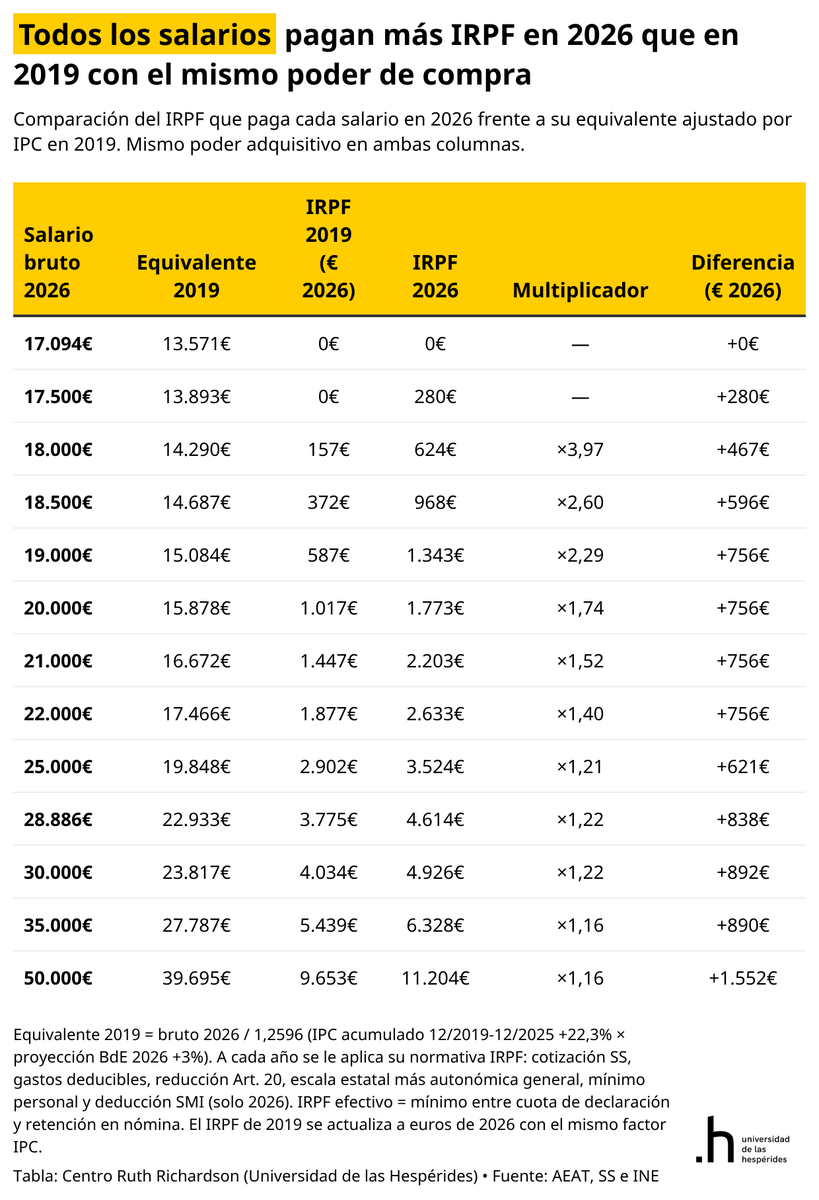
Así es, Presidente. El salario bruto pudo crecer por encima de la inflación, pero a igual poder adquisitivo todos los salarios pagan más IRPF en 2026 que en 2019.
Una renta de 18.000€ paga casi cuatro veces más que su equivalente de 2019; el salario medio pierde 838€ de neto al año. Nada de esto ha pasado por el Parlamento: es progresividad en frío.
¿Sigue ganando poder de compra quien entrega esa parte del sueldo a una subida que nadie ha votado?