Que loucura! O inverno cripto vai acabar na semana do 5 de outubro de 2026 (mais 4 meses). Estava escrito o tempo todo no gráfico.
Bull market: 1'064 dias
Bear market: 364 dias
🚨 THE 2026-2027 CYCLE SCHEDULE:
June: Bitcoin Crash
July: Accumulation
August: Recovery
September: Optimism
October: Bull Run Starts
November: New Bitcoin ATH
December: Bull Trap
January: Market Dump
February: Mass Liquidations
March: Cycle Bottom
Reminder: I publicly called the $17K Bitcoin bottom in 2022 and the $126K top in 2025.
I'll be sharing my next major market call here as well.
Follow and turn notifications on.
I’m sick of it. The Bitcoin gloom and disappointment. Don’t you see what is underway?
When you close your eyes, there’s one number you should see in your mind: $500T of fiat assets.
That’s how much global asset value is sitting in Bonds (fixed income) & Money (M2 fiat currency). Why does that matter?
Because that giant reservoir of ~½ the world’s asset value contains the potential energy necessary to power hyperbitcoinization.
This is what Saylor sees.
But do you see it yet?
Consider Hoover Dam. The reservoir behind it contains 12 TWh of usable hydroelectric energy – it just looks like one big lake, calm and placid. But if you stick a pipe through that damn and put a turbine generator in the middle of it and let the water run through it… you can generate enough energy to power the city of Las Vegas for 5 years.
That’s potential energy. Stored, untapped power. And by removing the barrier for the water to flow towards a lower energy state, you can harness the pent up power of the reservoir.
This same mental model works for capital.
A high Sharpe ratio is the financial analogue of a low-energy equilibrium state. Capital flows downhill, always seeking lower risk per unit of return.
(Yes, I know everyone thinks about it as “highest return per unit of risk”, but this is the equivalent and helps understand the physical metaphor)
Do you see it yet?
Think about all the capital parked in fixed income instruments or money market funds. All of this capital is parked there because it has historically provided an acceptable trade-off of modest nominal returns for minimal risk.
The entire premise of fixed income is “here’s a way to park cash in low-risk instruments that will generate a positive return slightly greater than inflation.” Adjacent to this asset category is “cash and cash equivalents” where the value proposition is somewhat smaller returns in exchange for even less risk.
And over the decades, a steady stream of capital has found its way into these asset buckets that promise low risk and modest nominal returns via future fiat cashflows.
These buckets have become a giant fiat reservoir, brimming with nearly $500T of capital.
Do you see it yet?
Along comes Strategy. @saylor realizes that much of this $500T of capital would be better off if it flowed into Bitcoin. But Saylor also recognizes that this reservoir of capital is inherently constrained. Boxed in by convention, investment mandates, risk management, volatility aversion, etc.
It won’t flow to Bitcoin on its own. It can’t – it’s walled off, dammed up.
Strategy engineers a solution. Creates a product to meet that capital where it’s at. The $500T fiat asset reservoir wants low risk, low volatility, fiat cash flows. Strategy designs preferred equity instruments that solve for these constraints, while Strategy uses the fiat capital proceeds to buy Bitcoin (which it believes will appreciate at 29% CAGR for the next 20 years).
In exchange for capital today, STRC offers 11.5% annual returns with volatility asymptotically approaching 0. The Sharpe ratio is off the charts. It breaks everything in tradfi portfolio allocation. At first glance, it seems impossible. But it works because it’s not powered by risk-taking layered on top of fiat inflation; it’s powered by the ongoing monetization of a superior monetary asset whose endogenous properties ensure its appreciation when valued in fiat currency units over time.
Saylor terms this kind of Bitcoin-powered fixed income offering “Digital Credit.”
When a commodity flows from a high-energy state to a low-energy state, it releases energy. In the case of Hoover Dam, that energy can be used to power a hydroelectric turbine. In the case of Bitcoin treasury companies with Digital Credit offerings, that energy can be used to power shareholder returns for common equity holders. This can happen in every major capital market in the world.
Do you see it yet?
Strategy has stuck a pipe through the dam. A conduit through which capital can flow out of the Fiat Asset Reservoir and towards a low-energy equilibrium state. Digital Credit offerings (e.g., STRC, SATA, and others) create that value proposition.
And what’s the Total Addressable Market (TAM)? All $500T of fiat assets in the reservoir.
The recent SpaceX IPO Prospectus recently made a splash by claiming the company had a combined $28.5T TAM, proclaiming that this was the “largest TAM in human history.”
But my essay from 2023 titled “Bitcoin’s Full Potential Valuation” already articulated how Bitcoin’s TAM is all value itself, above and beyond the usual lens of annual economic activity across industries. Saylor read it, adopted it for his presentations, and built on it with the Bitcoin24 valuation model.
The SpaceX Prospectus is wrong. Bitcoin has the largest TAM in human history.
And Digital Credit has the second largest TAM in human history – the $500T Fiat Asset Reservoir.
Do you see it yet?
Digital Credit offerings will redirect some % of the $500T Fiat Asset Reservoir into Bitcoin. This will happen because the value proposition of Digital Credit offerings is higher Sharpe than anything I am aware of in the entire $500T reservoir, inflation-adjusted.
Think of it as the Second Law of Capital Dynamics: capital flows toward assets offering superior risk-adjusted returns.
If Digital Credit ingests 1% over the coming decades, that’s $5T. It seems unreasonably pessimistic to think that only 1% of the $500T Fiat Asset Reservoir would be interested in vastly better returns with a similar (or better) risk profile.
Let’s say Digital Credit appeals to a (still-conservative) 10% of the $500T fiat asset reservoir, that’s $50T.
Bitcoin is currently a $1.5T asset.
Do you see it yet?
Digital Credit may direct a torrent of $50T of capital into Bitcoin over the coming decades. All of it bidding for a finite supply of Bitcoin.
The scale of that inflow would likely drive Bitcoin’s valuation to $10m/BTC, or ~$200T total.
Digital Credit is the plumbing of hyperbitcoinization.
This is how it happens – you’re watching the early stages of Bitcoin’s monetization megatrend.
The question is: do you see it? Or will it have to play out first?
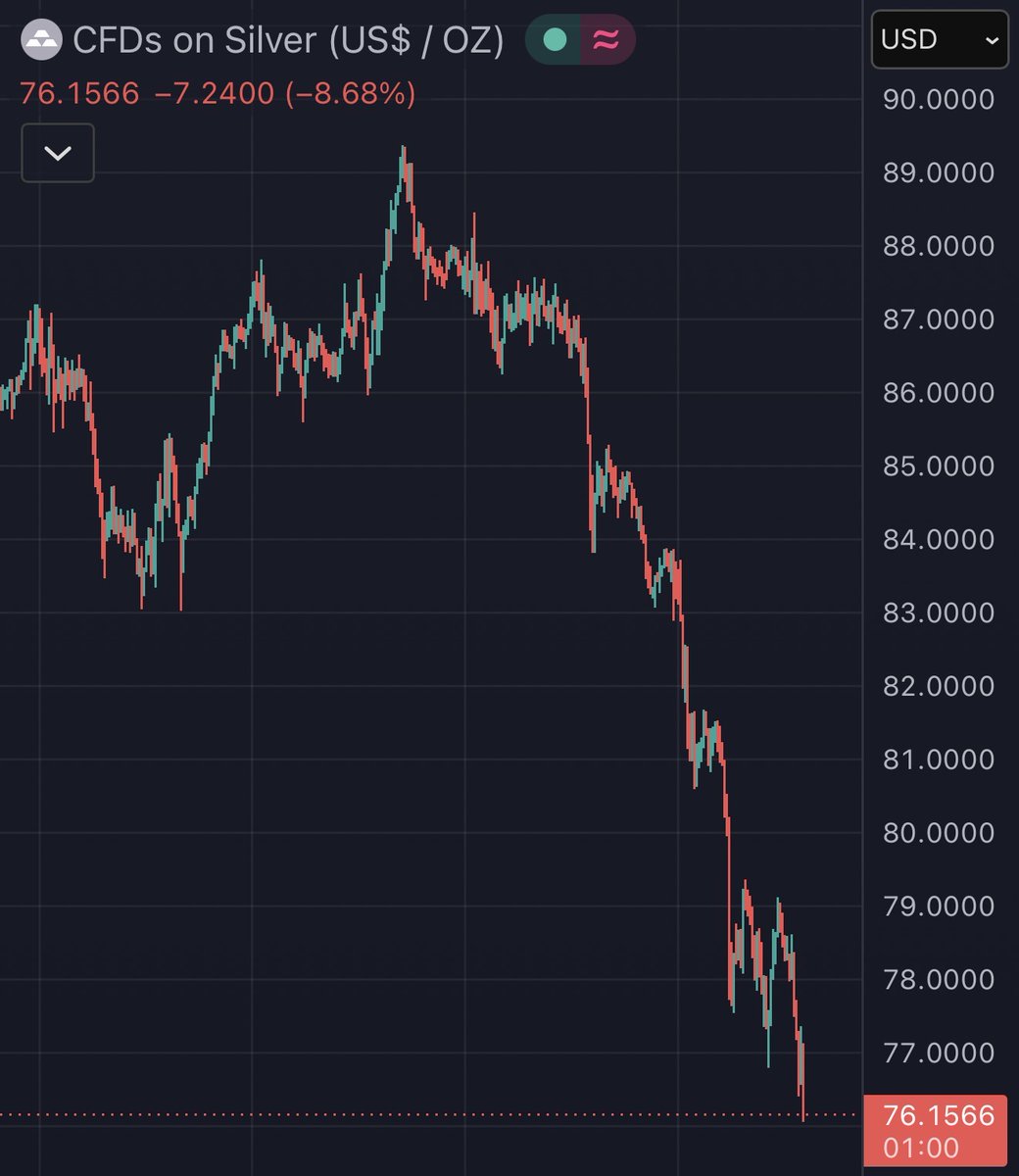
Silver miners are on the verge of a major breakout. 🥈
Production cost: $15 to $20 per ounce.
Selling price: $75 per ounce.
That is the strongest margin this industry has ever seen.
The best plays are miners who produce now AND can grow.
AYA checks both boxes. 6 million oz today. 37 million oz coming by 2029. $250 million in free cash flow right now. 📈
#AYA #SilverMining #PreciousMetals
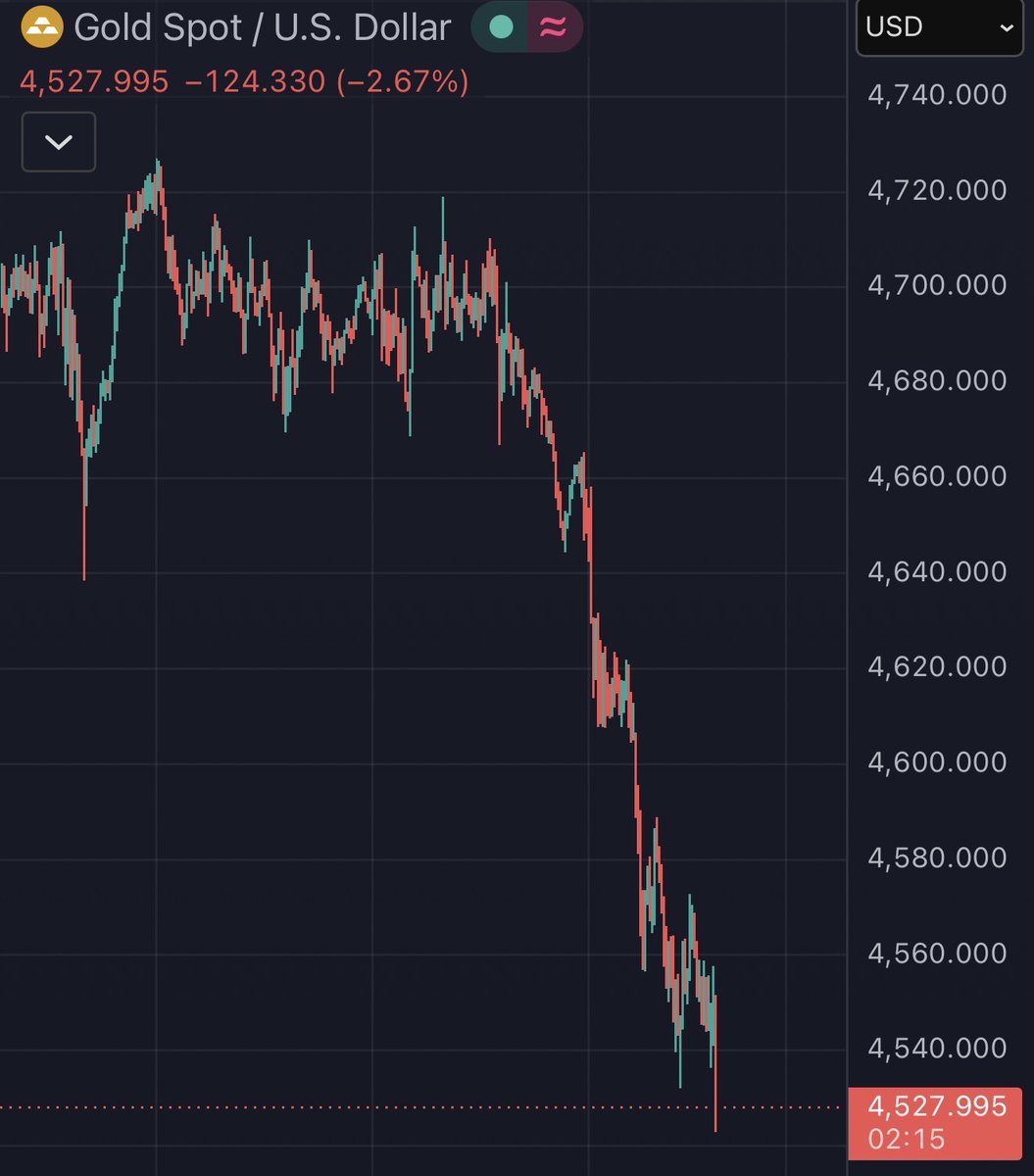
🚨 THIS IS NOT NORMAL
In the last 30 minutes:
Silver: -9.10%
Platinum: -4.37%
Gold: -2.91%
Bitcoin: -2.46%
Palladium: -1.66%
Trillions just disappeared from the market.
We’re moving into an extreme statistical event.
Something that has NEVER happened in the history of finance.
That’s more than the GDP of 99% of countries erased in minutes.
This is the start of a FORCED LIQUIDATION PHASE.
Liquidity is vanishing.
Funds are getting margin-called.
Positions are being closed.
They’re selling whatever still has value just to stay alive.
I’ve been in finance for more than 15 years.
When I EXIT the markets completely, I’ll say it here publicly, like I always do.
Turn notifications on. If you’re not following yet, you’ll understand why that was a mistake later.
Além disso, o Bitcoin tem um ciclo histórico muito claro: halving a cada ~4 anos, redução da oferta nova, seguida de valorização expressiva. Sempre aconteceu. E o próximo ciclo de alta já está em curso.
Ou seja, hoje você compra um ativo "barato" em relação ao seu ciclo histórico, que reduz o risco Brasil da sua carteira, protege contra a impressão global de dinheiro, e que tem um mecanismo estrutural de valorização embutido no próprio código.
Não é fé. É matemática.
O NEGÓCIO TÁ FEIO: O Tesouro Nacional confirma: a dívida do Brasil está saindo do controle
O próprio Tesouro já admite que a dívida pública brasileira deve atingir 84,3% do PIB em 2028. Isso quer dizer que, para cada R$ 100 que o Brasil produz, mais de R$ 84 já estarão comprometidos… e o caminho até lá está acelerando. Quanto maior a dívida, mais caro fica para o governo se financiar, mais dinheiro dos impostos vai parar no bolso de quem detém os títulos e menos sobra para saúde, educação e segurança. E é claro que investidores passam a cobrar cada vez mais caro para emprestar ao país.