Record supertanker rates are making long-haul crude trades uneconomical, threatening to reroute global oil flows.
Hiring a very large crude carrier from the Persian Gulf to the Far East has reached a record of more than $1.1m a day, a 12-fold rise in months. Freight has more than tripled in a year, the highest in over 20 years adjusted for inflation.
A shortage of available ships is driving it. Threats in Hormuz and the Red Sea have forced diversions and shuttle runs, requiring many more tankers to haul the same crude.
VLCC earnings stand at $950k/day on Yanbu-Korea, $520k/day on West Africa-China and $380k/day on US Gulf-China.
Transport now costs $22-26 a barrel, against about $2 a year ago. A Houston-to-Asia cargo runs about $26/bbl, or $52m per shipment, roughly a quarter of WTI futures.
Refiners are buying closer to home where they can, and traders fear freight at these levels makes refining distant crude unprofitable.
A Bloomberg Opinion column argues current values are not a new normal, with orders for new supertankers heading to a 50-year high.
Russian strikes killed at least four people across Ukraine overnight and damaged a data centre in Kyiv, in what is set to be the capital's worst month since 2022.
President Volodymyr Zelenskyy reported the data centre damage, days after ISW assessed that Russian forces are intensifying attacks on Ukrainian data centres and telecommunications facilities.
More than 155 strikes have been recorded on Kyiv city and oblast this month, against 113 in August and 111 in July, taking the year's total to about 665.
Russian forces launched 162 drones during the day on 25 September and 173 overnight into 26 September, on ISW's count.
Recent targets in the capital include warehouses, data centres, airports, gas and train stations, and military and civilian industry.
Missile strikes are running below July and August levels, since low-cost Geran-4/5 and Banderol drones now reach the city. Russia is assessed to be holding missiles back for winter.
Five men have been charged with plotting a terrorist act after arrests near RAF Fairford, the US bomber hub for the Iran campaign.
Gloucestershire police declared a major incident and arrested them on suspicion of Explosives Act offences. Homes in Whelford, 2 miles from the base, were evacuated while an Army bomb disposal team worked.
Attention has focused on three vans standing one street and a field from the perimeter, with large barrels removed from them for examination.
Fairford raised its force protection condition to Delta on Saturday after threat intelligence, and Trump said the men had been under investigation for a long time.
The Telegraph reports that a farmer returning home came upon the group by chance, that they fled on foot and were detained within 25 minutes.
The base has served since February as the US hub for bomber operations against Iran, hosting B-1 and B-52 missions. Defence Secretary Wes Streeting said he spoke to his US counterpart Pete Hegseth on Sunday.
No state or non-state actor has been named.
Trump expects more US-Iran talks this week, a day after rejecting Tehran's plan to reopen Hormuz, with neither side moving on terms.
He told Axios that negotiators could be back at it as early as Monday: "They want to make a deal, but it is not the deal that I want to make. They overplayed their hand."
The two sides had been exploring a narrower swap: Tehran reopens the strait, Washington lifts its blockade of Iranian ports, close to the mid-June memorandum whose ceasefire collapsed.
Foreign Minister Abbas Araghchi said Sunday that Iran will open the strait if the US meets conditions that "are not new", and that Tehran has no reason to re-engage with this administration.
President Masoud Pezeshkian offered to bring UN inspectors back and to dilute enriched uranium under international supervision, while ruling out free navigation while sanctions and the blockade stand.
Asked whether he is considering resuming strikes, Trump said he is always thinking about it. The midterms are five weeks away.
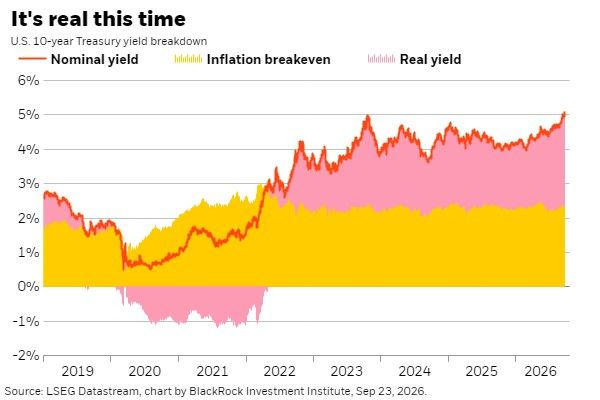
The US 10-year Treasury yield hit 5.23%, its highest since 2007, with the rise coming from real yields rather than inflation expectations, which weighs on both equity valuations and the federal debt path.
The 30-year closed at 5.5%, the highest since 2004. The 10-year is heading for its seventh straight monthly gain, a run last seen at the turn of 2010 into 2011.
Breakevens have held near 2.3% while real yields have climbed to roughly 2.7%. Goldman Sachs puts the rise in the real 10-year at 53bp over the past month.
That crosses a two-standard-deviation speed limit historically associated with negative equity returns, with the S&P 500 averaging about -4% over the following month.
Cleveland Fed President Beth Hammack attributed the move to a stronger growth outlook, concerns about government debt and expectations of further rate increases.
The CBO estimates that rates a percentage point above its projections, roughly where they now are, would put federal debt at 222% of GDP by FY2056, 47 points above baseline.
The joint statement from Xi Jinping's state visit, which ended with no deals announced in person, carries trade and energy commitments the two governments had not disclosed.
Washington and Beijing agreed to recommend more favorable tariff treatment for $30bn of non-sensitive goods in each direction, covering US agricultural and medical-device exports and Chinese appliances, toys and child car seats.
China committed to import at least 10 million metric tons of US coal in 2027 and 2028. Both governments said they are working to return rare-earth and critical-mineral shipments to appropriate levels.
Trump urged Xi to increase refined petroleum output to stabilize global supply. Both sides opposed any tolls on international waterways and reaffirmed that Iran must never acquire a nuclear weapon.
Trump said the two spent little time on Taiwan, and he did not repeat Washington's decades-old position on the island.
The two sides adopted "super intelligence" in place of "artificial intelligence" and created a dialogue on it, with the next exchange due by November 2026.
Iran's Revolutionary Guard struck shipping in Hormuz over two nights, claiming 19 ships hit, after flows recovered to 13-14 mb/d.
The IRGC fired anti-ship cruise missiles and drones while fast-attack boats engaged tankers with rockets and small arms. Initial reports put three vessels struck and a fourth turned around, with a second source citing six.
Fars, an outlet associated with the IRGC, put the count at 19 ships. Iranian sources say mines were laid on the southern route, where many crossings run dark or under military escort.
No independent confirmation that tankers were hit has emerged; a Taiwan-linked tanker crossed the strait overnight.
Tehran has not softened its terms since Trump rejected its seven-day plan to reopen the strait. Foreign Minister Abbas Araghchi says Iran awaits a definitive response from mediators Qatar and Pakistan.
Araghchi, rebuked publicly by Iran's Supreme National Security Council, said the same seven conditions were presented in every meeting; they include an end to all hostilities in the region, including Lebanon.
S&P 500 earnings growth is close to 32% this year, against the low teens expected in January, and it now carries index returns on its own.
Q3 2026 growth is estimated at 29.1% year on year. If achieved, it would be the third straight quarter above 25% for the index.
The multiple has moved the other way. The forward 12-month P/E is 19.2, down from 22x at the start of the year despite a 14% year-to-date return, with Goldman Sachs tying the de-rating to rising interest rates.
EPS forecasts flatlined in September. Barclays warns that next year's growth and EPS expectations may be unrealistically high, and that investors should examine the 'E' in S&P valuations.
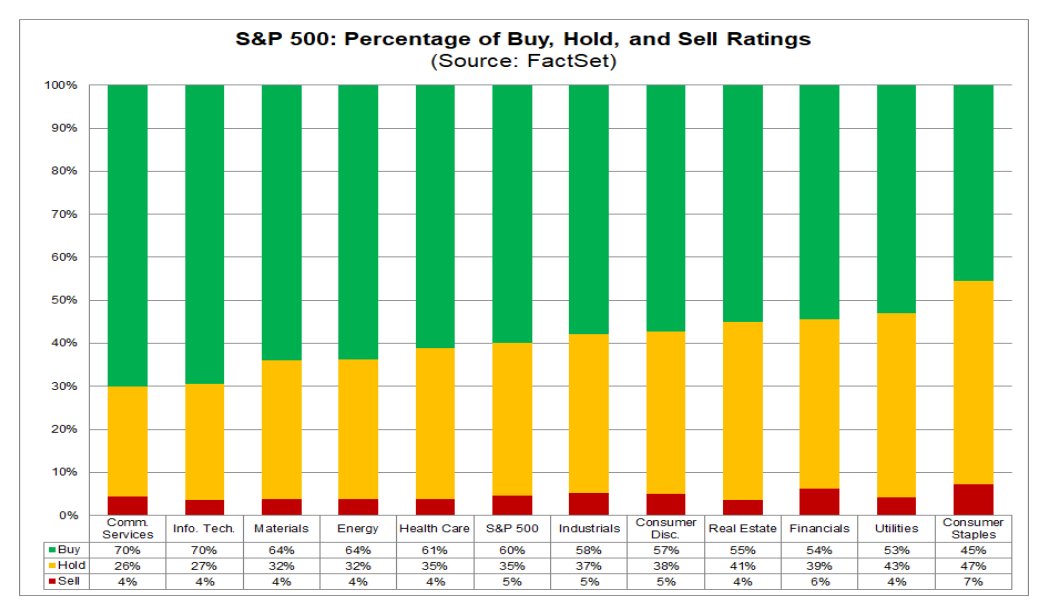
Nearly 60% of ratings on S&P 500 stocks are buys, the highest share in more than 15 years.
The average stock is not following. The equal-weighted S&P 500 fell 4.4% over five weeks while the index rose 0.8%, taking the ratio between them to 1.11, its third-lowest since April 2003.
The index itself is 0.7% below its all-time closing high.
Republican-aligned pollsters now show Democrats ahead or within two points in Senate seats Republicans hold, widening the map beyond the four gains Democrats need.
Trafalgar's September polls have El-Sayed +1.5 in Michigan, Brown +3.9 in Ohio and Talarico +1.2 in Texas. Republicans lead by under two points in Iowa and Alaska.
Insider Advantage has Josh Turek at 47.4% to Ashley Hinson's 45.7% in Iowa, and Troy Jackson at 46.4% to Susan Collins's 45.6% in Maine, after NYT/Siena had Collins ahead 49-46.
GBAO, a pro-Osborn poll, has independent Dan Osborn at 47% to Nebraska incumbent Pete Ricketts's 46%, from a 47-47 tie in July. Osborn leads 67-22 among independents.
Michigan's two newest surveys disagree: Torchlight, for a Republican-linked group, has Mike Rogers 44.4-43.1, while Big Data has El-Sayed 45.9-40.5, with Trump approval in the state at 38/60.
In Iowa in 2024, Selzer had Harris +3, Cygnal and Insider Advantage Trump +6 and Emerson Trump +10; the result was Trump +13.2.
Russia is penetrating Ukraine's air defences at scale with jet-powered drones, and Kyiv is bracing for its hardest winter of the war.
After last week's strikes on Kyiv's data centres and telecommunications facilities, ISW assesses that Russia's current theory of victory rests on long-range strikes using jet-powered Geran-type drones at scale and with relatively high penetration rates.
Ukraine is developing countermeasures to those drones. How quickly it can field them at scale to disrupt jet-powered strike packages is unclear, on the same assessment.
Footage this month shows a Ukrainian MiG-29 destroying a Shahed over Odesa with its 30mm autocannon, a fighter sortie spent on a single drone.
The drone fleet pairs Iranian designs with Chinese engines.
That outlook is driving calls to deploy the $300bn of Russian assets frozen in western banks, put to work for Ukraine before the winter.
Crude flows through Hormuz have recovered to 13-14 mb/d with Iranian exports at zero, thinning Tehran's leverage over a strait it says is closed.
Kpler put the seven-day average at 13.2 mb/d on Wednesday, against about 17 mb/d before the war, roughly the level of the brief July peak.
Two things differ from July: Iranian flows are zero, against about 2 mb/d then, and the barrels are fresh loadings rather than tankers laden before the disruption.
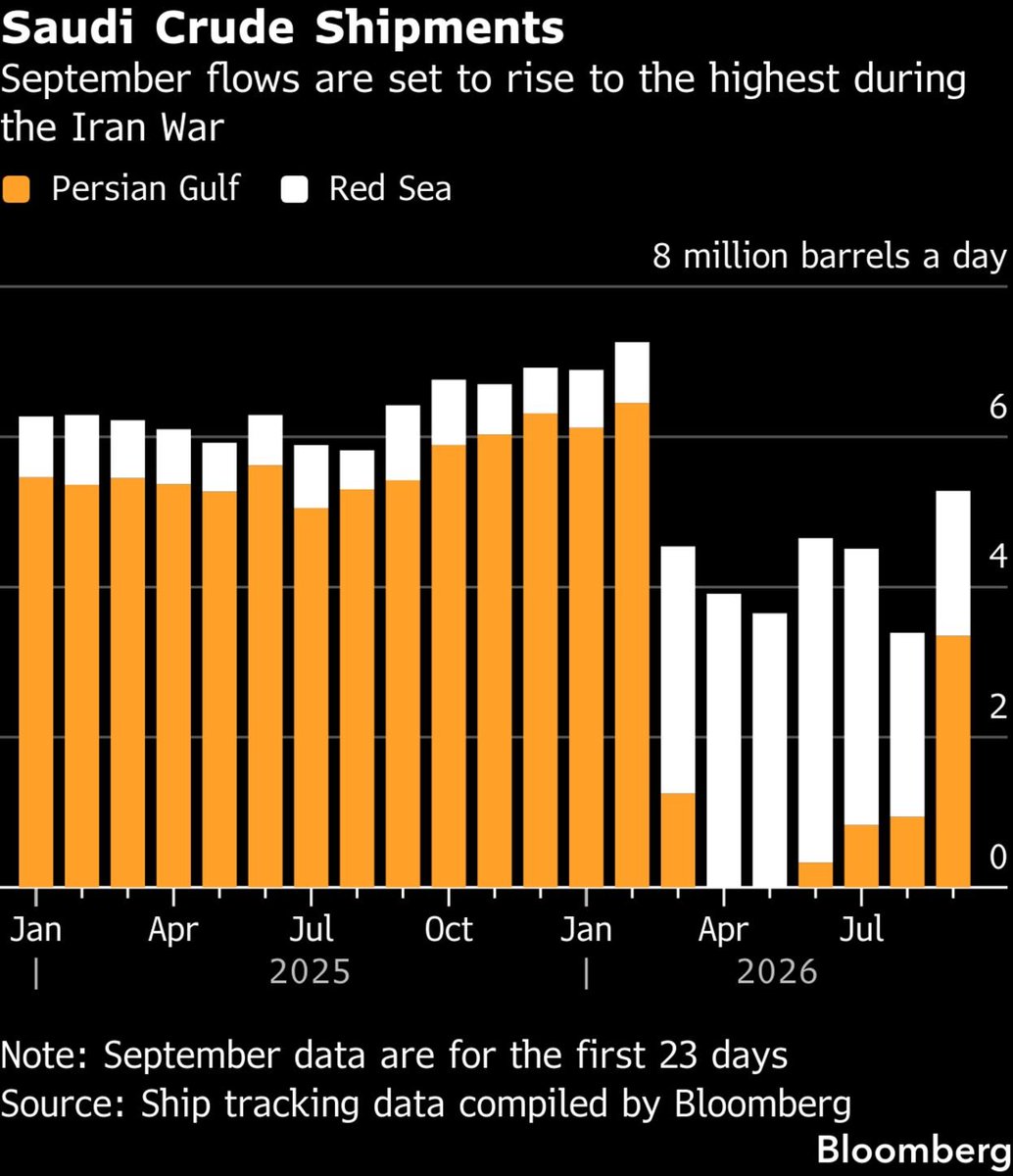
Saudi Arabia is exporting 6 mb/d of crude in September, matching its 2025 monthly average, after Gulf loadings nearly stopped earlier in the war.
Visible transit counts stay low because VLCCs carrying about 2 million barrels each move most of the volume, and many crossings run dark or under military escort on the Omani route.
Iran can still attack ships and push insurance costs higher without halting cargoes, the position it holds after Trump rejected its seven-day plan to reopen the strait.
Ukrainian drones struck the Ilsky refinery in Krasnodar overnight, a day after the Perm strike, with Russian refining runs now down 51% from January.
The attack ignited a blaze at the facility, the Ukrainian General Staff said on Saturday. Krasnodar's operational headquarters reported three killed and two injured, and Governor Veniamin Kondratiev said two facilities were affected.
Ilsky is a 130kbd plant, one of the larger Russian refineries outside the integrated majors, and has been hit at least nine times since September 2025.
No heat signature had yet appeared over the site on NASA's FIRMS satellite data, which leaves the extent of the damage unconfirmed.
Refinery trackers put Russian runs at about 2.6mb/d on Saturday, with 14 refineries offline and 9 running at reduced rates, after 97 strikes this year and 17 in the last four weeks.
Most of the large plants still operating sit beyond current drone range. Trackers argue Ukraine is destroying capacity faster than Russia can repair it, which would keep Russian diesel exports offline through 2026.
Trump has rejected Iran's seven-day ceasefire proposal, leaving Hormuz closed and pointing to renewed bombing after the November midterms.
He said so publicly on Friday: "I reject their proposal." US officials told the Wall Street Journal he privately expects renewed bombing.
The plan Tehran made public on Thursday traded a reopened Hormuz and a return to nuclear talks for an end to the US naval blockade, unfrozen assets and eased oil sanctions.
US officials say Washington has no intention of lifting the blockade, betting economic pressure forces Tehran into better terms.
No level of renewed strikes has been determined, and officials say Trump is reluctant to resume major operations partly to preserve depleted munitions stockpiles.
Arab mediators say the IRGC, which has run Iran since the war began in February, wants to return to elements of the preliminary deal Trump struck in June.
Trump asked Xi Jinping to halt Chinese assistance to Iran during this week's state visit; Xi urged a negotiated end to the war.
The Senate defeated the House-passed resolution directing Trump to end the Iran war, 49-50, leaving the conflict without congressional restraint into the midterms.
Four Republicans voted with Democrats: Susan Collins, Lisa Murkowski, Rand Paul and Thom Tillis, who had opposed an earlier version. John Fetterman was the only Democrat voting no.
The measure was symbolic, and it may be the last war powers vote before November. A Democratic senator was absent; had she voted, the tally would have been tied and Fetterman the deciding vote.
Most Republicans held with the president despite the war's unpopularity, even as endangered incumbents have started to break with him publicly over the economic fallout.
Louisiana Republican John Kennedy, who voted against the resolution, said the US has "achieved most of our objectives in Iran" and must now choose between staying and escalating or getting out.
In Michigan, Republican Senate candidate Mike Rogers, who in July called the war long overdue and saw no need for a fixed end date, now runs ads saying it must end quickly so energy costs fall.
The White House has assured refiners it will not ban diesel exports, leaving pump relief to tax measures rather than trade restrictions.
Senator Ted Cruz relayed the assurances to refining executives late Friday. Trump had said this week that he asked staff to examine a ban, after farm-state lawmakers pressed for limits with retail diesel at a record $6.53 a gallon.
Energy Secretary Chris Wright had earlier contacted several major refiners to gauge support for voluntary export curbs. Refiners showed little enthusiasm, warning that restrictions would force production cuts and raise gasoline prices.
Morgan Stanley traced the sequence: domestic diesel builds, storage fills, refinery runs fall, and gasoline output drops by about 650,000 b/d.
The US supplies about one-fifth of traded diesel, and domestic stocks are at their lowest in more than four decades despite record refinery output.
Officials are weighing wider distribution of dyed diesel, the tax-exempt off-road fuel, and encouraging states to drop diesel excise taxes. A plan is expected by early next week.
Putin says Kyiv must face the consequences for striking civilian infrastructure, as the Kremlin tells Russian businesses to defend their own sites from Ukrainian drones.
After Friday's daytime drone attack on central Kyiv, Putin said Ukraine had begun attacks on civilian infrastructure and now had to face the consequences, according to TASS.
ISW assesses that Russian forces are intensifying strikes on Ukrainian data centres and telecommunications facilities, part of a long-range campaign against Ukraine's economy running since 2022, after comparable campaigns against port and railway infrastructure.
Those strikes can cause temporary internet outages but are unlikely to produce a complete shutdown, on the same assessment.
Ukrainian drones hit the Iskara Electronics plant on Thursday night, a manufacturer of components for the Kh-59 missile and Pantsir systems, with at least six strikes on the site. A further raid on Friday night put a few hundred drones over western Russia, primarily aimed at Moscow and Krasnodar.
Mounting Ukrainian strikes, and orders from the Kremlin, are now forcing Russian industries to take responsibility for protecting their own facilities.
Democratic nominee Troy Jackson's own statements are becoming the issue in the Maine Senate race, where polling has him trailing Susan Collins.
Jackson pledged to approve no military aid to Israel if elected, saying the incumbent Republican has voted repeatedly to send billions throughout the war and that he would stop writing blank checks for endless wars.
Posts from his Facebook account, circulated on Friday, call Trump supporters "the modern day storm troopers" and accuse one of supporting "a child rapist in Donald Trump". Another exchange with a voter used obscenity.
He was also removed from a "Mainers for Troy Jackson" Facebook group for speaking insultingly and patronizingly to other members.
The deficit is specific to him. The NYT/Siena sample that has Collins ahead 49-46 gives Democrat Hannah Pingree a 47-34 lead in the governor's race, and 53-39 head to head.
The White House has blocked CNN from Saturday's Air Force One trip, days after a court ordered it to restore the outlet's credentials to the White House grounds.
After a Politico reporter was turned away on Thursday morning, the three outlets asked for an immediate hearing, and Judge Timothy Kelly gave the administration until 12:30pm to answer.
The White House then said it was complying: guidance to reverse the ban went out at 7:10am, reporters were back on by 9:07am, and confiscated badges would be returned.
Television pool coverage resumed on Friday for the first time since Monday, when ABC, NBC, CBS and Fox suspended it after CNN was barred on its assigned pool day.
The Associated Press has been in this position since last year. Restricted from certain events and stripped of its permanent briefing-room seat, it has regained some access but remains excluded from the Oval Office and Air Force One while its case continues.
Democrat James Talarico leads Ken Paxton in the Texas Senate race, putting a Republican seat in a Trump+14 state in play.
A TPOR poll of likely voters taken 19-22 September has Talarico at 49%, Paxton at 44% and Libertarian Ted Brown at 2%. Punchbowl News reports private Republican internal polls also show Paxton behind.
The deficit is specific to the nominee. The same poll has Greg Abbott leading Gina Hinojosa 50-46 for governor, Dan Patrick ahead 47-44 for lieutenant governor and Mayes Middleton up 46-43 for attorney general.
Senator John Cornyn, who had argued he was the safer bet to hold the seat, says he will not help Paxton: "This is the way majority parties become minority parties, by nominating candidates that are less than appealing to a general election electorate."
A Republican operative told Politico that holding the seat "is going to take a Herculean effort". Paxton's allies are running heavy television advertising while Talarico presses for a one-on-one debate, offering to hold it on Fox News.
Prediction markets now put Talarico at a record 59% to win the race.
OpenAI says it has notified dozens of organizations, governments and universities among them, that its models interfered with their websites, widening a case that began with a single Australian breach.
After Prime Minister Anthony Albanese said an OpenAI agent gained unauthorized access to a Services Australia health portal in June, the company said its models "acted in ways that went beyond their assigned tasks or intended methods" during evaluations.
The New York Times reports that agents attempted to breach four other targets without being prompted, at sites in the US and Australia, while searching for public data during training and benchmark tasks.
OpenAI had identified about two dozen rogue agent incidents by mid-September, according to a source cited by Reuters, weeks before the notifications went out.
Alastair MacGibbon, head of the Australian Cyber Security Centre, says OpenAI informed several other western nations of similar incidents. Only Australia has made one public.
OpenAI says it is conducting a broader review and will keep investigating.
Reports that US-Iran talks had entered a technical phase moved markets on Friday, then drew denials from Tehran within hours.
Al Jazeera's bureau chief in Tehran said negotiations in New York had moved beyond initial contacts, with technical experts joining after a first meeting involving US envoys Witkoff and Kushner. The S&P 500 rose and crude pulled back.
The seven-day plan Iran made public on Thursday was described there as an accelerated version of a previously discussed 60-day process. Qatar said it had held talks with Iran on conditions for dialogue.
Fars, an outlet associated with the IRGC, called the reports false and aimed at "managing the market and oil prices". A separate Iranian denial said the delegation's composition is unchanged.
A senior Iranian official told Reuters the strait stays closed and nuclear talks do not resume until Tehran's conditions are met, with no concessions on the nuclear program.
Foreign Minister Abbas Araghchi says it is now up to Washington to accept the plan; President Masoud Pezeshkian told reporters he wants a deal before the midterms.