A digital asset investment and trading firm. We study macro and fundamentals to capture beta and alpha opportunities from crypto waves to financial tides.
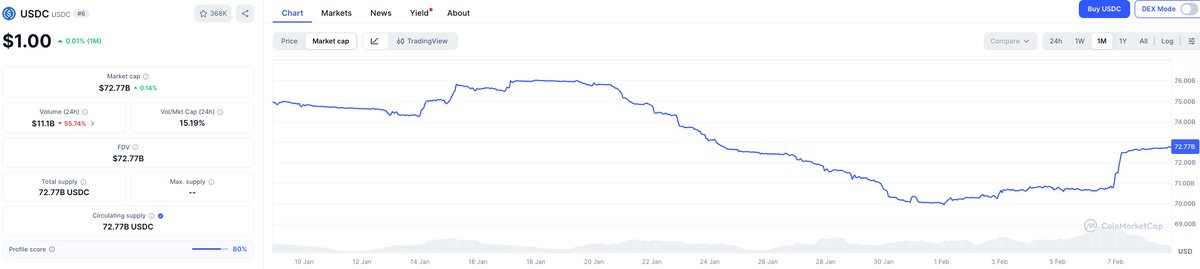
After declining for nearly a month, $USDC supply has finally shown signs of recovery from the bottom.
This points to renewed inflows of capital, suggesting that some investors may be beginning to buy the dip and that the broader market could be entering a stabilization phase.
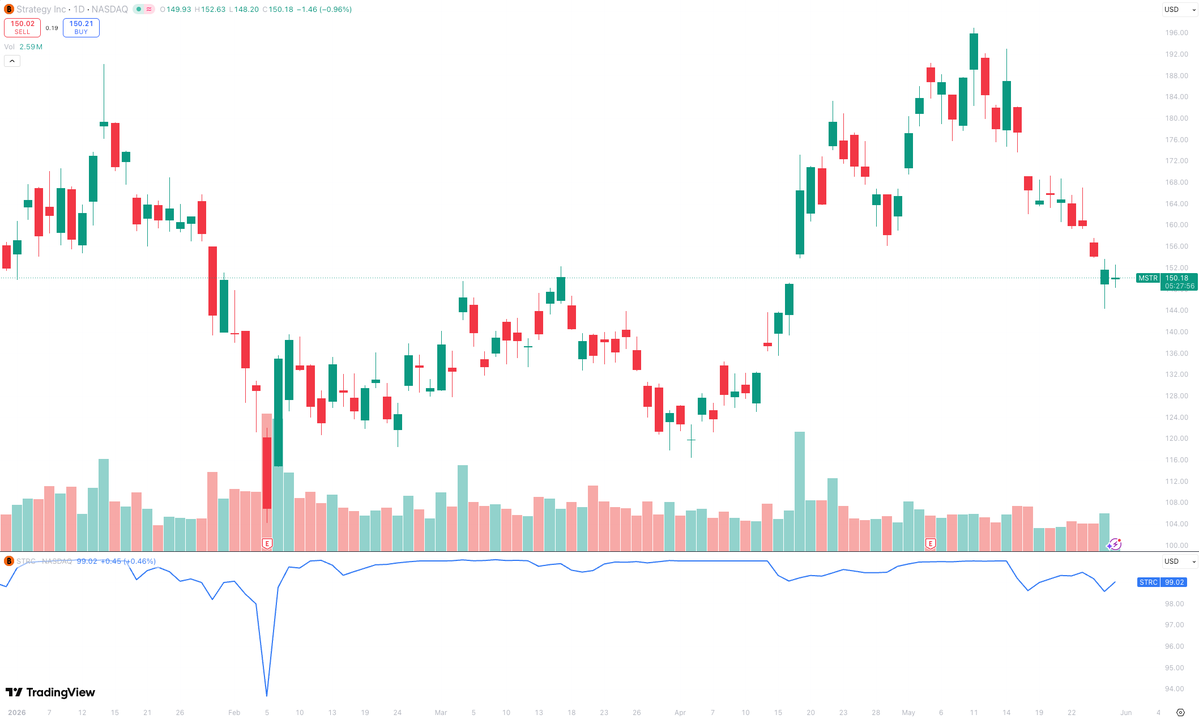
MSTR and STRC have both weakened recently, putting MicroStrategy’s capital structure under pressure.
To meet scheduled interest obligations, MSTR may ultimately need to sell a small amount of $BTC to raise liquidity — a risk that has contributed to $BTC’s recent price weakness.
Recently, capital raised by MicroStrategy through $STRC has become one of the key sources of buying pressure for $BTC.
Once $STRC trades below $100, that buying channel becomes significantly constrained, leading to a noticeable weakening in marginal demand for BTC.
Hot US PPI challenges the disinflation narrative and pushes back against Fed cut expectations.
The macro read: stickier inflation, higher-for-longer rates and tighter global liquidity.
For crypto, the key variable is no longer “risk appetite” alone, but the cost of liquidity.
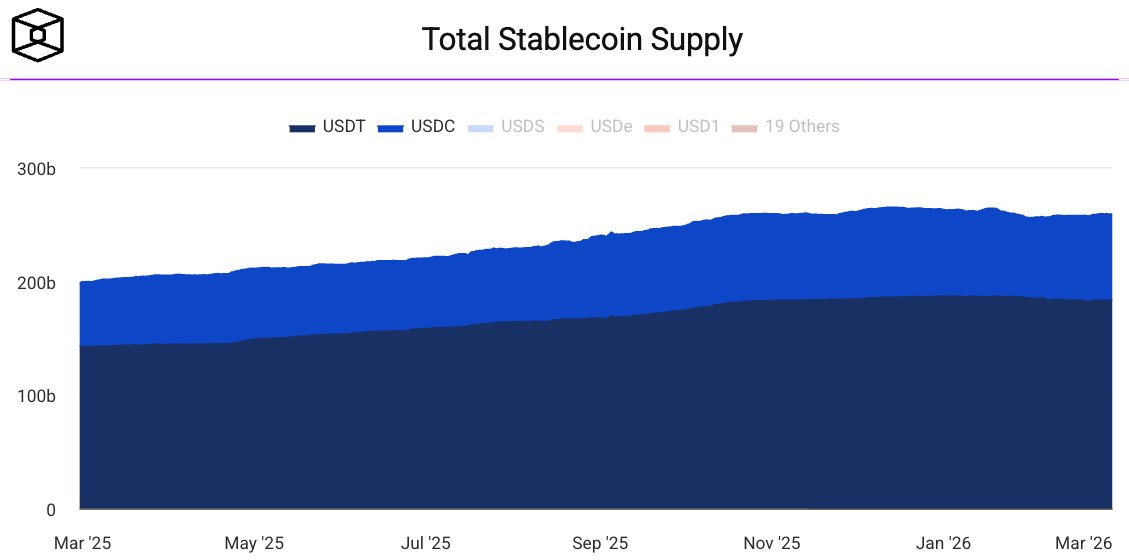
bitcoin:native has broken above $80,000, with price action showing clear strength. In April, the combined supply of USDT and USDC increased from $261.6 billion to $266.9 billion.
The continued expansion of stablecoin liquidity provides a solid foundation for bitcoin:native's move higher.
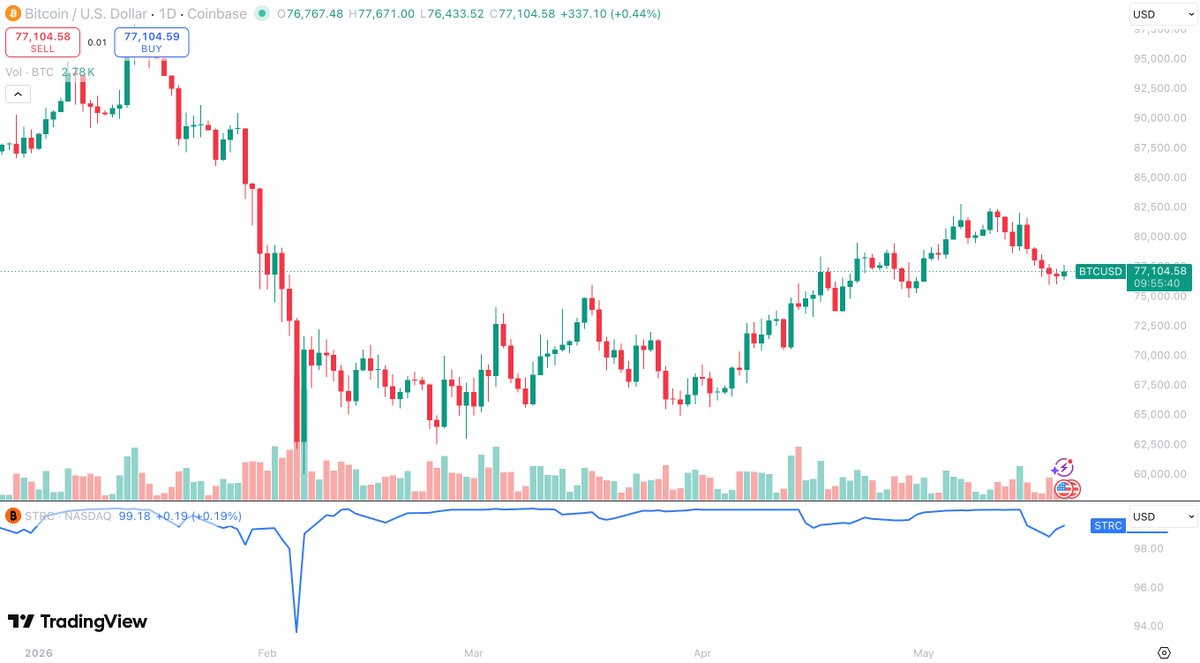
The expansion in stablecoin supply is beginning to plateau, while $STRC continues to trade below $100, suggesting that near-term marginal demand for bitcoin:native may soften.
With bitcoin:native hovering around $76,000, the market appears to be transitioning into a consolidation regime.
Total USDT supply has risen by $5.6 billion over the past two weeks. This suggests incremental capital is flowing into the crypto market, helping sustain demand for $BTC and driving it back above $78,000.
$MSTR has broken out of its recent base, sharply restoring its mNAV premium and reopening the equity issuance bid for more $BTC purchases. With $BTC near $75,000, $MSTR's incremental buying could add another tailwind to the move higher.
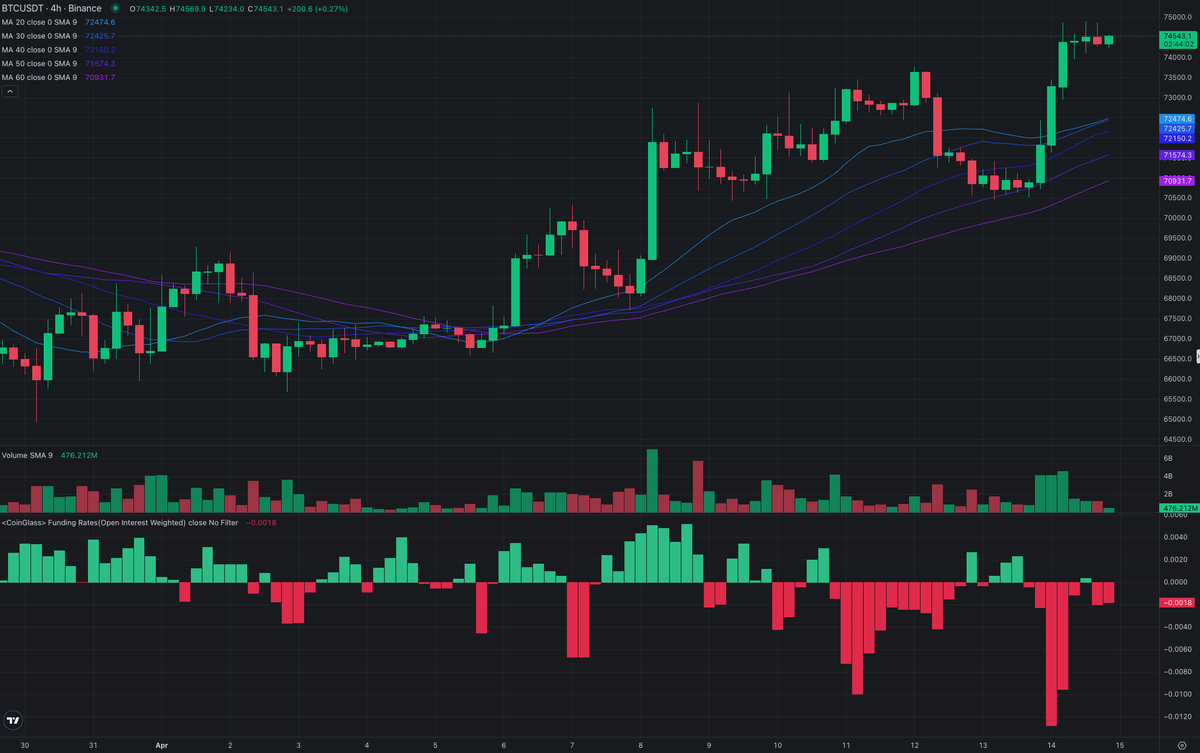
$BTC is trading near $74,500, and the 4-hour chart is showing a textbook bullish moving-average alignment. Even more notably, perpetual funding remains negative. If price continues higher, shorts could get squeezed, potentially accelerating the move.
March was marked by sudden geopolitical shocks and sharp volatility across global markets, yet $BTC and $ETH still closed the month in positive territory. Meanwhile, combined USDT and USDC supply rose by $2.7B to $261.6B, providing underlying support for the crypto market.
Amid extreme macro uncertainty, dispersion across asset classes is widening fast. One shift the market may still be underappreciating: since March 9, $BTC has begun to outperform gold, signaling a notable change in leadership among perceived hedges.
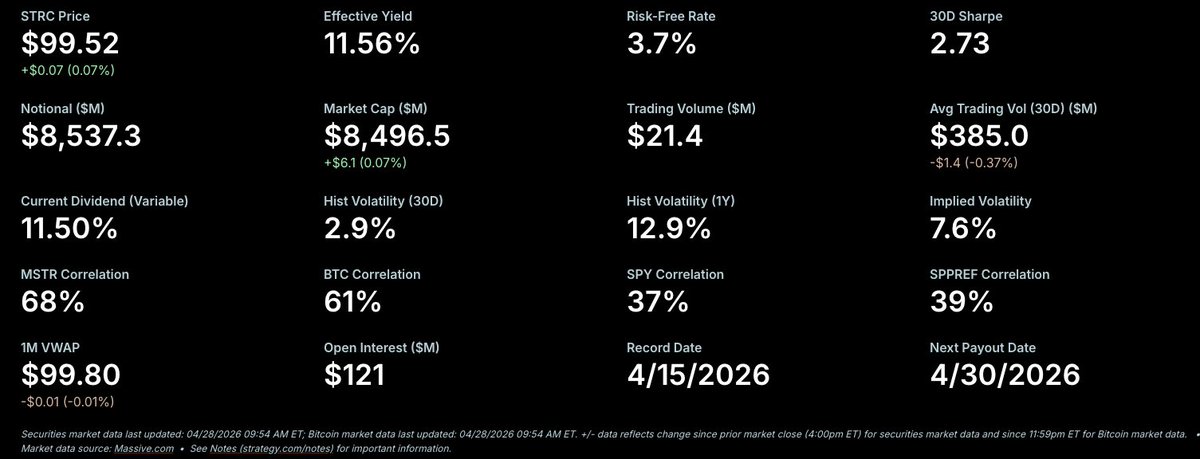
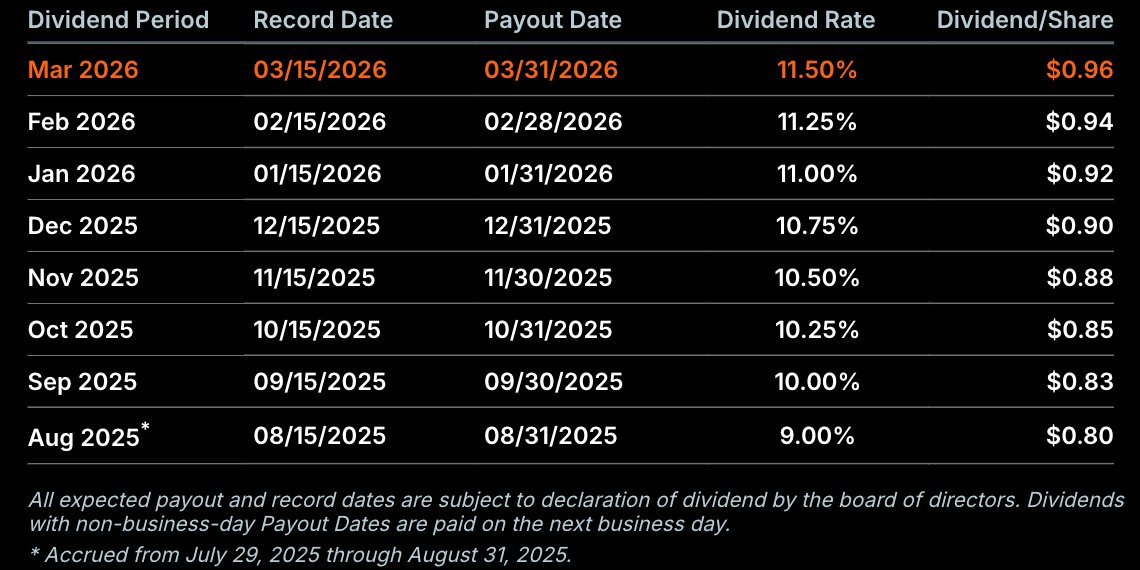
MicroStrategy raised $STRC’s yield to 11.50%, driving strong investor demand. Last week, $MSTR purchased over $1.2 billion of $BTC, and this week’s buying could reach another $1–2 billion, implying solid near-term support and a strong bid for $BTC.
Stablecoin liquidity is recovering. In February, combined USDT and USDC supply rose by $3.3B (+1.3%) to $258.9B. This upward trend signals renewed capital inflows, indicating the broader crypto market is forming a bottom.
As the "Fed Put" expires and liquidity ebbs, global markets are facing a historic stress test. Our research reveals how a shifting macro paradigm is driving silver's leverage washout, gold's resilience, and the repricing of $BTC.
Dive into our insights: https://t.co/5lIDyYM2sJ
Following the sharp market correction, USDT and USDC supplies have resumed expansion. This recovery suggests valuations have reached compelling entry points, signaling that significant capital is now deploying to buy the dip.
Since Jan 20, aggregate USDT and USDC supply has contracted by ~$7.5B, signaling persistent capital outflows. This liquidity drain indicates the crypto market-bottoming process remains incomplete and requires further consolidation before a reversal.
Since Jan 20, aggregate USDT and USDC supply has contracted by ~$7.5B, signaling persistent capital outflows. This liquidity drain indicates the crypto market-bottoming process remains incomplete and requires further consolidation before a reversal.
Gold and Bitcoin have shown a significant divergence recently, with investors aggressively accumulating the precious metal. In the current macro climate, a sustained tailwind for crypto may still be some time away.