I strongly believe that knowledge is fundamental to running a society. We need economists who understand monetary policy in central banks. We need researchers who have studied history, strategy, and military affairs to help steer national defense. We need doctors and public health experts to design effective responses to epidemics.
But the public needs sound reasons to let these experts shape their future. Once that trust evaporates, we are all worse off. Unfortunately, the Jason Arday scandal is the perfect example of how these experts, and the institutions they run, are destroying that trust.
I do not find Arday’s tales extraordinary. Throughout history, there are thousands of examples of people spinning fantastic tales about their lives. He is just one more name on a long list of confidence men.
What is extraordinary is the massive institutional failure at every level. Liverpool John Moores University granting a degree for a Ph.D. dissertation that did not survive even basic scrutiny (including a grammatical mistake in its title). Cambridge University appointing him (full) professor at an unusually early academic age (eight years after his dissertation; in academia, this is what matters, not your biological age) and with a scholarly record that was rather thin. Hilary Cremin (@hilarycremin), head of the Faculty of Education, telling the world on television that Arday was “the best in the world in terms of the research that you do.” The BBC broadcasting segments about Arday, a most unusual decision for an academic appointment. Simon & Schuster paying him a large advance for his memoirs on the basis of a book proposal that defied common sense. And Amazon promoting his book, still this very morning, as an editor’s pick.
If I were a regular person, say someone driving a truck in the Midlands or working at a small shop in Sussex, how could I trust the universities any longer? How could I trust the BBC and the media? How could I trust the publishing industry? How could I trust Amazon’s editor’s picks?
Then, should we be surprised if the farmer or the shop owner votes for someone selling snake oil? Or if they refuse to listen to the case for policies that cost them in the short run but benefit them in the long run, such as the transition to net zero emissions? Or if they read books written by charlatans? Or if they deny basic scientific findings?
The universities, the media, the publishing industry, Amazon, and many of our other core knowledge institutions have a serious problem. Their response is to close ranks and avoid a serious discussion. No, sorry, this will not do.
The Jason Arday scandal should be a moment of reckoning. Unfortunately, I am afraid it will not be.
Too bad Saudi won’t take us! They (husband and kids) just got their premium residency so it’s a yeay i guess!
But for citizenships or at least PR, where to consider and why and how? 🤔
Guysss yg pd pindah kewarganegaraan tell me why!?! Pros and cons?
Though I have been living abroad for maybe longer than half of my life, and for my husband, it’s throughout his whole adult life so far, it has never occurred to us to change citizenships.
The discussion from the pros on mw is interesting. A chapter in my dissertation (a paper in BIES) discusses how mw (district-level in jawa island) affects labor force participation! The dep var was also raw employment numbers (not share of pop).
Economists call this diminishing marginal utility. The first dollars change your life. The billionth doesn't. So the argument stops being about consumption and starts being about power.
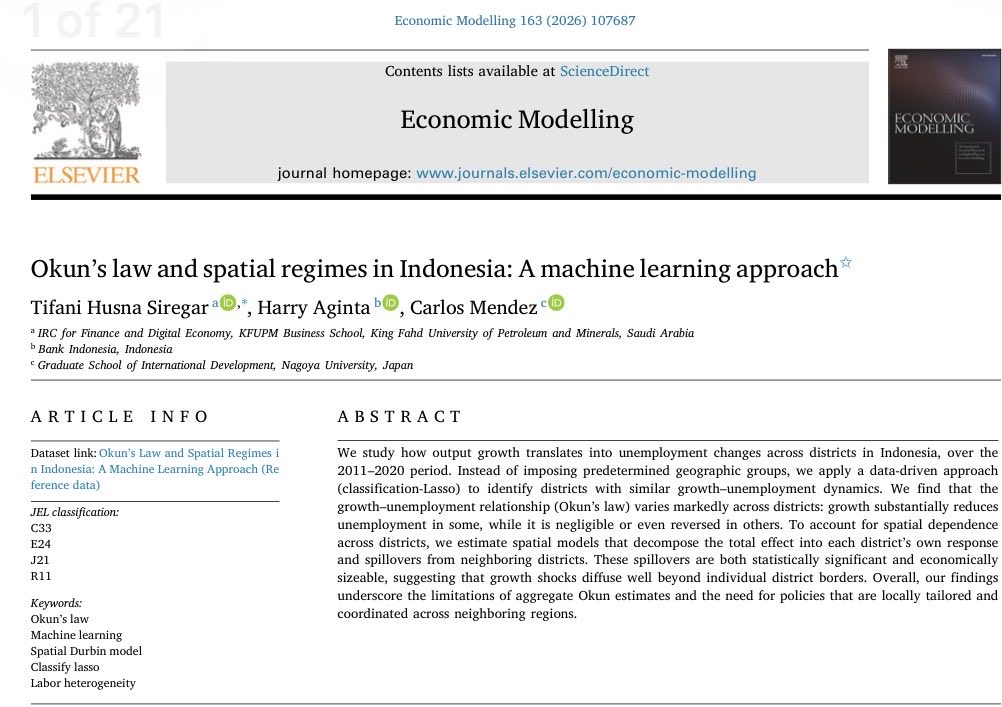
Our paper is out as a pre-proof in Economic Modelling! @Econ_Modelling
“Okun’s Law and Spatial Regimes in Indonesia: A Machine Learning Approach”
with Harry Aginta (Bank Indonesia) and Carlos Mendez (Nagoya University)
Read the paper (pre-proof) here: https://t.co/Qk0zglLEZx
This was my last “Indonesian labor market” paper in my current pipeline. I would love to continue working on topics related to Indonesia, but don’t have the time for solo work. So hit me up if you would like to collaborate 🙏😊
Article out now in Economic Modelling!
“Okun’s law and spatial regimes in Indonesia: A machine learning approach”
Direct link to the article:
https://t.co/HHbQQ6fCxm