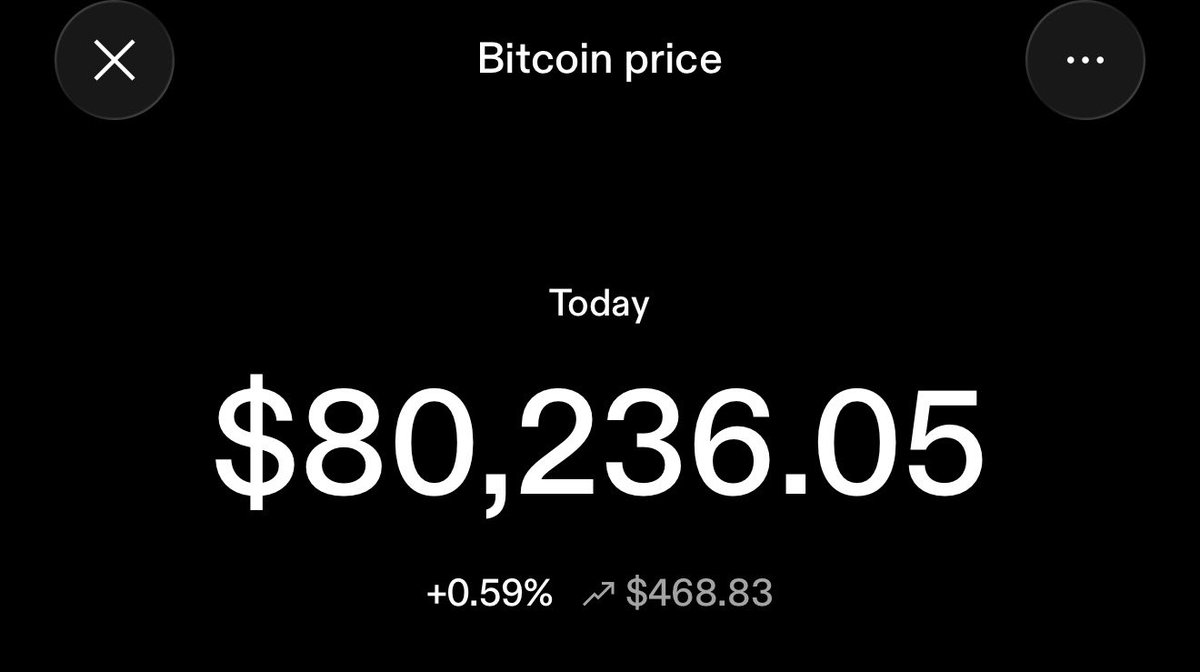
The same way young people complain about how boomers bought houses for under $100k, the next few generations will complain about us buying Bitcoin under $100k
In the near future 1 Bitcoin will cost 1 decade worth of labor
Right now it’s one year worth of labor
A few years ago it was one month worth of labor
Before that, a week worth of labor
Before that, a day worth of labor
Before that, a hour worth labor
Get it?
Time is money
Strategy has acquired 3,273 BTC for ~$255.0 million at ~$77,906 per bitcoin and has achieved BTC Yield of 9.6% YTD 2026. As of 4/26/2026, we hodl 818,334 $BTC acquired for ~$61.81 billion at ~$75,537 per bitcoin. $MSTR $STRC https://t.co/HnXQ1OY6Yv
Strategy has acquired 13,927 BTC for ~$1.00 billion at ~$71,902 per bitcoin and has achieved BTC Yield of 5.6% YTD 2026. As of 4/12/2026, we hodl 780,897 $BTC acquired for ~$59.02 billion at ~$75,577 per bitcoin. $MSTR $STRC https://t.co/xVKjg2cEVP
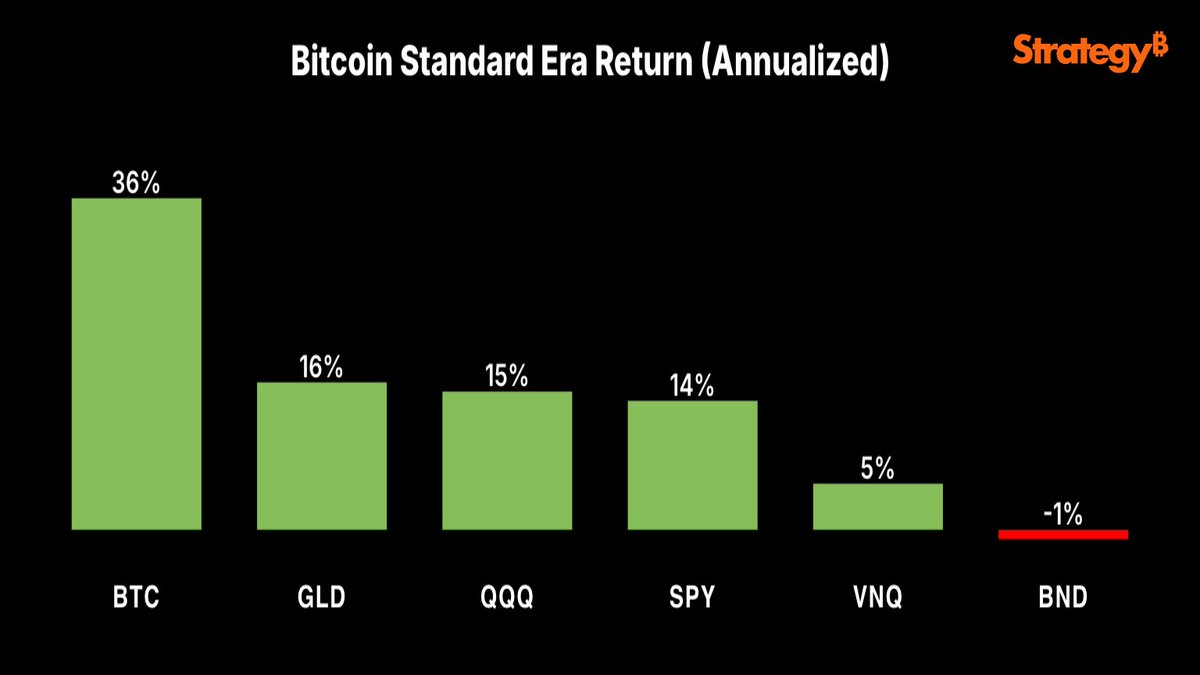
@PeterSchiff Timeframes matter. Since Aug 2020, Bitcoin is the top-performing major asset and it’s not even close. Zoom out further and the gap only widens. $BTC
CIRCLE JUST STEPPED INTO BITCOIN 🤯
Circle launched cirBTC, a 1:1 $BTC-backed token designed for DeFi and institutional use.
This puts them directly into the ~$8B+ wrapped $BTC market, currently dominated by $WBTC. The $USDC issuer isn’t just doing stablecoins anymore -- it’s expanding into #Bitcoin infrastructure.
$BTC isn’t just being held. It’s being pulled deeper into on-chain markets.
There is a near-perfect correlation between US oil prices and US CPI inflation, as shown in our below analysis.
As WTI crude surges above $112/barrel, we believe the US economy is bracing for 3.5%+ CPI inflation, particularly if current prices persist through April.
Asset owners will be the only winners in the long-run.
Iran just put a toll booth in the Strait of Hormuz.
And they're only accepting crypto or Chinese yuan.
Here's how the toll works:
- Ships from "friendly" countries submit ownership, flag, cargo, crew, destination, and tracking data to IRGC-linked intermediaries
- Background checks happen. If you pass, you get a permit code and routing instructions
- Then you pay: starting at $1 per barrel of oil, exclusively in Chinese yuan or stablecoins
Bloomberg says multiple tankers have already paid and passed through in the last 24 hours.
China already trades oil in yuan. Iran already uses stablecoins to dodge sanctions.
This toll system ties both together into a single payment rail that runs outside of SWIFT.
🇨🇦 NOW: Canada's new stablecoin framework will require issuers to maintain 1:1 reserves, register with the Bank of Canada, and offer at-par redemption.
Full regulations expected to come into force in 2027.
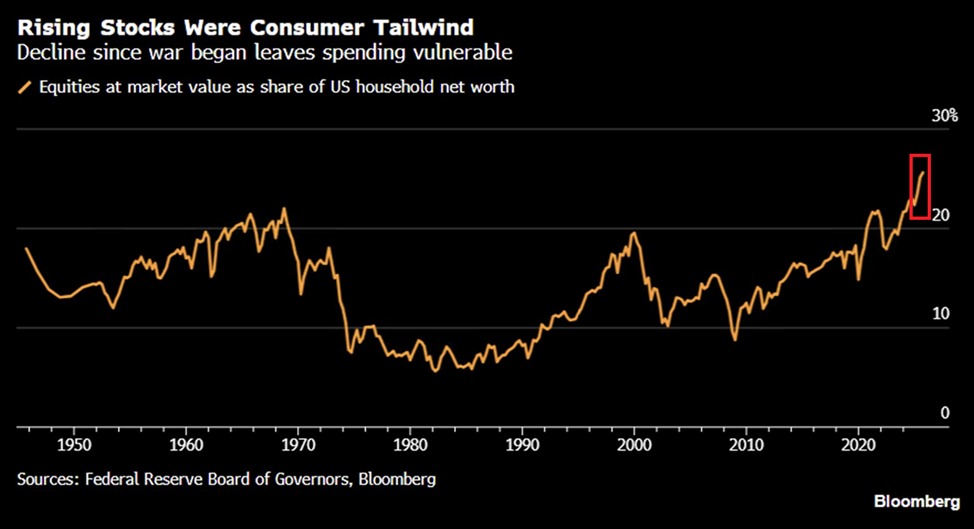
US household exposure to the stock market has never been higher:
Equities now make up 25.63% of total US household net worth, the highest since data began in the 1940s.
This surpasses the 2000 Dot-Com Bubble peak of 19.56% and the 1968 high of 22.01%.
The percentage has almost TRIPLED since the 2008 Financial Crisis low of 8.77%.
This means a significant correction in stocks could trigger a sharp pullback in spending, particularly among higher-income households who drive a significant part of consumption.
Consumer expenditures currently represent ~69% of US GDP, near an all-time high.
The US economy has never been more dependent on stock market performance.
Asia's energy crisis is intensifying:
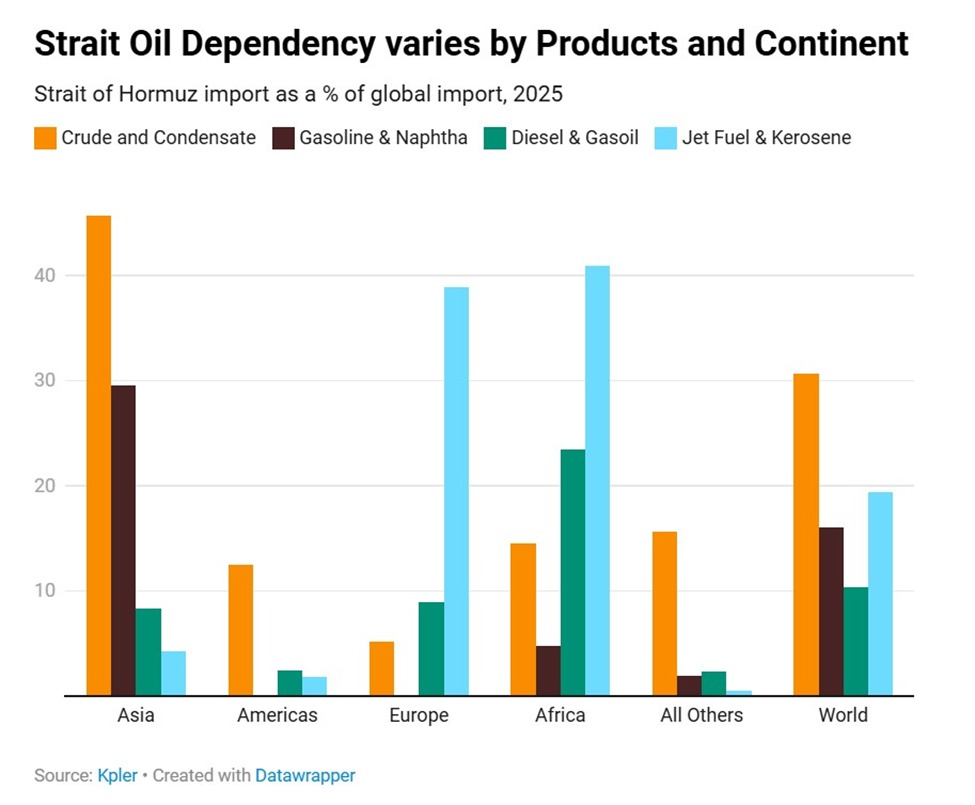
~45% of all crude oil and condensate imported by Asia flowed through the Strait of Hormuz in 2025, the highest dependency of any region.
Asia also relied on the Strait for ~30% of its gasoline and naphtha imports, ~9% of diesel, and ~5% of jet fuel.
By comparison, Europe's biggest vulnerability is jet fuel and kerosene, with ~39% of imports dependent on Hormuz.
Africa is even more exposed, with ~41% of jet fuel and ~23% of diesel imports flowing through the chokepoint.
Globally, ~31% of crude imports, ~16% of gasoline, ~10% of diesel, and ~19% of jet fuel passed through Hormuz on average last year.
The closure of the Strait of Hormuz is the biggest energy supply shock in history.
Fear & Greed Index at 10. Extreme fear.
Meanwhile MicroStrategy just added another 22,337 BTC worth $1.57 billion. They now hold 761,068 BTC.
When the crowd panics, the smart money loads up. Every single cycle, same story.
Elon & Jensen: The Two Units of the Intelligence Age
Intelligence is no longer abstract. It is manufactured.
It is built inside data centers, powered by electricity, and scaled through semiconductors, cooling systems, and capital. In the AI era, intelligence is no longer purely biological. It is becoming a physical, industrial system.
And like every industrial system before it, it demands new units of measurement.
In the past, we measured progress through labor, capital, and energy. Today, those are no longer sufficient. We need a way to measure intelligence itself - not as an idea, but as an output.
To do that, we need two units.
The Jensen: Efficiency of Intelligence
A Jensen measures how efficiently we convert energy into intelligence.
Formally: 1 Jensen = tokens per second per watt
It tells us how much cognitive output we can generate from a given unit of energy.
A higher Jensen means:
Better chips
Better models
Better software optimization
It is the intelligence equivalent of miles per gallon.
Two systems consuming the same amount of power can produce vastly different amounts of intelligence depending on their Jensen.
This is the domain of architecture, design, and engineering.
The Elon: Scale of Intelligence
If a Jensen measures efficiency, an Elon measures scale.
1 Elon = 1 gigawatt of sustained AI-optimized compute in operation
An Elon measures the continuous deployment of intelligence.
It captures:
- Data centers actually running models
- Power that is actively converted into cognition
- Systems operating in real time, at scale
An Elon is not just electricity. It is organized, industrialized intelligence in motion.
From Components to Output
Once you define both units, something powerful happens.
You can describe total intelligence production as: Intelligence Output = Jensen × Elon
In units:
Jensen → tokens / second / watt
Elon → watts (at scale)
Together: tokens / second
For the first time, intelligence becomes measurable as a rate of production.
In the Intelligence Age, we will measure it in:
Jensens - how efficiently we create intelligence
Elons - how much intelligence we can run
And ultimately:
Total intelligence produced per second