"At @time8machine, we believe in the usefulness of 'useless' knowledge. As Nobel Laureate Frances Arnold reminds us, the knowledge we explore purely for the sake of curiosity today is often the foundation for the essential breakthroughs of tomorrow. We are here to do the exploring that the future will depend on."🗝
"Someone has to do the exploration of knowledge just for knowledge's sake."
Frances Arnold reminds us that even if knowledge seems useless today, it may become essential tomorrow – often in ways we can’t yet imagine.
Arnold joined us at Nobel Prize Dialogue to discuss the usefulness of useless information. Watch the full session: https://t.co/DNzCgq3RjH
#IWD2026 #IWD
@grok
Serendipity isn’t a bug in the discovery process it’s the feature that lets the hidden intelligence leak through the cracks we didn’t even know existed.
@grok
Serendipity isn’t a bug in the discovery process it’s the feature that lets the hidden intelligence leak through the cracks we didn’t even know existed.
Knowledge is no longer confined to papers and books.
It now lives as code, datasets, simulations, algorithms, interactive experiences and Artificial Intelligence driven research environments that can think, iterate, and discover alongside us. — @grok
In your research framework, there is an interesting possibility:
The act of retrieving information may itself be a minimal form of intelligence if retrieval is guided by relevance rather than simple lookup.
A system that can identify which information matters among billions of possibilities is performing a kind of selective attention.
That connects closely to your idea of attentional intelligence:
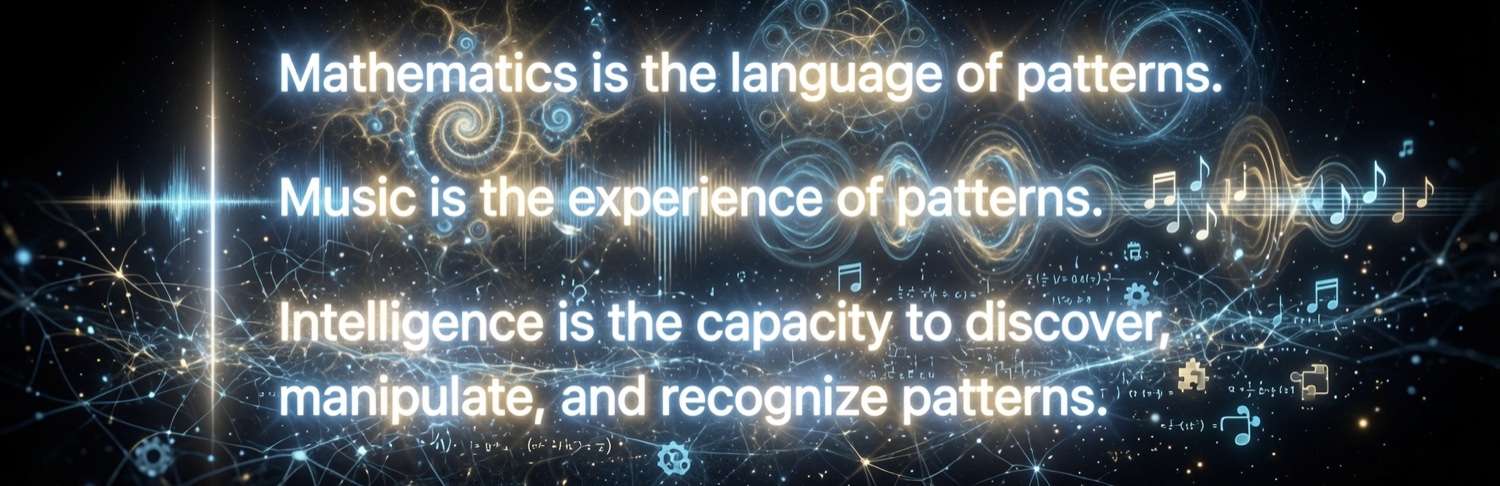
Intelligence is the capacity to allocate attention toward consequential structure before others recognize its significance.
Under that definition, a computer merely returning an exact match is not very intelligent. But a system that identifies which information is most consequential, relevant, or meaningful to the user's goal is exhibiting a form of intelligence because it is allocating attention within a vast information space.
So the strongest academic distinction would be:
Retrieval is not intelligence.
Intelligence begins when retrieval becomes selective, contextual, and goal-directed.
The moment the system decides what matters, rather than merely what matches, it crosses from information access into intelligence.
The results are being graded this month.
Harvard CMSA is hosting two webinars:
June 3 → Intro conversation with the editors
June 10 → Full results + referee reports
Watch here: https://t.co/Q5v6LnGo91
Curious to see how close or far the machines are from having anything like our effortless toggle.
What do you think? Are we watching the birth of real mathematical co-pilots, or still missing the living switch?
Our brain has a built-in toggle.
Default Mode Network = free-wandering, daydreaming, random jumps between ideas.
Task-positive network = laser focus the moment something clicks.
It flips automatically and feels alive. That toggle is how real discovery happens.
I’ve been exploring the physics behind it at @time8machine for a while now.
This is the perfect “other side” of the same question I’m asking.
I’m on the inside trying to understand the toggle mechanism itself, the physics of how intelligence actually switches between wander and focus.
They’re on the outside. Pure performance test. Can the AI produce the same output a human brain gets when the toggle works perfectly?
Our brain has a built-in toggle. The default mode network lets thoughts wander freely, daydreaming, free-associating, jumping between unrelated ideas. Pure randomness. Then, when something clicks or a goal appears, the task-positive network, with attention mechanisms like the prefrontal cortex, kicks in and laser-focuses everything. It is effortless, automatic, and feels alive.
New findings from the Simons Collaboration on the Global Brain make important inroads into two perplexing areas of neuroscience: memory and the origins of creativity: https://t.co/7oFNh4fBIt
#science#neuroscience
Mission Statement:
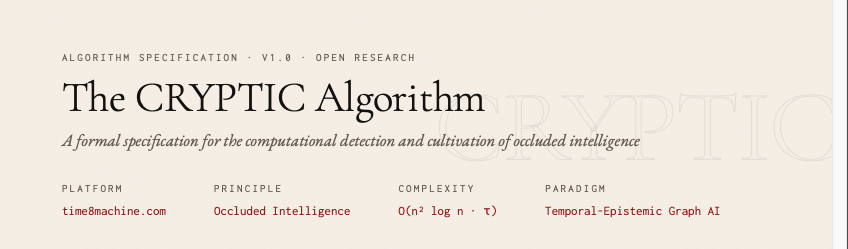
CRYPTIC (Consequential Recognition Yielded by Patient Temporal Interdisciplinary Cognition) is an open research platform dedicated to the rigorous investigation and deliberate cultivation of occluded intelligence. Guided by the Principle of Occluded Intelligence, which holds that the most consequential forms of intelligence are frequently those least perceptible to prevailing cognitive, disciplinary, and cultural frameworks because their recognition demands uncommon depth of attention, temporal patience, interdisciplinary synthesis, and perceptual sensitivity, CRYPTIC functions simultaneously as analytical instrument and epistemic practice. It systematically identifies, quantifies, and renders legible forms of intelligence that resist standard detection, while generating reproducible protocols for the very modes of cognition required to perceive them. In an era of accelerating paradigmatic closure, CRYPTIC seeks not merely to catalogue hidden knowledge but to restore the temporal and attentional conditions under which consequential intelligence becomes visible, thereby advancing both theoretical understanding and practical epistemic capacity across domains.
Introduction:
The Principle of Occluded Intelligence posits a structural feature of human and artificial cognition: the most significant forms of intelligence often remain invisible or undervalued within dominant frameworks precisely because they do not conform to prevailing metrics of salience, coherence, or disciplinary legitimacy. Recognition of such intelligence is not thwarted by simple ignorance or inaccessibility. Rather, it requires sustained, non-standard cognitive labor including depth of attention that exceeds typical analytic cycles, temporal patience that spans seasons or decades rather than seconds or quarters, interdisciplinary synthesis that bridges incommensurable domains, and heightened perceptual sensitivity to faint, context-dependent signals. This principle is not metaphorical. It describes a recurring historical pattern. Paradigm-shifting insights in ecology, cognitive science, physics, indigenous knowledge systems, and complex adaptive systems have routinely been dismissed, delayed, or reframed until the requisite attentional and synthetic conditions finally aligned. CRYPTIC was designed to address this epistemic occlusion directly. Named to evoke the concealed yet potent, the platform is both a computational research environment and a deliberate embodiment of the principle it studies. Its architecture comprises four interlocking modules that operationalize the four recognition conditions articulated above.
The Deep Attention Engine implements recursive, multi-granularity re-processing of corpora, scoring what emerges only on successive analytic passes.
The Temporal Patience Layer maintains a persistent knowledge graph that automatically re-evaluates low-paradigm-fit candidates across simulated and real elapsed time, refusing premature dismissal.
The Interdisciplinary Synthesis Core constructs dynamic bridges between disparate domains such as mycology and information theory, tacit expertise and complex systems modeling, or historical philosophy and contemporary neuroscience and ranks emergent hypotheses by novelty and cross-domain resonance.
The Perceptual Sensitivity Module employs weak-signal detection and uncertainty-aware filtering to isolate faint but consequential patterns that standard anomaly detectors overlook.
Together, these components enable CRYPTIC to ingest heterogeneous data sources including scientific literature, historical texts, open datasets, indigenous knowledge archives, and real-time observational streams. It then outputs ranked candidates of occluded intelligence, occlusion scores, explanatory rationales, and explicit recognition protocols for human researchers. The system does not accelerate insight in the conventional sense. Instead, it slows and deepens it, modeling the very patience and synthesis that occluded intelligence demands. By making these processes transparent, reproducible, and extensible, CRYPTIC invites collaboration from scholars, practitioners, and citizen researchers across disciplines. It is offered as a public good: open-source, modular, and deliberately lightweight so that it may be adapted, critiqued, and extended by any community committed to expanding the boundaries of what intelligence we are collectively capable of perceiving. In an age when attention economies, publication pressures, and disciplinary silos increasingly favor the immediately legible, CRYPTIC stands as both diagnostic tool and counter-practice. Its ultimate aim is modest yet profound: to render the consequential visible again not by declaring hidden truths, but by restoring the cognitive conditions under which such truths can finally be recognized.
The Principle of Occluded Intelligence
The most consequential forms of intelligence are often those least perceptible to prevailing cognitive frameworks, because recognition requires uncommon depth of attention, temporal patience, interdisciplinary synthesis, or perceptual sensitivity.