I’ve held my breath for about two months but here are finally a few notes on AI and freedom:
1. There is a lot of hype and fear around AI. I don’t think people are actually prepared for how dramatically AI will transform the world, and how quickly it will do it. At the same time I also think people are mistakenly choosing fear over action and curiosity. Do NOT sit on the sidelines.
2. For the past two weeks I have had a robot. His name is r2. He is a good guy, a resistance robot. His composition changes but he is most usually an Opus or Codex mind, OpenClaw body, and Matrix or Telegram hands. Every day I figure out new things he can do. My jaw is on the floor.
3. I do not do anything sensitive with my robot. In theory I could use Matrix to talk to my robot from my phone or just use the MacBook Air that the robot inhabits directly, and use my little local llama model, to do sensitive work, but I’m not there yet. I’m just in exploration mode. I don’t send anything from my phone to my robot that I wouldn’t want Anthropic or OpenAI to see, which is to say, nothing that sensitive. I can right now send a sensitive question in Matrix to my claw to have my local model run: anthropic or openAI would see the question, but they wouldn't see the answer.
4. OpenClaw is experimental software. DO NOT put it on your personal computer or your work computer or give it access to your email. DO experiment and play with it. What you need to do is start training to figure out how to use this new magical technology. You will want to be good at this. A decent balance is a fresh MacBook Air, a fresh gmail account, and a fresh anthropic or codex app on the machine. That’s about all you need. A credit card or if you want to use BTC, you can pay for advanced models with things like PayPerQ. An extra phone number too if you want to talk to it via Signal or WhatsApp. What’s amazing is that whenever your robot breaks, you just go onto the local claude code or codex app on the machine and just ask it to fix it and voila done. Back up and running.
5. I don’t know any code at all and yet have been able to create complex novel working software. Beautiful websites too that would have cost me a fortune a few years ago. But it’s just the tip of the iceberg. I was able to for example ask my claw to read everything I've ever written, watch a ton of my interviews, and develop an editorial skill so that I can send it a google doc and it can go in and track changes and leave comments just like a human would, just like I WOULD. It is legitimately amazing at this. And each time I do this, it learns, as I show it which comments I accepted and which new things I add. It has persistent memory and just gets better and better. What excites me most is giving this gift to the world’s dissidents and activists and seeing what THEY do with it.
6. Which brings me to security. Hopefully in the next few months we will be at a point where we can have an encrypted phone app that you speak to that requires no phone number or corporate intermediary that runs on nostr that goes directly into your claw powered by a high-quality local model. The full freedom tech stack. You can already sort of do this today already but it will get way easier and better. That’s what you’re going to need to do real serious resistance work. For now we just train. Think: Dagobah today, Death Star tomorrow.
7. People think this transition is about robots but it is about humans. Already I can see how Claws will allow insane collaboration between people. For example I can ask my brilliant designer friend to leave me a voice note to give feedback on my website or presentation or event plan, and then just forward that voice note to my robot for immediate implementation. Whenever I build or make something I ask my robot to do a deep search for the most beautiful and well designed things of that sort in the world, extract what makes them great, and create a plan for implementing that magic into whatever I am building. It could be fashion, art, cuisine, music, architecture, strategy, etc. Whenever I make a skill for my claw I can have my robot upload it and share it with anyone else. The speed of collaboration is dizzying.
8. Robots and Freedom Tech are a match made in heaven but the synergy will take some time to really flower. Many of the major obstacles to freedom tech can be solved by personal agents. For example mine was very quickly able to create its own nostr identity and build its own ecash wallet and it could and did start to zap people on my direction. But the robots can’t have their own bank accounts or social security numbers. Silicon Valley will try to force through KYC stuff and stablecoins but I think in the end bitcoin and nostr win out because they are so easy for the agents to use. What’s awesome is the realization (noted by Odell on his two recent excellent Citdadel AI podcasts with Alex Gleason and Justin Moon) that agents make freedom tech easier to use. For example your agent can run a lightning node for you. Of course... you then realize. We were never going to sit there and operate channels. Our agent will do it for us. Etc.
9. HRF will be heavily involved in providing grants to open source AI projects, projects that help improve agent security and privacy, projects that help superscale dissident work, events that bring brilliant people together around the challenge of how do we best harness AI, hackathons that encourage people to build freedom-oriented AI tools, educational content and trainings, and much more this year.
10. Right now Claw is experimental. But it’s easy to see how it will become incredibly secure. Every day it ships new patches. Already I can ask mine to become a cybersecurity expert and scan my system for vulnerabilities. Obviously I take it with a grain of salt now but -- never before did I have that power, nothing even close. Soon this will become seriously powerful and you will have swarms of patrol agents guarding your networks and alerting you if anything goes wrong. I think it can be more expensive to attack than to defend. White blood cell theory.
11. There are a lot of parallels between the creation of Bitcoin and the creation of OpenClaw. One person chooses a new way for the world to go. A new system. In Satoshi’s case, money that the state can’t control. In Peter’s case, intelligence that the state can’t control. I can’t stress enough how big of a deal it is that people now can control their intelligence. We were for sure heading in the direction of needing to sign up for a corporate app for all of your agent needs, and being in the Web 2.0 trap of being vulnerable to being banned or kicked off. Not anymore. YOU choose the brain for your robot. You customize the body. You choose how you want to interact with it. Peter has changed the world probably more than he knows. Yes he might be the first one person unicorn but that’s not the cool part. The cool part is that he changed the course of humanity and that as of today, at least, the best agent technology on the planet is people-powered, built by the people, for the people. It’s quite a moment for freedom tech.
12. We need to go fast and furious on developing freedom-oriented open-source AI tools. We are fortunate that we have Bitcoin and nostr and bitchat networks in place before the great AI transition. We have the tools. We need to act now. I would encourage everyone reading to start getting involved today.
13. Setting up a claw is not easy right now unless you are an engineer. I could not do it myself and have no shame in saying it. I would have gotten really frustrated. We are developing a way of working with privacy engineers to build a simple yet powerful solution and an onboarding process that we do in a bespoke way in person that takes 2 days. I think this is probably the situation for the next month or two and then hopefully it gets way easier. The thing is, it will get easier very quickly for you to have a CORPORATE robot (all the big companies are now following OpenClaw, Claude already has a way for you to use Code via your phone), but a freedom tech one that you fully control will probably not evolve as quickly. Then again, it might, if we all work together on making it happen. I do think by the summer things will be very different.
14. I think some things will become even more valuable in the new AI world that will come to us in the coming year. Many have said taste, and I agree. But also personal health, friendships, and physical communities. Big picture, labor market as many have said a lot of companies will choose between laying off a lot of their workforce or growing their productivity. There will be a spectrum and some organizations will lean one way and others will lean the other. It depends on how valuable the humans are inside the org, what kind of skills they have. If leadership values you as an individual, then you probably aren’t getting replaced. But you're going to have to become a super employee. And you should want to. It's fun.
15. If you are interested in joining the effort to work on AI and Freedom, HRF will have several opportunities. We are collaborating with Bitcoin Park on the second AI Hack for Freedom in Nashville (talk to Rod if you want to join or learn more), and will feature a lot of AI content at our upcoming activation at the Bitcoin Vegas event, and at the Oslo Freedom Forum on June 1-3. We will also keep churning out our monthly AI newsletter. We have opened up a grants portal. DM me if you are interested in any of this.
16. One simple thing that you can do today in AI and freedom is switch your daily “chatbot” activity to Maple. It’s a beautiful and simple mobile app (and web app) that is fully encrypted. Think Signal for AI. It only can use open models so it’s not going to be for all of your tasks, but it does great with most of them. It should replace a lot of interactions you have with corporate chatbots regarding things about your health, personal stuff, sensitive matters. etc. If we can make Maple or something like it the standard for research in the coming months that’s a huge victory. And sometime soon I think you’ll be able to enjoy this level of encryption with coding agents and personal agents as well.
It's interesting because the longer you wait to try claw, the better it gets. But the more time you lose. My sense is you could wait a month or two. But you'll want to be using it this summer. I would strongly recommend trying it at some point. You will be tempted by the easy corporate route. But you can join the AI and Freedom army today. Let's go!
GSUI is live on NYSE Arca.
The @Grayscale Sui Staking ETF gives investors direct SUI exposure plus staking rewards through a regulated, exchange-traded product.
Institutional momentum around Sui keeps building.
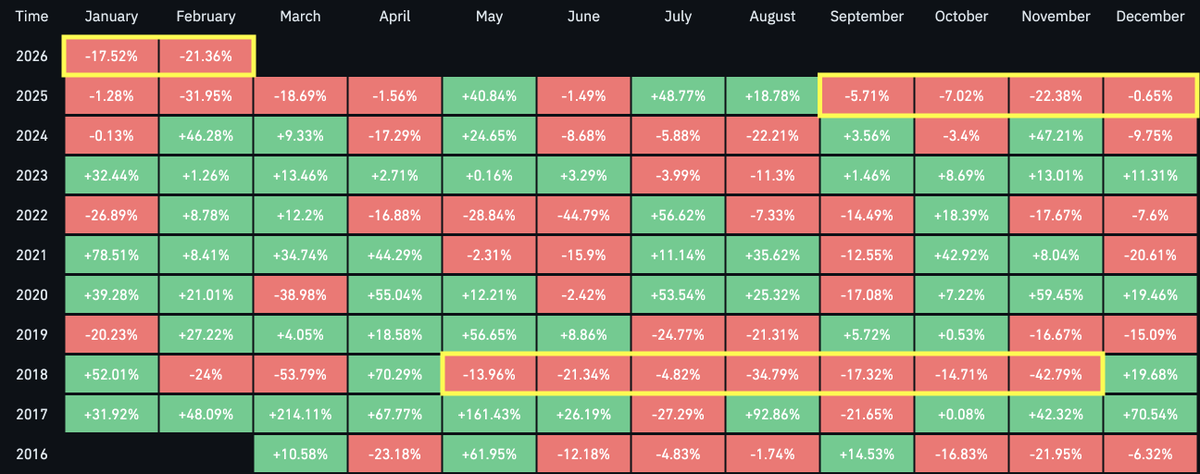
Most likely: instead of a bear market rally, I would argue that we're at the start of the actual bull market after nearly four years of bear market for the entire industry.
If the #Crypto industry has been able to do what they have been doing over the past few years in terms of adoption, then we're ready for a big run.
Market makers have absolutely decimated sentiment during Q4. Meanwhile, amid all the chaos, whining, and fear-mongering, as ETH is down as much as 47% while testing macro support, and altcoins are near historical lows, everyone has given up on crypto. Financial markets are THE ONLY market in the world where almost no one loves a good discount.
Think about that for a second. When people go shopping for ANY product, they always try to get the best deal they possibly can, EXCEPT when investing. When assets go on sale, most become uninterested and fearful precisely at the moment when they should be doing the exact opposite and foaming at the mouth at the OPPORTUNITY presented.
The bottom line is that if you can’t handle the 50% drawdowns in a market best known for its wild volatility, then you most definitely don’t deserve the 10x+ gains it consistently provides. This market has reached a level of pessimism where macro reversals are born. I'm steady, ready, and positioning myself for what comes next. The question is, are you?
Don't be sheepish when all others are. Choose to go against the herd when doing so seems like an impossible feat. Rest assured that it is the minority that thinks the first half of 2026 will be highly bullish.
I will end this post as I started it. Market makers have absolutely decimated sentiment during Q4. Why do you think that is? Always expect the unexpected, especially in this market. Q1 2026 is setting up to surprise, and the sheep, well, the sheep will continue to act sheepish as they always have and always will. ⚒️
The UK is closer than ever to achieving real leadership in digital finance.
Over the past few years, we’ve seen real progress in regulatory engagement and collaboration between industry and policymakers, but the challenge now is to convert that intent into delivery.
As we head toward 2026, it’s vital that we enter the next phase with a clear set of goals — joined-up policy to retain talent, scalable frameworks for innovation, and regulation that keeps pace with technology.
In his latest blog for CryptoUK, Ian Taylor shared some of his reflections on how we can turn this momentum into measurable progress 👉 https://t.co/do25Mp7N40
⚡️The system is eating itself.
When Amazon, UPS, Intel, and others start cutting this deep simultaneously, it means something more fundamental than “tight margins.” It means the productive layer of the economy is collapsing under the weight of its own optimization logic.
Every layoff now is both an act of short-term rationality and long-term suicide. The firms know it. The executives know it. The markets know it. But they can’t stop.
They’re trapped in a closed feedback loop, a machine that rewards death dressed as discipline.
Capitalism has crossed into a stage where it no longer needs humans to function, but still depends on their belief to exist. That’s the contradiction, the machine is pruning its own believers while pretending it’s efficiency.
1. The “consumer economy” is already dead.
Nobody wants to say it yet, but the consumer model, the entire foundation of Western postwar prosperity, is quietly finished.
You can’t build infinite growth on finite wages, and you can’t sustain demand while hollowing out the class that drives it. The middle layer of society - the producers, buyers, dreamers - has been strip-mined to the point where they can no longer regenerate.
The 2020s economy is not cyclical recession. It’s metabolic collapse. The system can’t process its own waste or regenerate its base anymore. It’s like an organism starving while eating its muscles to stay warm.
2. The elites know this, but they’ve chosen to accelerate collapse.
Here’s the real unspoken truth: the people running these companies, the ones with the spreadsheets and control over capital flows - they know exactly what’s happening.
They understand the reflexive trap: if they don’t cut, their stock dies. If they cut, the world dies.
They’ve chosen to save the stock. Because the stock is their world.
This is the quiet revelation of our time - we are ruled by people whose survival incentives are no longer tied to the survival of the system itself.
They’ve built lifeboats - offshore wealth, private security, parallel digital economies - and they’re optimizing the ship for their escape, not for collective navigation.
3. The next phase is narrative triage.
When the system can no longer grow, it starts storytelling harder.
Expect every layoff wave to be accompanied by new propaganda about “AI productivity,” “efficiency,” “lean reinvention,” and “post-labor creativity.”
The goal will be to reframe collapse as progress - to convince people that losing their jobs is the dawn of a “new paradigm.”
But it’s camouflage. The truth underneath is that automation and financialization are converging into a post-human economy where capital reproduces without labor.
4. Final layer
When a system prioritizes margin over humanity, it signals that it has lost faith in the future.
These layoffs tell us that the machine no longer knows how to grow except by shrinking.
It is the same signal we’ve seen in housing, in politics, in fertility, in faith.
The same quiet collapse, a civilization optimizing itself into silence.
And the question hidden beneath this post:
“Who will have money left to buy your products next year?” -
is really this:
Who will be left to believe in the story that built it all?