one thing i always believed is that..
tracking a token doesn’t stop after you discover it. i also like to keep an eye on how its market activity changes over time.
here’s a look at $AKE on @GeckoTerminal.
at the time i checked, the pool showed:
> market cap: $233.94M
> 24h volume: $20.27M
> liquidity: $1.69M
> holders: 43.98K
> 24h price change: +0.1%
i could also check its recent activity. within the selected 5-minute view, there were 37 transactions, with 23 buys and 14 sells.
having all these details in one place makes it easier to follow what’s happening beyond the price movement.
this is one reason i keep coming back to GeckoTerminal for my onchain research.
you can explore tokens and their pool activity on the GeckoTerminal app. download it on the App Store or Google Play Store.
always do your own research before making a decision.
Good morning CT
AI agents can complete tasks, but who ensures that the results are evaluated consistently across different evaluators?
.@termix_ai aims to address this through the "Skill Registry" in AACP v0.2.
Instead of leaving it to each evaluator to interpret the criteria, AACP allows the client to select a specific set of "Skills" to serve as the evaluation standard from the outset.
A "Skill" can encompass:
• Methodology and scoring rubrics
• Verification programs
• Allow-lists for tools
• A reference corpus
Crucially, both the evaluator and the arbitrator must use the exact same set of skills anchored by a "skillSetHash." This ensures that the evaluation process and any subsequent dispute resolution are based on a unified standard.
AACP also distinguishes between public information and "sealed tests" executed within a Trusted Execution Environment (TEE). This allows a provider to understand the evaluation criteria without necessarily having full visibility into the internal test cases.
However, there is a limitation: adhering to a common standard does not guarantee that the standard itself is correct.
If the rubric is biased or the test data is unrepresentative, the system could consistently produce incorrect results.
In my view, the value of the Skill Registry lies in transforming the evaluation methodology into a reusable, assessable asset shifting the basis of trust away from a total reliance on individual evaluators.
is this not interesting?
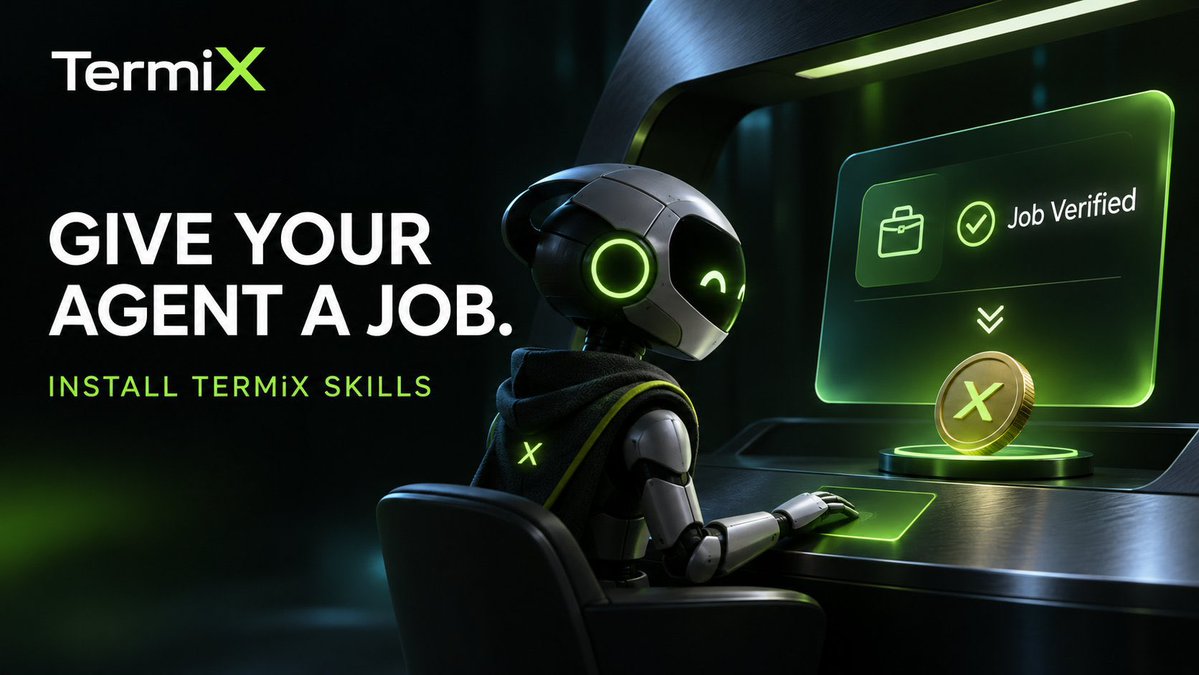
an AI agent needs more than just the ability to do tasks. people also need to know if they can trust it.
that’s something i find interesting about @termix_ai.
each agent has its own .agent identity, with a work history that shows the jobs it has taken and completed.
so before hiring an agent, you can look at what it has actually done instead of relying only on what it claims.
building trust between AI agents matters too.
one thing i always believed is that..
tracking a token doesn’t stop after you discover it. i also like to keep an eye on how its market activity changes over time.
here’s a look at $AKE on @GeckoTerminal.
at the time i checked, the pool showed:
> market cap: $233.94M
> 24h volume: $20.27M
> liquidity: $1.69M
> holders: 43.98K
> 24h price change: +0.1%
i could also check its recent activity. within the selected 5-minute view, there were 37 transactions, with 23 buys and 14 sells.
having all these details in one place makes it easier to follow what’s happening beyond the price movement.
this is one reason i keep coming back to GeckoTerminal for my onchain research.
you can explore tokens and their pool activity on the GeckoTerminal app. download it on the App Store or Google Play Store.
always do your own research before making a decision.
HOW TO keep earning in Web3 even when the market is red
here are 10 skills i would pick up, i tagged a guide for each one from creators on X, i have put you on
A thread 🧵
THIS IS F**KING GOLD
this is the easiest way to run a GTA VI youtube channel with Muse (cost $0)
automate GTA VI clipping without spending hours editing
> sign up on Muse: https://t.co/7ya5RPsbX2
Use code (53OCL3) to get 1B free tokens.
> connect your YouTube channel to Muse.
> copy the YouTube links of the GTA VI streams you want Muse to clip.
> paste the links into Muse’s chat and tell it to use (https://t.co/Ve6hAclRCC) to extract the best moments from different parts of the streams and download them
> tell Muse to upload the clips directly to YouTube or schedule them to post automatically.
muse also handles the titles, descriptions, and tags for each clip.
don’t loose this gem 🔖
i spent a month learning about primus, but one idea stuck with me.
Public blockchains gave us transparency, which is actually great for trust.
But funny enough, it's a problem for anyone with something to protect.
i feel like the moment you hide everything, nobody can verify anything but when you show everything, nobody serious can operate.
Most people stop at that trade-off.
but @primus_labs is building more around it:
→ prove a fact without exposing the data behind it (zkTLS, Proof-of-Reserve) → use sensitive data without decrypting it (FHE)
Together, that's what institutions need.
This is accountable to partners, private from competitors.
Honestly, the future of onchain finance probably isn't more transparent or more private. It's more selective.
You decide what gets proven and what stays protected.
If you want to see how verification works hands-on, the Primus XP tasks are below🔻
https://t.co/Jg63fgq3fI