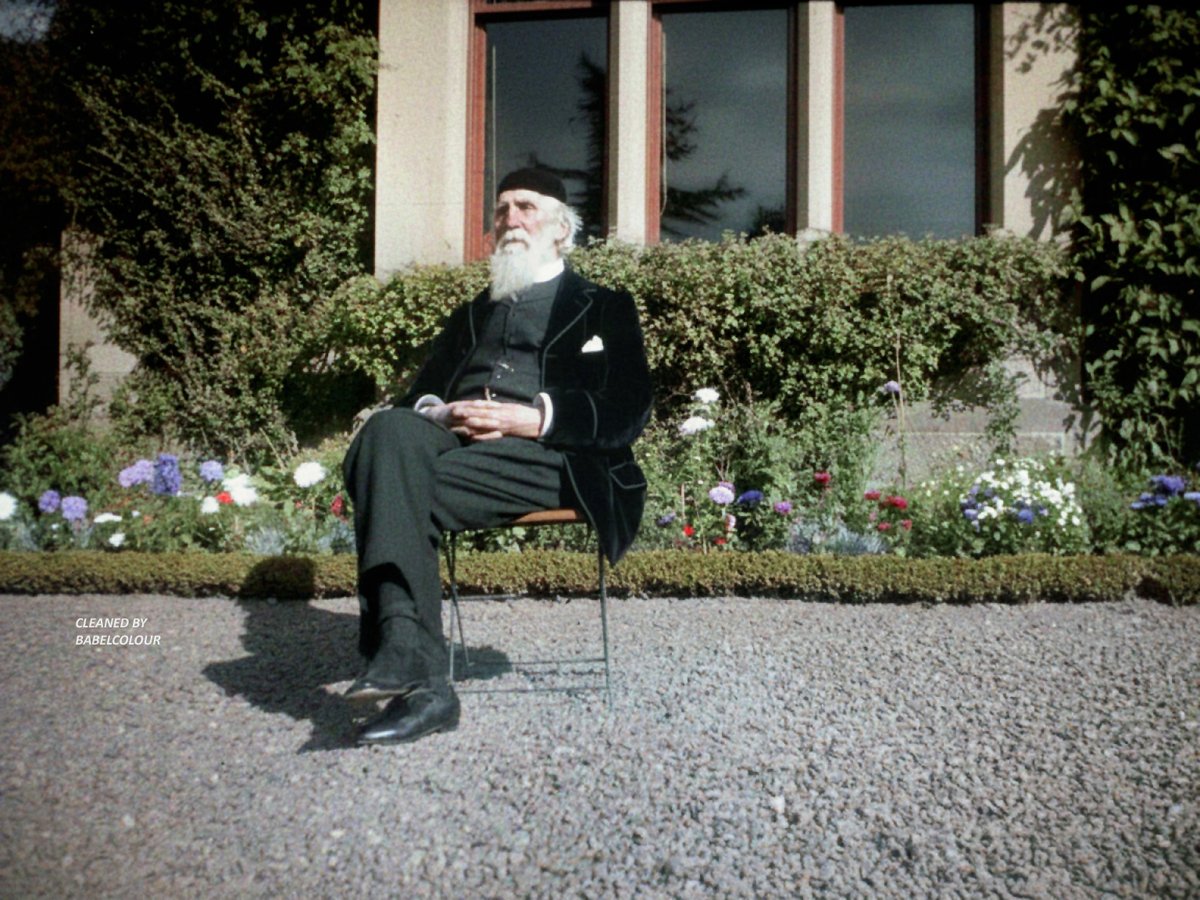
I have cleaned-up this fascinating autochrome of James Thin (famous for his chain of bookshops), who was born 202 years ago (in Edinburgh on 23rd March 1824), making him (so far as is currently known) the earliest-born person ever to have been photographed in colour. He is seen here in the garden of Ashlea House, Stow, at the age of 86. It is original colour, not colourised.
I have cleaned-up this fascinating Autochrome portrait of the author Mark Twain (1835-1910). He is shown in bed with his book and pipe at the age of 73, and the shot was taken in colour 118 years ago at his home in Redding, Connecticut, by American photographer Alvin Langdon Coburn.
Twain (real name Samuel Langhorne Clemens) is famous for such literary works as 'The Adventures of Tom Sawyer (1876), 'The Prince and the Pauper' (1881), 'The Adventures of Huckleberry Finn' (1884), and 'A Conneticut Yankee in King Arthur's Court' (1889).
The photo was taken in 1908 using an early colour glass-plate process and isn't colourised.
An observation test for your inner 8-year-old.
Can you spot the 13 mistakes in the picture?
From Treasure magazine, 1965
Official answers coming soon
(Even if you don’t reply, could you please ‘like’ or share this one?)
This week I came across the obituary of a photographer named David Plowden. I was unfamiliar with his work, but decided to browse his website after reading that he specialized in photos of trains and industry.
I’m not much of an art guy, but these photos are astonishing. (1/4)
In November 1912, sixty women in Sydney were jailed.... Not for theft. Not for violence. For the length of their hatpins.
A municipal bylaw had been passed restricting how far a hatpin could protrude from a woman's hat. The stated reason was public safety. A sharp pin, the argument went, was a hazard to others in a crowd.
The women who wore them knew exactly what that argument was leaving out.
For years, hatpins had served a purpose the authorities preferred not to name. Women traveling alone on streetcars and omnibuses, navigating crowded markets and busy pavements, had learned that a long pin worn through the hat was also, when needed, a means of discouraging men who pressed too close, grabbed, or refused to stop. The hatpin was not just a fastener. It was a boundary, made physical.
The bylaw threatened to take that away.
When the sixty women appeared before the Sydney court and were offered the standard option, pay a fine and go home, they refused.
They called the law iniquitous. Several said so directly, on the record. None of them paid.
So they went to jail instead.
The tactic was not accidental. Refusing the fine and accepting imprisonment was a form of protest that women in the suffrage movement had used elsewhere to expose the absurdity of a law by forcing authorities to enforce it in full view of the public. A woman in a jail cell for the length of her hatpin was a harder image to dismiss than a woman who quietly paid a small fee and walked away.
The story had been building for some years on both sides of the world. In Chicago, a woman named Nan Davis had become one of the more prominent voices arguing that hatpins were a legitimate tool of self-defense and that legislation against them was, at its root, an effort to leave women more vulnerable in public space rather than less. Davis had made the case plainly: if men in public conducted themselves appropriately, the pins would never need to be used as anything other than hat fasteners. The problem being regulated, she argued, was not the pin.
The Sydney case carried the same logic into a courtroom and then into a jail.
The women who refused to pay were not fringe figures. They were ordinary residents of a modern city making a deliberate choice about which laws they considered legitimate and which they did not. They understood that paying the fine would have made the protest disappear. Jail kept it visible.
What happened to most of the sixty afterward is not fully recorded. The historical trace is thinner than the event deserves. But the refusal itself was noted at the time, reported in the press, and placed in a broader international conversation about women's safety, women's rights in public space, and the habit of regulating women's bodies in the name of other people's comfort.
The hatpin restriction did not survive long as a serious enforcement priority. Whether that owed to protests like the one in Sydney, to shifting public opinion, or simply to the arrival of new hat fashions that made the question moot, is hard to say with certainty.
What is certain is this: sixty women were offered a door and chose not to take it.
They called the law unjust. They said so out loud. And they sat in jail to prove they meant it.
An everyday object. A small municipal bylaw. Sixty women who understood that the details are rarely just details.
The hatpin debates of the early 1910s were genuinely international. Cities in the United States, Britain, and Australia all saw versions of this argument play out around the same years, which suggests the question of women's safety in public space was pressing on a lot of people at once. If you want to read further, the contemporaneous newspaper coverage of the Sydney case and Nan Davis's Chicago advocacy are both worth tracking down in digitized archives.
#archaeohistories
A young schoolboy concentrates on his work in a school on one of the Hebridean islands, Scotland, ca. 1955 - by Thurston Hopkins (1913 - 2014), English
Colorized mugshot taken in 1895 of 18-year-old Carl Wilhelm Strand “Piggen”, a blacksmith sentenced for stealing 15 dozen eggs from his former employer.
Carl tries to sell the eggs to various shopkeepers, but no one wants to buy them. He gives up, and the next day he tries to return them—but the police arrive, and he is arrested. Carl is convicted of theft by means of breaking and entering and sentenced to three months of hard labor, which he serves at the state prison in Långholmen from December 3, 1894 to February 10, 1895.
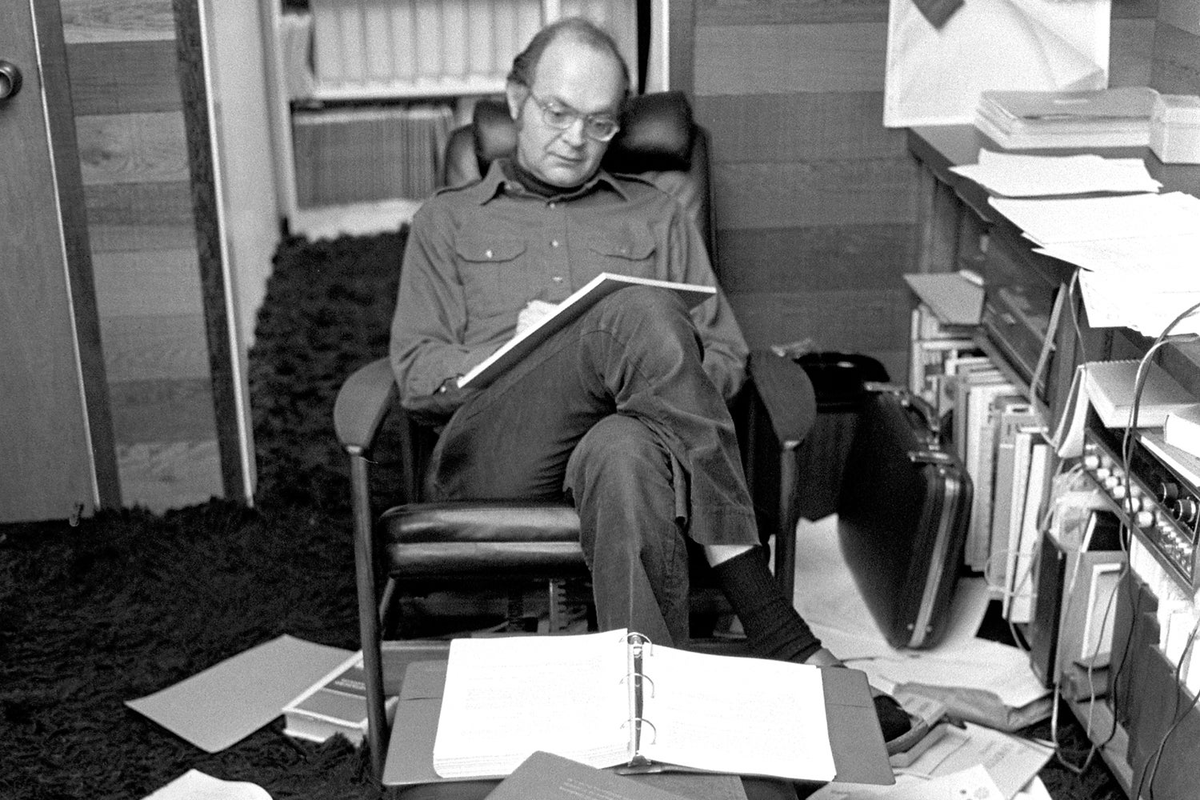
A computer scientist won the Turing Award at 36 and then walked away from almost every other project for the next 50 years to write one book that he has still not finished at age 88, and it may be the most important book in his field.
His name is Donald Knuth. He won the Turing Award in 1974, which is the closest thing computer science has to a Nobel Prize.
He was 36 years old. He had already written volumes one, two, and three of a book series called The Art of Computer Programming. He was the youngest person ever to receive the award at that point in its history.
Almost anyone else would have ridden that moment for the rest of their career. Founded a company. Sat on boards. Gone on speaking tours. Knuth did the opposite. He went back to his desk and kept writing.
He started the book in 1962. He was 24 years old. His publisher had asked him to write a short paperback on compilers. He sat down to outline it and discovered that to explain compilers properly he would have to explain the deeper algorithms underneath them first.
The short paperback became a draft outline of 12 chapters. The 12 chapters became a planned 7-volume series. The 7-volume series became the project he is still working on 63 years later.
Volume 1 came out in 1968. Volume 2 in 1969. Volume 3 in 1973. He was producing books faster than most academics produce papers. Then everything stopped.
In 1977 he received the printed proofs of the second edition of Volume 2. He looked at the pages and was so disgusted by how the publisher had typeset his mathematical notation that he could not bring himself to release the book.
The equations looked ugly. The fonts looked wrong. The spacing was off. He decided he could not in good conscience publish another volume of TAOCP until the typesetting problem was solved.
So he paused the book.
He stopped writing TAOCP and spent the next 8 years inventing TeX from scratch.
TeX is the typesetting system that every academic paper, every math textbook, every physics journal on earth now uses. Every PhD thesis in the sciences is set in TeX. Every paper on arxiv. Every equation in every paper Anthropic, OpenAI, and DeepMind have ever published. The system that the entire scientific publishing world runs on exists because one man refused to compromise on how the second edition of Volume 2 looked.
He gave the entire TeX system away for free. He never tried to commercialize it. He went back to writing TAOCP.
In 1992 he retired from Stanford at the age of 54. Most professors retire to slow down. Knuth retired to speed up. He explicitly said he was leaving teaching because he needed every remaining hour of his life to keep writing the book. He stopped using email on January 1, 1990.
He answers no calls. He takes paper mail only. He is on a personal mission to finish a multi-volume series that nobody is forcing him to write, on a deadline that only exists in his own head.
Volume 4A came out in 2011. Volume 4B in 2022. He is currently working on Volume 4C. Volumes 4D, 4E, 4F, 5, 6, and 7 are still ahead of him. He is 88 years old. He will almost certainly die before he finishes.
The thing that should haunt anyone reading this is the math of his choice.
Every modern incentive structure tells you to optimize for speed. Ship the imperfect version. Get it out the door. Iterate later. Move on to the next thing.
Knuth has spent 63 years doing the exact opposite. He pays a $2.56 reward in hexadecimal dollars to anyone who finds an error in his published books. Real checks, until check fraud made him switch to certificates of deposit. He treats every single error in every single volume as a personal failure. He revises. He rewrites. He goes back to fix issues that nobody else could have spotted.
He could have written 30 books in 63 years. He chose to write one.
The reason is the one almost nobody understands the first time they hear it. There is a category of work that loses all its value when it is done quickly.
A reference book that engineers will rely on for the next 200 years is not the same kind of object as a blog post that has to ship today. The slow project and the fast project look like the same activity from the outside. They are completely different games.
Bill Gates once said in an interview that if you can read the whole of TAOCP, you should send him your resume. He meant it. He was not joking. The man who founded Microsoft was telling the world that the rarest skill on earth is being able to finish a book that one man has spent his entire adult life writing for an audience that mostly does not have the patience to read it.
The book may never be finished.
The man writing it knows this and keeps writing anyway.
The work outlives the worker. That is the entire point.
A 26-year-old Chicago real estate agent bought a box of unknown negatives at a thrift auction in 2007 for around $400.
He took it home and found thousands of street photographs taken by a French-American nanny who had carried a Rolleiflex around her neck for forty years and shown her work to no one.
She had lost the storage locker for unpaid rent. She died poor in 2009 not knowing her photographs were being seen.
Vivian Maier is now considered one of the greatest American street photographers of the 20th century.
Una niña pelirroja con vaqueros, una construcción de LEGO en las manos y una sonrisa que no está posando para nadie. Esa imagen lleva más de cuarenta años siendo uno de los anuncios más citados de la historia de la publicidad.
Se llamaba Rachel Giordano. Tenía unos siete años cuando la fotografiaron para la campaña de 1981. El titular decía simplemente: What it is is beautiful. Lo que es, es hermoso. Sin mencionar si era niña o niño. Sin color rosa. Sin instrucciones sobre qué debía construir.
Lo que muchos recuerdan como un gesto revolucionario de LEGO en realidad era la continuación de algo que la empresa danesa llevaba haciendo desde los años 50: vender sus piezas como un juguete universal. Los sets se llamaban Universal Building Sets. La creatividad era el producto, no el género del comprador.
Lo interesante llegó después.
En los años siguientes, LEGO fue derivando hacia una segmentación por géneros cada vez más marcada. En 2012 lanzó LEGO Friends, una línea diseñada específicamente para niñas, con colores pastel, figuras femeninas estilizadas y sets de cafeterías, salones de belleza y boutiques. Las críticas fueron inmediatas.
Fue entonces cuando alguien rastreó a Rachel Giordano, la niña del anuncio de 1981. La encontraron: tenía 37 años y era médico. En una entrevista con Adweek en 2014 fue directa: en 1981 los LEGO eran universales y la creatividad del niño producía el mensaje. En 2014, era el juguete el que le decía al niño quién debía ser.
LEGO escuchó, al menos en parte. En 2021, en el 40 aniversario del anuncio original, la empresa lo recreó para el Día Internacional de la Mujer bajo el nombre Future Builders y se comprometió públicamente a eliminar los estereotipos de género de sus productos y campañas.
El anuncio de 1981 no era radical para su época. Se volvió radical cuando la industria fue en dirección contraria.
There is no Woman of the Day today but if there was, suffragette and social worker May Billinghurst, born OTD in 1875 in Lewisham, would be a contender for using a modified tricycle painted in suffragette colours (she was crippled by polio) and recruiting more women while she wheeled herself round the exercise yard at HM Prison Holloway.
She had contracted polio as a child and used a tricycle wheelchair for most of her life. As a young woman, she took up social work assisting women at a workhouse in Greenwich, taught Sunday school, and volunteered for a temperance charity — then very much a women’s rights issue.
"My heart ached and I thought surely if women were consulted in the management of the state, happier and better conditions must exist for hard-working sweated lives such as these... It was gradually unfolded to me that the unequal laws which made women appear interior to men were the main cause of these evils. I found that the man-made laws of marriage, parentage and divorce placed women in every way in a condition of slavery - and were as harmful to men by giving them power to be tyrants."
Inspired by Millicent Fawcett and Emmeline Pankhurst, May was drawn early to militant tactics and joined the Women’s Social and Political Union in 1907. She started the Greenwich branch in 1910.
“I wondered how the public could ever be made to think about it. In the midst of the hopelessness of it all, Christabel Pankhurst sounded the war note of militancy and was imprisoned for her boldness, and the subject of votes for women was on every tongue."
When Prime Minister HH Asquith went back on his word by focussing on another bill rather than the promised Conciliation bill that would have granted women the vote, May took full part in the WSPU demonstration outside the House of Commons in November 1910, known as Black Friday.
“At first, the police threw me out of the machine onto the ground in a very brutal manner. Secondly, when on the machine again, they tried to push me along with my arms twisted behind me in a very painful position, with one of my fingers bent right back, which caused me great agony. Thirdly, they took me down a side road and left me in the middle of a hooligan crowd, first taking all the valves out of the wheels and pocketing them, so that I could not move the machine, and left me to the crowd of roughs, who, luckily, proved my friends.”
She knew how it would look: a helpless woman with obvious disability being treated quite callously, thus underlining the the brutal tactics of the police when dealing with women. In fairness, she gave no quarter. She was known to ram the police with her tricycle at a fast rate of knots to stop them arresting her sister suffragettes.
May was able to get closer to the House of Commons on in November 1911. This time, police had second thoughts about attacking her tricycle with its 'Votes for Women' banner and she was carried “shoulder high by four policemen in her little tricycle or wheel-cart that she propels with her arms. Amid immense cheering from the crowd she followed the rest into the police station."
During the window smashing campaign of March 1912, May hid a supply of stones under the rug covering her knees and smashed a window herself. She was sentenced to one month’s hard labour at HMP Holloway. She never did the hard labour. Holloway simply didn’t know what to do with her. May, on the other hand, made good use of her time there, recruiting other women prisoners on the exercise yard to join her in the fight for women’s suffrage.
Alice Ker, another imprisoned suffragette, said in a letter to her daughter: “Miss Billinghurst is here with her tricycle. She has irons on each leg, and can only walk with crutches, her tricycle works with handles. She drives it round the yard at exercise time. It is painted in the colours, with a placard, Votes for Women, on the back of it.”
Arrested again in December 1912, this time for damaging postboxes, May represented herself in court, and once again used the opportunity to promote the cause of votes for women, telling the all-male jury:
“This is a women’s war in which we hold human life dear and property cheap, and if one has to be sacrificed for the other, then we say let property be destroyed and human life be preserved. We are not hooligans seeking to destroy but we mean to wake the public mind from its apathy.”
She was sentenced to eight months imprisonment and forcefed.
“The government may further maim my crippled body by the torture of forcible feeding, as they are torturing weak women in prison today. They may even kill me in the process, for I am not strong, but they cannot take away my freedom of spirit or my determination to fight this good fight to the end.”
May was released early when her health declined but returned immediately to the fray. In May 1914, she chained herself to the gates of Buckingham Palace. The police responded by destroying her tricycle.
This indomitable woman died in 1953 at the age of 78, with full voting rights, her work done.
When the weather is fine, why not enjoy a picnic (though probably a less finely-attired one!)...
Travel back 116 years to a resplendant picnic at Yalta on the Crimean Peninsula. I have cleaned-up this 1910 autochrome by Peter Ivanovich Vedenisov. The people in the picture are recorded as Tania, Natasha, Kolia & Liza Kozakov, with Vera Vedenisov & Elena Bazilev. It is an early colour glass plate process and not colourised.