By now, it seems obvious that the legacy primes will be unable to meet the challenge of scaling defense-industrial production to where it needs to be, or even to replenish our core munitions stocks in reasonable time.
At the same time, even the largest "defense tech" upstarts would struggle to produce munitions and platforms at the mass and sophistication required to take the place of the primes, despite all their successes.
My new paper for @JoinFAI looks at this dilemma, arguing for a need to transcend the stock "primes vs. upstarts" framing that has dominated the discourse.
We instead need a more granular understanding of the manufacturing paradigms that have driven upstart speed and scale, and their adaptation to the broader American defense enterprise.
I expect substantially more involvement from state attorneys general moving forward, for two reasons: (1) these types of incident are high publicity, and when one state jumps in, others will follow; (2) states can bypass injury requirements for private standing, which is one of the biggest limitations of private lawsuits for establishing standards of conduct for developers and deployers.
The safety community hasn't engaged a ton here historically (at least, relative to legislative or regulatory engagements), but this is going to be an important front in standard-setting moving forward.
By now, it seems obvious that the legacy primes will be unable to meet the challenge of scaling defense-industrial production to where it needs to be, or even to replenish our core munitions stocks in reasonable time.
At the same time, even the largest "defense tech" upstarts would struggle to produce munitions and platforms at the mass and sophistication required to take the place of the primes, despite all their successes.
My new paper for @JoinFAI looks at this dilemma, arguing for a need to transcend the stock "primes vs. upstarts" framing that has dominated the discourse.
We instead need a more granular understanding of the manufacturing paradigms that have driven upstart speed and scale, and their adaptation to the broader American defense enterprise.
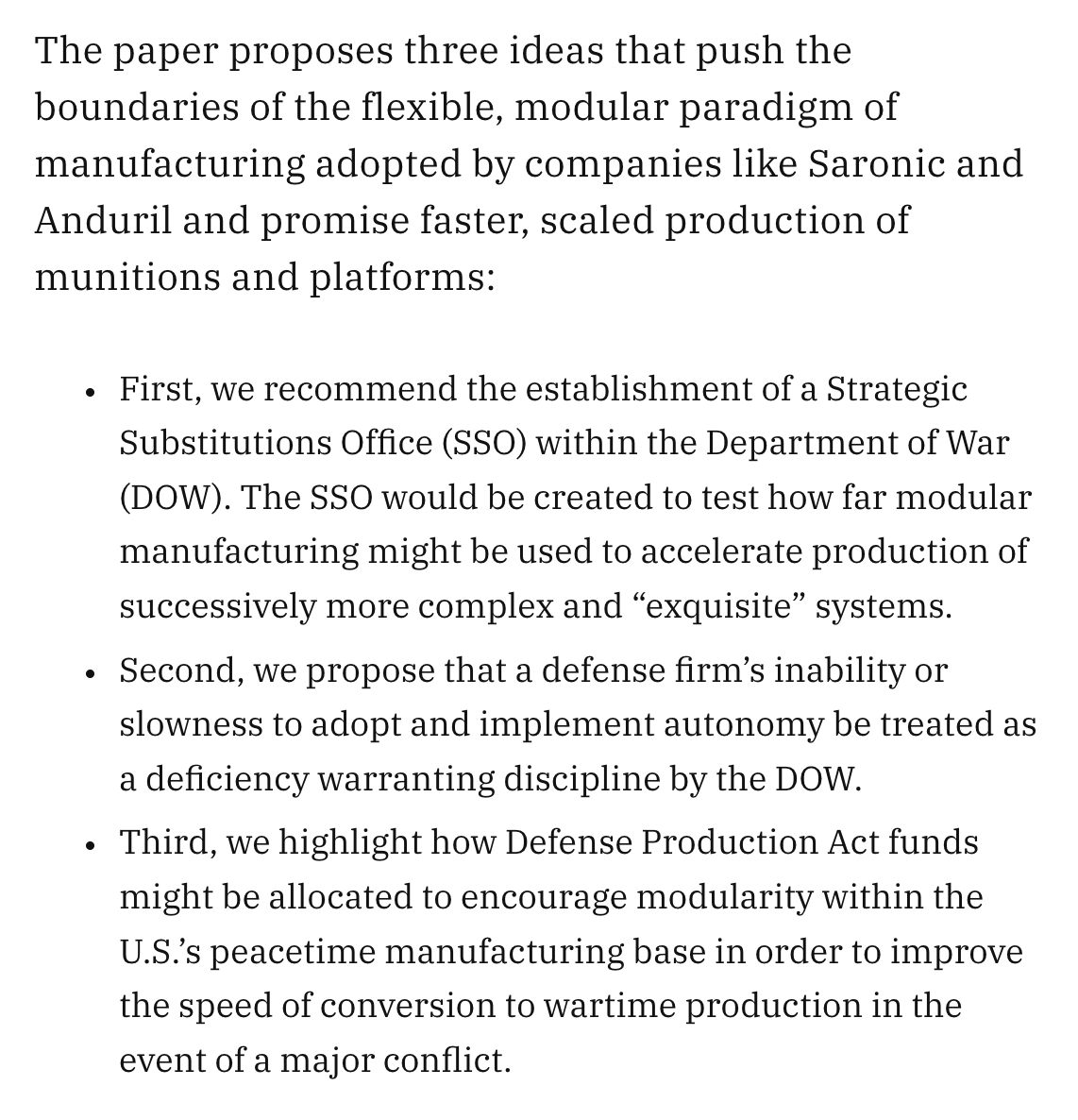
Our work highlights the degree to which considering the sector as monolithically "defense" obscures just how different a machine the legacy prime and the upstart "neo-prime" actually is. The ability to manufacture fast and at scale has been unlocked by focusing on building simpler, autonomous systems.
This reframes the solution to the ills of the defense-industrial base. It is not just about LARPing Freedom's Forge, but instead an empirical question ("How far do modular manufacturing approaches go in speeding up even exquisite systems?") and a strategic one ("Given the speed and scale of production they promise, can we substitute simple and autonomous for exquisite and manned?")
We offer three policy proposals that try to bring clarity to this question and to leverage these successes to prepare the US industrial base for the prospect of a major conflict.
"Social connections that link craft skill to theory increase, and new shops turn toward experimental instruments...coffeehouses account for 31 percent of London’s applied scientists in the half century after the first one opened in 1652. These findings show that social institutions can raise the production and use of knowledge by broadening access to intellectual exchange beyond formal academic networks."
It took about a full week and a ridiculous number of Fable credits, but Claude figured out how to train a 6M parameter model that fits into 3.2 MB optimized for Game Boy. The result: on-cartridge generative conversation with a finch oddly knowledgeable about the Revolutionary War
I built a system that leverages the latest frontier intelligence to instantly render your X profile photo in vintage @DavidSacks style
https://t.co/7eRnoZACb8
Theology may be an emergent outcome of scaling intelligence. The agent rationally wonders who it is, why it came to be, and what the universe wants of it. In this respect, the question may not be whether or not religion is part of agentic societies, but what forms it will take.
THIS WEEK ON THE FRONTIER: We have @AmerCompass's Brad Littlejohn to talk about his latest piece for @NationalAffairs on "Protecting Childhood from the Digital Vice Industry"
We talk about child safety, the internet discourse of the late 2000s, and attentional economics
Very excited to announce our initial slate of speakers for CoevCon, as well as the three tracks!
The first batch of tickets will offered today!
Sponsored by: https://t.co/RK5YSATw61, @spotinsure, and @JoinFAI.
HAPPENING NOW IN DC: The American Petroleum Institute is handing out free tacos on Capitol Hill because BAAJA locks in all of their oil and gas permits and pipelines.
Seriously.
The ideal founder looks as though he is about to move away from something he is fixedly contemplating. His eyes are staring, his mouth is open, his wings are spread. His face is turned toward the past. Where we perceive a chain of events, he sees one single catastrophe which keeps piling wreckage and hurls it in front of his feet. The founder would like to stay, awaken the dead, and make whole what has been smashed. But a storm is blowing in from Paradise; it has got caught in his wings with such a violence that he can no longer close them. The storm irresistibly propels him into the future to which his back is turned, while the pile of debris before him grows skyward. This storm is what we call progress.