8. Let RGB Be the Language of Vision
🔑 Keywords: RGB In and RGB Out (RINO), unified vision-language systems, structured visual signals, zero-shot performance
💡 Category: Computer Vision
🌟 Research Objective:
- This research introduces a unified formulation for vision models, termed as RGB In and RGB Out (RINO), to handle diverse visual information as RGB images and convert visual tasks into a common RGB-to-RGB image editing problem.
🛠️ Research Methods:
- The study utilizes a generic image editing backbone without task-specific fine-tuning, allowing diverse visual tasks to share encoding and decoding architecture, similar to text operation in language models.
💬 Research Conclusions:
- RINO displays robust zero-shot performance in both dense understanding tasks like segmentation and dense-conditioned generation tasks like pose-to-image generation, advancing towards creating general unified vision-language systems.
👉 Paper link: https://t.co/UCw4bvyHkq
🚀 Fast SAM 3D Body — accelerating SAM 3D Body for real-time human mesh recovery!
⚡ 10.25× faster 3D body estimation
⚡ 10,426× faster MHR→SMPL conversion
⏱️ ~65ms end-to-end
🤖 Deployable on humanoid robots
#Robotics
@carlosedubarret@pablovelagomez1 Another advantage of Fast SAM 3D Body is flexibility. Through our provided run_demo.sh, users can easily adjust inference settings and choose their preferred trade-off between speed and accuracy. We are also planning to release a video demo comparing 3DB, Fast 3DB, and the C++.
@pablovelagomez1@carlosedubarret Overall, the speedup appears to come primarily from simplifying the original pipeline rather than from C++, ONNX, or TensorRT itself. Fast SAM 3D Body was designed as a balance between speed and accuracy, while the C++ makes different trade-offs to prioritize runtime speed.
@pablovelagomez1@carlosedubarret The C++ version also removes MoGe-based camera estimation and instead approximates camera parameters from the image size, making the estimated camera parameters dependent on the input resolution.
@pablovelagomez1@carlosedubarret 2. The C++ version also removes the IntermPred module, an important component in our original design that helps improve body pose estimation accuracy. Without it, body pose predictions can become less accurate and tend to be underestimated in scale.
@pablovelagomez1@carlosedubarret 1. The C++ version removes the dedicated hand decoder, so it no longer performs explicit hand prediction and instead relies on body decoder placeholders for hand outputs.
@pablovelagomez1@carlosedubarret As the author of Fast SAM 3D Body, I compared the C++ with ours. The speedup mainly comes from removing the hand decoder, IntermPred, and MoGe camera estimation. This significantly reduces accuracy, removes dedicated hand prediction, and makes camera estimation less reliable.
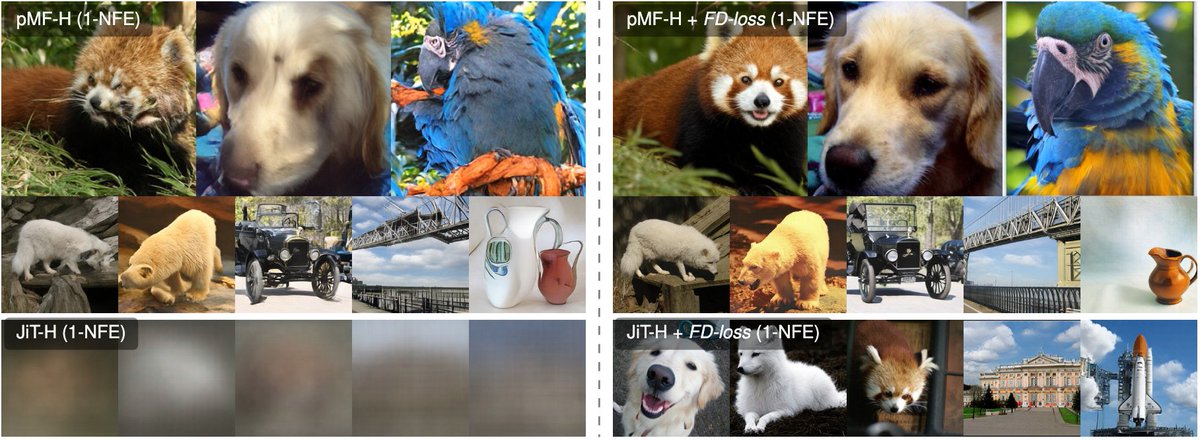
Two months ago, I vaguely posted a number: 0.9 FID, one-step, pixel space.
Now it is 0.75, and can be even lower.
Many wonder how.
I thought it might end as a small FID prank: simple and deliberate.
It started with one question: can FID be optimized directly, and what does it reveal?
Introducing FD-loss.
@carlosedubarret Thank you for your interest. Could you please share the configuration you used in run_demo.sh? Using different configurations might lead to varying FPS and accuracy.
@ChongZitaZhang Exactly! The original MHR conversion requires 300 iterations, which is a total bottleneck for real-time tasks. We replaced that process with a few MLP layers to strip away the latency while keeping the accuracy.
🚀 Fast SAM 3D Body — accelerating SAM 3D Body for real-time human mesh recovery!
⚡ 10.25× faster 3D body estimation
⚡ 10,426× faster MHR→SMPL conversion
⏱️ ~65ms end-to-end
🤖 Deployable on humanoid robots
#Robotics
@jackadoresai This depends on the capabilities of SAM 3D Body, which we have fully inherited. Additionally, we support multi-view input, which helps mitigate occlusion issues to a certain extent.