Finally finished this blog on a Flixbus from Munich to Freiburg.
The current research direction in efficient attention is genuinely fascinating a lot of recent work is actively pushing away from the transformer architecture, and it feels like the right way to go.
As part of my master's thesis, I'm sharing a short literature review of where the field is heading.
If the concepts are new to you, video 1 at the end is a great place to start.
https://t.co/lKQ72InxFL
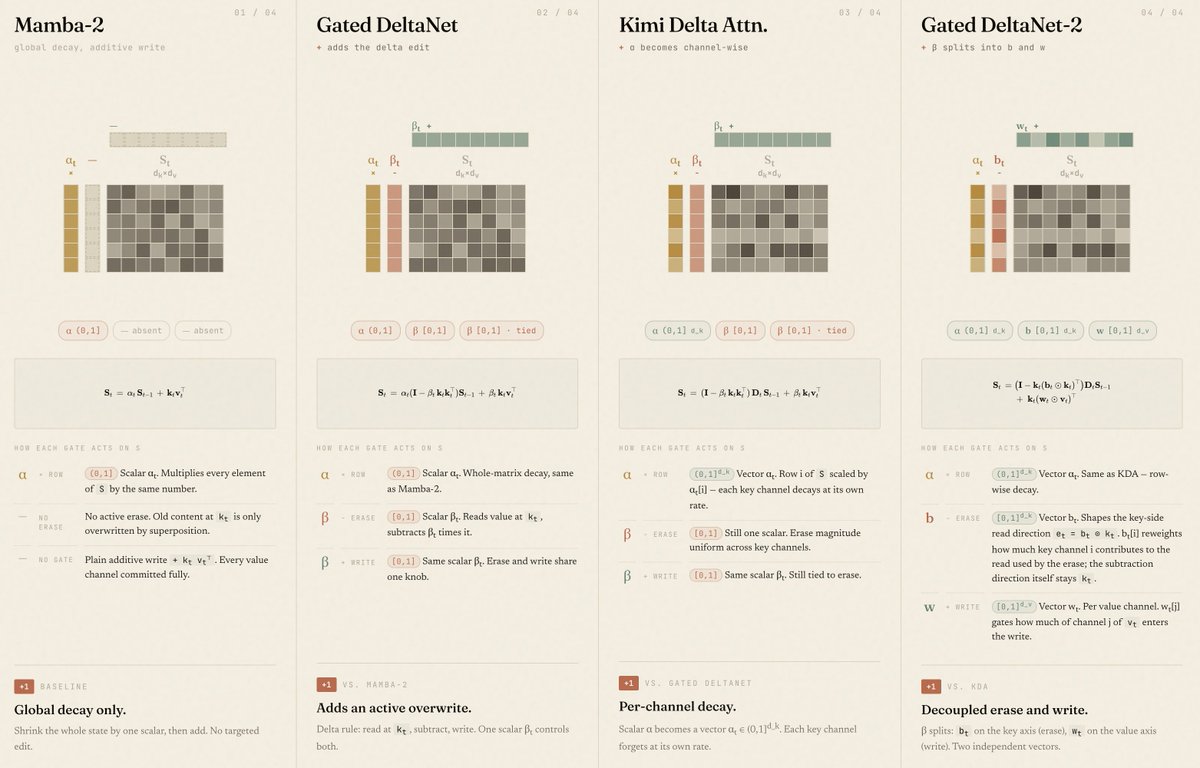
gated deltanet 2 compared to previous linear attention methods (kimi delta attention, gated deltanet, mamba2)
each new variant adds finer control over what to decay, erase, and write in the state matrix
gated deltanet 2 compared to previous linear attention methods (kimi delta attention, gated deltanet, mamba2)
each new variant adds finer control over what to decay, erase, and write in the state matrix
Higher-Order Linear Attention Models Are RNNs/SSMs:
Generalizing State-Space Duality to higher-order linear attention.
It’s getting wild.
https://t.co/vUBN3nDFMy
Over the past few weeks, I’ve been intensively participating in the OpenAI Parameter Golf Challenge:
Train a small language model under 16MB in less than 10 minutes on 8× NVIDIA H100 GPUs.
A few numbers from the journey:
-> 112+ experiments run
-> +1.000EUR burned on GPUs via RunPod
Thank you @OpenAI for the financial support. :)
My approach was a hybrid autoregressive architecture with a latent diffusion component, where the diffusion part acted as a regularizer.
For the challenge.
I used my own project, OpenColab, to collaborate with multiple AI agents:
The Professor: Opus 4.6 in Claude Code
Set project direction and coordinated the overall strategy (Human taste and judgment remain essential for setting project direction).
Scout : Gemini 3.1 Pro Preview in Gemini CLI
Handled deep research on papers, and experiment spec generation.
The Engineer: Codex 5.4 xhigh in Codex CLI
Implemented scout’s spec.\
AutoResearch — Opus 4.6
Ran experiments overnight. See example below.
I didn’t manage to set a new record, but I came close and got some very interesting results. The network was able to learn faster with fewer steps than the autoregressive architecture, but because my hybrid implementation was slower per step, the autoregressive architecture was still able to outperform it overall.
OpenColab is inspired by @OpenClaw, @NanoClaw, and @Karpathy’s AutoResearch.
We hosted Prof. Alyosha Efros (UC Berkeley) at @SkildAI! He didn't believe that robots could actually cook eggs reliably. :)
Tested back-to-back 5times without fail! One batch of scrambled eggs every ~2.5mins nonstop. The same model assembles a GPU on a server rack too.